Specs are compiled from manufacturer listings and verified buyer reviews and can change over time — please confirm the key details on the product page before buying.
Any thermometer on this list will tell you roughly how hot your stove is running. The real difference is whether you can read it from across a dim room, whether it holds onto a hot pipe, and whether it was built for the surface you actually own. Buy for placement and legibility first — the dial is only useful if you can see it and trust what it says.
This guide is built by comparing the manufacturers’ published specifications and the patterns across verified customer reviews, so you get each pick’s real strengths and trade-offs instead of marketing spin.
You are about to see why a magnet-mounted dial and a flue probe solve two different problems. A cheap surface gauge cannot see inside a double-wall pipe, and a probe meter is wasted on single-wall steel. Match the mount to your pipe first, and the rest of the shortlist sorts itself out in a hurry. Our standout holds the top spot among these wood stove thermometer picks for the everyday single-wall setup.
Top Picks


How To Choose The Best Wood Stove Thermometer
Before you read a single dial, work out three things about your setup: where the thermometer will sit, whether that surface is single or double wall, and how far away you stand when you check a burn. Those three answers eliminate most of the confusion on this page.
Match the meter to the surface, not the brand
A magnetic dial is built to stick to a steel or iron flue pipe, while a stove-top puck is meant to sit on the flat iron top. A probe meter reads the gas inside the pipe and needs a drilled hole to do it. If you own a double-wall flue, a surface magnet reads the outer shell — which is cooler than the smoke inside — so it will under-report your burn.
Read the zones in plain English
The colour bands do the thinking for you. A low-fire zone warns that the fire is smouldering and leaving creosote deposits. The middle safe zone is where you want to live. The over-fire band signals wasted fuel and unnecessary heat. One gauge here reads from 100°F to 800°F, so you can catch a creeping fire before it runs away.
Legibility beats a crowded scale
A thermometer you have to squint at is a thermometer you stop checking. Colour-coded faces, bold needle markers, and a face you can read from a few steps back matter more on an evening log than a tight tolerance. That is worth weighing alongside accuracy when you pick.
Mounting strength and the pipe surface
A strong magnet relies on a flat, ferrous metal face. Vitreous enamel, cast iron, and bare steel all hold a magnet; a double-wall pipe’s painted outer jacket may not offer the same grip. Check magnetism on your own pipe before you buy anything magnetic, and keep a safety screw or wire as a backup where the maker includes one.
Side-by-Side Comparison
| Model | Best For | Mount / Fit | Reading Range | Face / Dial | Amazon |
|---|---|---|---|---|---|
| Valiant Magnetic Log Burner★ Best Overall | Everyday single-wall flue | Magnetic flue pipe | — | Analog, 2.5 in | Amazon |
| Boone Hearth Color-CodedGlance-Read Value | Glanceable colour zones | Magnetic, magnet included | — | Color-coded analog | Amazon |
| StoneGard Stove Top (3-26)Soapstone Specialist | Soapstone stove tops | Stove top | Recommended soapstone range | Analog, optimal zone marked | Amazon |
| Magnetic Burn Indicator | Wide-range single-wall watch | Magnetic, single wall | 100°F to 800°F | Analog, 5.88 in long | Amazon |
| Midwest Hearth Pipe & Chimney | Durable single-wall pipe | Magnetic, holds to 800°F | From 230°F | Porcelain enamel | Amazon |
| Inferno Stove Top Meter (3-30) | Stove-top temperature holding | Magnetic / stove top | — | Porcelain enamel dial | Amazon |
| ChimGard Energy Meter (3-4) | Stovepipe flue safety | Magnetic stovepipe | Up to 900°F | Yellow/orange/red zones | Amazon |
| Midwest Hearth Probe | Double-wall pipe reading | Probe, drilled hole | Up to 1700°F | Colour zones, 4 in probe | Amazon |
| FlueGard (3-39) | Precise double-wall monitoring | Probe, 4 in stem | Up to 1700°F | Dual F/C, colour zones | Amazon |
Detailed Reviews
1. Valiant Magnetic Log Burner & Stove Thermometer-Red, 63mm
Our pick — 4.5+★ from 5,500+ verified ratings; the strongest balance of quality and price.
The compact red dial that snaps onto your flue and tells you when to feed the fire.
If you own a single-wall steel flue and want a gauge you can trust without fuss, this is the one to start with. The 63mm face (about 2.5 inches across) is small enough to sit tight against the pipe without crowding the wall behind it. It sticks to most vitreous enamel, iron, or steel flue pipes — check magnetism on your own pipe first, exactly as the maker advises.
It helps you find the optimum fuel-burn temperature and cut the deposits that form when a fire smoulders too cool. That is the everyday win — you stop guessing whether the fire is lazy or running away. The red steel-alloy body looks tidy on a dark flue, and the analog needle needs no batteries.
The honest limit is coverage. It is a surface gauge, so it reads the skin of the pipe, and it is not built for the inside of a double-wall flue. Compared with the Magnetic Burn Indicator, this face is far smaller — 2.5 inches against 5.88 inches — so the wide dial remains easier to read from a distance. What this one trades for size is a neat fit that barely shows. It carries 4.5+ stars across thousands of owners, and that review volume is why it holds first place.
What earns it the top slot
- Reads optimum burn so you can time refuelling instead of guessing
- Compact 2.5-inch face sits flush on enamel, iron, or steel pipe
- Reduces fuel deposits and overheating risk by keeping you in the safe band
The trade-offs to weigh
- Surface-only reading — a poor fit for a double-wall flue
- Needs a magnetic pipe face, so check before you commit
Buy this if: your flue is single-wall steel or enamel and you want one simple dial that ends the guesswork.
Not your meter if: you run a double-wall chimney — the outer shell will read cooler than the fire inside.
2. Boone Hearth Stove Thermometer
Colour bands you can read from across the room — no squinting at tiny numbers.
This is the gauge for the person who checks the fire from the sofa and wants the answer in colour, not numerals. The red and yellow zones show at a glance whether the burn is in the ideal band, which helps keep tar and creosote from building up and adds life to the stove. At 2.5 x 2.5 x 0.4 inches and 1.4 ounces, it is light enough to ignore on the pipe and small enough to tuck anywhere.
Installation is the easiest part — the magnet is included, so you attach it and you are done. No drilling, no screwing, no wiring. Wiping it clean takes a second. The visibility is the real draw: owners can see the colour change from a distance, which is the whole point of a stove gauge when you are across the room loading logs at night.
Calibration is where this gauge shows its limits. The face is colour-coded and clear, but buyers report mixed accuracy and heat-range results — some find it true, a few say it reads cool. Treat it as a direction-of-travel gauge (a rough guide to whether the temperature is rising or falling) rather than a lab instrument. At 1.4 ounces, it is lighter on the pipe than the Magnetic Burn Indicator at 1.92 ounces. For a quick visual check of if you need to add wood, it does the job well.
Who it fits: anyone who wants creosote-watch colour bands and a zero-fuss magnet install, and can accept a rough read rather than a precise number.
What to plan for: use the colour transition as your guide rather than chasing an exact figure, and confirm it holds a magnet on your specific pipe.
Reach for it if: a readable colour patch from across the room is worth more to you than a tight tolerance.
Look elsewhere if: you need a number you can quote to yourself and trust to the degree.
3. StoneGard Stove Top Thermometer (3-26)
A stove-top gauge built around the slower heat of soapstone, not steel.
Soapstone warms and holds heat differently from cast iron, and its surface runs cooler than a steel flue. That is exactly the gap this meter fills: it monitors soapstone temperature for optimal performance and long life, with the optimum burn zone clearly marked so you know when you are in range. If your stove has a soapstone top, the other magnetic pipe gauges on this list are reading the wrong surface for you.
The build is solid and American-made, with a black, silver, and red face and a waterproof construction that shrugs off splashes and damp. Functionality is the thing that stands out most here — owners lean on it to catch overheating before it happens, and plenty of them say they would buy it again. It also reads clearly, so checking the fire stays a quick look rather than a chore.
Pair it with a flue meter if you want the full picture, since this one watches the stone top, not the pipe. If your stove is bare iron, a stove-top puck tuned for steel will suit you better than this soapstone-tuned dial.
Why soapstone owners pick it
- Optimum zone marked for soapstone’s cooler surface temperature
- Waterproof build handles damp and splashes on the stove top
- Accurate, easy-to-read face that helps prevent overheating
What to consider
- Tuned to soapstone — a mismatch on a plain cast-iron top
- Reads the stove top, not the flue, so it misses pipe-side creosote signs
Matches best with: a soapstone-clad stove where a standard iron gauge would mislead you.
Think twice if: your top is cast iron or steel, where a general stove-top meter reads truer.
4. Magnetic Burn Indicator
A long-faced single-wall meter that reads right down to a cold 100°F.
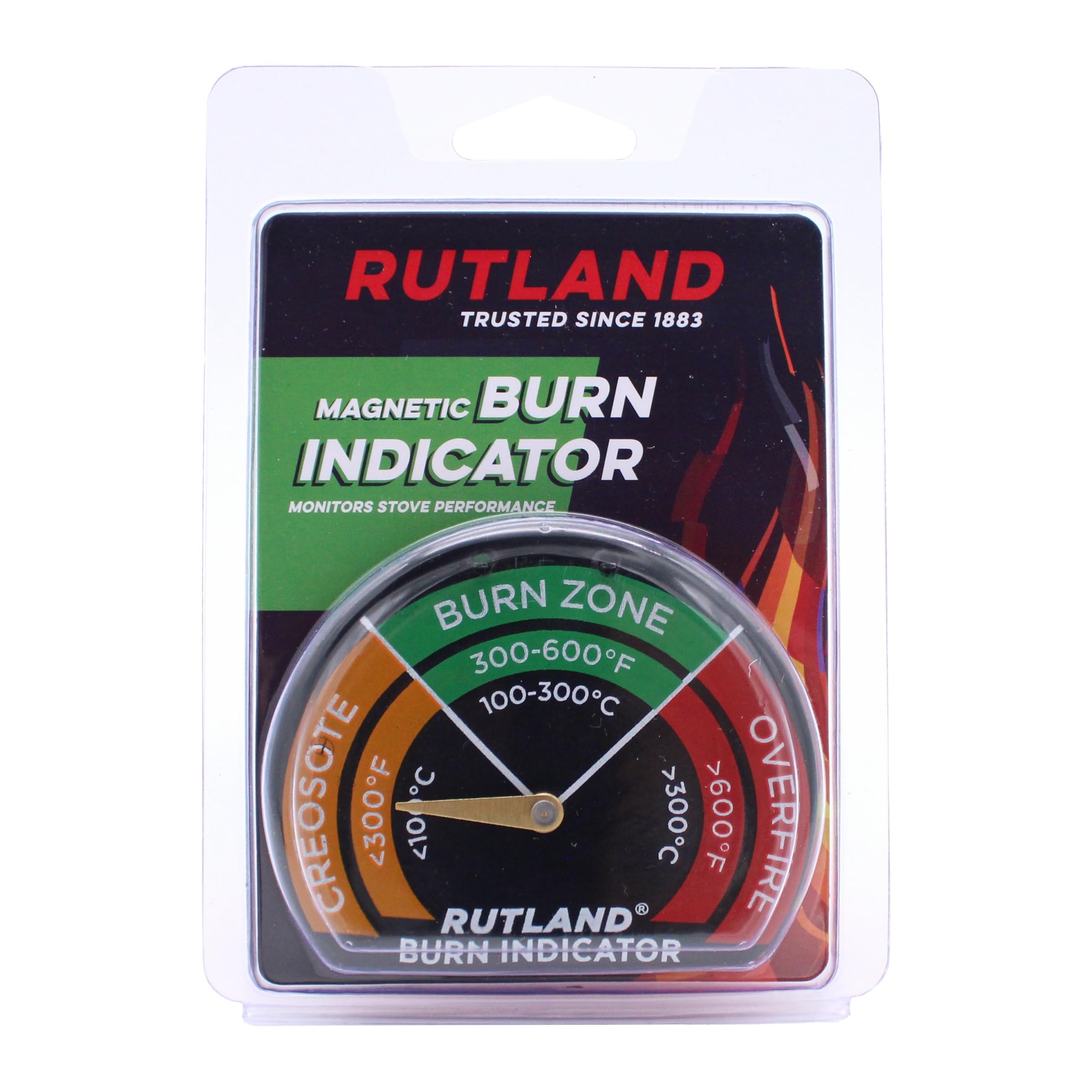
This is the gauge for the tinkerer who wants to see the whole climb, not just the safe middle. It measures from 100°F to 800°F (35°C to 430°C), with a low-fire zone flagged for creosote build-up and an over-fire zone for wasted fuel and heat. The face runs 5.88 inches long, so the numbers are spread out and easy to follow.
The design is deliberately parts-simple: a metal body and a mechanical analog dial with nothing to charge. It is built for single-wall stove pipes, which is where it reads true. Readability is what wins people over — the markings are clear and the needle is easy to follow as the fire settles into a steady burn.
The trade-off is the mount and the needle. Magnet strength draws mixed feedback, and in practice some buyers find the grab weaker than they would like on a hot pipe — which is where its lower temperature floor comes in. It starts reading at 100°F against the Midwest Hearth’s 230°F, so it catches a cooler, earlier burn. A magnet that is only as strong as the pipe allows is the thing to check first.
The honest read: a wide 100°F to 800°F window on a long face is great for watching an early fire build, and the low-fire warning is genuinely useful for creosote.
Before you stick it on: confirm the magnet bites your pipe, and note it is meant for single-wall only.
Good pick for: single-wall pipe owners who like watching the full temperature arc and catching a low fire early.
Skip if: you want a rock-solid hold above everything else, or you run a double-wall flue.
5. Midwest Hearth Stove Pipe & Chimney Thermometer

A porcelain-enamelled dial with a flip-up handle, so you can move it without gloves off.
Build quality is where this one lives. The porcelain enamel finish is made to hold up and to look good on a nice stove, and the metal body feels substantial in the hand. It is calibrated for single-wall chimney pipe and sticks to metal with a magnet rated to hold to 800°F. The easy-to-read zones help you optimise efficiency, prevent overheating, and keep creosote down.
A flip-up handle lets you lift and reposition the meter without fumbling, which matters when the pipe is hot. If you want a fixed mount to back up the magnet, a safety screw or wire is included. For a gauge this size, the hard-wearing face is why owners single out quality as the thing they value most.
The catch is calibration. Accuracy draws mixed reports — some find it true, some say it reads off from the real temperature — so treat it as a trend gauge rather than a precise instrument. It also starts at 230°F, well above the Magnetic Burn Indicator’s 100°F floor, so a slow, smouldering start can read below its range. Buy it for the finish and the handle, not for lab-grade numbers.
Why it earns its keep
- Porcelain enamel finish that holds up and looks sharp on a good stove
- Flip-up handle for grabbing and repositioning without fuss
- Magnet holds to 800°F, with a safety screw or wire included
Where it falls short
- Reads from 230°F, so a cold, early burn sits below the dial
- Accuracy is mixed in real use — check it against a probe if precision matters
Deserves a look from: the proud stove owner who wants a durable, good-looking face and an easy-grab handle.
Best to pass if: you want to read a slow-starting fire from well below 230°F.
6. Inferno Stove Top Meter (3-30)

A rugged stove-top puck with a coloured dial you can read from a distance.
Set this dial flat on the iron top of your stove and it tells you what the cooking surface is doing. It is calibrated specifically for stove-top use, so it reads the plate you actually stand next to rather than the flue behind it. The genuine porcelain enamel face is built to take heat and look good doing it, and the rugged steel case is made for long life.
Owners use the coloured dial to hold a steady stove-top temperature, and the reading tracks within 25 to 50 degrees of true — close enough for everyday fire management. The colour bands let you read the burn from a distance without walking up to the stove. It is American-made, which a lot of buyers look for in a piece of stove hardware.
The one wrinkle worth knowing is the magnet. Because this is a stove-top meter, it will not warn you about a cool, smouldering flue the way a pipe gauge does.
What it nails: a durable porcelain dial that holds a steady stove-top temperature and reads from across the room.
One thing to know: handle the magnet cleanly so it grabs the stove rather than itself, and pair it with a flue gauge for the full picture.
Made for: the stove owner who wants a tough, glare-friendly dial watching the iron top.
Not the last word if: you need to monitor the flue, which a stove-top meter cannot see.
7. ChimGard Energy Meter (3-4) Woodstove Thermometer
A flue-mounted meter that shows safe pipe temperatures up to a scorching 900°F.
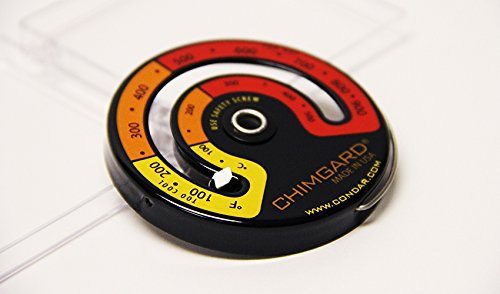
This is the gauge for the person who wants to know the pipe itself is safe, not just the room. It reads flue temperatures up to 900° Fahrenheit (500 Centigrade), with yellow and orange safety zones marked on the face. The rugged steel case and genuine porcelain enamel are built for a long run against the heat, and the bold graphic dial is meant to be read at a glance.
The clear zones show you safe flue temperatures without a calculation. It mounts on woodstove chimneys, and its accuracy lines up closely with an infrared check — one buyer found it matched their IR reading. The strong magnet holds to stove pipes well, and a safety screw is included if you want a firmer mount than the magnet alone.
The 1.44-ounce body is light on the pipe, and the black case with its yellow, orange, and red bands reads easily from a few steps back. If your priority is watching the chimney rather than the stove, this is the meter for the job.
What stands out
- Reads flue pipe up to 900°F with clear yellow and orange safety zones
- Has tracked closely against an infrared thermometer in real use
- Strong magnet plus included safety screw for a secure mount
What to weigh
- Reads the pipe, so it is no good for a double-wall flue’s inner temperature
- Relies on a magnet first — add the safety screw if your pipe face is uneven
For you if: chimney safety is the number you care about most, and your flue is single-wall.
Skip if: you run a sealed double-wall pipe, where a surface magnet under-reads.
8. Midwest Hearth Wood Stove Probe Thermometer

A chrome probe that reaches inside a double-wall pipe and reads what the surface hides.
A double-wall flue has a cooler outer shell, so a stick-on magnet reads low. This probe solves that by reaching into the pipe with a 4-inch chrome-plated probe and measuring the gas inside up to 1700°F. That is the number you actually want when the pipe is insulated and the outside tells you little. Brightly coloured zones make it easy to read and to spot overheating and creosote risk.
Installation is a small drilled hole, and the instructions walk you through it — magnetically secured once it is in place. Owners find it simple to fit and accurate once installed, with consistent readings as the fire runs. It is a genuine upgrade for anyone who has been squinting at a surface magnet on an insulated pipe and getting a misleading number.
The trade-off is that it is a one-time install rather than a drop-on gauge: you commit to drilling, and positioning matters. Durability draws mixed feedback, so treat the chrome stem and cable with care. For the right setup, though, nothing on this list reads a double-wall flue the way this probe does.
The real value: it reads inside the pipe up to 1700°F, where a magnet-only meter on a double-wall flue simply cannot.
The honest cost: you drill once, and the mixed durability feedback means a careful hand pays off.
Your answer if: you own a double-wall pipe and want a true internal reading, not a surface guess.
Overkill if: your pipe is single-wall, where a plain magnetic dial already reads true.
9. FlueGard Thermometer (3-39) for Double Wall Pipe

The three-layer copper probe with a dual Fahrenheit and Celsius dial.
When you want the cleanest read on a double-wall pipe, this is the probe to beat. Its 4-inch stem reaches inside and measures up to 1700 degrees, and the face shows both Fahrenheit and Celsius so you never convert in your head. The yellow, orange, and red zones mark the safe band and the danger band at a glance, and the porcelain enamel finish keeps its colour against the heat.
The stem is the clever part: a high-temp steel core clad in pure copper for fast conductivity, then chrome-plated to resist corrosion. That copper cladding is why the reading settles quickly rather than lagging behind the fire. Owners find it accurate enough to catch an overheat before it gets away, and the magnetic attachment holds it firmly in place once the probe is fitted.
It is a one-time install like the Midwest Hearth probe, so you drill once and it stays put. The face runs small enough that a few find it fiddly at a glance — but the trade is a precise, fast-reading instrument rather than a big wall clock. For a serious double-wall setup, that precision is the reason to pick it.
Why precision buyers choose it
- Three-layer probe — steel core, copper cladding, chrome plating — for a fast, stable read
- Dual Fahrenheit and Celsius scale with clear yellow, orange, and red zones
- Reads inside double-wall pipe up to 1700 degrees with a firm magnetic hold
What you accept
- Requires drilling the pipe once to seat the probe
- The compact face is less glanceable than a big stove-top dial
Settle on this if: you run double-wall pipe and want the fastest, most precise internal read on the list.
Look elsewhere if: you want a drop-on gauge with no drilling at all.
Know the Specs
Magnetic vs Probe vs Stove-Top
A magnetic dial sticks to a steel or iron flue and reads the surface, so it is best for single-wall pipe. A probe reaches inside the pipe through a drilled hole and reads the gas, which is what you need for a double-wall flue whose outer shell stays cool. A stove-top meter sits on the iron plate and tracks the cooking surface instead. Pick the mount that matches where you need the temperature.
Temperature Range and Zones
The range tells you what the dial can actually show. A wide surface gauge can read from 100°F to 800°F, while a probe can reach 1700°F and a flue meter up to 900°F. The colour zones — low-fire, optimum, and over-fire — translate those numbers into action: a low reading warns of creosote, the middle band is your target, and the hot band flags wasted fuel and a running-away fire.
Probe Depth and Speed
A probe needs to sit deep enough in the flue to sample the gas rather than the wall. A 4-inch stem puts the sensor well inside the pipe, and a copper-clad core speeds up how fast the reading settles. Faster settling means less lag between the fire changing and the dial telling you about it.
Legibility and Mount Security
A face you can read from a few steps back is what keeps you checking the fire. Colour-coded bands, bold needles, and a wide dial all help. On the mount side, a strong magnet needs a flat ferrous surface, and an included safety screw or wire gives you a fixed backup where the magnet alone feels unsure. Check magnetism on your own pipe before you buy.
Common Questions
Will a magnetic wood stove thermometer work on a double-wall flue?
Where should I place the thermometer on my stove pipe?
What do the coloured zones on the dial actually mean?
Do I need a stove-top meter or a flue meter?
Is a soapstone stove top different for a thermometer?
How accurate are these thermometers?
Can I leave a magnetic thermometer on the pipe all the time?
Why does my flue thermometer read lower than I expect?
How long does a probe thermometer last?
Does the probe meter need a hole drilled in the pipe?
The Bottom Line
For the everyday single-wall setup, the Valiant Magnetic Log Burner is the smart start — it reads optimum burn, cuts fuel deposits, and snaps onto enamel, iron, or steel with a compact face that hardly shows. If chimney safety is what keeps you up at night, the ChimGard Energy Meter watches the flue up to 900°F with clear safety zones. And for a sealed double-wall pipe, the FlueGard gives you the fastest, most precise internal read with its copper-clad probe. Match the mount to your pipe and you will get a number you can trust.
How we choose
We do not accept paid placement. Every pick is matched to a real buyer and a real use-case; we do not hands-on test units.
Sources
Specifications: manufacturer listings and product documentation. Review insights: verified customer reviews, as of November 2026. Pricing: not shown on this page (it changes often); check the current price via the retailer link.
As an Amazon Associate, Tactical Gear Guy earns from qualifying purchases. This does not affect which products we feature.