Specs are compiled from manufacturer listings and verified buyer reviews and can change over time — please confirm the key details on the product page before buying.
Watery marina gas and a clogged filter are the cheapest ways to wreck a healthy outboard. A fuel filter is the part standing between that gas and your carburetors. The picks below cross-reference to real Yamaha part numbers and hold up in saltwater service. Start with the Sierra 18-7866: 4.5+ stars across 850+ ratings, the crowd favorite.
This guide is built by comparing the manufacturers’ published specifications and the patterns across verified customer reviews, so you get each pick’s real strengths and trade-offs instead of marketing spin.
You will see the exact part numbers each filter replaces, the micron rating that decides what gets through, and how flow capacity lines up with your horsepower. Every pick here is a Yamaha-compatible filter, so the real decision is matching the right one to your engine and fuel. For most high-horsepower owners, the answer is a 10 micron Yamaha Outboard Fuel Filter with the flow to feed the motor at wide-open throttle.
Top Picks

How To Choose The Best Yamaha Outboard Fuel Filter
Two filters can look identical on a screen and still mount to completely different Yamaha fuel systems. Buying by photo is the mistake most owners make. The reliable method: read the part number off the old filter, then confirm the replacement lists that number as a supersession or cross-reference.
Start With The Part Number On Your Engine
Yamaha changes part numbers over the years, and a newer number often replaces the old one (a supersession). A listing that names both numbers is far less likely to leave you with a part that will not seat. Write your number down before you shop, then match it against the cross-reference list in each listing.
Match The Filter Type To Your Fuel Line
Inline filters push onto a fuel hose and suit smaller four-stroke motors. Spin-on and cartridge-style separators (thread-on metal canisters) handle the volume of bigger engines. Squeeze an inline filter into a high-horsepower fuel system and it will not flow enough. A spin-on canister will not plumb into a line built for a hose barb. Type first, then brand.
Weigh Micron Rating Against Flow
Micron rating tells you the particle size the filter media catches — 10 micron filtration captures particles as small as 10 microns (a micron is one millionth of a meter). Tighter media cleans better but can restrict flow if the element is undersized for your engine. Look for a tight rating paired with a healthy flow rating, which is exactly how the top pick here is built.
Water Separation Matters More Than You Think
Ethanol fuel absorbs moisture, and free water in the fuel is what stalls engines and corrodes injectors. A filter that also strips emulsified water (water mixed into the gas) out of the gasoline does two jobs instead of one. Keep a spare on the boat — filters load up, and swapping on the water beats limping home.
Side-by-Side Comparison
| Model | Best For | Micron Rating | Flow Rate | Replaces | Amazon |
|---|---|---|---|---|---|
| Sierra 18-7866★ Best Overall | High-horsepower 2- and 4-stroke outboards | 10 micron | 90 GPH | MAR-FUELF-IL-TR, MAR-10MEL-00-00 | Amazon |
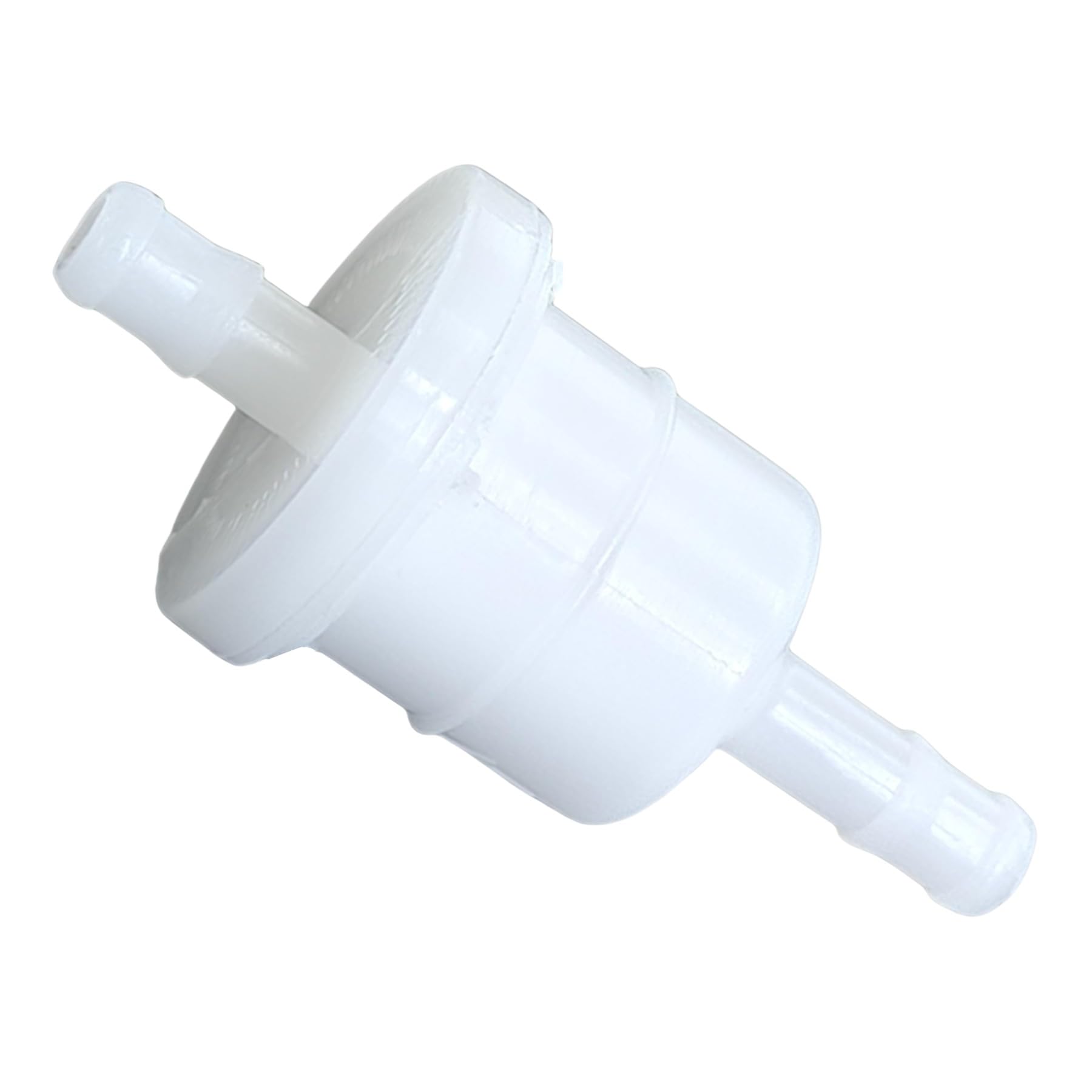
| 68T-24251 Inline Fuel FilterBest Value | Yamaha 4-stroke F4 through F15 | — | — | 68T-24251-00/01, 6EE-F4251-00 | Amazon |
| Yamaha Mini 10 #MAR-M10EL-00-00 | Tight-space fuel/water separation | — | — | MAR-MINIF-IL-TR | Amazon |
| Yamaha Primary #6D8-WS24A-00-00 | Yamaha F90 primary filtration | — | — | 6D8-24563-00-00 | Amazon |
Detailed Reviews
1. Sierra 18-7866 Fuel Water Separator Filter
Our pick — 4.5+★ from 850+ verified ratings; the strongest balance of quality and price.
The filter that does the cleaning and the drying in one cartridge, with the flow to feed a big outboard.
The Sierra 18-7866 earns this slot on one number: 90 GPH. That is 90 gallons per hour of fuel flow, enough volume to keep a high-horsepower motor fed at wide-open throttle. Its 10 micron media (trapping particles as small as 10 microns, roughly a grain of pollen) keeps fine grit and rust from reaching your injectors. Sierra rates the media over 90 percent efficient at 10 microns.
Cross-referencing is where it pulls ahead of the others here. It replaces Yamaha MAR-FUELF-IL-TR and MAR-10MEL-00-00, along with Mercury 35-8M0154754 and Mallory 9-37807. That broad list covers a lot of repowering and mixed-brand docks. The listing says it fits all high horsepower 2-stroke and 4-stroke Yamaha outboards on an 11/16-16 thread (the thread that screws into your fuel head). Check that thread against your old filter before ordering — it is the part that actually holds the filter on.
Buyers report it simply fits and works, and the value ranks close behind, since it undercuts a dealer-counter branded filter. The water separation is the detail worth paying for: the maker claims it extracts over 99.8 percent of emulsified water, the moisture ethanol-blend fuel quietly collects in a vented tank. Sierra covers it with a limited lifetime warranty. The 6 inch high-capacity element and 1.3 pound metal body mark it as a substantial spin-on cartridge, not a clip-in element.
Where it pulls ahead
- 10 micron filtration, rated over 90 percent efficient at catching particles that small
- 90 GPH flow keeps high-horsepower motors fed at wide-open throttle
- Replaces Yamaha MAR-FUELF-IL-TR and MAR-10MEL-00-00 plus Mercury and Mallory numbers
- Sierra claims 99.8 percent emulsified-water removal from gasoline
- Sierra limited lifetime warranty
The honest trade-off
- Built for high horsepower Yamaha outboards only — a small F4 or F6 four-stroke needs the inline style instead
- Listed at 1.3 pounds, so it is a substantial metal-bodied cartridge, not a clip-in element
Your match if: you run a high-horsepower Yamaha and want water separation and fine filtration from one cartridge.
Keep looking if: your motor is a small four-stroke on an inline filter — the 68T below is the correct shape.
2. 68T-24251 Inline Fuel Filter
A tiny inline filter for the small four-strokes that never needed a spin-on canister in the first place.
Small tiller and portable Yamaha four-strokes — the F4, F6, F8, F9.9 and F15 — run a hose-barb inline filter, not the big separator cartridge. This 0.02 kg part is that filter, light enough to hang in a fuel line on a bouncing boat without strain. It cross-references to Yamaha 68T-24251-00, 68T-24251-01 and 6EE-F4251-00, plus Sierra 18-7710-1, so you can match it to whatever number is stamped on the old filter.
Fit is the strongest part of the story: owners mention it drops into place on the listed models and the fuel flows clean. Conformity splits the reviews. Some owners call it a great stand-in for the factory part; others feel it is not quite the same quality as the original, and the value question splits the same way. That is the honest picture on a low-cost aftermarket inline — it works, but it is not the factory piece. No manufacturer warranty is listed either, which is worth knowing before you buy two.
Who it quietly suits: the owner of a small Yamaha four-stroke who wants a spare in the toolbox without paying dealer-counter money. It is light, it fits F4 through F15, and it swaps fast.
What to accept going in: 0.02 kg reflects a simple molded inline housing, and the mixed verdict on conformity means you should inspect it at the dock rather than assume it is the OEM piece in disguise.
Buy it when: your cowling hides an inline filter and your engine badge reads F4 through F15.
Step up when: you want an exact OEM replacement with the factory name on the box.
3. Yamaha Mini 10 Fuel/Water Filter

The factory Mini 10 canister — small enough to tuck into a cramped fuel bay, branded by Yamaha itself.
A tight fuel bay is the whole reason the Mini 10 exists. It is a compact fuel/water separator built to drop into a cramped compartment where a full-size canister will not go, and it is a genuine Yamaha part under number MAR-M10EL-00-00. That number supersedes (replaces) MAR-MINIF-IL-TR, so an old filter carrying the earlier code gets this one as the current replacement. The metal outer body signals a proper cartridge rather than a plastic inline shell.
Buyers praise the fit most: it slots into the space it is meant to occupy and installs without a fight. Reviewers also treat it as the factory part, not a lookalike, which keeps it popular as a service item. One review describes it helping keep a 40 HP four-stroke running — about as direct as an endorsement of a filter gets. Verified fitment is on you, though. The listing asks you to confirm your own application before ordering and flags it for personal watercraft compatibility, so cross-check your engine’s part number rather than trusting the photo.
The case for genuine: you get the Yamaha name on the part, the current supersession number in hand, and a compact body that solves a real space problem on crowded fuel systems.
The catch to plan around: it is an OEM part with a specific application, so confirming fitment sits with you. Read your old filter’s number, match it to MAR-M10EL-00-00, and check warranty terms with Yamaha Motor directly.
Reach for this if: you want the genuine Yamaha Mini 10 and your fuel bay is tight on room.
Look elsewhere if: you need a high-capacity separator for a big-horsepower motor — the Sierra flows 90 GPH and this one is built for compact installations.
4. Yamaha Primary Fuel Filter

The primary-stage factory filter that gets the first crack at whatever comes out of the tank.
On a Yamaha four-stroke like the F90, the primary filter sees the fuel before anything else does. This genuine Yamaha part, number 6D8-WS24A-00-00, supersedes 6D8-24563-00-00, so an older engine still gets a current replacement. Yamaha states it is manufactured to meet the fit, form and function specifications of the original — the standard you want from a filter bolted directly to the engine.
Buyers put quality first and fit right behind it. The exact-fit reports for the F90 come up again and again, meaning the housing seals the way it should and you are not fighting threads. Then there is the quiet work that matters: it stops bad gas from reaching the carburetor, so a tank of questionable marina fuel does not turn into a carburetor teardown. Installation is straightforward, and buyers read the value as reasonable for a genuine part. The plastic outer body is the one thing to handle with care — snug it down properly, but do not over-torque it, because this is a replacement part, not armor.
Why it holds its ground
- Genuine Yamaha primary filter for the F90 and other specified applications
- Current part number 6D8-WS24A-00-00 supersedes 6D8-24563-00-00
- Built to Yamaha’s own fit, form and function specification
- Simple installation that seals without a fight
The fine print
- Plastic outer body — snug it down properly but do not over-torque it
- Vehicle-specific fitment, so the part number on your engine is the deciding vote
Best called for: an F90 or similar Yamaha four-stroke due for its primary-stage filter and nothing more.
Not the pick for: a high-horsepower engine that needs a 10 micron separator with 90 GPH flow — that is the Sierra’s job.
Know the Specs
Micron Rating
Micron rating tells you how small a particle the filter media will catch. A 10 micron filter catches particles down to 10 microns — tiny enough to keep fine grit from reaching injectors or carburetor jets. Finer media cleans better, but it also loads up faster, so a tight rating on a properly sized element is the pairing to look for. Sierra rates the 18-7866 over 90 percent efficient at 10 microns.
Flow Rate (GPH)
Flow rate is the volume of fuel the filter can pass in an hour, listed in gallons per hour (GPH). A high-horsepower outboard pulls a lot of fuel at wide-open throttle, and a filter that cannot keep up will starve the engine or run it lean. The Sierra 18-7866 carries a 90 GPH rating for that reason. Match the flow rating to your horsepower, not to the price tag.
Water Separation
Fuel/water separators do a second job beyond particle filtration — they strip water out of the gasoline. Ethanol blends absorb moisture, and free water in the fuel causes rough running and corrosion inside the fuel system. A separator style filter handles both; a plain inline filter is mostly about particles. Sierra claims 99.8 percent emulsified-water removal for the 18-7866.
OEM Part Number And Supersession
Every Yamaha filter carries a part number, and Yamaha periodically retires a number in favor of a new one. A listing that names both the old and new number is telling you it is the current replacement for engines that shipped with the older part. Always match the number on your own engine’s filter before ordering.
Common Questions
Will the Sierra 18-7866 fit my high-horsepower Yamaha outboard?
What does a 10 micron rating actually stop?
Do I need a fuel/water separator or a plain inline filter?
Is the Sierra 18-7866 a real alternative to the Yamaha-branded filter?
How often should I change my outboard fuel filter?
What does supersedes mean on a Yamaha part number?
Will the 68T-24251 inline filter work on my F15?
Which Yamaha primary filter is correct for an F90?
Is a metal-bodied filter better than a plastic one?
Does a fuel filter really prevent carburetor damage?
The Bottom Line
The yamaha outboard fuel filter that earns the top slot is the Sierra 18-7866. It pairs 10 micron filtration with 90 GPH flow and, per Sierra, 99.8 percent emulsified-water removal in one cartridge — the combination that matters at wide-open throttle. If your cowling hides a small inline filter on an F4 through F15, the 68T-24251 is the shape you need. And when only the factory part will do, the Yamaha Mini 10 or the metal-bodied #6P3-WS24A-01-00 covers you with the correct number in hand. Whichever you choose, match it to the part number on your engine, keep a spare aboard, and change it before it clogs.
How we choose
We do not accept paid placement. Every pick is matched to a real buyer and a real use-case; we do not hands-on test units.
Sources
Specifications: manufacturer listings and product documentation. Review insights: verified customer reviews, as of November 2026. Pricing: not shown on this page (it changes often); check the current price via the retailer link.
As an Amazon Associate, Tactical Gear Guy earns from qualifying purchases. This does not affect which products we feature.