Specs are compiled from manufacturer listings and verified buyer reviews and can change over time — please confirm the key details on the product page before buying.
A rolled mat is the reason your gym bag stays in the closet. It is bulky, it unrolls across the floor of a hotel room, and it never quite goes back the way it came. A foldable travel yoga mat solves that specific annoyance: it collapses into a flat brick you can drop into a suitcase or backpack, then unfolds into a full-length surface when you land.
This guide is built by comparing the manufacturers’ published specifications and the patterns across verified customer reviews, so you get each pick’s real strengths and trade-offs instead of marketing spin.
Below are nine foldable mats sorted by what they do best, from a 2.3-pound packable set with a stretch strap to a 12 mm mat that folds into a yoga block. Each entry covers folded size, thickness, and grip in plain terms, so you can match a mat to how you travel and practice.
Top Picks

How To Choose The Best Foldable Travel Yoga Mat
Most buyers compare unfolded length and stop there. That is backwards: the folded footprint decides whether the mat earns a permanent spot in your bag. The number that decides whether a folding mat earns a permanent spot in your bag is the folded footprint — and the second is whether the material still grips after being creased hundreds of times.
Start with the folded footprint, not the unfolded length
A mat that folds to roughly 12″ x 12″ x 1.3″ slides into a carry-on the way a rolled mat never will. A mat that folds to 15″ x 12″ x 4″ is still compact but takes noticeably more room. If you are packing a single backpack for a weekend, the smaller cube wins outright.
Thickness decides who the mat is for
Thin mats around 3 mm feel like the studio floor and pack down smallest — good for balance work, less forgiving on knees. A 6 mm mat adds cushioning for wrists and joints while still folding flat. Anything near 10 mm or 12 mm is a comfort-first choice that trades portability for padding.
Check the material for sweat and cleanup
TPE (a rubbery, flexible plastic foam) tends to be lighter and wipes clean easily. PVC (a denser vinyl) holds up to heavy use and takes a firm grip. A closed-cell surface seals out moisture, which matters when you are laying the mat over a hotel carpet or a borrowed studio mat.
Look at how the mat folds
Accordion folds create a stack of panels that opens flat in one motion. Some mats add printed crease lines that double as alignment guides. If you practice hot yoga, favor a mat with a dense texture on both sides so your hands do not skate when you sweat.
Side-by-Side Comparison
| Model | Best For | Thickness | Folded Size | Weight | Amazon |
|---|---|---|---|---|---|
| RUILIXIN Foldable Yoga Mat Set★ Best Overall | Home and travel starter set | 0.2″ (5mm) | 12.2″ x 9.84″ x 2.75″ | 2.3 lb | Amazon |
| Avoalre Foldable Yoga MatPacks Thinnest | Packing into a carry-on | 0.12″ (3mm) | 12″ x 12″ x 1.3″ | 2.87 lb | Amazon |
| Readaeer Foldable Yoga MatCushioned Value | Cushioned daily practice | 0.24″ (6mm) | — | 0.76 kg | Amazon |
| HAPBEAR Foldable Yoga Mat | Space-saving apartment storage | 0.24″ (6mm) | 15″ x 12″ x 4″ | — | Amazon |
| PROIRON Foldable Yoga Mat | Alignment-guided practice | 0.24″ (6mm) | 12″ x 12″ x 4″ | 0.8 kg | Amazon |
| Numu Foldable Yoga Mat | Comfort-first storage | 0.25″ (6.4mm) | — | 2 lb | Amazon |
| PAIDU Foldable Yoga Mat | Joint-heavy floor work | 0.39″ (10mm) | — | 2.6 lb | Amazon |
| Manduka PRO Travel Yoga Mat | Studio-grade thin surface | 0.08″ (2mm) | — | 2.4 lb | Amazon |
| Stakt The Original Foldable Yoga Mat | Mat-plus-block workouts | 0.47″ (12mm) | 24″ x 3″ x 12″ | 3 lb | Amazon |
Detailed Reviews
1. RUILIXIN Foldable Yoga Mat Set
Our pick — 4.5+★ from 550+ verified ratings; the strongest balance of quality and price.
Folds to the size of a hardback book and still brings a strap and bag.
The RUILIXIN earns the top spot because it treats the fold as the whole point. Unfolded it gives you 68″L x 24″W at 0.2″ thick (5 mm) — full-body room for floor work — and folded it collapses to 12.2″ x 9.84″ x 2.75″. That is small enough to sit beside a laptop in a tote, which is the entire reason people move off rolled mats. The PVC build is dense and tear-resistant, so the panels keep their shape instead of going floppy at the creases.
What comes in the box is the honest edge here. A 72″ x 1.5″ stretch strap covers the warm-up and cooldown work that most mats leave you improvising with a towel, and the included storage bag means the mat has somewhere to live between sessions. Owners consistently point to the build quality as the standout, and the portability is the second thing that gets talked up — the same two traits you want in a mat that splits its life between a living room and a hotel floor.
The trade-offs are worth naming plainly. It weighs 2.3 pounds, which is light for a full-size mat but not featherweight in a carry-on. PVC also arrives with a faint smell; the maker says to air it out after unrolling, and that clears within a day or two. Thickness is the one split point in the feedback — some want more cushioning under the knees. If you are heavy on kneeling sequences and want a thick pad under you, size up to a 6 mm or 10 mm option instead.
What earns it first place
- Folds to 12.2″ x 9.84″ x 2.75″ — genuinely bag-sized
- Stretch strap plus carry bag in the box, not sold separately
- Full 68″ x 24″ surface when unfolded
- Dense PVC resists tearing at the folds
Where it flexes under pressure
- 5 mm thickness leaves some buyers wanting more knee padding
- PVC needs airing out before the first session
- Hand wash only
The right call for: anyone who wants one mat that covers a home workout, a class, and a weekend trip without buying extras.
Think again if: you need deep padding under knees and wrists — a thicker 6 mm or 10 mm mat suits that better.
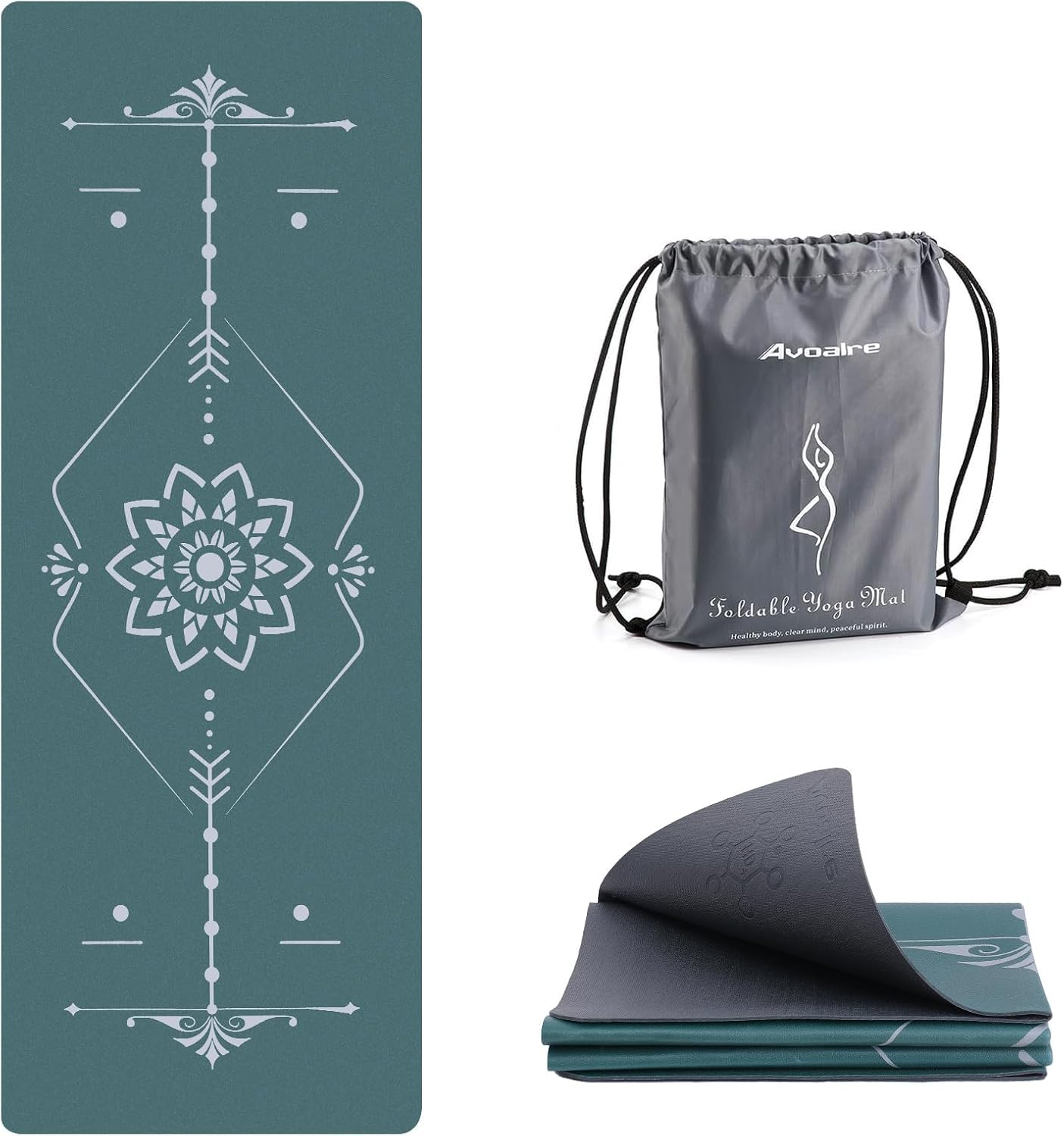
2. Avoalre Foldable Yoga Mat
The 12″ x 12″ x 1.3″ fold that disappears into a carry-on.
If your bag is already full, this is the mat that fits in the gap. The Avoalre folds down to 12″ x 12″ x 1.3″ — noticeably flatter than the HAPBEAR’s 15″ x 12″ x 4″ stack — and still opens to a full 72″L x 24″W. The 0.12″ (3 mm) surface is the thinnest in this group, which is exactly what makes the fold so tight. You get studio-floor feel underfoot rather than a padded platform.
Grip is where Avoalre put its effort. Both surfaces carry a high-density texture, and the maker describes the design as delivering a firmer hold than standard mats — the practical payoff is that downward dog and sweaty sequences do not slide the mat out from under you. The PVC is also listed as non-toxic and free of BPA and phthalates, tested to OEKO-TEX Standard 100 and SGS.
The honest limit is the 3 mm. On a hard hotel floor it is close to unforgiving if you have knee or wrist sensitivity — buyers do split on whether the thinness is a packing win or a comfort miss. It also arrives with a factory odor and the maker asks for 2 to 3 days of airing before first use. Plan the purchase a few days before a trip, not the night before.
Why it travels well: the 12″ x 12″ x 1.3″ footprint is the smallest fold here, and the 72″ x 24″ opening means you do not sacrifice stretching room to get it.
The real cost of that fold: 3 mm of cushioning means you feel the floor, so pair it with a towel if your knees are the problem area.
Built for the overpacker: a carry-on-only traveler who needs the mat to take up almost no room.
Look elsewhere if: you want padding for kneeling poses — this one trades cushion for flatness.
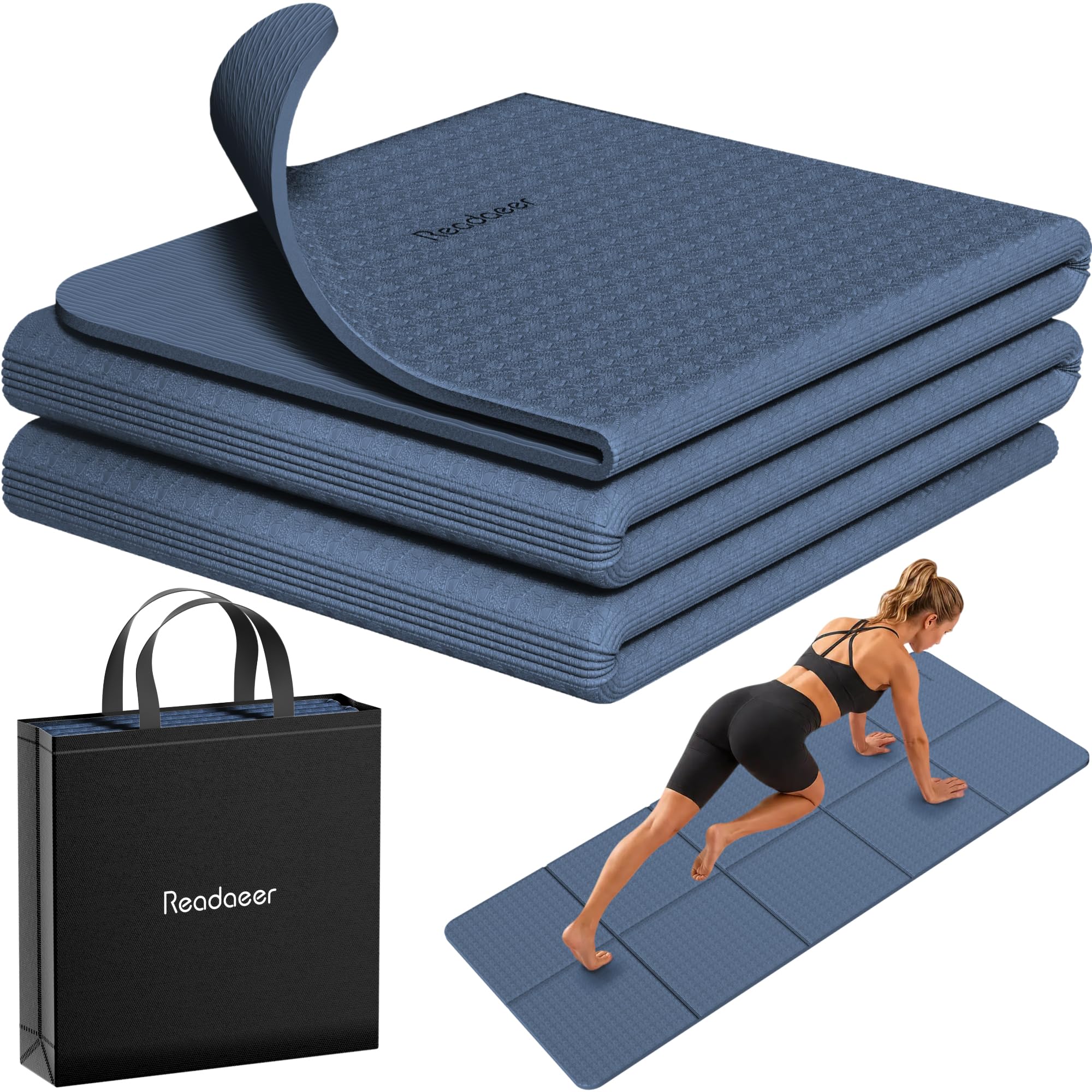
3. Readaeer Foldable Yoga Mat
Six millimeters of TPE padding that folds down for the gym bag.
The Readaeer is the one to look at if the word “thin” made you wince. It runs 0.24″ (6 mm) of TPE across a 72″L x 24″W surface, which is roughly double the Avoalre’s 0.12″ — a real difference when your knees hit the mat during a long kneeling sequence. TPE is a lighter, springier material than PVC, and the maker leans on that with a dense, shock-absorbing construction that bounces back quickly instead of flattening out.
The surface is finished on both sides: a polygonal texture on the skin side for grip and a wave pattern on the floor side for staying put. It ships with a storage bag, and the maker backs it with a one-year warranty, which is more than most mats in this bracket offer. The quality of the build is what gets discussed most in the feedback — it is consistently described as a comfortable, travel-ready mat that folds into its bag without a fight.
Where buyers split is the fold itself. Some love that it collapses; others find the accordion panels fussy to line up and re-fold cleanly. Thickness is the other divider — the 6 mm reads as generous to some and still thin to others. Treat the folding as a skill you learn in the first week rather than a friction-free motion, and it stops being an issue.
Worth the attention
- 6 mm TPE gives real cushioning without going bulky
- Two different textures, one for grip and one for floor hold
- Storage bag included, plus a 1-year warranty
The honest friction points
- Refolding the accordion panels takes practice
- Padding still reads thin to some buyers
- 0.76 kg is light but not the lightest here
Made for the mat-in-the-trunk routine: gym-goers who want cushioning and a warranty without a bulky roll.
Not the pick for: anyone who wants a mat that folds itself back in one motion every time.
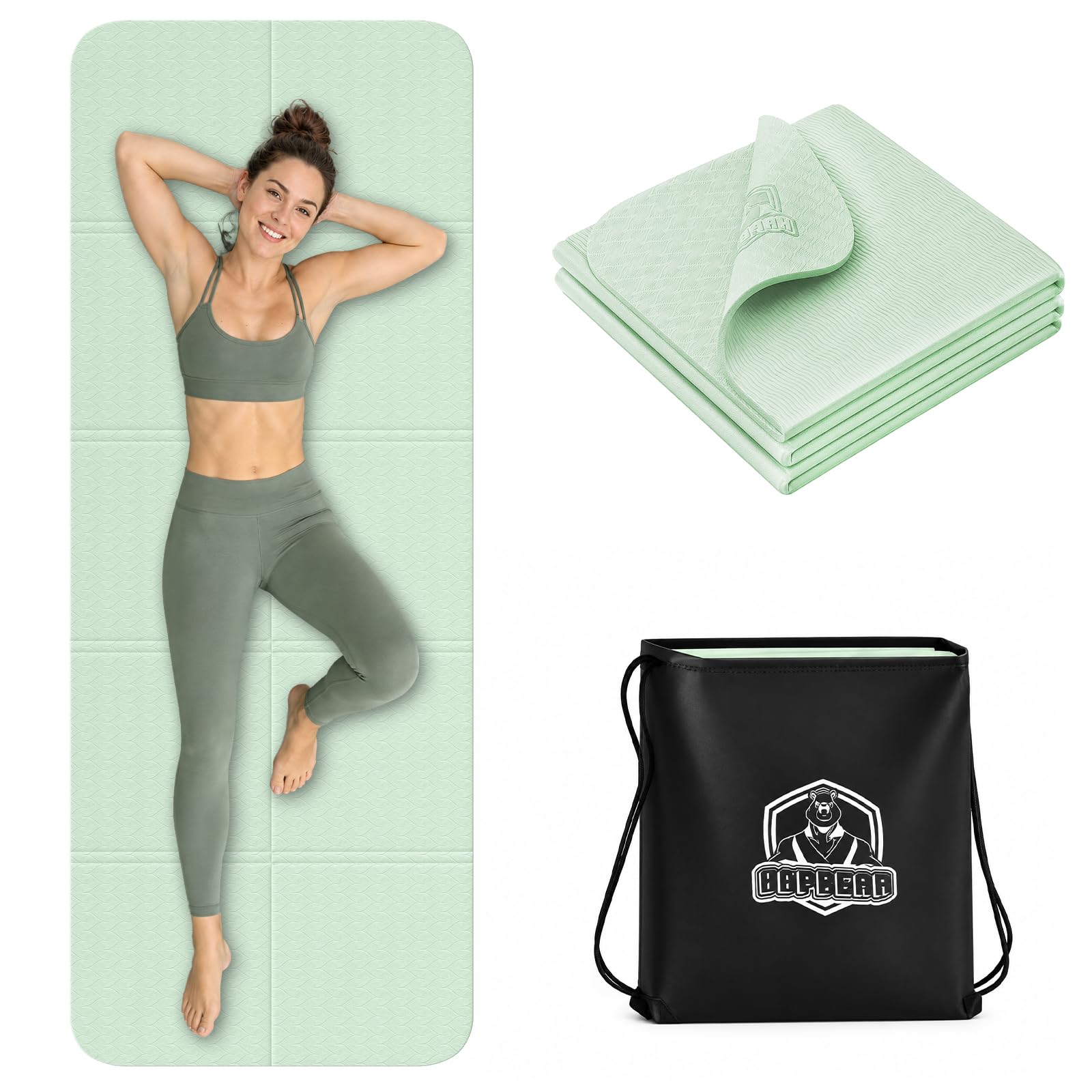
4. HAPBEAR Foldable Yoga Mat
A folding mat built to live in a closet shelf, not a gym bag.
HAPBEAR’s mat opens to 72″ x 24″ x 0.24″ (6 mm) and folds to 15″ x 12″ x 4″ — a stack the maker describes as 70% smaller than rolled mats. That is a chunkier fold than the Avoalre’s 12″ x 12″ x 1.3″, but you get 6 mm of cushioning in exchange, which is the sensible trade for anyone using it on a hard floor at home. It goes in the included carry bag and takes a corner of a shelf instead of leaning in a doorway.
The TPE is phthalate- and latex-free, and the surface is dual-textured so it holds both the floor and your hands. Wiping it clean takes a damp cloth, and the maker claims the surface resists sweat and tears through daily use — the closed feel of the material lines up with that. Buyers describe it as a step up from the rolled mats they owned before, with the fold and the portability carrying most of that praise and the cushioning getting called out for planks and floor exercises.
Where you should be careful is folding it in a hurry. A 4″ stack has more panels in play than a 1.3″ one, and it needs to be squared off to sit flat in the bag. Thickness is also the aspect buyers are most divided on — 6 mm is enough for most, short of the plush feel of a 10 mm. If you want to sink into the mat, keep reading.
The packing math: a 15″ x 12″ x 4″ fold means this rides in a suitcase or a shelf, not a small daypack — plan bag space accordingly.
Material edge: latex-free TPE with a wipe-clean surface is the easier mat to live with if you sweat hard or hate scrubbing.
The right fit: a home practitioner who wants real cushioning and a mat that stows flat in a cupboard.
Skip the shelf if: you are packing ultralight for a flight — the 4″ thickness eats bag room.
5. PROIRON Foldable Yoga Mat

The folds double as body-alignment lines you can actually see.
Most folding mats hide their creases. PROIRON turns them into a feature: the folded indentation runs down the centerline with parallel lines across the surface, and those lines act like reference guides for checking posture and body alignment mid-pose. It is a small idea that makes the mat more useful than a plain rectangle, especially if you are working on form alone at home.
On the physical side you get 72.05″L x 24.02″W at 0.24″ thick (6 mm) of TPE, folding to 12″ x 12″ x 4″, with a linen storage bag included. The grips are two distinct textures — a diamond pattern on the front and a water-wave pattern on the back — so it holds on a smooth floor and under your hands. The maker lists a 180-day satisfaction guarantee, which gives you a longer runway to decide than most in this group.
The 4″ folded height is the honest catch. It is a real stack, and it takes a bag with some depth. There is also no customer feedback posted for this model yet, so you are buying on the published spec sheet and the maker’s guarantee rather than on a track record. That is a fair reason to treat it as a considered bet — the guarantee softens the risk.
The standout idea: guide lines built into the fold pattern turn the mat into a form-checking tool for solo practice.
What you accept: a 4″ folded stack and no owner feedback to lean on, backed by a 180-day guarantee.
Best matched to: solo practitioners working on alignment who want visual cues on the mat itself.
Wait if: you need packable-thin — the 4″ fold wants a deeper bag, not a daypack.
6. Numu Foldable Yoga Mat

An accordion mat that cushions like a studio pad and carries at 2 pounds.
Comfort is the reason the Numu sits in the premium tier. At 0.25″ thick (6.4 mm) across 72″ x 24″, it pads knees, hips, and elbows for flow, strength, and floor work without turning into a slab. The material is a polyolefin elastomer foam — a springy, waterproof foam — and the mat is listed as odorless and tear-resistant, which addresses the two most common complaints about foldable mats before they start.
The accordion design is the signature. It folds in a stack rather than rolling, opens flat in one pull, and stays flat once down. A yoga strap ships with every mat, so you have a carry handle and a stretching aid in one. Owners most often describe the mat as comfortable, with the fold and portability close behind — and the feedback also flags a practical bonus: because the mat stacks, the clean top surface stays clean instead of picking up floor grit the way a rolled mat’s outside does.
The weight is 2 pounds, which is light enough to sling over a shoulder but not a pocket-size fold. And a 6.4 mm pad is a comfort mat first; if you want a firm, floor-like surface for balance work, this is softer than you need. The accordion stack also wants to be squared up on the way back together.
Why it stands out
- 6.4 mm cushioning that holds up through floor work
- Accordion fold opens flat and stores as a stack
- Waterproof, odorless foam surface
- Strap included for carrying and stretching
What to know before you buy
- Softer feel than a floor-like studio mat
- 2 pounds carries easily but is not the lightest option
- Needs re-squaring when you fold it after use
Where it belongs: in the bag of someone who wants cushioning under knees and hips on the road.
Not for you if: you do balance-heavy work and want to feel the hard floor through the mat.
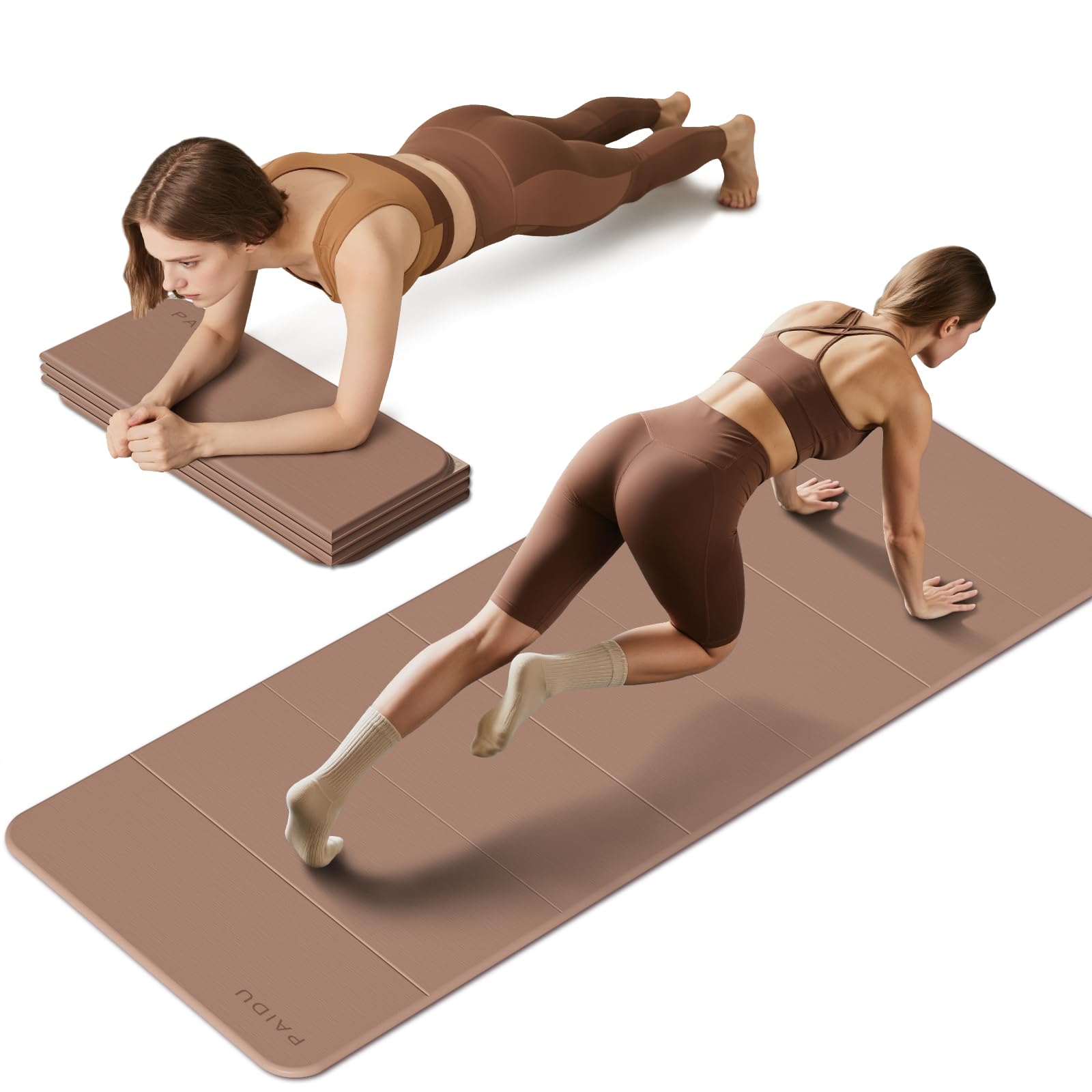
7. PAIDU Foldable Yoga Mat
Ten millimeters of padding across an extra-wide 75″ x 26″ surface.
This is the mat you buy when the floor is the enemy. PAIDU builds it at 75″L x 26″W x 0.39″ thick — that is 10 mm, roughly triple the Avoalre’s 3 mm — and describes it as giving 30% more use area than a standard mat. Knees, elbows, and spine land on TPE rather than tile, and the 2.6-pound weight keeps it manageable despite the size. Folding takes about 3 seconds by the maker’s count, collapsing to a fraction of the open footprint.
The surface is double-sided: a line pattern on the front, a dot pattern on the back, with different colors on each face. TPE is SGS certified, so the material claim is at least documented. Owners praise the fold and the thickness most, then the grip — it does not slide when you flow. The cushioning and the look both earn mentions, and the color pairing is the kind of detail people notice in a class.
Value is the divider. A fat, wide mat costs more material, and some buyers feel the price sits high for the build. The 10 mm also makes for a squishier platform, which is gentle on joints but less stable for one-legged balance poses. If you want a rock-solid surface for standing balances, go thinner; if your knees have opinions, this is the pick.
The headline number: 0.39″ (10 mm) of SGS-certified TPE over a 75″ x 26″ footprint covers the whole floor routine with room to spare.
The trade you make: softness under joints comes at the cost of firmness under balance poses, and some buyers find the value only fair.
Goes to: anyone whose knees or back need real padding for floor work and stretching.
Stay away if: you want a firm surface for standing balance — 10 mm is soft underfoot.
8. Manduka PRO Travel Yoga Mat

Two millimeters of closed-cell PVC built to feel like a studio floor.
The Manduka PRO Travel is the opposite of a cushioned mat, and that is the point. At 2 mm thick across 71″ x 24″, it lays flat and firm the way a studio surface does — you feel the floor for balance work, and inversions stay steady. The closed-cell PVC surface seals out moisture, so sweat stays on top where you can wipe it away instead of soaking in. That closed skin is also why it works draped over a hotel carpet or a borrowed rental mat: you get a clean, familiar base.
The bottom carries a no-slip dot pattern that keeps the mat anchored on studio or home flooring. It weighs 2.4 pounds and is foldable, so it packs in a suitcase. The material is OEKO-TEX certified PVC, latex-free, and made in a German facility the maker describes as emissions-free. Grip and travel-readiness both draw consistent praise from owners.
The gripe is the thinness, and it is a real one: 2 mm does not pad a bad floor. Knees and sit bones will feel the ground. That is the trade for a mat that stays put and packs flat. This is a mat for someone who values a firm, steady surface over softness — not a first mat for a beginner who wants comfort.
What the 2 mm buys you: floor-like stability and a moisture-sealed surface for balance work anywhere.
Where it stings: no padding under knees or sit bones, and the maker asks you to use only its own mat wash.
For the practice-first traveler: someone who wants a studio-grade surface they can carry.
Look past this if: you need cushioning under your knees — 2 mm is a firm surface by design.
9. Stakt The Original Foldable Yoga Mat

A mat that folds into a block, a step, or a meditation seat.
Stakt’s mat is the most unusual thing in this group. Laid flat it measures 69″ x 24″ at 12 mm thick — twice the thickness of a standard mat by the maker’s description. Folded it measures 24″ x 3″ x 12″, and in that folded state it becomes a raised platform you can use as a yoga block, a step, or a seat for meditation. It is a 2-in-1 design filed under a patent, and you can see the appeal: fewer props to carry to a studio or a class.
The structured build is what makes that work. It folds into a stable stack rather than a soft bundle, so it holds shape under Pilates moves, core work, and strength training. The surface is non-slip to keep you grounded during flows and balance drills. At 3 pounds it is the heaviest mat here, but it still folds down for a weekend trip without dragging extra gear along.
The cushioning draws consistent praise — thick and supportive without going mushy, which is a tricky balance to hit. Durability and value are the two aspects buyers are split on: some question how it will hold up, and the higher end of the price range is a real consideration. If you already own blocks and want a simple flat mat, the extra thickness and the prop role are things you are paying for and may not need.
The case for it
- 12 mm folded height turns the mat into a block, step, or seat
- 69″ x 24″ flat surface with non-slip grip
- Folds to 24″ x 3″ x 12″ for studio and travel
What you are weighing
- 3 pounds — the heaviest mat in this group
- Durability is a question mark in the feedback
- You pay for block function whether or not you need it
Suits the prop-heavy routine: Pilates and core work where a block and a step do double duty.
Not worth it for: a flat-mat-only practice where the extra thickness and weight are just along for the ride.
Know the Specs
Folded Size
This is the number that decides whether a mat goes in your bag or stays home. A fold of 12″ x 12″ x 1.3″ is carry-on friendly. A fold of 15″ x 12″ x 4″ needs a suitcase or a shelf. Compare folded size before anything else — it is the whole reason to buy a folding mat over a rolled one.
Thickness in Millimeters
Thin mats around 2 mm to 3 mm feel like a studio floor and pack down tight. A 6 mm mat adds cushioning for knees and wrists without going bulky. A 10 mm or 12 mm mat is a comfort choice that trades stability for padding. Match the number to your joints and your balance work, not to a marketing label.
Common Questions
Will a foldable mat fit in a carry-on suitcase?
How do I get rid of the smell when a new mat arrives?
Is a 3 mm mat too thin for my knees?
What is the difference between TPE and PVC in a foldable mat?
Do folded mats leave crease lines that affect grip?
Can I use a foldable mat for hot yoga?
Which mat works over a hotel carpet?
How should I clean a foldable yoga mat?
Is a folding mat okay for Pilates and strength work?
The Bottom Line
For most buyers, the foldable travel yoga mat winner is the RUILIXIN Foldable Yoga Mat Set because it packs small at 12.2″ x 9.84″ x 2.75″, opens to a full 68″ x 24″ surface, and throws in a stretch strap and storage bag. If you are squeezing into a carry-on and want the flattest fold, the Avoalre folds to 12″ x 12″ x 1.3″. And for knees that need padding on the floor, the PAIDU brings 10 mm of cushioning.
How we choose
We do not accept paid placement. Every pick is matched to a real buyer and a real use-case; we do not hands-on test units.
Sources
Specifications: manufacturer listings and product documentation. Review insights: verified customer reviews, as of November 2026. Pricing: not shown on this page (it changes often); check the current price via the retailer link.
As an Amazon Associate, Tactical Gear Guy earns from qualifying purchases. This does not affect which products we feature.