Specs are compiled from manufacturer listings and verified buyer reviews and can change over time — please confirm the key details on the product page before buying.
You want a cup that tastes like coffee, not hot water with a brown tint, and you want it without babysitting a pot all morning. The picks below split cleanly into two jobs: single-serve pod brewers that make one mug at a time, and full-carafe machines that fill a thermal or glass pot for a household. The crowd favorite here is the Keurig K-Elite, at 4.5+ stars across 73,000+ owners, because it puts a 75 oz water reservoir and a hot-water button on the same countertop footprint.
This guide is built by comparing the manufacturers’ published specifications and the patterns across verified customer reviews, so you get each pick’s real strengths and trade-offs instead of marketing spin.
Some machines here hold heat in an internal tank and pour in about four minutes, while others rely on a warming plate you set to low, medium, or high. The pages below separate those two designs so you buy the one that fits how you actually drink coffee.
Start with the machine that matches your pour volume, then check the carafe material, because that single choice decides how long a Worlds Coffee Maker keeps your second cup drinkable.
Top Picks


How To Choose The Best Worlds Coffee Maker
The first decision is volume, not brand. A single-serve pod brewer makes one mug and leaves no pot to clean, while a carafe machine fills a pot for several people at once. Pick the volume you drink before you look at any feature list.
Match the brew style to your morning
A pod brewer with a 75 oz reservoir lets you pull several cups before a refill, which suits one or two people who each want a different drink. A 12-cup or 14-cup glass carafe suits a household that pours at the same time. Espresso machines are a separate job entirely — they push water through finely ground coffee to build pressure, and the result is a shot rather than a mug.
Look at heat retention, not just heat
Drip machines keep coffee warm two ways: a warming plate under a glass carafe, or a thermal carafe that traps heat with no plate at all. A warming plate on a 12-cup brewer may hold coffee up to 4 hours, and some let you set the plate to low, medium, or high. A thermal carafe keeps the pot hot without cooking it further, which matters if you pour the last cup an hour after the first.
Understand the pressure number on espresso models
A 20-bar pump, or a 15-bar pump, describes how much force the machine can apply to push water through the coffee grounds. Higher pressure machines are built to extract oils and build crema, which is the tan foam on top of a shot. For drip coffee that number does not apply at all — a drip brewer relies on gravity and a sprayhead, not a pump.
Check what actually comes in the box
Reusable filters, scoops, water filters, and portafilter baskets can all swing your first-week costs. Some machines ship with a permanent filter; others include a single and double basket plus a tamper. Read the included-components line closely, because a missing basket means a separate order before you can brew.
Side-by-Side Comparison
| Model | Best For | Brew Style | Water Capacity | Cup Output | Amazon |
|---|---|---|---|---|---|
| Keurig K-Elite★ Best Overall | One mug at a time | Single-serve K-Cup pod | 75 oz | 4, 6, 8, 10, 12 oz | Amazon |
| Ninja Fresh Brew CE251Most Versatile Drip | Small-to-large drip batches | Drip, ground coffee | 60 oz removable | 12-cup glass carafe | Amazon |
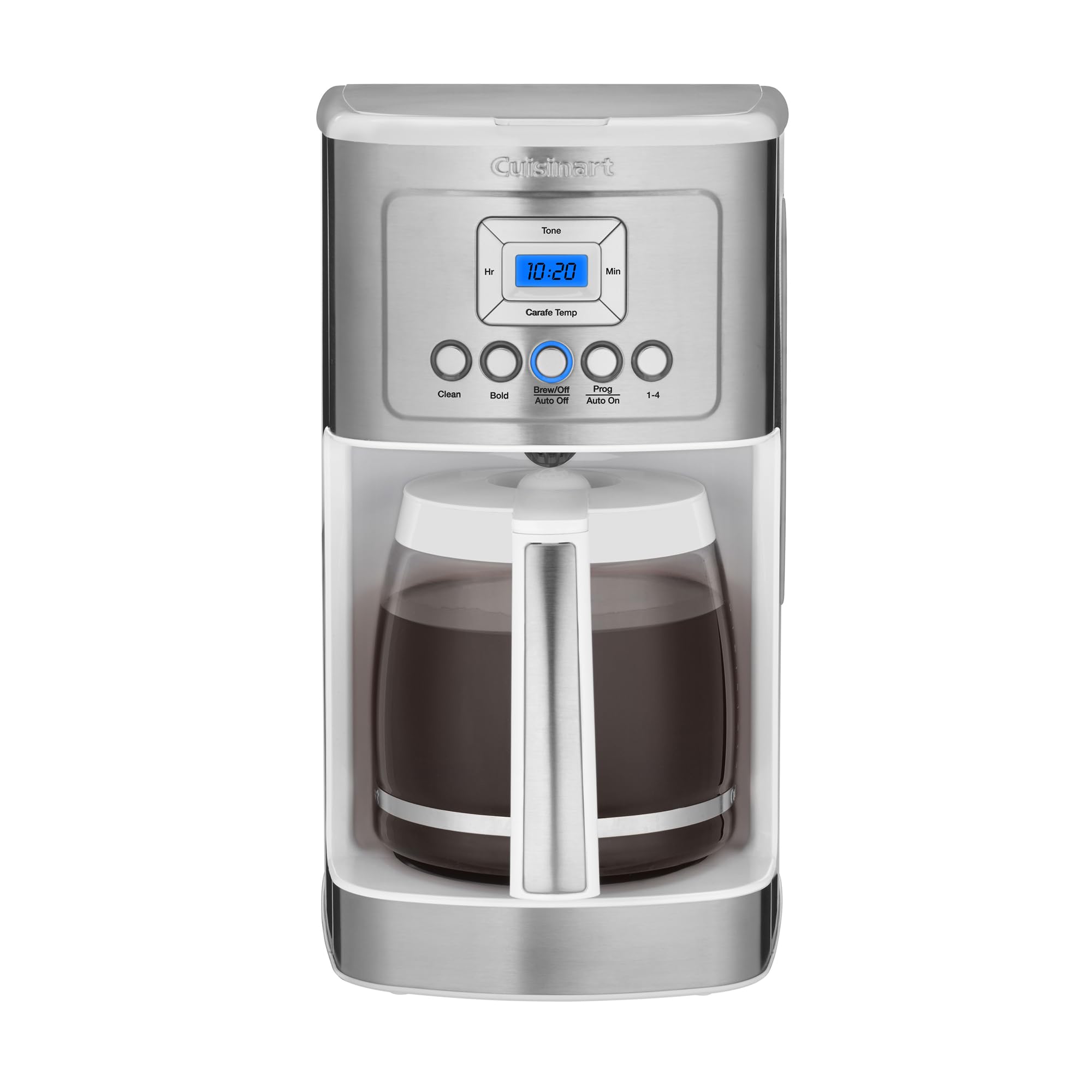
| Cuisinart DCC-3200WNASLargest Carafe | Big households, hot pots | Drip, ground coffee | Easy-view water window | 14 cups | Amazon |
| BUNN GRB Velocity Brew | Speed and back-to-back pots | Drip, always-hot tank | 70 oz internal tank | 10-cup carafe | Amazon |
| CASABREWS Ultra | Learning espresso at home | Espresso, 20-bar pump | 73 oz removable | Single or double shot | Amazon |
| Technivorm Moccamaster KBTS | Clean, simple drip coffee | Drip, thermal carafe | Water reservoir lid included | 8 cups / 32 oz | Amazon |
| De’Longhi La Specialista Arte Evo | Grind-to-shot espresso | Espresso, 15-bar pump | 3.5 lb bean capacity | Single or double espresso | Amazon |
| Ninja Luxe Café Pro | Four brew styles, one box | Espresso, drip, cold brew | 68 oz | Single or double, plus pot | Amazon |
| Philips 5500 Series | Push-button, no dialing in | Fully automatic espresso | 1.8 liters | 20 presets | Amazon |
Detailed Reviews
1. Keurig K-Elite Coffee Maker
Our pick — 4.5+★ from 73,500+ verified ratings; the strongest balance of quality and price.
A 75 oz reservoir that carries a household through several days of K-Cup brewing before a refill.
That 75 oz reservoir is the number to focus on, because it means several cups go by before you touch a faucet. It even carries 25% more water than the Ninja Fresh Brew’s 60 oz tank, which is the difference between refilling mid-week and not. Cup sizes run 4, 6, 8, 10 and 12 oz, so a small afternoon cup and a tall travel-mug fill both work from the same machine.
The removable drip tray clears travel mugs up to 7.2″ tall, and it catches a full accidental brew instead of letting it pool on the counter. Around the back of all that sits quiet brew technology, which keeps the machine from announcing itself at 6 a.m. There is also a hot-water button on demand for instant soup or oatmeal, plus an iced setting that brews hot over ice.
The honest catch is longevity. Durable performance is the mixed spot on this machine — a run of buyers report the unit quitting around the three-month mark — so treat the maintenance reminder as a real instruction and descale when it tells you to. The K-Elite also locks you into K-Cup pods, which costs more per cup than grinding your own beans. What wins people over, overwhelmingly, is the performance itself, with brewing quality the clear second favorite.
What earns it the top slot
- 75 oz reservoir means days between refills, and it tops the Ninja Fresh Brew’s 60 oz.
- Five cup sizes from 4 oz to 12 oz cover a small cup or a tall travel mug.
- Hot-water button on demand handles tea, soup and oatmeal without a second appliance.
- Strong Brew dials up intensity when a standard pod tastes thin.
- Removable drip tray clears mugs up to 7.2″ tall and holds a full accidental brew.
Where it asks for care
- Durability is the mixed spot, with some units quitting around three months.
- K-Cup pods lock you into a per-cup cost that grinding your own beans avoids.
- Descaling is not optional — skip the reminder and taste suffers.
Buy this if: you want one mug at a time, a deep reservoir and a hot-water tap without giving up counter space.
Look at a carafe instead if: your household pours three or four cups at the same moment and you want to grind your own beans.
2. Ninja CE251 Coffee Maker
A 1-4 cup small-batch setting for solo mornings, and a 12-cup glass carafe when guests arrive.
The small-batch function is the feature that earns this one a spot. Set it for 1 to 4 cups and the machine adjusts so you are not drinking a diluted version of a full-pot brew. Step up to the 12-cup glass carafe for a crowd, and the adjustable warming plate holds the pot up to 4 hours. There is a 24-hour programmable delay brew, so the machine can start before your alarm does.
At 6.6 pounds, this machine is 2 pounds lighter than the Cuisinart DCC-3200WNAS at 8.6 pounds — a difference you notice when you slide it out to wipe the counter. The 60 oz reservoir lifts off and carries to the sink, which beats pouring from a pitcher into a fixed tank. A mid-brew pause lets you grab a cup before the cycle finishes, and the clean setting descales at the press of a button.
Two brew styles — Classic or Rich — give you a strength choice without a separate setting menu. Coffee quality is the second thing buyers talk about after performance, and value for money gets consistent praise. The carafe is the weak link: glass this size draws reports of breaking around the 10-month mark, so wash it by hand and set it down gently. Simplicity is the real strength here, from filling to cleaning.
Where the money goes: the 60 oz removable reservoir, small-batch accuracy and a warming plate with a 4-hour window are the parts you actually touch every day.
Fair warning: the glass carafe wants hand washing and careful handling, because it is the component most likely to fail first.
Right machine for: a household that pours a small batch on weekdays and a full pot on weekends.
Choose the Cuisinart instead if: you need 14 cups at once and want the plate temperature adjustable.
3. Cuisinart DCC-3200WNAS Coffee Maker
Fourteen cups in one pot — two more than the Ninja, which matters at a family breakfast.
Capacity is the headline: 14 cups against the Ninja Fresh Brew’s 12, and the brand notes a cup equals roughly 5 oz depending on brewing technique. The warming plate temperature is adjustable to Low, Medium or High, so you set the heat you want instead of accepting one fixed level. A 1-4 cup setting handles a small morning batch, and brew strength control gives you regular or bold.
Full programmability covers 24 hours, auto-off anywhere from 0 to 4 hours, and an optional ready alert tone. The easy-to-view water window lets you fill precisely, and brew pause lets you pour mid-cycle.
Performance is what this machine is known for, with coffee quality and temperature right behind it. The honest limit sits in the pot itself: durability draws mixed feedback, with some units failing within a year, and leakage comes up around the carafe area. Wipe the basket dry before it sits, and handle the glass with respect. If you pour a hot pot at breakfast and dinner both, this one is built for the volume.
The strongest card: 14 cups of capacity plus a Low, Medium or High warming plate — a combination none of the smaller brewers here offer.
The trade-off: the glass carafe and its seal are the parts to watch, since leakage is a recurring mention among the mixed reviews.
Pick it when: your carafe needs to feed a full table and stay hot through a second pour.
Skip the size if: you brew for one or two, because 14-cup glass gets heavy to lift and rinse.
4. BUNN GRB Velocity Brew 10-Cup Home Coffee Brewer, Black

A 70 oz stainless steel tank kept hot all day, so a full carafe brews in 4 minutes.
Inside this machine sits a commercial-grade stainless steel hot water tank holding 70 oz at temperature all day. That tank is why a full 50 oz carafe lands in 4 minutes, which the brand describes as half the time of typical coffee makers based on internal testing. A 20 oz travel mug fills in 2 minutes, so a weekday commuter cup does not need planning.
The footprint is a different story. At 7.1″D x 13.8″W x 14.3″H it runs 4.7″ wider than the Ninja Fresh Brew’s 9.9″W, so measure your counter run before you order. On the plus side, the exclusive drip-free carafe uses a proprietary lid and spout that arcs coffee into the cup and wicks the rest back, which keeps the pour clean. A switch-activated warmer plate holds serving temperature once the pot is full.
Heat divides opinion — some owners find the pot stays very hot while others call it lukewarm — so taste it before you commit your whole morning routine to it. The multi-stream sprayhead showers the grounds evenly to build café-style flavor, and the reusable filter means no paper cones to buy. A 3-year warranty backs every Speed Brew model, and it is assembled in the USA with service based in Springfield, IL.
The speed case: a 70 oz reservoir kept hot, a 4-minute carafe and a 2-minute travel-mug fill make back-to-back pots easy.
Measure first: the 13.8″ width is the widest here, and the fixed hot tank means it wants to stay plugged in and on the counter.
Built for: a fast-moving kitchen that wants a pot ready in the time it takes to find your shoes.
Think twice if: your counter is tight, or you want to control exact brew temperature rather than trust the tank.
5. CASABREWS Ultra Espresso Machine
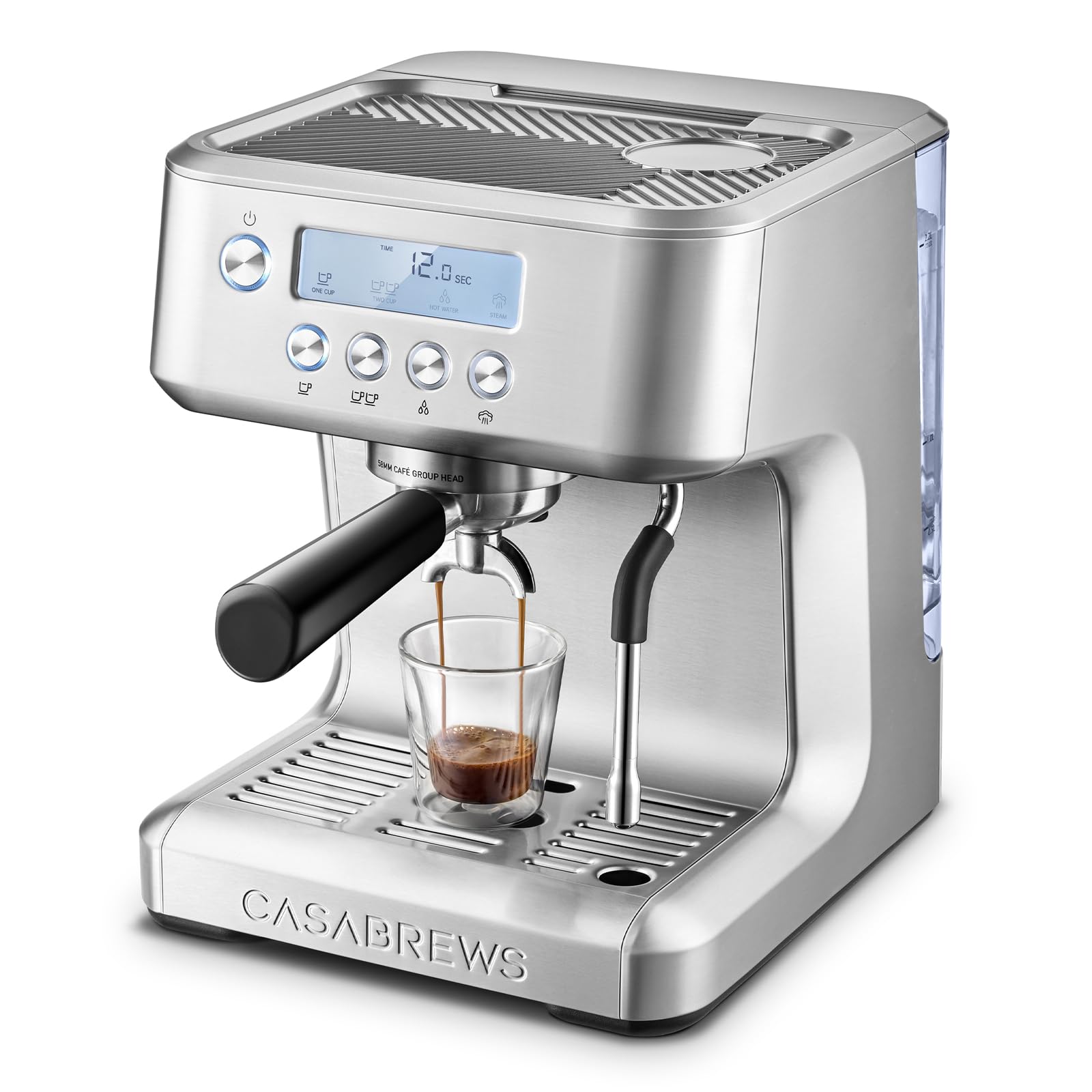
A 20-bar Italian pump and a 58mm portafilter for learning real espresso shots.
A 20-bar Italian pump paired with a 1350W heating system is the engine here, and it is built to push water through a 58mm portafilter to pull a proper shot. Four temperature settings let you adjust the brewing temperature to taste, though the brand notes that adjustment applies to espresso brewing only. A clear LCD display walks you through steam, hot water and pre-programmed shots step by step.
For milk drinks, the advanced steam wand textures microfoam — the fine, glossy milk that makes latte art and a proper cappuccino possible. The 73 oz water tank lifts out for refills, and the brushed stainless steel finish sits well on a counter. It ships with a single and a double brewing filter in both single-wall and dual-wall versions, plus a tamper with spoon and a cleaning needle.
Beginners are the clear audience — the machine is cited as easy to use for people new to espresso, and performance leads the praise with value for money close behind. Heating speed is the mixed spot, so give it a moment to warm before the first shot rather than rushing it.
Why it earns the spot: 20 bars of pressure, a 58mm portafilter and four temperature settings at the lowest espresso commitment on this list.
Know before you buy: it does not grind beans, so budget for a grinder and expect to dial in grind and dose yourself.
Go for it if: you want to learn espresso shots and milk texturing without a built-in grinder steering the result.
Hold off if: you want café drinks at one touch and no dialing in.
6. Technivorm Moccamaster 79212 KBTS Coffee Brewer

A 32 oz thermal carafe with no warming plate, so the last cup is not cooked further.
This brewer holds 32 oz across 8 cups, so it suits a smaller household that wants quality over volume. The standout part is the thermal carafe: no warming plate, no slow scorch on the last cup. A 9-hole outlet arm spreads water across the grounds, and the included brew basket lid lets you bloom the grounds to adjust flavor depth.
It brews a full pot in under five minutes, and the aluminum and stainless steel body weighs 6.3 pounds — the lightest full-size brewer in this group. Setup is deliberately simple: a water reservoir with its own lid, a brew basket, the carafe and the arm, nothing more. Loose grounds or whole beans both work since you supply the paper filter.
What owners consistently describe is cup quality — this is a machine people buy for flavor, not for a display or a program menu. The honest limit is the 32 oz ceiling: pour for three people and the pot empties fast, and there is no warming plate to keep a leftover cup hot. The carafe does that job instead, which is the whole point of the design.
What it is: a stripped-down drip brewer with a thermal carafe, a 9-hole spray arm and a 32 oz pot.
The ceiling: 8 cups only, and no warming plate — the thermal carafe is your only heat source after the brew ends.
For you if: flavor comes before features and you pour two or three cups, not a crowd.
Not for you if: you want programmable delay brew or a large pot waiting hot when you wake.
7. De’Longhi La Specialista Arte Evo Espresso Machine
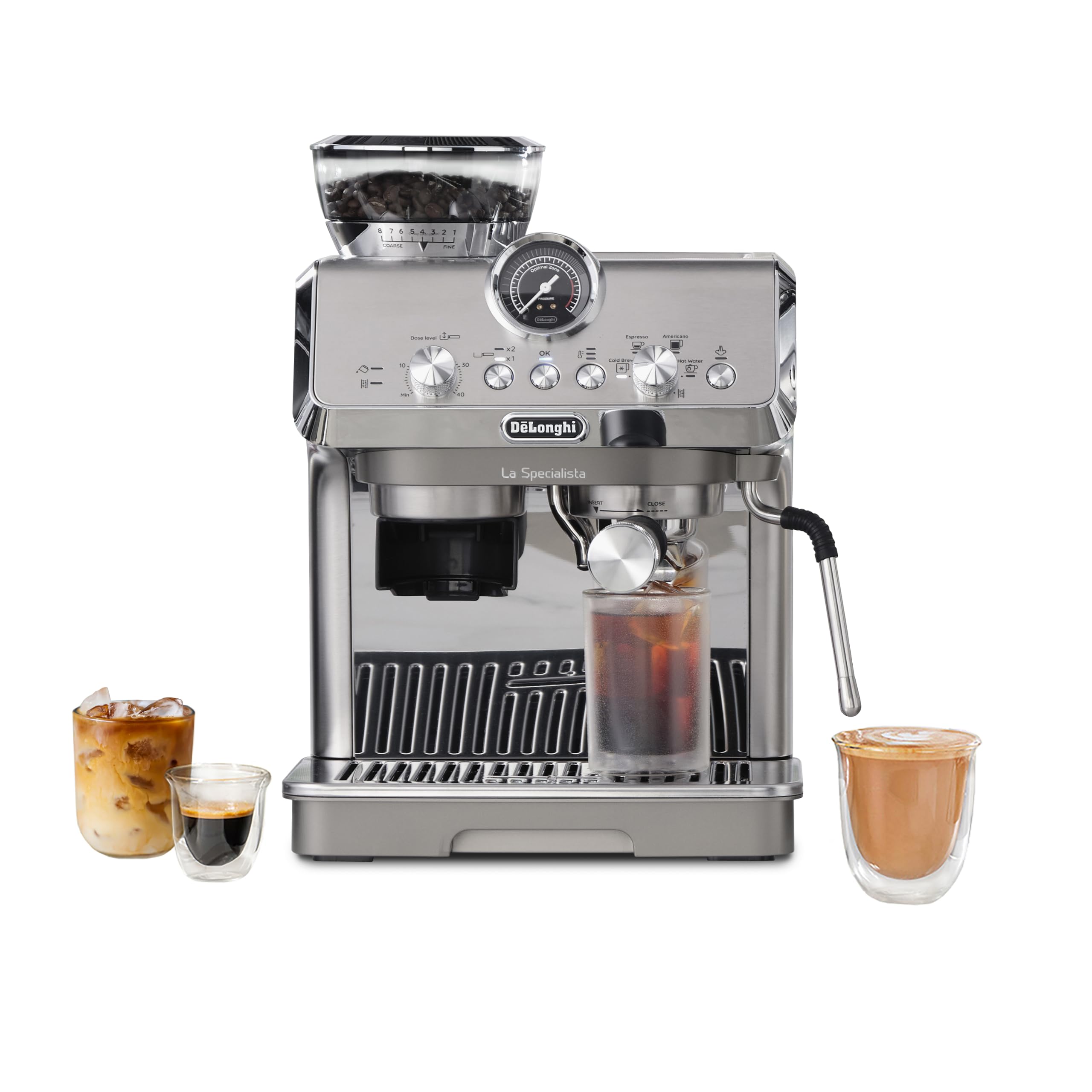
A built-in conical burr grinder with 8 settings doses fresh grounds straight into the portafilter.
A conical burr grinder sits inside this machine and doses freshly ground coffee for a single or double espresso, with 8 grind settings to move between bean varieties. A 15-bar Italian pump handles pressure through the whole brew, from low pressure during pre-infusion up to 9 bar during extraction. Active Temperature Control offers 3 infusion temperatures, since a light roast and a dark roast want different heat.
Four presets cover Espresso, Americano, Cold Brew and Hot Water, and the Cold Extraction Technology makes a cold brew in under five minutes. A commercial-style steam wand delivers the steam pressure for micro-foam and latte art. The barista kit adds a dosing and tamping guide plus a tamping mat, and the detachable parts are dishwasher safe.
There is a real counter cost here: 25.8 pounds and 18.31″W is a substantial appliance, so plan the space before it arrives. Performance draws strong reviews and coffee quality follows, though the grinder performance and value for money both come in mixed — this is a machine that rewards patience with grind and dose. Cleaning gets consistent praise, which matters on a machine with this many parts.
Where it stands out: a built-in burr grinder with 8 settings plus 3 infusion temperatures, so beans go in and espresso comes out.
The cost of that: 25.8 pounds of machine to place, and grinder and value feedback splits — expect to dial in.
Best match: someone who wants to grind fresh for every shot and will learn the dosing routine.
Look at the CASABREWS instead if: you already own a grinder and want a lower-commitment start.
8. Ninja Luxe Café Pro 4-in-1 Espresso Machine

A 4-in-1 that pulls espresso, drips a pot and makes cold brew from a single 68 oz reservoir.
A built-in conical burr grinder with 25 settings is the core of this 4-in-1, and it grinds to whatever drink you pick. Barista Assist Technology handles the steps: precision grinding, weight-based dosing, an integrated tamper that works at the pull of a lever, and real-time temperature and pressure adjustments for the selected drink. A 68 oz reservoir feeds all of it.
Hands-free frothing comes from the Dual Froth Pro system, which pairs a magnetic spinning whisk with an automatic steamer to build microfoam while you walk away. The XL milk jug makes enough for two drinks at once. The cold pressed espresso function brews at lower temperature, pressure and pace for a smoother iced drink, and rapid cold brew skips the long steep.
It ships loaded — portafilter, XL milk jug, single, double and Luxe baskets, cleaning brush, descaling powder and a hard water testing kit — and onboard accessory storage keeps it all together. At 27.1 pounds with a 68 oz tank, this is a counter fixture, not something you tuck in a cupboard. The appeal is the guidance: it is designed for beginners who want a dialed-in cup without studying pressure curves.
The pitch: espresso, drip, cold brew and hot water from one machine, with a 25-setting grinder and guided dosing doing the thinking.
What it asks: 27.1 pounds of permanent counter space, and a routine for cleaning the frother, baskets and discard after each session.
Worth the counter space if: your household drinks espresso some mornings and a pot on others.
Overkill if: you only ever pull shots and would rather put the footprint toward a dedicated espresso machine.
9. PHILIPS 5500 Series Espresso Machine
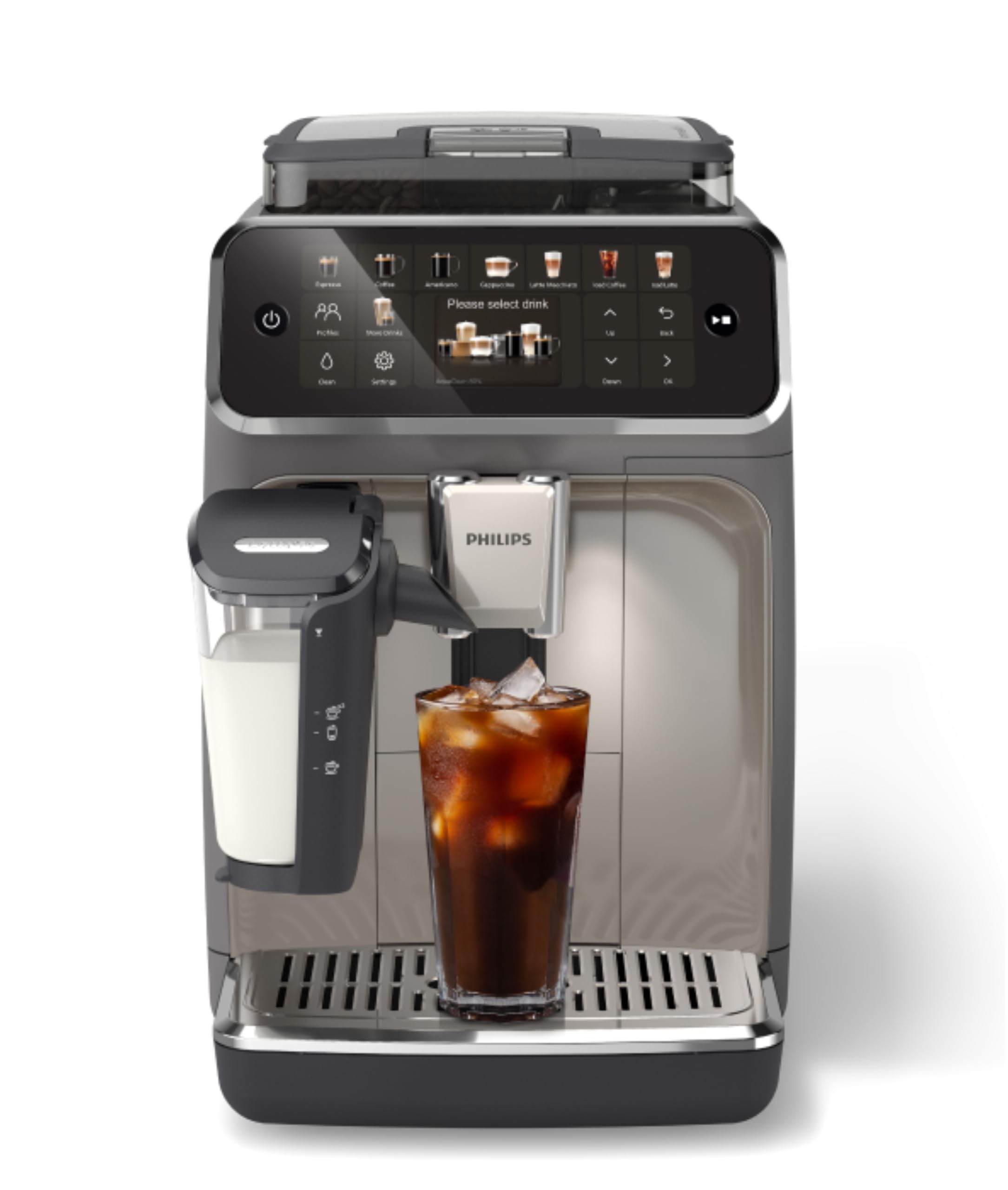
A fully automatic that grinds, tamps and brews at one push across 20 drink presets.
The 20 presets run from espresso and coffee to lattes, cappuccinos, iced coffee and plain hot water, and you set strength, volume and milk preference for each. Save up to 4 profiles and the machine returns to your favorites every time. A 1.8 liter water tank keeps the refill trips rare, and an intuitive color display carries the whole menu.
QuickStart has it ready to brew in 3 seconds, and SilentBrew uses sound shielding and quiet grinding to keep the machine from waking the house. LatteGo is the milk side of the story: 3 parts, no internal tubes or hidden compartments, dishwasher safe or rinsed clean in 10 seconds. The brand notes SilentBrew is certified by Quiet Mark and 40% quieter than earlier models.
What you get for the price is automation — this is a machine that grinds, tamps and brews with no separate steps for you to learn. The limitation is control: a semi-automatic like the De’Longhi lets you adjust tamping pressure and pre-infusion, while this one makes those calls for you. For someone who wants a cafe-style latte on a rushed morning, that is the point rather than a flaw.
The one-touch argument: 20 presets, 4 saved profiles and a 1.8 liter tank mean a latte without handling a portafilter.
What you give up: the hands-on dialing that a semi-automatic offers — the machine chooses pressure and tamp for you.
Right choice if: you want a café drink with one press and the fewest steps to clean up after.
Wrong choice if: you enjoy pulling shots by hand and adjusting grind and dose yourself.
Know the Specs
Reservoir Capacity (oz and liters)
Reservoir size tells you how many cups go by before a refill. A 75 oz tank on a pod brewer covers days; a 60 oz removable reservoir on a drip machine lifts off to carry to the sink. Liters show up on larger automatic machines, and the bigger the tank the less often you stop mid-brew to fill it.
Pressure (bar) on Espresso Machines
The bar rating measures how hard the pump pushes water through the coffee. A 20-bar pump or a 15-bar pump both describe the machine’s ceiling, not the pressure at the grounds every second. Drip brewers do not use a pump at all, so pressure numbers apply only to espresso models.
Carafe Material: Glass vs Thermal
A glass carafe sits on a warming plate that holds heat, with adjustable settings on some models. A thermal carafe traps heat with no plate, so the coffee is not cooked further as it waits. Glass lets you see the level; thermal keeps the last cup hotter.
Cup Size and Batch Settings
Pod brewers list cup sizes in ounces — 4, 6, 8, 10 and 12 oz on one model here. Drip machines list cups in a carafe count, where the brand may define a cup as roughly 5 oz. A small-batch setting on a drip machine keeps a 1 to 4 cup brew from tasting diluted.
Common Questions
Do K-Cup pods work in a drip coffee maker?
How long does coffee stay hot in a glass carafe on a warming plate?
What does 20-bar pressure actually mean on an espresso machine?
Can I use whole beans in a drip coffee maker?
Why does my coffee taste like plastic?
Do I need to descale a coffee maker, and how often?
What is the difference between a single-serve pod brewer and an espresso machine?
How tall a travel mug fits under a pod brewer?
Is a thermal carafe better than a warming plate?
Can a fully automatic machine make drip coffee too?
The Bottom Line
For most kitchens, the worlds coffee maker to buy first is the Keurig K-Elite, because a 75 oz reservoir, five cup sizes and a hot-water button cover a whole household’s morning without a second appliance. The crowd has already voted on it, and the reservoir alone tops every other pod machine here. If you grind your own beans and want a full pot, the Ninja Fresh Brew CE251 gives you a 12-cup carafe, a 60 oz removable tank and a small-batch setting that keeps a 4-cup brew from tasting thin. And when the morning needs to move at double speed, the BUNN GRB Velocity Brew holds 70 oz hot in its tank and fills a full carafe in 4 minutes.
How we choose
We do not accept paid placement. Every pick is matched to a real buyer and a real use-case; we do not hands-on test units.
Sources
Specifications: manufacturer listings and product documentation. Review insights: verified customer reviews, as of November 2026. Pricing: not shown on this page (it changes often); check the current price via the retailer link.
As an Amazon Associate, Tactical Gear Guy earns from qualifying purchases. This does not affect which products we feature.