Specs are compiled from manufacturer listings and verified buyer reviews and can change over time — please confirm the key details on the product page before buying.
Buying a wooden rolling pin sounds simple until you realize the wrong one fights you on every stroke. A pin that is too thin bows under pressure. One that is too short cannot cover a full pie crust in a single pass. This guide sorts the real differences between solid-wood pins so you can pick one that rolls flat, stays straight, and lasts through years of dough.
This guide is built by comparing the manufacturers’ published specifications and the patterns across verified customer reviews, so you get each pick’s real strengths and trade-offs instead of marketing spin.
A short, light pin forces extra passes, while a wider barrel and a longer reach let you roll a full crust in fewer strokes. Below you will see how length, diameter, and wood type change the way a pin handles dough, plus the honest weak points worth knowing before you buy. Below, nine solid-wood pins are ranked by barrel diameter, length, and wood type, from budget beech dowels to tapered French rollers.
Top Picks


How To Choose The Best Woodworking Rolling Pin
The most common buying mistake is choosing a wooden pin by its looks instead of its barrel diameter and length. A rolling pin works as a lever, so barrel diameter, barrel length, and wood density decide whether it rolls flat or flexes and sticks. Match those three specs to your usual dough and the pin will roll flat without wobbling or sticking.
Diameter and barrel type: dowel versus handled
A dowel pin (also called a French or tapered pin) has no handles — you grip the barrel itself. That gives you direct feel for how thick your dough is. A handled pin spins on bearings, so the barrel turns while your hands stay fixed. Dowels give more control on delicate pastry; handled pins suit people who want less wrist work on big batches.
Barrel diameter is the spec most shoppers overlook, and it decides how much the pin flexes under a hard press. A fatter barrel spreads your pressure across more dough, so the pin flexes less and rolls flatter. Thin barrels bow in the middle under a hard press, which leaves a thicker patch right where you pushed hardest.
Length decides how many passes you make
A longer barrel covers more dough per stroke. If you regularly roll pizza or large pie crusts, a longer pin saves you from repositioning halfway through. Shorter pins suit small batches and tighter counter space.
Wood type and finish
Beech, acacia, and maple are the common solid woods here. Each is dense enough to resist cracking when cared for. What matters is that the wood is unfinished inside — no wax, no lacquer, no paint — so it is safe against dough and easy to oil. A quick wipe with a damp cloth and a thin coat of food-safe oil keeps the grain sealed.
Side-by-Side Comparison
| Model | Best For | Barrel Length | Diameter | Material | Amazon |
|---|---|---|---|---|---|
| Etens Professional Dowel 17.3″★ Best Overall | All-purpose daily rolling | 17.73 in | 1.73 in | Beech Wood | Amazon |
| Folksy Super Kitchen with Thickness RingsEven-Thickness Pick | Beginners chasing even thickness | 17.7 in | — | Wood | Amazon |
| Eppicotispai Beechwood 19-1/4″Long Barrel Pick | Long Italian-style rolls | 18-1/2 in barrel | 1-5/8 in | Beech Wood | Amazon |
| Farberware Acacia Wood | Handled, bearing-smooth rolling | 17.72 in | — | Acacia Wood | Amazon |
| Ironwood Gourmet Acacia French 20″ | Tapered French-style control | 20 in | 1.5 in at widest | Acacia Wood | Amazon |
| Vinoil Classic Set with Mat | Complete starter kit | 17 in | — | Beech Wood | Amazon |
| Fletchers’ Mill Maple 18.5″ | Heirloom maple build | 18.5 in | — | Maple | Amazon |
| Winco Commercial 18″ | Heavy-duty slab work | 18 in | — | Wood | Amazon |
| XBLDMJY Long Rolling Pin 23.23″ | Wide dough in one pass | 23.23 in | 1.38 in | Beech Wood | Amazon |
Detailed Reviews
1. Rolling Pin 17.3Inch
Our pick — 4.5+★ from 800+ verified ratings; the strongest balance of quality and price.
The chunky dowel that presses flat where thin pins bow in the middle.
Most dowel pins run around 1.5 inches across. This one measures 1.73 inches across the barrel; the Ironwood French pin below measures 1.5 inches at its widest point. A wider barrel spreads your downward push across more dough, so the pin flexes less and the sheet comes out even instead of thick in the center.
A 17.73-inch length from end to end and a 17.3-inch spec mean you can fold rolled dough back over the pin — a classic move for lifting a pastry round cleanly onto a tin. That lighter feel helps when you are rolling for a long stretch. It is hand-finished from solid European beech wood with no paint, so it sits against dough cleanly.
What wins people over is the build quality — solid, straight, and easy to steer. It handles pizza, pasta, pie crusts, cookies, tortillas, dumplings, and fondant without complaint. The one honest catch: plenty of cooks note the wood surface feels a little soft. If you scrub it hard against a sharp bench scraper or press a knife into it, it can pick up marks. Treat it like a wooden cutting board — gentle wash, dry promptly, oil now and then — and it holds up fine.
Where This Pin Shines
- 1.73-inch barrel — wider than a typical 1.5-inch dowel, so it flexes less under a hard press
- 17.73-inch length lets you flip rolled dough over the pin to transfer it
- Solid hand-finished beech wood with no paint, so it is safe against dough
- Versatile across pizza, pasta, pie, cookies, and fondant
Worth Knowing First
- The wood feels soft to some — sharp tools can dent the surface
- No handles, so it takes a little practice to grip
Reach for this one: if you want the highest-rated all-rounder that rolls pizza, pastry, and cookies on the same pin.
Keep looking if: you plan to work the pin hard against metal scrapers and want a denser, harder wood.
2. Wood Rolling Pin with Thickness Rings
Five snap-on rings that end the guesswork of how thick your dough should be.
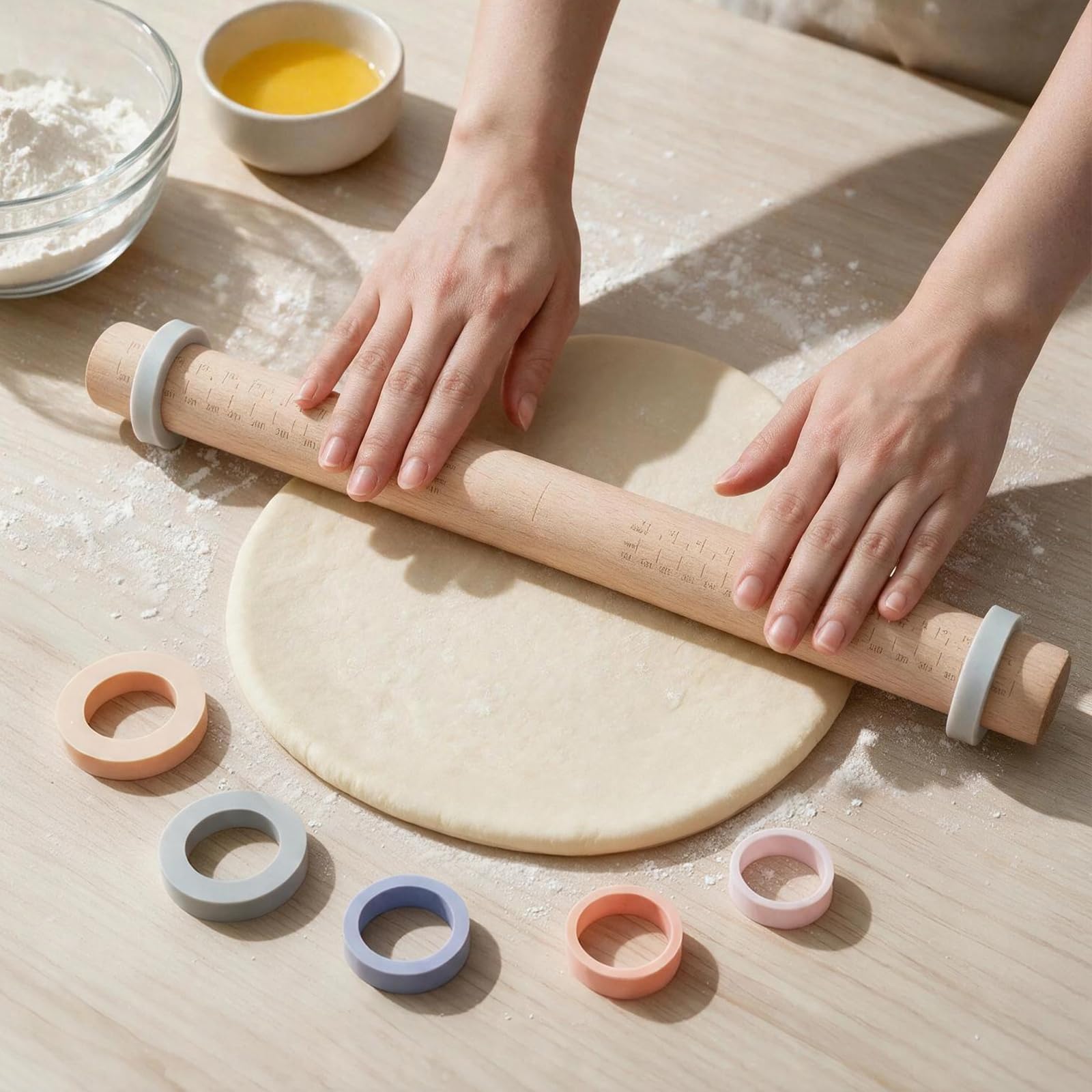
If you have ever rolled a pie crust too thin at the edges and thick in the center, this pin is built for you. It comes with 5 removable silicone rings in 2mm, 3mm, 5mm, 8mm, and 10mm. Click on the pair that matches your recipe and the pin holds the dough at that height. The rings snap on and off easily, and printed measurement marks on the barrel help you track the size of your sheet.
At 17.7 inches long, the maker says it rolls a 16-inch pizza crust in one pass with no repositioning. It is a one-piece handle-free barrel, so pressure goes evenly from edge to edge. Closed ends keep flour and moisture from getting trapped inside. The beech wood is finished with no paint or chemical coatings, which keeps it clean against direct food contact.
The adjustability and ease of use drive a lot of the enthusiasm, and the non-stick surface means a quick rinse with soapy water or a wipe-down is all it takes. The one real weakness is the printed marks — those can wear or smudge over time, so treat the silicone rings as your main guide and the marks as a backup. And never soak it or run it through a dishwasher; wood swells and warps when water sits in it.
The ring system: 5 thickness settings from 2mm to 10mm turn a judgment call into a repeatable result, which is why beginners take to it fast.
Care that matters: wipe with a damp cloth before first use and apply a thin coat of cooking oil 2–3 times until it absorbs, then re-oil about once a month.
Best match for: new bakers who want identical thickness batch after batch without eyeballing it.
Think twice if: you prefer a pure bare dowel with nothing to snap on or lose.
3. Beechwood Rolling Pin 19-1/4″ x 1-5/8″ Diameter
A one-piece beech pin with a long working barrel for big sheets of dough.
This pin is cut from a single solid piece of natural beechwood, made in Italy. No glued joints, no handle inserts — just one continuous block of wood. That single-piece build is why it stays straight when you lean into a stiff dough. The working barrel runs 18-1/2 inches, and the pin measures 22-3/4 inches from tip to tip overall. It weighs 1.2 pounds, and at 23.6 inches in its listed dimensions it is a notably long tool compared with the 17-inch Vinoil set.
The 1-5/8-inch diameter sits right in the comfortable middle — thick enough to resist flex, thin enough to steer with your fingertips. If your counter is deep and you often roll large rounds of pastry or big sheets for a tray bake, the extra barrel length means fewer passes and less lifting.
It is a simple, honest tool with no rings, no stand, and no mat — you are paying for the wood and the length. There are no rings, mat, or stand in the box — just the beech barrel. If you want a plain, solid, long piece of beech you can oil and keep for years, it earns its place.
Choose it for: a no-frills, single-piece pin with a long barrel for sizeable dough sheets.
Pass if: you want thickness guides or a storage kit bundled in.
4. Farberware Acacia Wood Dough Rolling Pin – Brown, BPA-Free
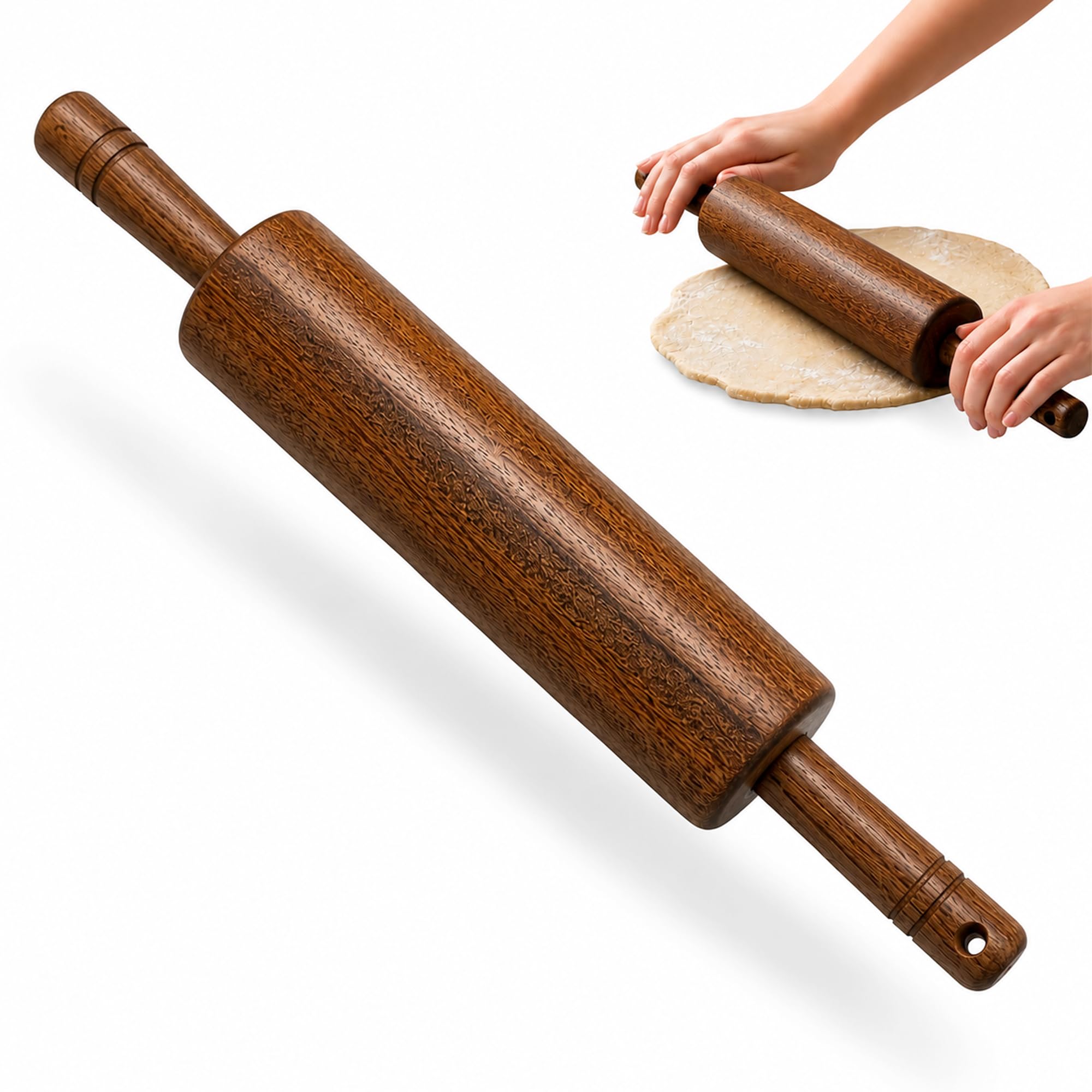
The handled acacia pin whose bearings do the turning so your wrists do not.
This is the best-loved pin on this list by a wide margin — 4.5+ stars across 22,000+ owners. The reason is the feel. It has handles on a free-spinning barrel with rustproof bearings, so the pin rolls while your hands stay put. That cuts down on friction and wrist strain when you are pressing out pastry, pizza dough, cookies, or pie shells. The comfortable grip gives you solid control and stability.
It is made from sturdy acacia wood, at 17.72 inches long and 2.5 inches wide, with a natural grain that varies pin to pin. The materials are BPA-free, which matters for a tool that touches food daily. What people praise most is simply the overall quality — solid, smooth-rolling, and easy to clean.
The honest catch lives in the handles. The durability of the joint is a split verdict — some owners find it sturdy, while others see the handles loosen and come apart during use. It is worth treating the handle joints with care and not cranking down hard on them. For everyday rolling and occasional big batches, that is a small price for the smooth bearing action. Acacia is a harder, denser wood than beech, so the barrel itself takes knocks well.
What Earns The Buzz
- Rustproof bearings give a smooth, low-friction spin so your wrists do less work
- Acacia wood is dense and hard-wearing for daily baking
- BPA-free construction, safe against dough
- Comfortable handles keep control and stability
The Fair Warning
- Handles can loosen over time — the joint is the weak spot
- Natural grain and color vary, so no two pins look the same
Point this at: anyone who rolls often and wants handle-driven spinning instead of gripping a bare barrel.
Look away if: you want a single solid piece of wood with no handle joints to worry about.
5. Ironwood Gourmet 28981 French Rolling Pin

The tapered French pin that lets your fingertips read the dough as you press.
A tapered, handle-free French pin like this one gives you direct feedback on how thick your dough is. Your hands press outward from the middle, which makes rolling delicate pastry easier. You use fewer strokes, put in less elbow grease, and stop tearing the sheets. The design measures 1.5 inches in diameter at its widest point, so it is slimmer than the Etens 1.73-inch dowel — a little more nimble in the hand, less brute force.
The 20-inch length makes short work of pie and pastry dough, cookies, cakes, tarts, quiche, pizza, and fondant. Bakers who have used both handled and French pins often prefer the French style for this tactile control. The acacia wood is harvested from family-owned small farms, and it weighs 13.7 ounces. It looks the part on the counter, too.
The quality and smoothness are where it earns its keep, and the feel in the hand is genuinely nice. The honest trade-off is consistency: the functionality gets mixed marks, with some saying it works great while others hit issues. Tapered pins also ask for a slightly different grip than a straight dowel, so give yourself a few rolls to adjust. Care is easy — wipe with soap and water and towel dry promptly, then apply butcher block oil now and then to keep the wood sound.
Why pros like the taper: pressing outward lets you feel the dough’s thickness instead of guessing through handles, which helps on thin pastry.
One adjustment: the tapered shape and 1.5-inch diameter feel different from a fat straight dowel — expect a short learning curve.
Right for: hands-on cooks who want fingertip control on delicate pastry and a pin that looks good doing it.
Not for: anyone who wants the maximum-press brute force of a fat straight barrel.
6. Classic Wood Rolling Pin 17″

Everything a first-time baker needs in one box: pin, mat, rings, and a stand.
This set does not just give you a pin. It bundles the whole station. You get the 17-inch beech pin, two removable silicone thickness rings (4mm and 2mm) on each end, a 23.6″ x 15.7″ silicone pastry mat, and a wooden stand that doubles as a phone holder. For a beginner setting up a kitchen from scratch, that save trips and guesswork.
The pin itself is solid beech wood, hand-polished 3 times for a smooth rolling surface. It carries no wax, no paint, no burrs, and no cracking, which keeps it clean against dough. The non-stick surface means a quick rinse or a damp-cloth wipe is the whole cleanup. The included stand keeps the pin off the counter and stops it rolling away mid-batch.
The silicone mat is a genuine highlight — it earns consistent good words and makes dough handling tidier. The rings let you dial in thickness without eyeballing. Two honest notes: the durability of the set draws mixed views, so store it away from sharp edges, and the size also gets a split verdict, meaning check the 17-inch length if you mainly roll huge pizza rounds. For everyday pie crusts, cookie dough, pasta, and bread, the length is plenty.
Best starting point for: newer bakers who want a full kit — pin, rings, mat, and stand — instead of buying pieces one at a time.
Skip if: you already own a mat and just want the pin by itself.
7. Fletchers’ Mill Bakery Rolling Pin, Maple – 18.5 Inch

Handcrafted Maine maple built like a tool you hand down, not replace.
Rock maple is a dense, hard hardwood, and Fletchers’ Mill crafts this pin from a solid piece of it. The result is a barrel that feels solid and rolls with little effort — the maker says it is built to last. At 18.5 inches long and weighing 16 ounces, it is sized for both the home baker and the professional chef. The smooth surface is a common point of praise, and the weight sits in the hand nicely.
It is wide enough for large pies and rolls out big sheets of dough, which makes it a natural choice for batch baking. This pin is handcrafted in Maine from New England hardwoods. Compared with the Etens dowel, it trades a slightly shorter barrel for a denser, harder wood that takes everyday use without denting.
Care rules are strict and worth respecting: wipe with a damp cloth only. Do not put it in a dishwasher and do not submerge it. Water sitting in maple swells and cracks the grain. Follow that and the build rewards you — people describe it as heirloom-quality, the kind of pin that stays in the family. It behaves as a simple, honest tool, so if you want rings and mats, look elsewhere.
What it brings: solid rock maple at 18.5 inches and 16 ounces, handcrafted in Maine for a dense, smooth surface.
Non-negotiable care: damp cloth only, towel dry promptly, never submerge or dishwash.
Pick it if: you want a hard-maple pin with a craftsman feel that you plan to keep for the long haul.
Choose otherwise if: you want a dishwasher-tolerant or lightly-oiled-and-forget tool.
8. Winco 18″ Wood Commercial Rolling Pin
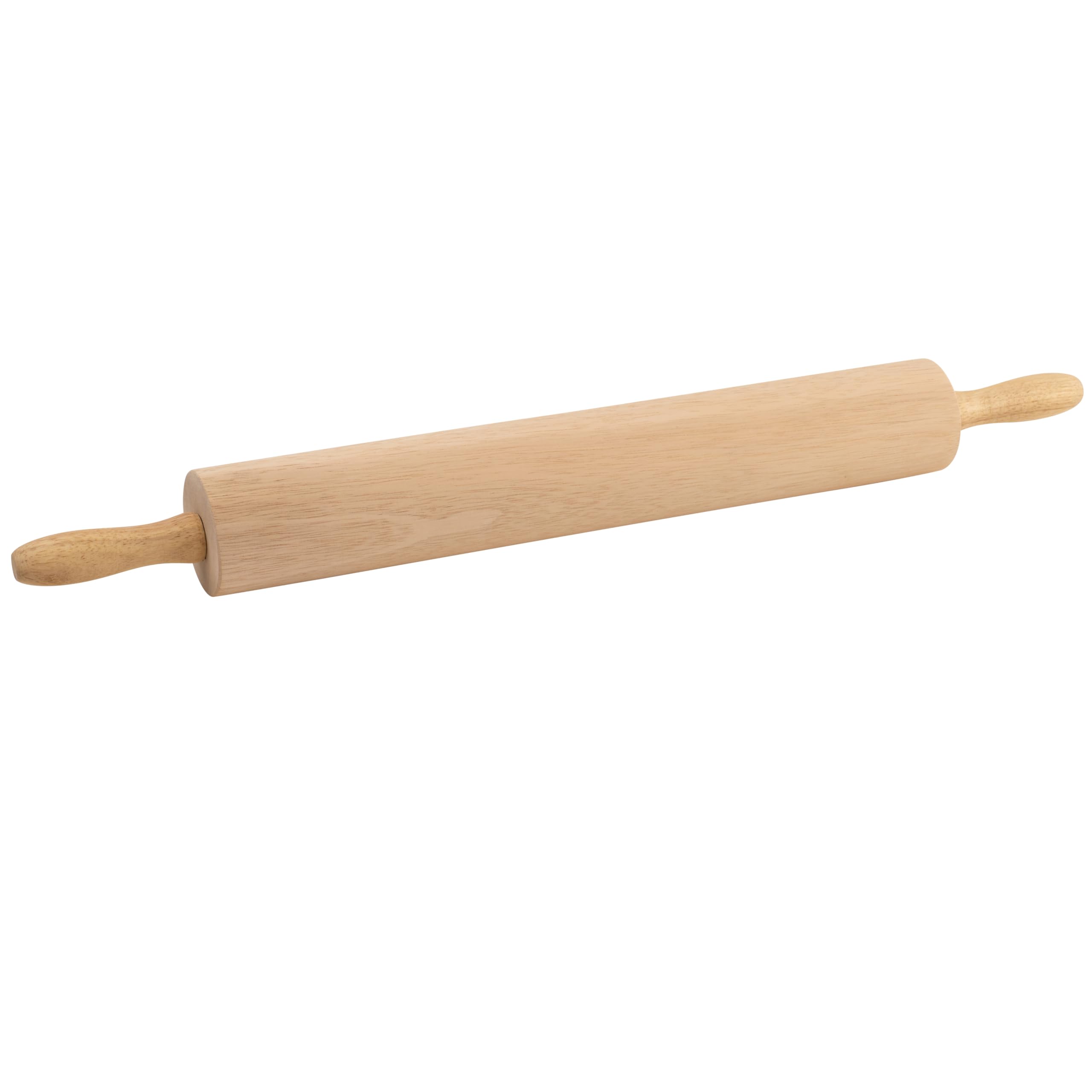
A commercial-grade 18-inch roller that brings real weight to slab work.
This is the pin for someone who wants mass behind the roll. The Winco is a commercial-style wooden pin with an 18-inch roller and a durable wood body. Its heavy weight is a plus for the people who want it — the momentum carries through dense dough, and the size covers large pie crusts and cookie dough without constant repositioning. Slab building, the maker notes, goes fast and easy with this length.
What the weight buys you is fewer passes and steadier pressure. What it costs you is agility — this is not a dainty pin for fine pastry edges. It is at its best on cookie sheets, pizza bases, and big batches where you want a firm, even press. The 18-inch length is a sweet size for a kitchen that rolls often.
The honest note here is durability. Many buyers expect a commercial pin to last a lifetime, and the reviews are split on how it holds up. Treat it as a sturdy workhorse rather than an heirloom, oil it regularly, and it does the heavy jobs well. If you are after beautiful craftsmanship to display, the maple pin above fits better. If you want muscle for big slabs, this delivers.
Muscle Where It Counts
- Heavy weight drives through dense dough with fewer strokes
- 18-inch roller handles large crusts and cookie sheets
- Smooth operation for slab building and batch work
Trade-Offs To Weigh
- Durability views are split — expect a workhorse, not an heirloom
- The heft makes fine, delicate work less nimble
Built for: high-volume cookie, pizza, and slab work where a heavy roller saves effort.
Reconsider if: you mostly roll thin, delicate pastry and want a light, nimble pin.
9. long rolling pin, 23.23×1.38inch / 59×3.5cm

The longest pin here — 23.23 inches of solid beech for wide, even sheets.
If wide dough is your routine, length is the spec that matters, and this one leads the pack at 23.23 inches. That is far more barrel than the 17-inch Vinoil set, so a single pass covers a big sheet. It is cut from natural European beech wood without splicing — one solid piece, not joined sections. The workmanship is clean, with no wax and no lacquer, so the wood is bare and food-safe.
The diameter is 1.38 inches, making it the slimmest barrel here. It is a handle-free dowel, hard and smooth, with a non-stick surface that is easy to grasp and steer. That slimmer profile keeps it nimble in the hand, even with the extra length. It rolls donuts, bread, corn tortillas, fudge, pie crusts, biscuits, noodles, and pastries. The maker also sells it in other lengths in case this one is more reach than you need.
Two things to weigh. It also weighs 14.08 ounces, which is the lightest feel of the long pins. What owners praise most is the overall quality, and the size lands well for people rolling regular batches. For big sheets on a budget-minded long dowel, it earns its spot.
Grab it for: the longest reach on this list when you want wide sheets and a bare, handle-free dowel.
Step back if: you need a thick barrel to lean hard on stiff, heavy dough.
Know the Specs
Barrel Diameter: The Flex Factor
Diameter is the measurement across the round part of the pin, and it controls how the pin behaves when you press down. A wider barrel spreads your push across more dough, so the pin bows less and the sheet stays even. A thinner barrel flexes more under a hard press, which can leave a thick patch where you pushed hardest. If you routinely roll stiff dough, favor a thicker barrel. If you want fingertip control on delicate pastry, a slimmer tapered pin suits you better.
Barrel Length: Passes Per Sheet
Length decides how much dough you cover in one stroke. A longer barrel means fewer passes and less repositioning on big sheets, which matters for pizza and large pie crusts. A shorter barrel is easier to store and steer on small batches. Measure your usual batch size, then match the length — a 17-inch pin is plenty for everyday cookies and pie, while a 20-inch or longer pin pays off on wide rounds and slabs.
Dowel Versus Handled Pins
A dowel pin has no handles — you grip the barrel directly, so you feel the dough’s thickness through your hands. A handled pin spins on bearings, so the barrel turns while your hands stay fixed, which can mean less wrist work. Dowels suit people who want direct control; handled pins suit people who want the pin to do the turning.
Wood Type and Oil Care
Beech, acacia, and maple are the solid woods you will see here. Each resists cracking when cared for and stays clean against dough. The key is an unfinished interior — no wax, no lacquer, no paint. Wipe with a damp cloth, dry promptly, and apply a thin coat of food-safe or butcher block oil now and then. Never soak a wooden pin or send it through a dishwasher; water swells the wood and cracks the grain.
Common Questions
Is a dowel rolling pin or a handled rolling pin better for pastry?
How thick should a rolling pin be?
Can I put a wooden rolling pin in the dishwasher?
How do I stop dough from sticking to a wooden rolling pin?
Do thickness rings actually help with even dough?
How long should a wooden rolling pin last?
What is the best way to clean and oil a wood rolling pin?
Does a longer rolling pin make rolling easier?
Which wood is best for a rolling pin?
Can a handle-free rolling pin work for pizza dough?
The Bottom Line
The woodworking rolling pin that makes the most sense for most kitchens is the Etens 17.3-Inch Dowel. Its 1.73-inch barrel is the widest here, so it presses flat where thin pins bow, and its solid beech build handles pizza, pastry, and cookies on the same tool. If even thickness batch after batch is your goal, the Folksy Super Kitchen with 5 snap-on rings takes the guesswork out. Want fingertip control on delicate pastry? Reach for the tapered Ironwood Gourmet French pin. Each pin here wins on one spec — the widest barrel, the longest reach, the only ring set — so pick the one that matches the dough you roll most.
How we choose
We do not accept paid placement. Every pick is matched to a real buyer and a real use-case; we do not hands-on test units.
Sources
Specifications: manufacturer listings and product documentation. Review insights: verified customer reviews, as of November 2026. Pricing: not shown on this page (it changes often); check the current price via the retailer link.
As an Amazon Associate, Tactical Gear Guy earns from qualifying purchases. This does not affect which products we feature.