Specs are compiled from manufacturer listings and verified buyer reviews and can change over time — please confirm the key details on the product page before buying.
If you heat with wood, the real question is not which splitter is fastest — it is which one matches the logs you actually haul. A 20-ton machine handles most firewood rounds, but knotty oak and big-diameter rounds need 25 tons or more, and a towable unit only pays off if you have ground to tow it across. This guide separates the light, wheel-it-yourself splitters from the full-size tow-behind machines, so you can pick by log size, yard layout, and how much lifting your back will tolerate.
This guide is built by comparing the manufacturers’ published specifications and the patterns across verified customer reviews, so you get each pick’s real strengths and trade-offs instead of marketing spin.
Every pick below runs on its own gas engine, so you can split at the woodpile with no cord or outlet. Three numbers decide how a day of splitting actually goes: tonnage (how much force the wedge pushes with), cycle time (how long the ram takes to go out and back), and log capacity (the biggest round the machine accepts). The picks below rank on exactly those numbers, so you can match a gas wood splitter to the wood you cut.
Top Picks


How To Choose The Best Gas Wood Splitter
The biggest mistake first-time buyers make is shopping by tonnage alone. A 20-ton splitter with a fast cycle and a wide log opening will outwork a slow 28-ton machine on a normal firewood pile. Match tonnage and log capacity to your rounds first, then pick wheeled or towable to suit your ground, then weigh how much lifting your back will take.
Start with the logs you actually cut
Measure the widest rounds on your woodpile before you buy anything. Splitting force in tons tells you how stubborn a log the wedge can push through, while maximum log diameter and length tell you what physically fits on the beam. A machine rated for 16-inch diameter logs will not accept the 24-inch rounds off a big oak trunk, no matter how many tons it claims.
Cycle time is your real throughput number
Cycle time is the full round trip: the wedge pushes through the log and the ram retracts for the next one. A 7-second cycle means far more logs per hour than a 14-second cycle, and the difference adds up fast across a cord. An auto-return valve, which retracts the ram by itself after each split, keeps that rhythm going without extra handle work.
Decide how you will move it
Light splitters with transport wheels roll around a yard by hand and fit in a shed. Towable full-beam machines hook to an ATV or hitch and cover ground fast, but they are heavy and need space. If your woodpile stays put, a 130–150 lb wheeled splitter rolls into a shed; if you tow to the log lot, budget for a 500 lb-plus full-beam machine and a hitch vehicle.
Side-by-Side Comparison
| Model | Best For | Splitting Force | Cycle Time | Max Log Length | Amazon |
|---|---|---|---|---|---|
| Landworks Portable 20-Ton★ Best Overall | Rolling around a home yard | 20 tons | 7.5 seconds | 20 inches | Amazon |
| Ezasin 20 Ton 209CCBest Value | Farm and household volume | 20 tons | 8 seconds | 20.5 inches | Amazon |
| SuperHandy 20 Ton BucherCrowd Favorite | Proven portability on a budget | 20 tons | 7.5 seconds | 20 inches | Amazon |
| BILT HARD 22 Ton | Towable mid-size work | 22 tons | 7 seconds | 21 inches | Amazon |
| SuperHandy 25 Ton | Fat rounds up to 24 inches | 25 tons | 12 seconds | 20 inches | Amazon |
| Full Boar 28 Ton | Steady farm-volume splitting | 28 tons | 10.9 seconds | — | Amazon |
| Full Boar 33 Ton | Stubborn hardwood rounds | 33 tons | 14.3 seconds | — | Amazon |
| Full Boar 38 Ton | Heavy full-beam durability | 38 tons | 13.8 seconds | — | Amazon |
| BILT HARD 30 Ton | Road-towing to the wood lot | 30 tons | 11 seconds | 24 inches | Amazon |
Detailed Reviews
1. Landworks 20-Ton Gas Log Splitter
Our pick — 4.0+★ from 350+ verified ratings; the strongest balance of quality and price.
A 7.5-second ram cycle that turns a weekend woodpile into an afternoon job.
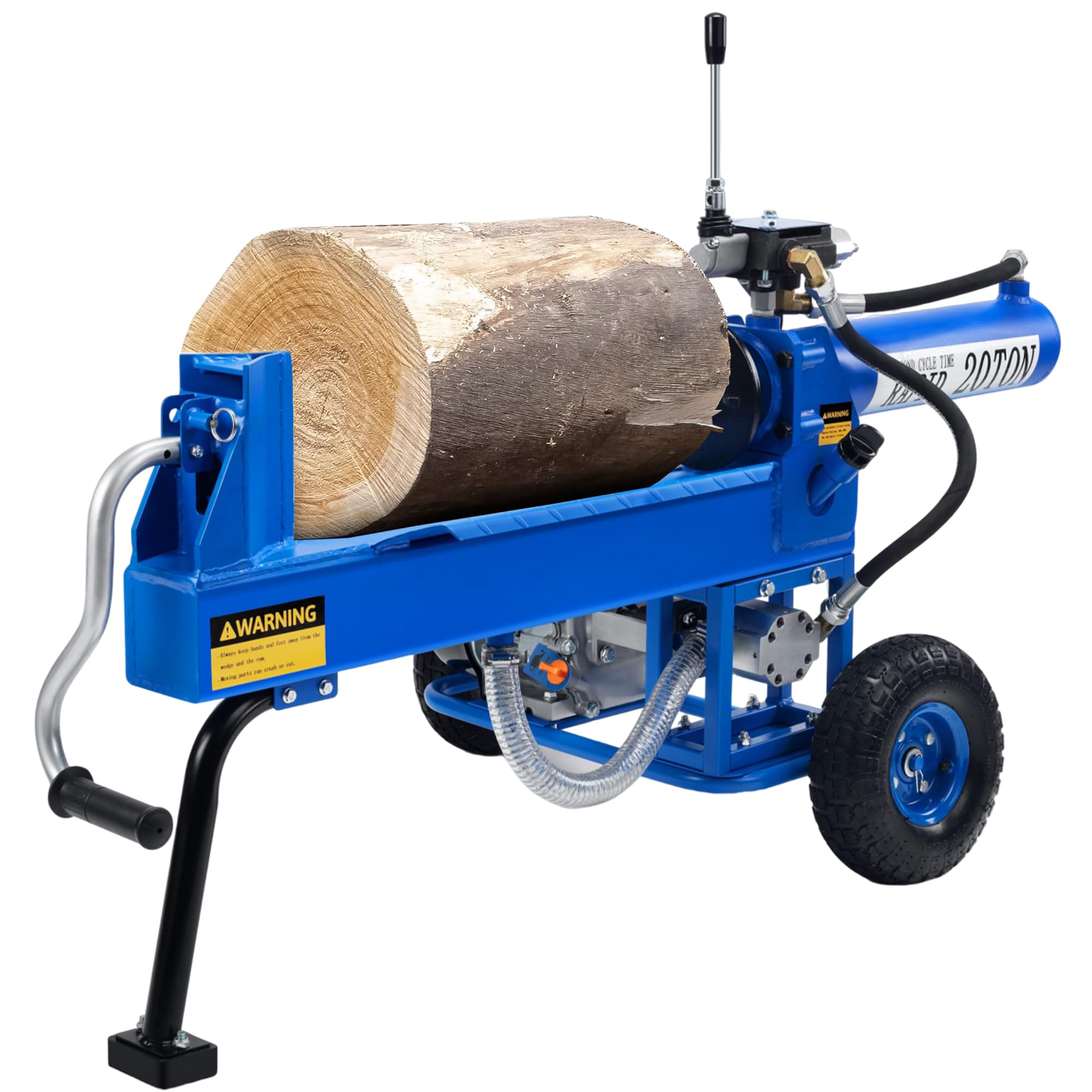
Here is the number that decides your day: 7.5 seconds. That is how long the ram takes to push the wedge through a log and reset for the next one, so you feed rounds in a steady rhythm instead of standing around watching hydraulics move. Underneath sits a 7 HP gas engine driving a 2-stage Bucher hydraulic gear pump (a two-speed pump that moves fluid fast at first, then shifts to high pressure for the tough part). The rated force is 20 tons, and it swallows logs up to 20 inches long and 16 inches across.
Where this machine earns its keep is the setup around the split itself. The horizontal full-beam frame and steel wedge ride on 10-inch transport wheels, so you can roll it from the woodpile to the shed by hand without a trailer. It weighs in at 148.7 pounds as shipped, heavy enough to stay planted while you work but light enough to reposition solo. Buyers report it works better than other models they have tried, including one who put more than 300 logs through it with no issues. Assembly is described as a roughly 20-minute job for anyone comfortable with tools. One honest catch: hydraulic fluid is not included, and AW32 is the recommended fill, so budget for that before your first start.
Where it pulls ahead
- 7.5-second cycle keeps you splitting without waiting on the ram
- 20-ton force clears most firewood rounds up to 16 inches in diameter
- 10-inch wheels roll it around a yard with no trailer needed
- Setup is quick — roughly 20 minutes for a mechanically handy owner
Weigh before you buy
- Hydraulic fluid sold separately, so plan the AW32 fill
- Horizontal only — big rounds still need to be manhandled onto the beam
- At 148.7 pounds it is a two-hand roll, not a one-arm carry
balance: You keep your splitting in one spot and your rounds measure under 16 inches across, and you want fast cycles without a trailer.
Look elsewhere if: You are regularly wrestling 24-inch trunk sections — the SuperHandy 25 Ton takes a wider log.
2. Gas Log Splitter 20 Ton 209CC
The entry ticket to gas splitting that still claims 450 logs an hour.
An 8-second cycle with an auto-return detent valve is the whole pitch here. The detent holds the handle until the split finishes, then the ram slides back on its own — you load a log, pull, load the next one. The maker rates it at up to 450 logs per hour, and a 209CC 7HP engine feeding a 20-ton hydraulic ram handles logs up to 20.5 inches long and 16 inches wide. That capacity covers most household and farm woodpiles without reaching for a bigger machine.
What owners keep coming back to is simple reliability. Functionality is the thing buyers talk about most, followed by overall quality and how cleanly it splits wood, and the consensus is that it just works — including one note that it suits home use particularly well. The dual-stage aluminum gear pump shifts between a fast approach and a high-pressure mode for the tough stuff, which is how it manages both speed and grunt from one engine.
The catch is front-loaded: nothing is filled at the factory. You need 1.6 gallons of AW32 or AW46 hydraulic oil, 0.145 gallons of SAE 15W-40 engine oil, and 0.74 gallons of 87-octane-or-higher gasoline before the first pull. Get those three in hand and setup is straightforward. It rolls on 10-inch pneumatic tires over a lightweight steel frame at 135 pounds, and the 90-degree alloy steel wedge with multi-point welding is built to split oversized and knotty hardwoods cleanly.
The real draw: A fast 8-second cycle and auto-return at the entry end of the gas market, with a wedge built for knotty wood.
Before you start it: Three fluids to buy and measure first — hydraulic oil, engine oil, and gas — so read the manual before the delivery day.
Reach for this if: You want gas power and speed on a modest budget and do not mind a short fluid-fill ritual.
skip it if: Your rounds run past 16 inches wide — they will not fit the beam.
3. SuperHandy Log Splitter 20 Ton
Starts on the first pull and splits 24-inch locust without a pause.
This one earns its spot on owner feedback: it sits at 4.0+ stars across 500+ owners, the deepest review base here. It runs the same core machine as the Landworks pick — 7 HP engine, 20 tons of force, a 7.5-second cycle, and limits of 20 inches in length and 16 inches in diameter — but buyers have made it the crowd favorite. The hardware is a 2-stage Bucher hydraulic gear pump (a two-stage oil pump that moves fluid fast, then pushes hard) behind a 7HP engine. Rapid Auto Return resets the ram between splits, so you are never waiting on the hydraulics. It weighs 149.7 pounds and rolls on 10-inch transport wheels.
The reputation here is about starting and splitting. Owners describe the engine firing on the first pull every time, and the machine out-splitting expectations on real wood — one buyer puts “it splits 24-inch diameter locust and oak without pause” in the review pages. That said, the rated log capacity is still 16 inches in diameter, so the big-round bragging is a matter of what gets balanced on the beam rather than what the spec sheet promises.
You set up fast wherever the wood sits, thanks to a lightweight horizontal full-beam frame and steel wedge on 10-inch wheels, with no outlet or power cord in sight. That freedom from an electrical source is the whole reason to pick gas. One thing to sort before delivery: hydraulic fluid is not included, and AW32 (a common grade of hydraulic oil) is the recommended fill. Buy the fluid up front and this machine is ready to work.
What buyers keep saying
- The engine starts on the first pull consistently
- 7.5-second cycle and 20 tons of force suit normal firewood rounds
- 10-inch wheels make yard repositioning a one-person job
- Gas power means no cord and no outlet at the woodpile
Plan around this
- Hydraulic fluid sold separately — AW32 is the recommended fill
- 16-inch diameter limit caps the fattest rounds you can load
- Horizontal-only beam means lifting big logs onto it by hand
The verdict: The safest gas splitter bet for a normal backyard woodpile, backed by a deep base of happy owners.
One caveat: If your property is a log lot you tow to, a wheeled full-beam sits behind the towable BILT HARD 30 Ton.
4. BILT HARD 22 Ton Gas Log Splitter
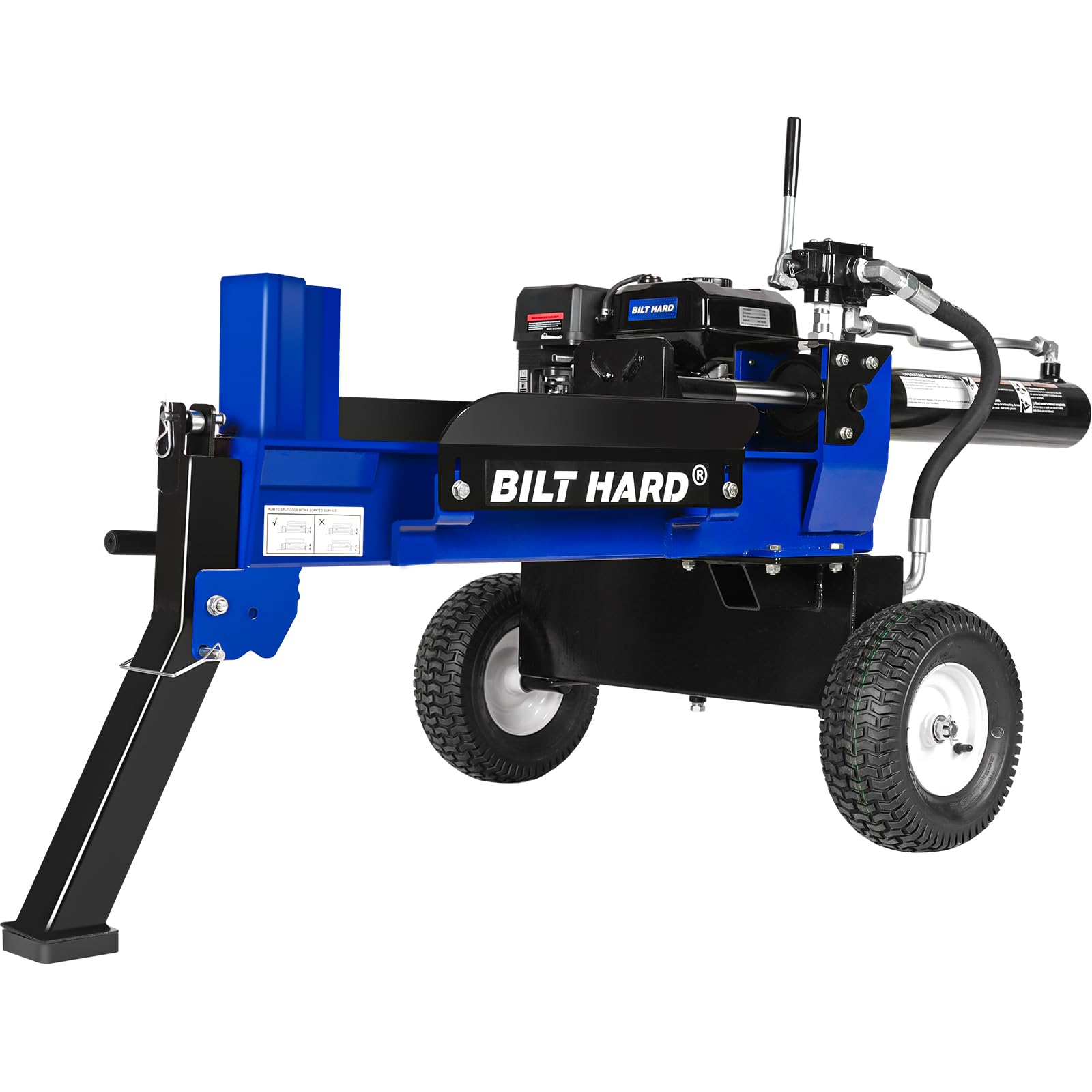
22 tons, a 7-second cycle, and 13-inch wheels that tow at 25 MPH.
The cycle time is the headline: 7 seconds per split, the fastest on this list and quicker than the SuperHandy 25 Ton’s 12 seconds. A 14 GPM 2-stage gear pump feeds a 3.5 inch by 19 inch hydraulic cylinder running at a maximum operating pressure of 25.5 MPa, and the 209cc gas engine holds that pace through a demanding session. Splitting force lands at 22 tons, and it takes logs up to 21 inches long — a touch more length than the Landworks pick’s 20 inches.
This is a machine built to move. Durable 13-inch wheels and towing at speeds up to 25 MPH let you drag it around the property instead of carrying it, and the rugged steel frame sits stable in horizontal operation. Where it differs sharply from lighter picks is weight: 344 pounds against the Ezasin’s 135 pounds, so this is a tow-or-team-lift machine, not something you roll into a shed corner.
Owners describe a tool that is well-built and easy to assemble and set up, with the engine firing on the first pull. The splitting stories are the vivid ones — a full cord of wood worked through in a week, and green hickory cutting like butter. Mobility and money-well-spent come up often too. Think twice if you have a tight suburban yard with no towing path; it is happiest on open rural ground.
What it does best: Combines the fastest 7-second cycle here with 21-inch log capacity and real towing at 25 MPH.
The physical reality: At 344 pounds it needs a hitch or a helper — not a hand-truck move.
Fits your property if: You have room to tow and want a mid-size machine that keeps pace all day.
Not for you if: You split in a small garden with no vehicle access to the woodpile.
5. SuperHandy 25 Ton Gas Log Splitter
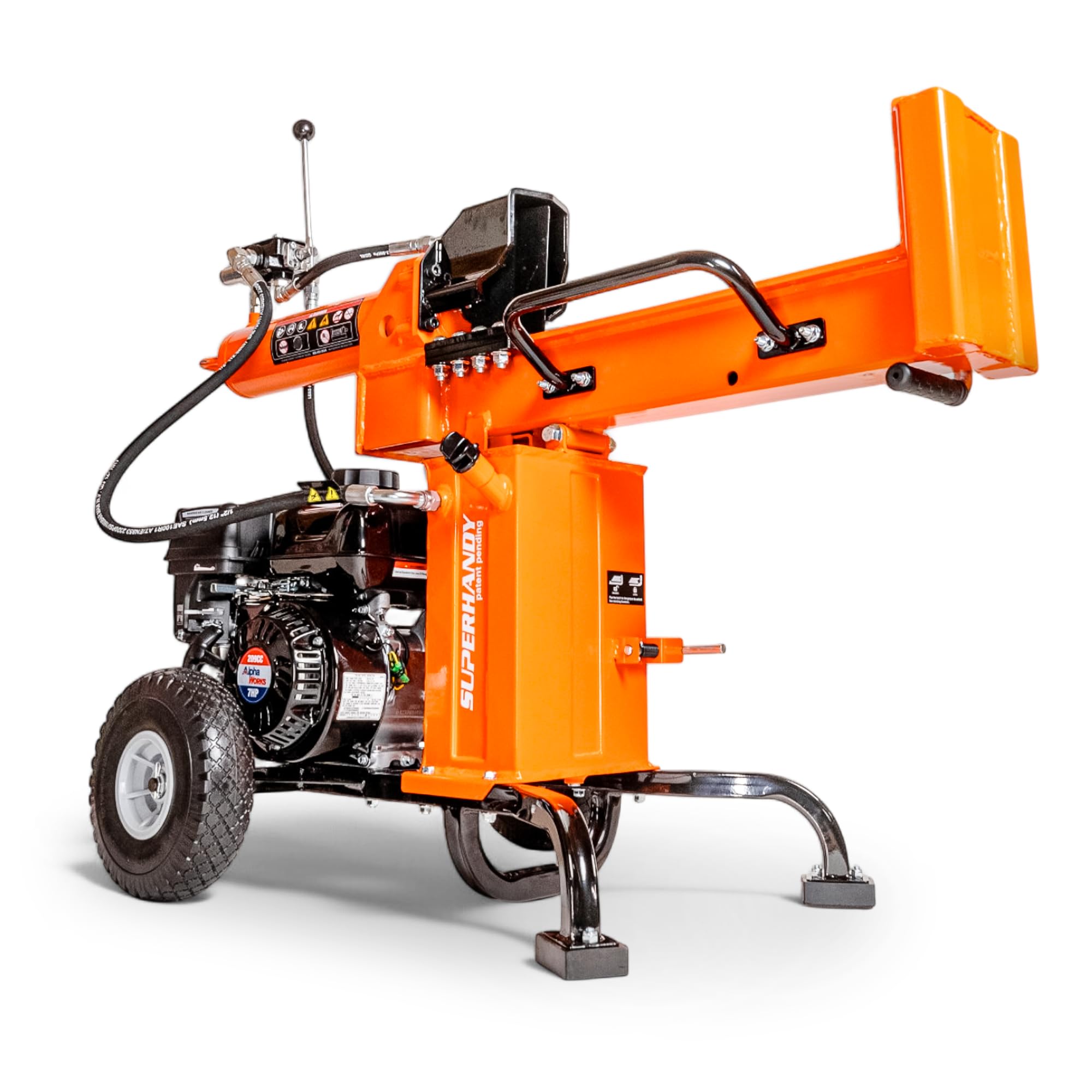
A 24-inch log opening that swallows the trunk sections smaller splitters refuse.
Diameter is where this model separates itself. It handles logs up to 24 inches across — the widest opening on the list, versus the Landworks pick’s 16 inches, and so wide that the maker’s own reviewers talk about working through full locust and oak. Splitting force is 25 tons from a 7HP AlphaWorks engine paired with a 2-stage Bucher hydraulic gear pump, driving logs up to 20 inches long through the half-beam steel wedge.
The force figure beats the Landworks and Ezasin machines cleanly — 25 tons versus 20 tons each — which is exactly what those fat, knotty rounds need. The trade-off is pace: the cycle time stretches to 12 seconds against BILT HARD’s 7 seconds. In practice that means fewer logs per hour on small, easy wood, but the ability to take on rounds the others physically cannot load.
Portability is handled with a lightweight half-beam design, 10-inch polyurethane wheels, and a folding handle, so it stores and rolls without a trailer. Owners are satisfied with the value and report plenty of power to split. The one honest wrinkle is assembly — some find it manageable while others say it takes two people to put together. Plan a helper for the first afternoon. Hydraulic fluid is not included; AW32 is recommended.
The strong suits
- 24-inch log diameter opening — widest of any pick here
- 25 tons of force for stubborn, knotty rounds
- Horizontal or vertical half-beam gives you options on huge logs
- Folding handle and 10-inch polyurethane wheels for storage
Costs to weigh
- 12-second cycle is slower than the 7-second BILT HARD on small wood
- Assembly can take two people according to some owners
- Hydraulic fluid sold separately
When it wins: Big, fat, knotty rounds are your norm — this one accepts what the 16-inch machines can’t.
Second thought: If speed on a cord of small wood matters more than diameter, the faster BILT HARD mid-size is the sharper tool.
6. 28 Ton Log Splitter-Full Boar Engine 212cc
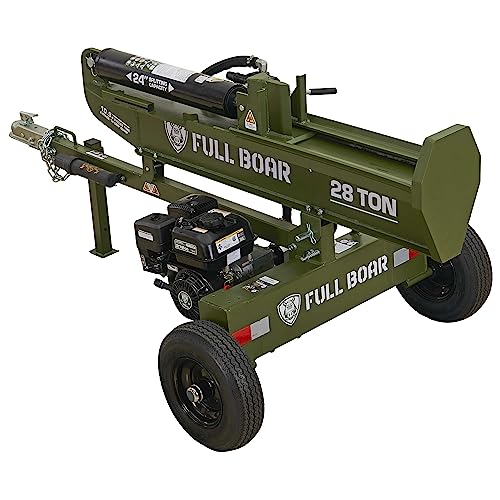
28 tons of full-beam muscle for the woodpile that never seems to end.
When a 20-ton machine starts groaning, this steps in with 28 tons of force from a 212cc Full Boar OHV engine (overhead-valve, a simple engine layout that stays easy to service). Cycle time is 10.9 seconds with an auto-return control valve and adjustable detent, so the handle locks through the split and releases the ram back for the next log without babysitting. The heavy-duty H-beam frame is the structural backbone, built to take the twisting load of big rounds without flexing.
One design detail worth knowing: the hydraulic oil filter is mounted inside the reservoir. That placement keeps the filter out of the falling-log zone, so a dropped round is less likely to smash it or snag an operator on it. It is a small engineering choice that speaks to how this machine is meant to be used — hard, day after day.
At 431 pounds this is a full-size unit, so plan for a permanent or towable spot rather than a rolling shed tool. Stepping up from a 20-ton class splitter to this gains you a large force margin on difficult hardwood, at the cost of a heavier machine and a slower cycle than the 7-second BILT HARD. If your wood is mostly easy softwood, you are paying for force you may not need.
The engineering angle: 28 tons on a heavy H-beam with the oil filter tucked safely inside the reservoir.
What you give up: 10.9-second cycles and a 431-pound frame — this is not a quick, roll-it-anywhere machine.
Pick this when: Hardwood knots and sheer volume are the job and you have a fixed spot for a full-beam splitter.
Keep looking if: You want a light machine to roll around a small yard.
7. 33 Ton Log Splitter-Full Boar Engine 223cc

33 tons for the rounds that laugh at a 20-ton machine.
Bump the engine to 223cc and the force climbs to 33 tons — a meaningful step above the 28-ton model for gnarly, twisted hardwood. The cycle time is 14.3 seconds, the slowest here, so this machine trades raw speed for the ability to push through wood that stalls lesser splitters. An auto-return control valve with adjustable detent handles the ram reset, and the H-beam frame carries the load.
The hydraulic oil filter lives inside the reservoir here too, shielded from falling logs and clear of the operator’s path. That layout is the family trait shared across the Full Boar line, and it is the detail that matters when you are dropping heavy rounds onto a beam all afternoon. At 473 pounds it wants a permanent home or a towing arrangement.
Do the math on your wood before you commit. The 14.3-second cycle will feel leisurely next to the 7-second BILT HARD mid-size on clean, straight logs. This pick makes sense when the logs are the problem — crotchy oak, thick knots, big diameter — and you would rather wait a few extra seconds than wrestle a round that refuses to split.
Made for: Landowners whose woodpile is dominated by hard, knotty rounds that need serious tonnage.
Think twice if: Your splits are easy — the slow 14.3-second cycle will test your patience on soft, straight wood.
8. 38 Ton Log Splitter-Full Boar Engine 306cc
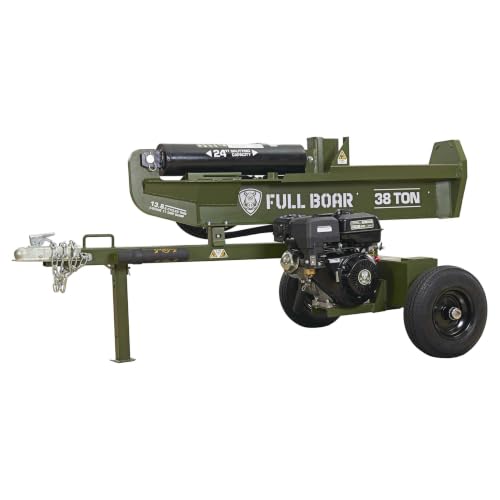
The 38-ton brute of the Full Boar family, built on a 306cc engine.
38 tons is the most splitting force in the Full Boar lineup here, pushed by the biggest engine of the three at 306cc. Cycle time is 13.8 seconds — quicker than the 33-ton model’s 14.3 seconds despite the extra force — so this is the pick that does not make you sacrifice speed for power within this family. The auto-return valve with adjustable detent keeps the handles working for you, and the heavy-duty H-beam carries the load.
Same smart hydraulic layout as its siblings: the oil filter sits inside the reservoir, protected from dropped logs and kept clear of the operator. At 514 pounds it is the heaviest of the Full Boar trio, so it belongs on a trailer or a dedicated pad. Choose this over the 33-ton if your hardest logs still leave you second-guessing, and you want the most force the family offers.
Owners are direct about it — the machine is called a beast and judged worth the money. Durability draws a mixed read, so treat it as equipment that rewards routine hydraulic and engine maintenance rather than one you ignore between seasons. Keep the fluid clean and the filter shielded in its reservoir spot, and it wears like the heavy tool it is meant to be.
Force-first thinking: 38 tons and a 13.8-second cycle make this the strongest of the Full Boar lineup without a speed penalty.
The honest note: Durability gets a mixed read, so routine fluid and filter care is part of ownership.
Reach for it when: You want the maximum force this family offers and have a permanent or towable spot for a 514-pound machine.
Alternatively: A power-first buyer who still wants a faster cycle should start with this rather than the 33-ton.
9. BILT HARD 30-Ton Gas Log Splitter
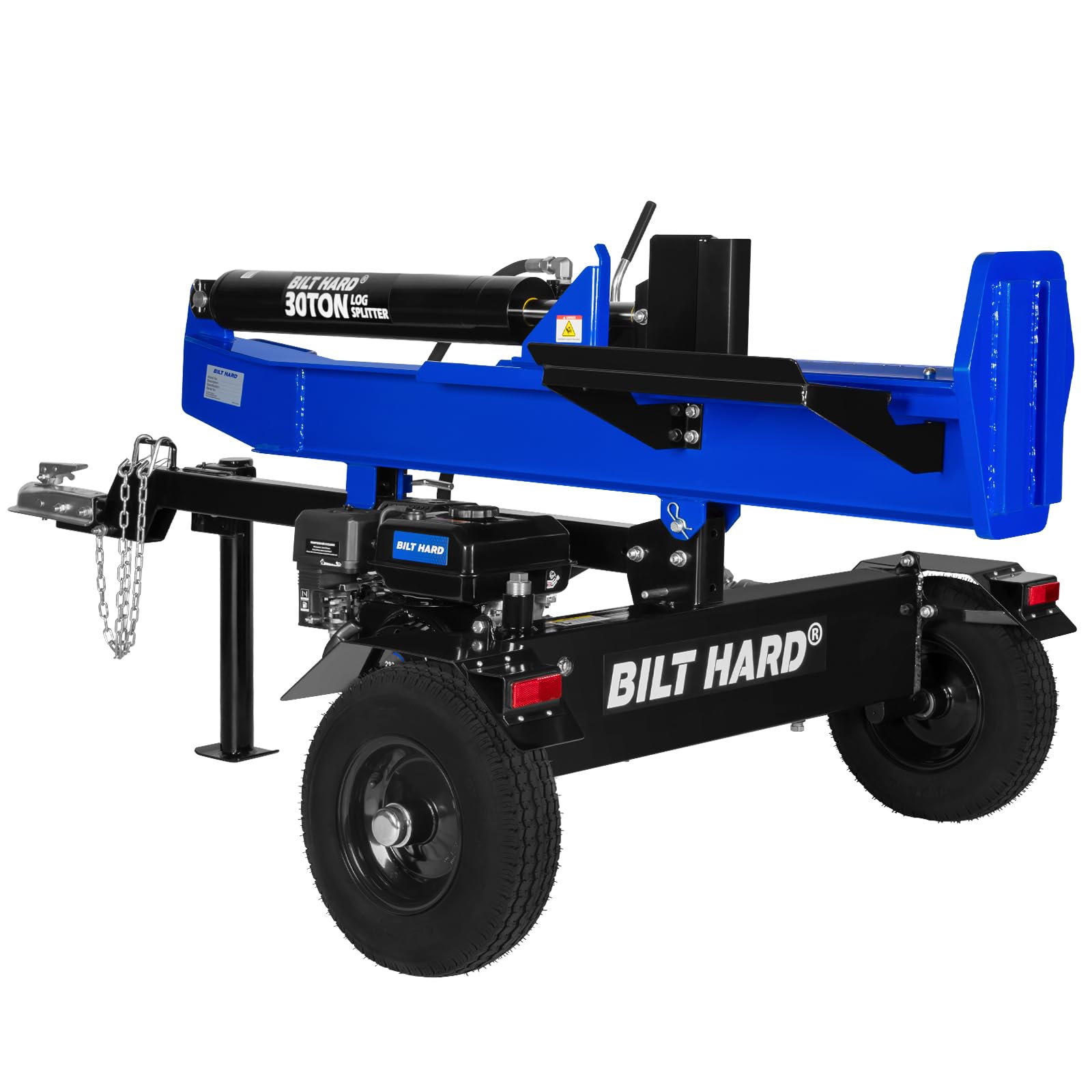
Tows at 45 MPH, flips horizontal to vertical in seconds, and takes 24-inch logs.
Your back gets a break from the dual-position design. This splitter switches between horizontal and vertical modes in seconds, so a heavy round you cannot lift onto the beam in horizontal mode gets split standing upright on the ground — less strain during a long session. Underneath, a 7.5 HP 223cc single-cylinder OHV engine (overhead-valve, a simple, easy-to-service engine layout) generates 30 tons of force. A durable 8-inch hardened steel splitting wedge finishes a full split cycle in just 11 seconds.
You can haul it behind a vehicle, which is where it pulls ahead of the BILT HARD 22 Ton and its 25 MPH towing limit. The 16-inch DOT-certified tires (meeting federal road-safety standards) and 2-inch ball coupler with 24-inch safety chains hook to an ATV or UTV, and it tows at speeds up to 45 MPH. The hydraulic system holds 6 gallons of oil and runs at 14 GPM (gallons per minute of oil flow). Both hydraulic and engine oil are included, so you are not hunting fluid before the first start.
Owners call it well-built and easy to assemble, with one reporting roughly an hour to split three-quarters of a cord of oak. Functionality and value land as the most-discussed strengths, and the log capacity reaches 24 inches in length for the bigger rounds. It weighs 533 pounds, so this is a tow-or-park machine — the 45 MPH capability is what makes moving it painless.
Why it earns the towable crown
- Horizontal-to-vertical switch in seconds saves your back on heavy rounds
- 45 MPH towing tops the 25 MPH BILT HARD mid-size
- Oils included — hydraulic and engine — so setup is complete
- 6-gallon hydraulic system at 14 GPM and 11-second cycles
Before you hitch it
- 533 pounds means a hitch vehicle or a permanent pad
- Needs a 2-inch ball coupler and chains to tow safely
- Towing at speed requires secure load checks every trip
Best for: Anyone whose wood lives away from the splitting spot and who wants vertical mode for the heaviest rounds.
Not ideal for: Yards too tight to maneuver a 533-pound trailer.
Know the Specs
Splitting force (tons)
Splitting force is how much hydraulic push the ram applies to the log, measured in tons. Higher tonnage lets the wedge force through denser, knottier hardwood without stalling. For most firewood rounds, a 20-ton machine copes fine; reach for 25 tons and above when your logs are big diameter or full of knots. Force alone does not decide throughput, though — a 7-second cycle at 22 tons outruns a 14-second cycle at 33 tons on straight firewood.
Cycle time (seconds)
Cycle time is the seconds a full split takes — ram out through the log, then back to start position. Shorter is better for volume work: a 7-second machine feeds far more logs per hour than a 14-second one. Auto-return valves help because the ram retracts by itself after each split, so you load the next log instead of resetting the handle. On a cord of wood, the gap between a 7-second cycle and a 14-second one is hours of standing at the beam.
Log capacity (length and diameter)
Log capacity is two separate limits: how long a round fits on the beam, and how wide a diameter the wedge will accept. A splitter rated for 21-inch length and 16-inch diameter simply will not take a 24-inch trunk section, regardless of tonnage. Measure your widest and longest rounds before buying — a 16-inch-diameter limit will not take the 24-inch sections off a big oak trunk.
Hydraulic pump and fluid
The hydraulic pump moves the fluid that drives the ram. A 2-stage pump shifts from a fast low-pressure mode to high pressure for tough splits, balancing speed and force. On fluid: several of these splitters ship without hydraulic oil, and AW32 is the commonly recommended fill — check and fill before the first start. A reservoir-mounted filter, where present, keeps the filter shielded from falling logs.
Common Questions
Will a 20-ton gas splitter handle oak and hickory?
Do I need to add hydraulic fluid before first use?
What is cycle time and why does it matter?
Can I tow a gas log splitter on the road?
Is vertical splitting better than horizontal?
What does a 4-way or 6-way wedge do?
How much space does a full-beam splitter need?
What is the heaviest log a log lift can handle?
Do these splitters come with engine oil and gasoline?
Can I use a log splitter indoors or in a garage?
Is a faster cycle time worth losing splitting force?
The Bottom Line
For most homeowners with a normal woodpile, the gas wood splitter worth buying is the Landworks Portable 20-Ton. Its 7.5-second cycle and 20 tons of force turn a weekend of splitting into an afternoon, and it rolls into a shed between jobs. If your rounds run fat and knobby, reach for the SuperHandy 25 Ton and its 24-inch log opening. And if your wood lives far from your splitting spot, the BILT HARD 30 Ton tows at 45 MPH and flips vertical to spare your back — hitch that one up when heavy rounds are the enemy.
How we choose
We do not accept paid placement. Every pick is matched to a real buyer and a real use-case; we do not hands-on test units.
Sources
Specifications: manufacturer listings and product documentation. Review insights: verified customer reviews, as of November 2026. Pricing: not shown on this page (it changes often); check the current price via the retailer link.
As an Amazon Associate, Tactical Gear Guy earns from qualifying purchases. This does not affect which products we feature.