Specs are compiled from manufacturer listings and verified buyer reviews and can change over time — please confirm the key details on the product page before buying.
You want a screw head to sit flush with the wood, not crushed into a splintered crater. A countersink bit does that whole job: it drills the pilot hole and carves the conical seat in one plunge. The picks below all cut at 82 degrees (the angle that matches most standard wood screws sold in the U.S.). They range from a three-piece set with a fixed taper to a nineteen-piece kit that also cuts plugs.
This guide is built by comparing the manufacturers’ published specifications and the patterns across verified customer reviews, so you get each pick’s real strengths and trade-offs instead of marketing spin.
Some sets give you adjustable depth collars so every screw sits at the same height; others hand you fixed tapers that need no setup. A few trade durability for a lower entry point, which matters if you drive hundreds of screws a week. Here is how the leading woodworking countersink bits compare on angle, stop collars and bit count.
Top Picks


How To Choose The Best Woodworking Countersink Bits
Three things decide whether a countersink set earns its place in your bit case: the angle of the head, whether the depth can be locked, and how the cutter holds up after a few hundred screws. Get those wrong and you are sanding mushroomed screw heads or replacing snapped pilots.
Match the angle to your screw heads
An 82-degree countersink matches the underside of a standard flat-head or bugle-head wood screw, so the head seats flush with the surface. That is the spec almost every set on this list carries. One pick in this group, the JNB Pro set, uses a 118-degree cutting angle instead — the point style used on general twist drills, which suits a slightly different screw geometry. Check the screws you actually plan to drive before you commit.
Depth stop or fixed taper
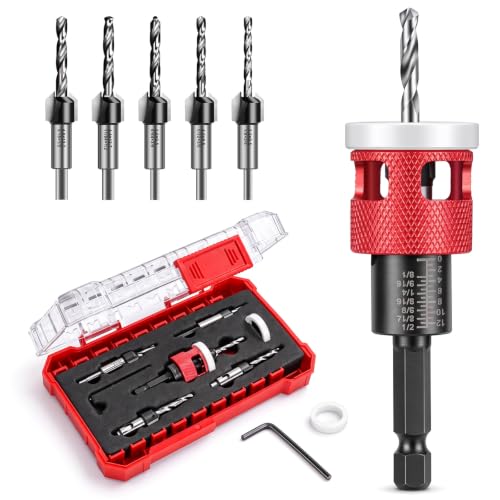
A depth stop collar locks how deep the pilot hole and the countersink go. It is the difference between a run of screws sitting at the same height and a run of screws sitting at slightly different heights. Adjustable stop collars let you dial in the pilot depth and the countersink depth independently, which matters when you switch between thin plywood and a thick hardwood rail. Fixed-taper sets skip that setup entirely but expect you to control depth by eye and by pressure.
What the cutter and the pilot are made of
Two different jobs sit inside one bit. The pilot drill bores the small lead hole; the cutter carves the cone. TCT (tungsten-carbide-tipped) cutters hold an edge longer in abrasive material like MDF and particleboard. M2 HSS (high-speed steel) pilots resist bending better than plain carbon steel, which is what keeps a thin bit from snapping. A set that pairs TCT cutters with M2 HSS pilots is covering both jobs with harder material.
Run slow, not hard
Several of these sets specify roughly 200 RPM for clean edges. Heat is what dulls a cutter and burns a ring into the wood, and excess speed generates heat faster than the flutes can clear chips. Wide flute channels give shavings somewhere to go, which keeps friction and clogging down. If your drill has no slow setting, feather the trigger instead of pulling it wide open.
Side-by-Side Comparison
| Model | Best For | Cutting Angle | Pieces | Pilot Sizes | Amazon |
|---|---|---|---|---|---|
| Snappy 3pc Tapered Countersink Set | Flush seats with zero setup | 82 degrees | 3 | 9/64″, 11/64″, 13/64″ | Amazon |
| Pro Countersink Drill Bit Set #4–#12 | Small bits for fine, delicate work | 82 degrees | 5 | 5/64″ to 9/64″ | Amazon |
| Mozeyerh 8 PCS Set with Depth Stop Collar | One set that covers two counterbores | 82 degrees | 8 | 1/8″, 9/64″, 5/32″, 11/64″, 3/16″ | Amazon |
| DEWALT 5 Pc Industrial Grade Set | Mixed metal, plastic and wood jobs | 82 degrees | 5 | — | Amazon |
| JNB Pro 5pc 4-Flute Set | Smooth walls in hardwood | 118 degrees | 5 | — | Amazon |
| LIBRATON 19PCS Tapered Set | Drill, countersink and plug in one kit | 82 degrees | 19 | #4, #6, #8, #10, #12 | Amazon |
| Amana Tool 55264 Carbide Tipped | Repeatable holes in tough material | 82 degrees | 1 | #8 screw | Amazon |
Detailed Reviews
1. Snappy 3pc Tapered Drill Bit Countersink Set
Three tapered bits, one hex key, and nothing to adjust before you drill.
This is the set for the person who wants a flush screw seat on the first try, without reading a manual. Each bit combines a tapered pilot drill with a built-in countersink head, so one plunge cuts the lead hole and the cone together. The 82-degree cutting angle matches standard wood screw heads, which is exactly what you want when you are hanging a shelf and the heads need to disappear into the face.
You get three sizes tied to screw numbers. The 9/64-inch pilot is for #6 screws, the 11/64-inch for #8, and the 13/64-inch for #10. Each one carries a 3/8-inch cutting diameter, so the cone is sized to bury a matching head cleanly. At 5.44 ounces for the whole set, it rides in a tool bag without you noticing the weight. That is 3.4 times the 1.6-ounce Pro set further down — the honest trade for bits this substantial.
What wins people over is how sharp these come out of the package — the edge quality is the most-praised trait across the range, and it shows the moment you touch one to hardwood. Tough species like white oak and maple are a common report, not a struggle. The recurring caveat is patience: a few owners find the steel gives out sooner than they would like under heavy repeated use, so treat these as a set for careful work rather than a production line. Alloy steel, uncoated finish, two flutes per bit.
Where It Wins
- 82-degree head seats standard wood screws flush with no depth stop to fiddle with.
- Sized to #6, #8 and #10 screws, covering the three sizes most furniture and cabinet jobs need.
- Sharp, ready-to-cut edges that handle white oak and maple without complaint.
- 5.44 ounces for the trio, so it disappears into a tool bag.
Honest Watch-Outs
- No depth-stop collar — you control seat depth by pressure and eye, not by a locked ring.
- Heavy repeated use takes a toll on the cutting edge sooner than some buyers expect.
Grab this set: if you drive #6 to #10 screws by hand and want a flush seat without setup — the 82-degree angle and three tapered bits do the job in one motion.
The honest limit: no depth collar means consistent seat depth is up to your touch, so plan on a few test holes in scrap before hitting the real board.
2. Pro Countersink Drill Bit Set 5-Piece
Five bits light enough to forget, tiny enough for trim work and thin panels.
The five-piece Pro set is the one you reach for when the board is thin and a full-size head would chew a crater wider than the trim allows. It runs five gold screw countersinks covering 5/64-inch, 3/32-inch, 7/64-inch, 1/8-inch and 9/64-inch pilots, so you can match a small screw exactly instead of forcing the nearest big bit.
The weight tells the story. At 1.6 ounces the whole set weighs a fraction of the Snappy trio’s 5.44 ounces — a compact pouch of fine bits instead of a chunkier handful. A carbide-tipped cutting edge with a fully sharpened face keeps the point biting, and the 1/4-inch hex shank slots straight into a power drill or quick-change chuck. The external thread design pushes waste out as you cut, which is what keeps a small hole from jamming.
Hole quality is the thing people notice first — the cut is reported as clean and quick, like a hot knife through softwood. The one fair warning sits with the smallest members: the fine pilot bits are delicate by design, and a few have snapped under sideways pressure. Keep the drill straight and let the edge do the work. Value is the most-praised trait across the range, and it is easy to see why given what this little set covers.
Fine-scale match: five pilot sizes from 5/64 to 9/64 inches mean small trim screws get a bit made for them, not an oversized head forced into thin stock.
Handle the little ones carefully: the thinnest pilots will snap if you lean on them — a straight, steady plunge is what keeps them whole. Skip this if you mostly drive #12 or heavier screws, which need the larger sets below.
Reach for it when: your work is trim, small boxes and delicate panels where a compact carbide-tipped bit beats brute size.
Pass it by if: you want one set to handle heavy framing screws — this one peaks at a 9/64-inch pilot.
3. 8 PCS Countersink Drill Bit Set
Two counterbore sizes in one case, with a plastic collar that spares the surface.
Eight pieces sounds like a lot until you see what they do. This Mozeyerh kit carries five two-flute TCT alloy tapered drills with a 3/8-inch 82-degree counterbore, plus three larger drills paired with a 1/2-inch 82-degree counterbore. That second counterbore is the practical draw: one compact set can seat both a small cabinet screw and a heavier fastener.
Depth is adjustable on both the pilot and the counterbore, set with the included wrench. A plastic collar threads on to soften the contact point, which is the detail that saves a finished face from a scuffed ring. The M2 HSS pilot drills run spiral chip flutes for fast clearing, and the steel-alloy cutting edges form the cone. The cutting diameter is 0.17 inches — compact next to the 0.5-inch counterbore, a difference you feel when working near an edge.
The set suits natural wood, chipboard, plywood, MDF, decking, drywall and plastic boards, and the maker recommends running it around 200 RPM for smooth edges. Everything packs into a small case at 8.82 ounces with a hanging hole. Quality is the clear standout — it is the most-praised trait by a wide margin, and the adjustability earns steady praise too. The honest wrinkle is setup: some find the depth adjustment fussy to dial in at first, so give yourself a scrap board to learn the collar before you commit to a good panel.
What Earns Its Place
- Two counterbores — 3/8-inch and 1/2-inch — so one kit covers small and heavier screws.
- Adjustable pilot depth and countersink depth, set with the included wrench.
- Plastic collar reduces surface marring on finished faces.
- Packs into a small case at 8.82 ounces with a hanging hole for the shop wall.
Where It Asks More Of You
- Depth setup takes some learning — a scrap board first is worth the minute.
- Slower 200 RPM operation is required for clean edges, so a fast drill needs a light trigger finger.
The right call for: anyone who switches between cabinet screws and heavier fasteners and wants both counterbores in one small case.
Think twice if: you want zero setup — the adjustable collar rewards a little practice before it pays off.
4. DEWALT Countersink Drill Bit Set DWAMDB5SETCS

The one set here that steps outside wood, into metal, plastic and PVC.
Not every countersink lives in a woodshop. This DEWALT five-piece set is milled and ground to an 82-degree tip, then aimed at machinable materials — iron, steel, soft metals, plastic, wood, PVC and fiberglass. If your project mixes a steel bracket with a wooden frame, this is the set that follows you across both.
Sizes run 1/4-inch, 3/8-inch, 1/2-inch, 5/8-inch and 3/4-inch, so the heads get progressively larger for bigger fasteners. A black oxide finish adds corrosion resistance, which matters if the bits live in a damp garage. The 1/4-inch shank fits all drills, and the straight shank keeps the bit aligned in a standard chuck. Two flutes per bit keep the cut clearing as you go.
One clear limit sits in the listing: it is not recommended for stainless steel, so leave the stainless work to a dedicated bit. Beyond that, the range is broad — reports have it cutting soft pine, hard hickory and plywood without trouble, and the sharpness holds up across those different densities. Quality and cutting performance are the traits that carry it.
The cross-over advantage: an 82-degree tip that works iron, steel, soft metals, plastic, wood and PVC means one set for a mixed-material build instead of two.
Know the boundary: stainless steel is off the table, and the largest 3/4-inch head is built for big fasteners, so fine trim work still wants a smaller bit.
Best matched to: the builder who countersinks steel brackets and wooden frames in the same afternoon and wants one set to do both.
Leave it for another set if: every screw you drive is small and wood-only — the bigger heads here are more than trim work calls for.
5. Countersink Drill Bit Set 5 PCS

Four cutting edges per bit, and a collar that keeps the bit centered on the mark.
Two things define this set. First, the cutters carry four flutes, twice the two-flute count of most of the sets on this list, and more edges mean a smoother cut through both hardwood and softwood. Second, a 118-degree cutting angle sits on the head instead of the 82 degrees the rest of these sets use — a different point geometry, worth checking against your screw heads before you buy.
The set is five countersink #6 bits made from M2 HSS steel with a black oxide finish, and it comes with two extra tapered M2 drill bits, a stop collar, a hex wrench and a storage container. Total weight is 5.28 ounces, close to the Snappy set’s 5.44 ounces, so it feels similarly substantial in the hand. The self-centering collar is designed to hold the bit on the mark and cut slippage, which is the detail that helps on delicate material and thin stock. A 1/4-inch universal hex shank drops into any hex-style power tool.
Coverage runs hardwood, softwood, plywood, MDF and PVC, so it is not a wood-only tool. The four-flute design is the reason to choose it — a smoother wall and a more accurate hole are the payoff. The narrower cutting diameter of 3.18 millimeters means the cone is small, so match it to smaller-screw work rather than a heavy fastener.
The flute count advantage: four edges per cutter against the usual two gives a smoother cut in both hard and soft wood, and the self-centering collar fights the slippage that ruins thin stock.
Check the angle first: a 118-degree head is a different geometry from the 82-degree standard, and a narrow 3.18-millimeter diameter points this at smaller-screw work.
A strong fit if: you want smoother hole walls and a collar that stays on the mark in delicate material.
Reconsider if: your screws are standard 82-degree heads — the 118-degree angle here wants a matching screw geometry.
6. LIBRATON Countersink Drill Bit Set 19PCS
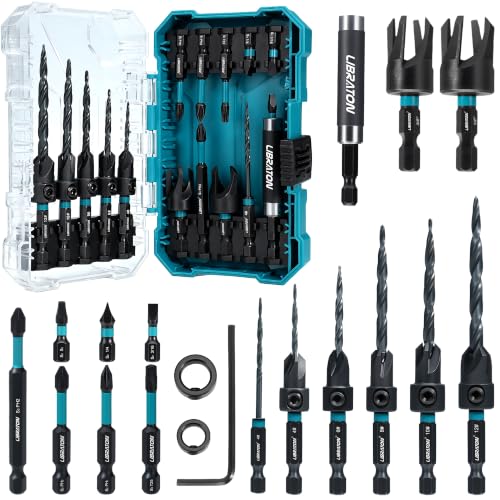
Nineteen pieces that drill, countersink, counterbore and cut plugs.
If you are setting up a shop from scratch, this is the set that saves you buying bits one at a time. It pairs six tapered drill bits with six matching countersinks, so it covers screw numbers #4 through #12 — including a #12 bit that takes a 1/2-inch countersink instead of the 3/8-inch the smaller bits carry.
The extra pieces are where the value sits. There are two wood plug cutters in 3/8-inch and 1/2-inch, so you can bore a plug hole and cut a matching plug from the same stock. Seven screwdriver bits in slotted, Philips, square and torx drive, plus an extendable magnetic bit holder, mean you can drive the screw without swapping tools. A hex wrench and two depth stop rings in 3/8-inch and 1/2-inch round it out.
The HSS bits get a nitride treatment the maker says resists rust and lasts up to twice as long as ordinary carbon steel wood bits. The four-edged countersink and conical drill run at an 82-degree angle. One real limitation sits in the fine print: the wood plug cutters are recommended for a bench drill for best results, so they are not a hand-drill job. The recurring durability complaint centers on screw heads stripping out — torque down gently.
The everything-in-one angle: six tapered bits for #4 to #12 screws, two plug cutters, seven driver bits and an extendable magnetic holder means one case replaces a drawer of odd bits.
Where to ease off: screw heads have been reported to strip, so ease the torque, and keep the plug cutters for a bench drill where they belong.
Best for: the new shop setup where one comprehensive 19-piece case beats assembling bits piece by piece.
skip it if: you only need basic countersinking — the plug cutters and driver bits are the value here, and you would be paying for tools you will not use.
7. Amana Tool Carbide Tipped 82 Degree Countersink Drill Bit 55264

One bit, built for the long haul, sized to a #8 wood screw.
This is the opposite bet to the big kits: instead of spread, it stakes everything on one tool. The Amana 55264 is an integral carbide-tipped bit with a 2-flute design and a slow-spiral HSS drill, sized for a #8 wood screw, with a 0.38-inch cutting diameter and an 82-degree angle. The 1/4-inch quick-release hex shank drops straight into a driver, so you can drill and countersink in one pass without a chuck change.
Where it earns its place is material range. It works acrylic, aluminum and non-ferrous metal, aluminum composite materials, composite decking, chipboard, man-made boards and MDF — a spread that most wood-only sets here do not touch. The carbide tip is the reason: it holds a cutting edge through abrasive composites that would dull a steel cutter fast, delivering repeatable precision.
Amana has built industrial cutting tools for over 50 years, and this bit carries a carbide tip built for abrasive composites. Quality is the trait that carries it, and sharpness gets called out for cutting cleanly through every material. Durability gives mixed reports — some find it long-lasting, others not — so treat it as a precision tool for the right job. One bit means no backups, so buy a second if you rely on it daily.
Where It Shines
- Carbide tip holds an edge through abrasive composites and man-made boards.
- Integral 2-flute design and slow-spiral HSS drill in one piece.
- Quick-release 1/4-inch hex shank for fast driver changes.
- 82-degree, 0.38-inch head sized for a #8 wood screw.
The Trade-Off
- One bit only — no spare in the case, so a second is worth having if you drill daily.
- Sized specifically for a #8 screw, so it will not cover every screw in the drawer.
Worth it for: the builder who drills #8 screws through composite decking, MDF or aluminum and wants carbide that survives abrasive material.
Not for: anyone who wants one purchase to cover every screw size — this is a single precision bit, not a kit.
Know the Specs
Cutting angle (82 degrees vs 118 degrees)
The cutting angle is the slope of the cone that the head carves into the wood. An 82-degree head matches the underside of a standard flat-head or bugle-head wood screw, so the head seats flush. A 118-degree head is the point style used on general twist drills — it suits a slightly different screw geometry. Check the screws you drive before you commit to an angle. Almost every set on this list runs 82 degrees; the JNB Pro set uses 118.
Pilot diameter and screw number
The pilot is the small lead hole the screw threads into. Its diameter is matched to a screw number — a #6 screw wants a smaller pilot than a #10. A set that covers #4 through #12 in one case saves you buying bits singly. Getting the pilot too large strips the thread’s grip; too small and the screw binds. Match the pilot size to the screw you are actually driving.
Depth stop collar
A depth stop collar is the ring that locks how deep the bit travels. It sets the pilot depth and the countersink depth, usually independently. A fixed-taper bit with no collar leaves depth control to your pressure and eye, which is faster but less consistent. A ball-bearing collar is built to stop rotating the moment it touches the wood, reducing drag and the burn marks that come with a collar scraping across a face.
TCT and HSS materials
TCT (tungsten-carbide-tipped) cutters hold an edge longer in abrasive material like MDF and particleboard. HSS (high-speed steel) pilots resist bending better than plain carbon steel, which is what keeps a thin bit from snapping. A set that pairs TCT cutters with M2 HSS pilots is covering both jobs with harder material. The material choice shows up in how long a bit stays sharp and how few holes you drill before an edge dulls.
Common Questions
What is the difference between a countersink bit and a pilot hole drill?
Will an 82-degree countersink fit my wood screws?
Do I need a depth stop collar for countersinking?
Can I use a countersink bit in a standard power drill?
What RPM should I run a countersink bit at?
Why do my countersink bits keep breaking or stripping?
Can a countersink bit cut metal or plastic, or is it wood only?
Does a four-flute countersink bit make a cleaner hole than a two-flute?
Can I cut wood plugs with a countersink bit set?
What size countersink do I need for a #8 wood screw?
The Bottom Line
For most woodworkers, the woodworking countersink bits winner is the Snappy 3pc Tapered Set because its 82-degree head seats standard screws flush in one plunge with no setup, and its sharp edges handle tough hardwoods. If you want adjustable depthstops and two counterbores in one compact case, grab the Mozeyerh 8 PCS Set. And for mixed-material work that steps outside wood entirely, the DEWALT 5 Pc Set is the one to reach for — its 82-degree tip covers iron, steel, plastic and PVC where the wood-only sets stop.
One honest nudge: the Snappy trio holds 4.5+ stars across 200+ owners, and that edge quality is why it sits first. But if you drive screws daily in production, a set with a depth collar — the Mozeyerh or the Csuephubs ball-bearing set — will save you re-drilling more than the fixed taper ever will.
How we choose
We do not accept paid placement. Every pick is matched to a real buyer and a real use-case; we do not hands-on test units.
Sources
Specifications: manufacturer listings and product documentation. Review insights: verified customer reviews, as of November 2026. Pricing: not shown on this page (it changes often); check the current price via the retailer link.
As an Amazon Associate, Tactical Gear Guy earns from qualifying purchases. This does not affect which products we feature.