Specs are compiled from manufacturer listings and verified buyer reviews and can change over time — please confirm the key details on the product page before buying.
The adapter you want is the one with enough ports to charge your phone, your tablet and your partner’s phone off a single foreign wall socket. Everything else — plug types, fuse rating, whether it converts voltage — decides whether that charger actually works when you land. A world travel adapter with USB is not a voltage converter, and confusing the two is the mistake that kills devices on the first night abroad. This guide walks you through nine adapters that cover the plug standards, and tells you plainly which one fits your trip.
This guide is built by comparing the manufacturers’ published specifications and the patterns across verified customer reviews, so you get each pick’s real strengths and trade-offs instead of marketing spin.
You will see which plug types each unit carries, how much USB power it pushes and where the honest limits sit. The pick that wins on both port count and charging grunt is the Epicka 70W GaN, a solid choice among the world travel adapter usb options here.
Top Picks


How To Choose The Best World Travel Adapter USB
Start with your itinerary, not the spec sheet. Count the countries on your route and write down the plug type each one uses — that single list narrows the field faster than any other step. Then count the devices you actually carry, because a two-port adapter is plenty for a phone and a watch, while a laptop plus two phones needs three or more.
Match the plug types to your actual route
Most of continental Europe runs on Type C sockets, the two-round-pin shape you will see in France, Germany, Italy and Spain. The UK, Ireland and Singapore use Type G, the chunky three-pin block. Australia, New Zealand, China and Argentina take Type I, and the US, Canada, Mexico and Japan use Type A. An adapter that lists all four covers the vast majority of trips, but India’s Type D and South Africa’s Type M sockets are separate shapes that many worldwide units leave out entirely.
Decide how much USB power you need
USB-C PD (Power Delivery) is the fast-charging standard most phones and laptops now use, and the wattage number tells you what it can feed. A 20W port tops up a phone at normal fast speed. A 70W port can drive a USB-C laptop. If you travel with a laptop that charges over USB-C, the wattage is the spec that matters most to you, and a low-wattage adapter will leave you charging slowly all evening.
Check the voltage rule before you pack a hair dryer
No adapter in this category converts voltage. It reshapes the pins so the plug fits the socket, but the wall still sends whatever voltage the country supplies. Dual-voltage devices — anything whose label reads 100–240V — are fine. Single-voltage appliances like many hair dryers, straighteners and clippers are not, and a high-wattage appliance can pop the adapter’s built-in fuse even when it claims dual voltage.
Weigh the fuse, the shutters and the cruise rules
A built-in fuse is a small sacrificial part that blows to stop a surge reaching your gear, and several picks here ship with spares. Safety shutters block the live contacts so a child cannot poke anything in. If you are sailing, note that cruise lines often restrict surge-protected power strips, so a compact adapter with no surge protection is the simpler choice to carry aboard.
Side-by-Side Comparison
| Model | Best For | USB-C Power | Outlets | Plug Types | Amazon |
|---|---|---|---|---|---|
| Epicka 70W GaN★ Best Overall | Laptop plus phones on one socket | 70W via PD3.0 | 6 | C, G, I, A | Amazon |
| Olcorife 6-Outlet Power StripMost Outlets | Hotel rooms with one distant socket | 1 USB-C port | 6 | C, E/F, G, A/I | Amazon |
| TESSAN 009Featherweight Pick | Ultra-light carry-on packing | 20W max via C1/C2 | 1 AC | C, G, I, A | Amazon |
| Hero International | Multi-country trips with laptop gear | 2 USB-C ports | 5 | C, G, I, A | Amazon |
| Ceptics World Set | Multiple regions in one kit | 20W via QC-PD | 4 | A, B with C, E/F, G, I attachments | Amazon |
| VINTAR Universal Kit | India and South Africa routes | 17W dual USB-C max | 5 | A, C, G, D, I, M | Amazon |
| UGREEN 45W 6-Port | Compact foldable daily carry | 45W max | 6 | A, C, E, F, G, I | Amazon |
| Baseus 70W Enercore CG11 | Cable-free travellers | 70W max built-in cable | 2 | C, A, G, I | Amazon |
| Ceptics 35W Kit | Surge protection for pricey electronics | 35W via PD USB-C | 2 | Worldwide kit | Amazon |
Detailed Reviews
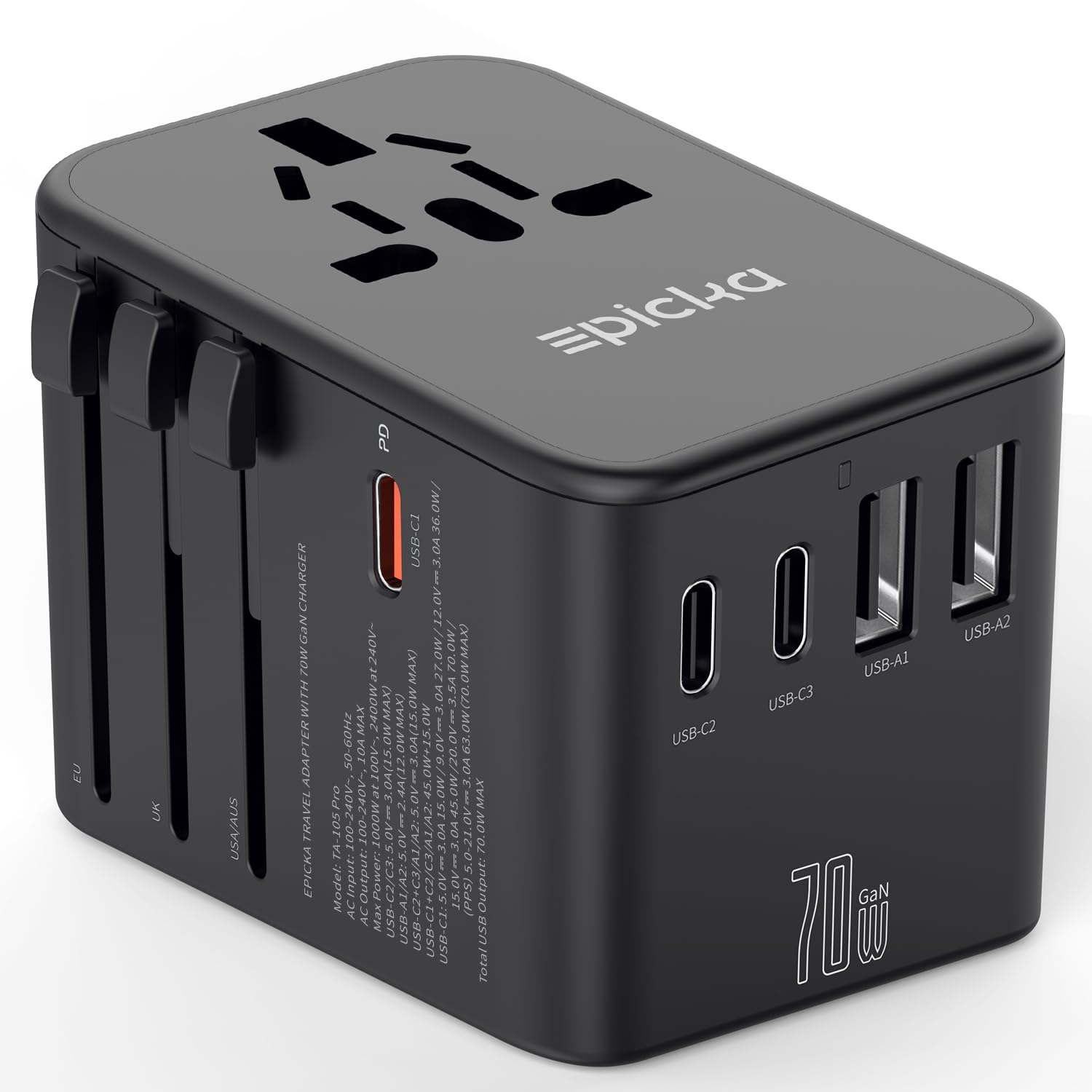
1. Epicka 70W GaN PD Universal Travel Adapter, 3USB-C/2USB-A
Our pick — 4.5+★ from 750+ verified ratings; the strongest balance of quality and price.
The one that replaces your laptop brick, your phone charger and your travel plug in a single block.
The 70W figure is the reason this adapter takes the top slot. That is the output of the USB-C1 port running PD3.0 (Power Delivery, the fast-charging handshake most modern laptops and phones use), and it is enough to top up a USB-C laptop overnight instead of trickling. Around it sit five more ways to plug in: three USB-C at 3A and two USB-A at 2.4A, giving six outlets in total. A couple and two kids can each claim a port and still leave the AC socket free for a camera charger.
The plug setup covers four of the standards most trips need — Type C for most of Europe, Type G for the UK, Ireland and Singapore, Type I for Australia and China, Type A for the US and Japan — across 200+ countries. Buyers praise the four plug types and the solid, planted feel of the 5.1-ounce body. The 5.1-ounce body stays planted in a vertical socket rather than sagging out of the wall. Note the two gaps: India’s Type D and South Africa’s Type M sockets are not supported, so a Delhi or Cape Town leg needs a different adapter.
Here is the honest catch. It is not a voltage converter, and the 10A fuse will pop if you push a hair dryer or an electric kettle through it — spares ship in the box, and replacements are sold under the Epicka name. It holds 4.5+ stars across 700+ ratings. It also posts the highest score on this list, and it leads the field on maximum USB-C power — 70W against the TESSAN 009’s 20W.
What earns it the crown
- 70W PD3.0 on USB-C1 means a laptop charges at full speed, not overnight-trickle speed
- Six outlets — 3x USB-C at 3A, 2x USB-A at 2.4A and one AC — so the whole family plugs in at once
- 4 plug types (C, G, I, A) cover 200+ countries, including most of Europe, the UK, Australia and the US
- 10A fuse, safety shutters and a separate plug lock, with 2 spare fuses and a carry bag in the box
- 5.1 oz and 2.05 x 1.97 x 2.8 inches, so it disappears into a side pocket
Where it stops short
- No Type D (India) or Type M (South Africa) support, so those routes need a second adapter
- Won’t convert voltage, and a high-wattage appliance like a hair dryer can trip the 10A fuse
Reach for this if: you travel with a USB-C laptop and at least two phones and want one block to serve all of them.
Look elsewhere if: your route runs through India or South Africa, where the plug shapes simply are not there.
2. Olcorife Universal Travel Adapter
A five-foot cord and six outlets for the hotel room where the only socket hides behind the bed.
The sockets are widely spaced on a multi-side body, so a bulky camera charger does not block the slot next to it. Add 2 USB-A and 1 USB-C and you can run 9 devices at once. The 5ft extension cord is the quiet hero: it reaches the desk from behind a nightstand, and two mounting holes on the back let you hang it on a wall at home between trips.
Functionality is what this one gets right, and owners lean on it specifically in France and England, where the sockets and the room layout both work against you. There is also a circuit breaker that cuts power when the load exceeds the rating, plus surge protection (a guard that absorbs voltage spikes, including from lightning strikes). If you travel with an expensive laptop, that is a real layer of insurance you do not get on every adapter here.
The trade-off is charging consistency. Some buyers report phones that do not charge properly off the USB ports, while others run several items at once without trouble. It is also a small power strip rather than a pocket adapter, so it earns its place in checked luggage more than in a day bag. Size-wise it runs 5 inches long by 1.9 inches wide — longer than the TESSAN’s 3.5 x 2.09 x 1.24 inches, which is the price of the extra sockets and the cord.
Best suited to: a family or a long stay where the room becomes a charging station — six outlets and a cord beat a pocket adapter you have to unplug and pass around.
One thing to plan for: check the USB ports on arrival with a quick test charge, so a slow phone is not a surprise at midnight.
Top of the list for: hotel rooms and rentals where everyone wants to plug in at once.
Think twice if: you want a pocketable adapter for a short city break — the cord and six sockets take up more bag space.
3. TESSAN Travel Adapter 009
Under four ounces, and it still splits your charging across three USB ports.
At 3.52 ounces and roughly 3.5 x 2.09 x 1.24 inches, this is the lightest adapter here, and it is barely bigger than the high-output wall charger you already carry. The 4-in-1 layout is one AC outlet rated to 2000W max plus three USB ports — two USB-C and one USB-A. The USB-C ports run PD 20W max on a single port, and the USB-A runs 18W max, with all ports capped at 20W combined. For a phone, a watch and a tablet that is a sensible split.
Compatibility is the thing that lands with travellers: Type C for most of Europe, Type G for the UK and Ireland, Type I for Australia and China, Type A for Japan and the US — over 150 countries on one block. Portability is close behind as a reason people keep it. There is no surge protection and no cord, which is exactly why it slips into a cruise-ship bag without a second thought. It also sits flush because there is no cord to tangle.
Now the honest part. Charging speed draws mixed reactions — the 20W ceiling is fine for a phone but will not drive a laptop, and that is the limit of the design rather than a fault. Compare it with the Epicka’s 70W against this adapter’s 20W on maximum USB-C output, so if a laptop is on your packing list this is the wrong tool. For phone-first travel, though, the small size is the whole point.
The case for it: the lightest, flattest way to get a phone and two accessories charging in 150+ countries, with nothing extra to pack.
The caveat worth knowing: no surge protection and a low USB ceiling mean it is for phones and tablets, not for the laptop you work on.
Pick this one for: short trips, hand luggage and cruise sailings where a small, cord-free adapter is all you need.
Skip the weight saving if: your bag holds a USB-C laptop that needs real wattage.
4. Hero International Travel Power Adapter
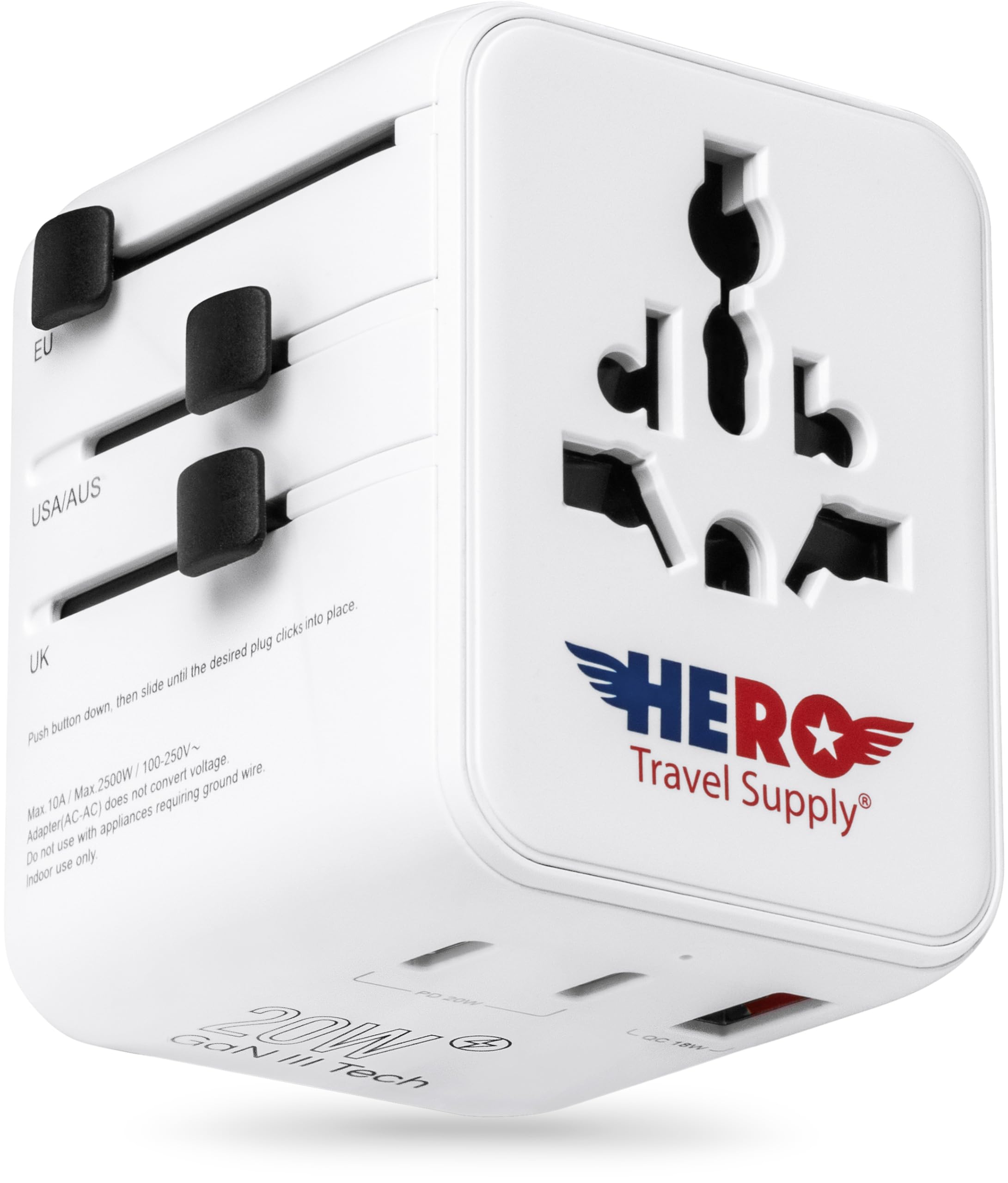
The name to remember when your trip skips between continents and you want one plug for all of them.
It packs 4 plug types into one compact unit, and that roster is the reason a round-the-world route is the natural fit. The adapter handles 100+ countries, with dual-voltage hair dryers, curling irons and straighteners working up to 10 amps — and the same rule applies here as everywhere: it does not convert voltage.
The charging side gives you two USB-C ports, one USB-A and two US outlets, so five devices at once. It runs on GaN III (gallium nitride, a newer chip material that generates less heat and wastes less power than older silicon designs), which is a genuine efficiency gain in a small body. The maker also backs every unit with a lifetime replacement guarantee and says each one is individually tested in the USA before shipping — worth knowing if a socket fails mid-trip and you want a replacement without an argument.
Buyers rate it for the built-in protection and pocket-sized body that earn it a spot in the bag on almost any itinerary. The honest gap is disclosure — the listing gives less detail on per-port wattage than the Epicka or UGREEN, so if a specific laptop-charging speed matters to you, ask the seller before you buy rather than assume.
Why it stands out: 4 plug types covering 100+ countries, backed by a lifetime replacement guarantee and pre-shipment testing.
Built for: multi-continent itineraries where you would rather pack one adapter than four.
Hold off if: you need a published per-port wattage figure to confirm laptop charging speed before you commit.
5. Ceptics World Power Plug Adapter Set
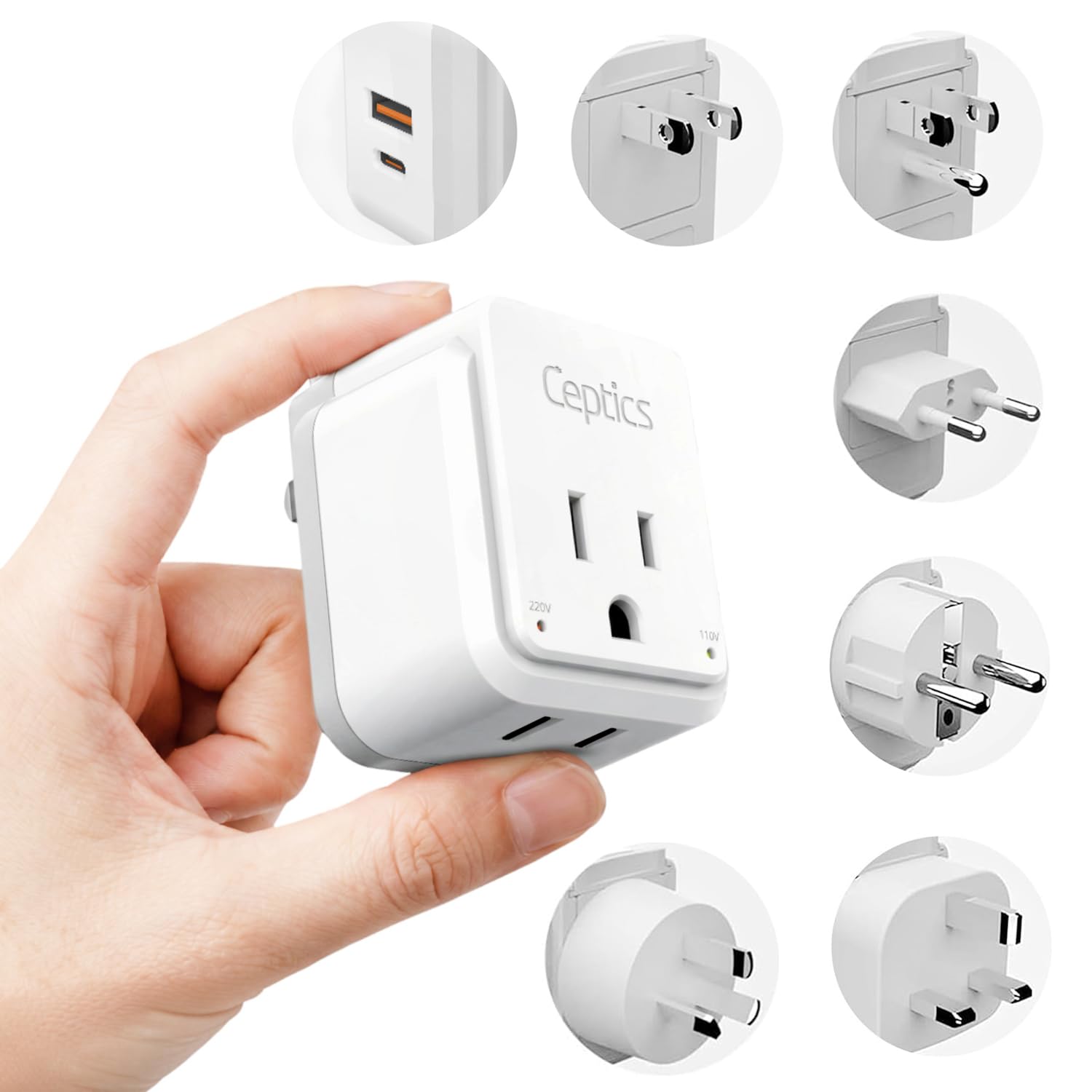
One adapter body and a bank of snap-on plug attachments instead of a pop-out all-in-one.
Ceptics builds this as a set rather than a single block. You get the main adapter with 2 USA outlets, 1 USB-A and 1 USB-C running up to 3.1A total and 20W via QC-PD (Quick Charge and Power Delivery, the two fast-charging protocols devices negotiate). The swadAPt attachment system then lets you fit the right plug for the region — Type C, G, E/F and I — covering Europe, the UK, Australia and much of Asia and South America on one purchase.
Attachments rather than sliding pins is a deliberate choice, and it is why the set suits a trip that crosses several regions in one go: you carry the one you need and leave the rest in the pouch. The body measures 1.93 x 1.6 x 2.18 inches, so the main unit is genuinely pocket-sized. Owners mention the 1.93 x 1.6 x 2.18-inch body holds up to being dumped in a rucksack between countries.
The honest limit is the power ceiling. The 20W USB-C tops up a phone well but will not charge a USB-C laptop at working speed — if that matters, the Epicka and Baseus units go far higher on wattage. And because the system is modular, you have to remember which attachment goes with which country, so label them in your packing pouch if the itinerary is complicated.
Fit for the swap-on system: modular plug attachments, 2 US outlets and USB-C PD 20W in a pocket-sized body — pack once and swap the tip per country.
Trade-off to know: 20W is phone and tablet territory, and the modular tips mean a little organising to keep the right one handy.
Ideal for: trips spanning multiple regions where you want every plug shape in one kit.
Not for you if: laptop charging speed is a priority, since 20W will not keep up.
6. VINTAR Universal Travel Adapter Kit

The one to grab for Delhi or Cape Town, where other adapters simply will not seat.
Six plug types make this the kit that covers the two sockets most others sidestep: Type D for India and Type M for South Africa, alongside A, C, G and I. If your route runs through India, South Africa, Kenya or Tanzania, this is the pick that actually fits — the Epicka and the TESSAN both stop at C, G, I and A. The detachable tips then serve sockets in Morocco, Egypt, Dubai, Israel, Thailand, the Philippines, Brazil and beyond.
On the charging side you get 5 in 1: 2 standard USA sockets rated 2500W max at 250V, plus 3 USB ports at 17W max — a dual USB-C pair running up to 3.4A (17W) and a single USB port up to 2.4A (12W). That is enough for five devices at the same rate, so you leave the extra power strip at home. The 17W USB-C ceiling is modest and sits below the Epicka’s 70W, so plan for phones, tablets, cameras and GoPros rather than a laptop under load.
The details are thoughtful for the price. An LED indicator shows the power is live, a storage bag keeps the tips from breaking in transit, and the shell is built for heat dissipation and flame resistance. It is certified CE and FCC and tested before shipment, with a 12-month warranty. Owners lean on it for Zimbabwe and Zambia trips in particular, where the Type D and Type M tips are the ones that fit.
Why it earns its slot
- Type D (India) and Type M (South Africa) tips included, which most worldwide adapters leave out
- 5 opportunities at once — 2 US outlets at 2500W max and 3 USB ports at 17W max
- LED power indicator and a storage bag to protect the detachable tips
- Heat-dissipating, flame-resistant shell, CE and FCC certified, 12-month warranty
The fair caveats
- 17W USB-C is below laptop-charging territory and trails the 70W picks on this list
- Detachable tips mean you must keep the right one organised or you lose the socket you need
Choose it when: India, South Africa or a multi-tip detachable kit is on your itinerary.
Consider a higher-wattage pick if: a laptop needs charging and nothing less than full speed will do.
7. UGREEN 45W 6-Port Universal Travel Plug Adapter Worldwide

Foldable pins, 45W and six ports in something that measures 3.48 x 2.05 x 1.22 inches.
The trick here is the pins. They fold and retract so nothing snags your bag lining, and it keeps the body at 3.48 x 2.05 x 1.22 inches at 135 grams — trim enough to live in a jacket pocket. The 6-port layout runs 2 USB-C, 2 USB-A and 2 AC, so a laptop, phone, watch and a couple of accessories all find a home. The 45W USB-C output is the useful middle ground: enough for a MacBook Air to top up, not quite the 70W of the Epicka, but well above the 20W phones-only units.
Compatibility spans Type A, C, E, F, G and I across 200+ countries — slide to the right pin for Italy’s Type L-adjacent sockets, the UK, Australia, Argentina, Japan, Korea and more. Inside, GaN-II chip tech plus automatic shut-off protection and safety shutters handle the safety side, and the shell is UL 94 V-0 flame-retardant PC (a plastic rated to self-extinguish if it ignites). It is certified to CE, FCC and UKCA, and the maker includes a 2-year warranty.
Buyers value the 6-port layout most — 2 USB-C, 2 USB-A and 2 AC from one plug. Charging speed draws mixed notes, largely because a 45W shared across six ports means each device gets less when everything is plugged in at once. Treat the headline wattage as a single-device figure and you will not be surprised.
The standout: foldable, retractable pins plus 45W over USB-C and 6 ports, in a package that slips into a carry-on without a bulge.
Watch for: shared wattage — plug in six devices and no single one gets the full 45W.
Made for: business trips and carry-on packers who want one compact block with real laptop-capable charging.
Weigh the trade-off if: you routinely charge a laptop and three phones at once, where a single-device 45W is shared thin.
8. Baseus 70W Universal Travel Adapter
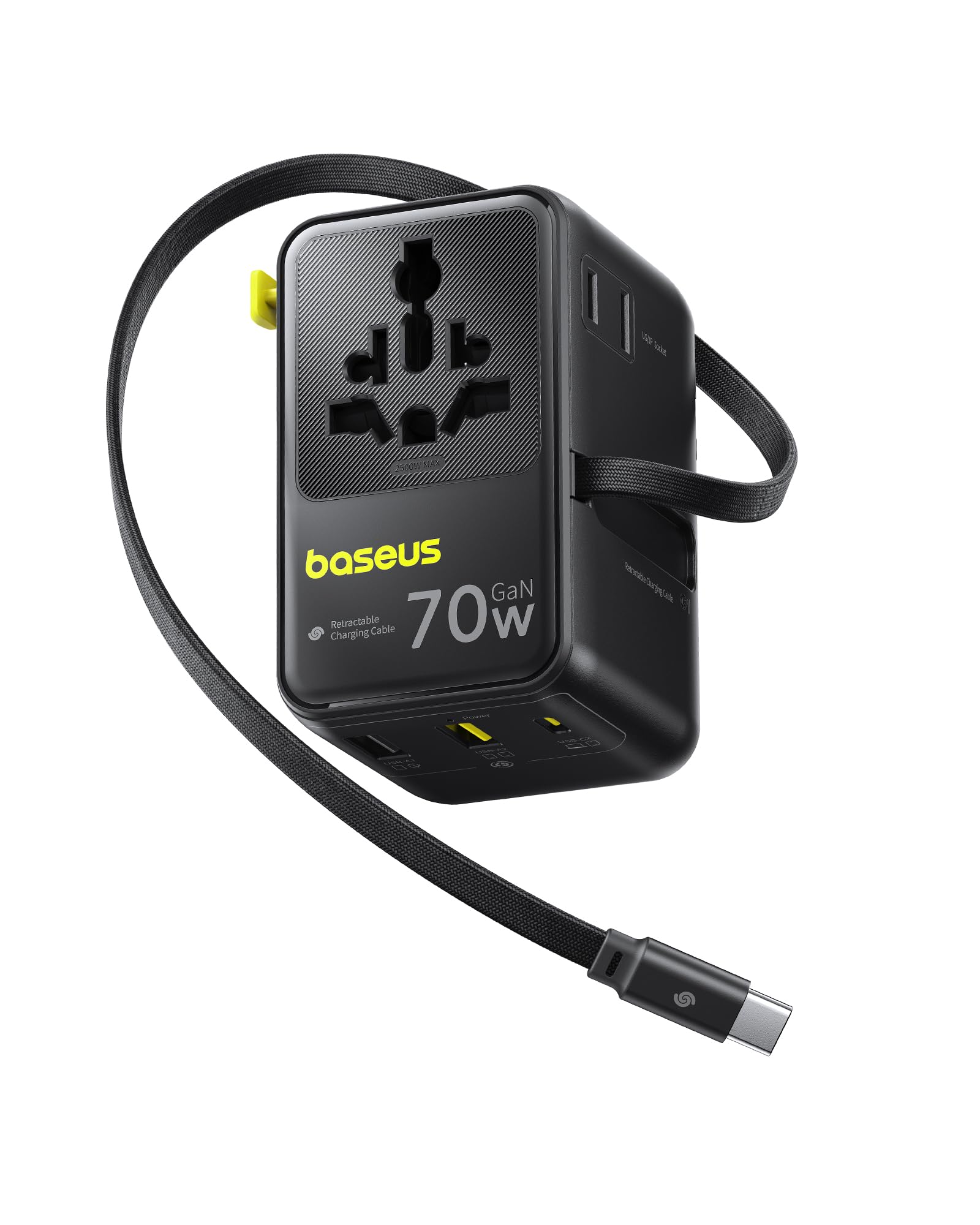
The cable is built in and retracts, so you never hunt for a USB-C lead in a hotel room again.
Enercore CG11 is the name on the box. The headline is 70W max out of a built-in retractable USB-C cable, braided with nylon so it stands up to daily pulling and winding. Pull it out to charge, let it wind back in to store — no loose lead to lose and no extra cable in the bag. Around it sit 6-in-1 multi-device charging and two AC outlets, so a laptop, tablet and phone all ride off one block.
Plug coverage runs Type C, A, G and I for 200+ countries across Europe, Asia, the USA and Australia. Safety is handled by dual 10A fuses and multiple protections — over-power, short-circuit and overheating — inside a fireproof, shock-resistant PC shell, with CE and FCC certification. It stays off surge protection, which keeps it simple to carry aboard a cruise ship.
Buyers rate it for multi-country trips, 70W fast charging and the retractable USB-C cable that replaces a loose lead. The one honest note is size: there is a split verdict on how compact it feels, and with the cable and dual fuses inside it is not the thinnest unit here. Think of it as the adapter for people who hate packing cables more than they hate a little bulk.
The decisive spec: a 70W retractable USB-C cable built straight into the body, backed by dual 10A fuses and over-power, short-circuit and overheating protection.
Best match for: cable-averse packers and multi-country trips where one block and one built-in lead carry everything.
Think again if: you want the slimmest possible adapter and do not mind carrying a separate cable.
9. Ceptics Universal Travel Adapter 35W
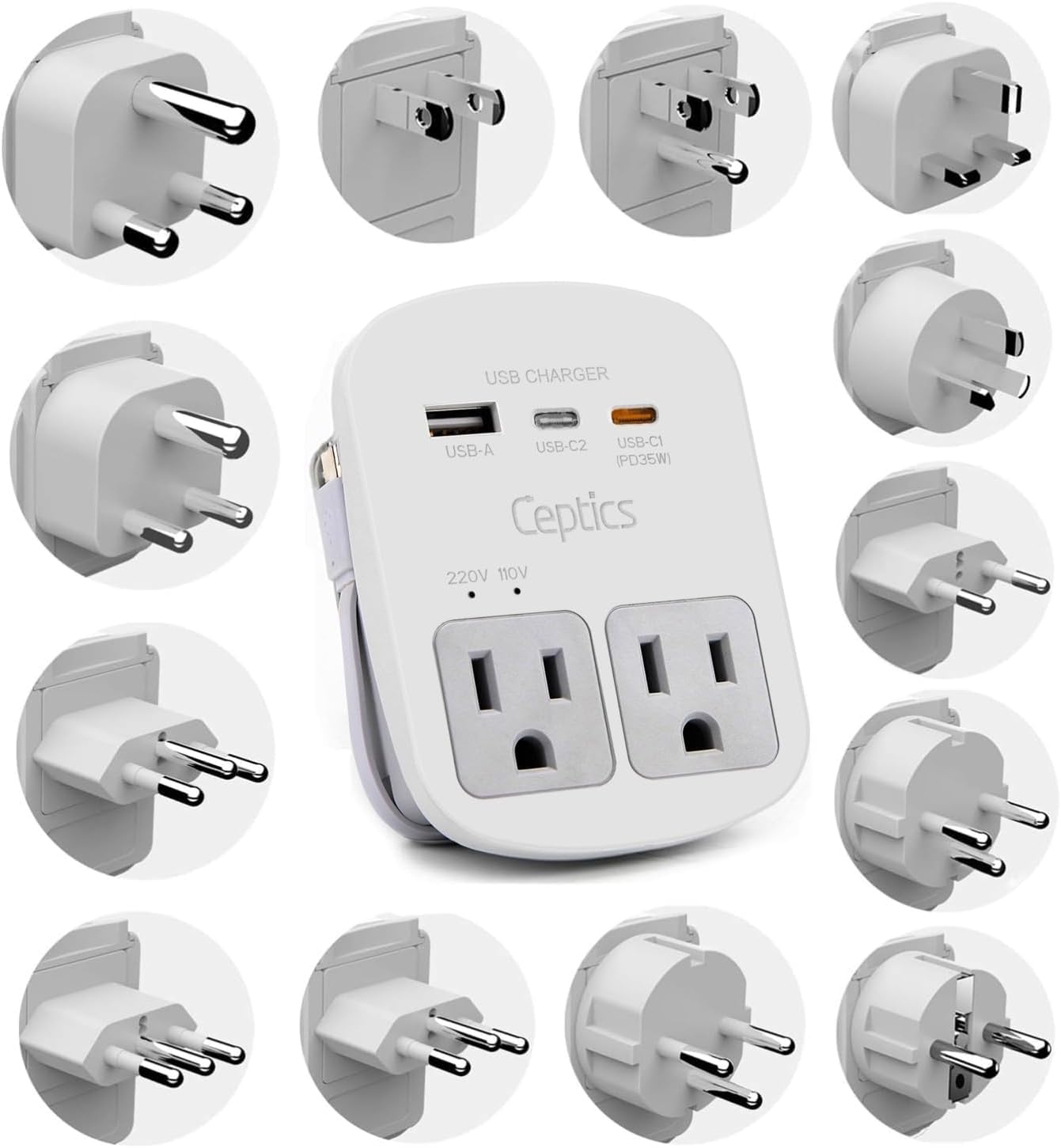
The only one here that ships with surge protection, an 85-joule guard for expensive kit.
If your travel bag holds a costly laptop or camera, this is the adapter that thinks about it. It carries built-in surge protection rated up to 85 joules — energy the adapter absorbs so a spike does not reach your electronics — and voltage indicator LEDs that light one for 110V or both for 220V, so you can see at a glance what the socket is sending. The rest is 2 USA outlets, 1 USB-A, 1 USB-C and 1 PD 35W USB-C, plus a USB-C cable and a travel pouch in the box.
The 35W PD output sits between the 20W phone-first units and the 70W laptop-class picks — enough to fast-charge a tablet or top up a laptop gently, without the bulk of a bigger block. At under 5 oz and 2.7 x 1.4 x 3.7 inches it stays a compact carry, and it works well in Europe with a good spread of plug types to match the region you are in.
The catch is the same voltage rule every adapter here repeats, and it deserves emphasis on this one: it only works with dual-voltage electronics. A 110V hair clipper, CPAP machine, hair dryer or curling iron will not run through it, because it is not a converter. It is a must-have for international travel where the gear is dual-voltage; for single-voltage appliances, no adapter on this list will do the job.
What makes it worth packing: 85-joule surge protection and voltage LEDs on a 35W PD adapter — a thoughtful guard for a laptop or camera you cannot afford to lose.
The limit to respect: dual-voltage devices only; single-voltage appliances have no path through this adapter.
Worth carrying if: you travel with high-value electronics and want surge protection built into the adapter itself.
Look elsewhere if: you want maximum USB wattage — the 70W picks beat this 35W output for laptop charging.
Know the Specs
USB-C PD wattage
PD stands for Power Delivery, the fast-charging standard that lets a port and a device agree on how much power to send. The wattage figure is the ceiling for a single port. 20W is phone territory, 35–45W can gently charge a small laptop, and 70W can drive a USB-C laptop much faster. Remember that with several ports sharing one adapter, each connected device gets less than the headline figure.
Plug types and the swappable-pin system
Every country’s wall socket has a lettered shape — Type C (two round pins) for most of Europe, Type G (three chunky pins) for the UK, Type I for Australia and China, Type A for the US and Japan. Worldwide adapters either slide between built-in pins or use detachable tips. Detachable kits reach rarer sockets like India’s Type D and South Africa’s Type M; all-in-one sliders are faster to switch and harder to lose a piece from.
Fuses and surge protection
A fuse is a thin wire that melts to break the circuit if too much current flows, protecting your devices and the adapter; a 10A fuse blows when a high-wattage appliance is drawn through it. Surge protection (measured in joules) absorbs spikes from the mains, such as from lightning, before they reach your gear. Units without surge protection are generally simpler to bring on a cruise ship, where some lines restrict surge-protected strips.
GaN (gallium nitride) charging
GaN is a semiconductor material used in newer chargers instead of the older silicon design. It runs cooler and wastes less energy, which is how a 70W charger fits into a shell small enough for a jacket pocket. You will see it labelled GaN-II or GaN III depending on the generation. The practical payoff is a smaller, cooler adapter for the same wattage.
Common Questions
Will a world travel adapter convert 220V to 110V for my US devices?
Which plug types do I need for Europe, the UK and Australia?
Can I plug a hair dryer into a travel adapter?
How many USB ports do I need for a phone, tablet and laptop?
Is a surge-protected adapter allowed on a cruise ship?
What is the difference between GaN and a standard charger?
Will my adapter work in India or South Africa?
Can a travel adapter charge a USB-C laptop?
Do I need spare fuses when I travel?
Is a detachable-tip adapter better than an all-in-one?
The Bottom Line
For most people, the world travel adapter usb winner is the Epicka 70W GaN, because 70W over PD3.0 and six outlets mean a laptop and two phones all charge from one block, across the plug types most trips need. If you travel with cables you always lose, the Baseus Enercore CG11 builds the USB-C lead into the body at the same 70W. And for a route through India or South Africa, the VINTAR Universal Kit is the one to reach for, with its Type D and Type M tips.
One honest nudge on the top pick: its 70W USB-C output is the spec that decides whether your laptop keeps up on the road.
How we choose
We do not accept paid placement. Every pick is matched to a real buyer and a real use-case; we do not hands-on test units.
Sources
Specifications: manufacturer listings and product documentation. Review insights: verified customer reviews, as of November 2026. Pricing: not shown on this page (it changes often); check the current price via the retailer link.
As an Amazon Associate, Tactical Gear Guy earns from qualifying purchases. This does not affect which products we feature.