Specs are compiled from manufacturer listings and verified buyer reviews and can change over time — please confirm the key details on the product page before buying.
If you have ever chased a rolling pin across a bare countertop while flour puffed off the edges, you already know what a wooden pastry board is for. It gives your dough one stable, floured work surface that stays still, keeps the mess contained, and wipes down when you are done. The picks below cover the three shapes that genuinely matter: a compact teak board you can chop and serve on, a huge walnut board with a raised lip and printed measurements, and a lighter beechwood board built around marking guides.
This guide is built by comparing the manufacturers’ published specifications and the patterns across verified customer reviews, so you get each pick’s real strengths and trade-offs instead of marketing spin.
You will see how thickness, weight and the markings on top change the way dough behaves under your hands. The right board turns rolling, kneading and cutting into one calm, contained job — and this breakdown of the wooden pastry board options shows which of the three suits the way you actually bake.
Top Picks
How To Choose The Best Wooden Pastry Board
Three things decide whether a pastry board helps you or fights you: how big it is, how it stays put, and what is printed on the face of it. Get those right and rolling dough stops being a balancing act.
Surface area decides what you can actually make
A board that is too small forces you to work in cramped batches and lets flour spill onto the counter. The Vesici measures 24.41″L x 23.03″W, which gives you room to roll a full pie crust without fighting the edges. The KitchenCraft at 17.72″L x 13.78″W is more compact, so it suits smaller bakes and shorter counter runs.
The lip, the groove, or neither
A raised side lip is a simple physical stop — it hooks over the counter edge or catches loose flour so the board does not slide while you press down. A juice groove does a different job: it channels liquid away so your counter stays dry. The teak board puts its groove on one side and leaves the other flat for chopping, which is why it pulls double duty.
Thickness you can feel
A thin board flexes slightly under a firm rolling pin, and that tiny movement is what shifts your dough. Thicker stock stays flat and planted. The KitchenCraft runs 0.59″ thick, the teak board 1″, and the Vesici 1.97″ — a meaningful ladder in how planted each one feels.
Markings that save you guessing
Printed diameter and length guides take the guesswork out of getting a crust to the size you want. Both the Vesici and the KitchenCraft carry measurement markings on the face. The KitchenCraft goes further with temperature conversions in °C and °F along the edge.
Side-by-Side Comparison
| Model | Best For | Dimensions | Thickness | Weight | Amazon |
|---|---|---|---|---|---|
| Teak Wood Cutting Board with Juice Groove★ Best Overall | Chopping and serving on one board | 18″L x 14″W | 1″ | 5.7 pounds | Amazon |
| Vesici Walnut Pastry Board with Lip | Large dough batches with markings | 24.41″L x 23.03″W | 1.97″ | 6.3 pounds | Amazon |
| KitchenCraft Home Made Pastry Board | Precision rolling on a lighter board | 17.72″L x 13.78″W | 0.59″ | 0.8 kg | Amazon |
Detailed Reviews
1. Teak Wood Cutting Board with Juice Groove (18x14x1″, S)
Our pick — 4.5+★ from 400+ verified ratings; the strongest balance of quality and price.
One board that rolls dough on Sunday and carves the roast on Monday.
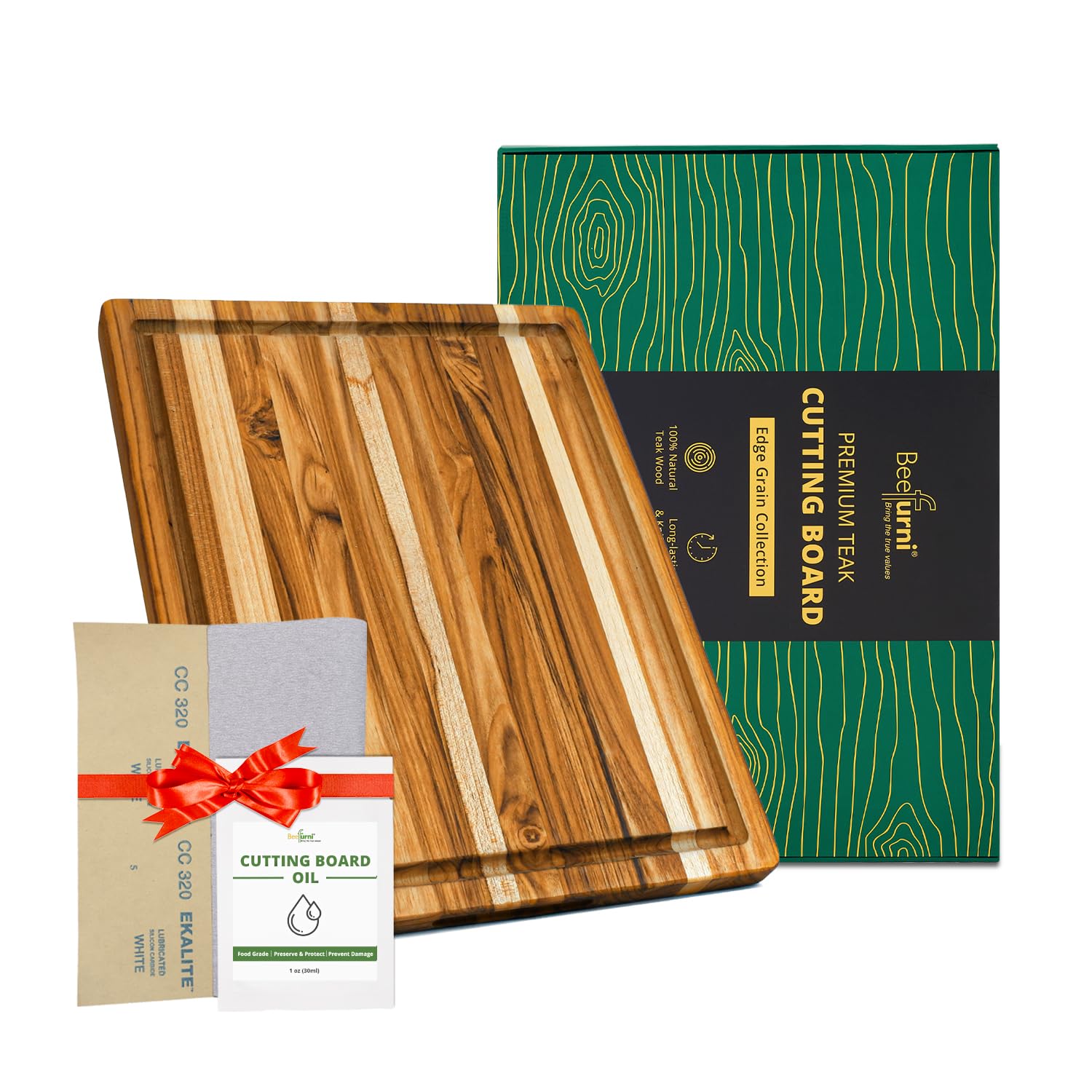
The thing that wins people over here is the way the teak looks — it is the single most praised quality of this board by a wide margin, and it carries into the dining room as a serving platter rather than hiding in a drawer. It is an edge grain build (thin strips of wood glued side by side, which makes the surface stable and gives it those long straight grain lines), and the warm brown tone reads as furniture, not utility. That dual role is why it lands at the top: it rolls dough, then carves and serves.
At 18″L x 14″W x 1″Th it is the smallest board in this group, and 5.7 pounds makes it the lighter of the two heavier picks. At 5.7 pounds it is light enough to lift one-handed yet heavy enough to stay planted. You can lift it one-handed to the counter, flip it over mid-recipe, and rinse it without a wrestling match. For pie crusts and small batches of cookie dough it is plenty of room. It is also a genuine step up from thin stock — 1″ of dense teak holds flat under a firm rolling pin in a way a 0.59″ board will not.
The double-sided design is what separates it from the dedicated pastry boards below. One face carries a deep juice groove for carving and serving juicy ingredients; the other is flat for everyday chopping. Teak’s natural moisture resistance lets it handle wet carving and dry chopping without swelling at the edges. The listed use cases run long — chopping board, charcuterie tray, cheese board, serving board, pastry board — and that range is the honest buy-in. You are getting one board that covers four jobs instead of four boards fighting for cabinet space.
What earns the top spot
- Solid 1″ teak edge grain that stays flat under pressure
- Reversible — juice groove one side, flat chopping surface the other
- Built-in side handles for carrying it to the table
- Ships with a care and maintenance kit plus a 1-year replacement on manufacturing defects
Where it asks for care
- Smallest working area here at 18″L x 14″W — big crusts will feel tight
- No measurement markings, so you size dough by eye
- Teak needs wiping and proper wood care to keep its finish
Reach for this one if: you want a single board that rolls, chops and serves, and you would rather buy once than stack four boards in a cupboard.
Look elsewhere if: you regularly roll large sheets of dough — the 18″ x 14″ face will cramp you, and the bigger Vesici is built for exactly that.
2. Vesici Walnut Pastry Board with Lip for Rolling Dough

A full 1.97″ of walnut with a lip that stops flour running for the floor.
Start with the numbers, because they tell the whole story. This board measures 24.41″L x 23.03″W x 1.97″Th and weighs 6.3 pounds. Compared with the KitchenCraft at 17.72″L x 13.78″W x 0.59″Th, you are getting a dramatically larger and thicker work surface — 6.3 pounds against 0.8 kg — which is exactly what a big batch of bread dough or a full sheet of pastry needs under it. The 1.97″ slab stays flat under a firm rolling pin.
The side lip is the detail that solves the everyday frustration. It sits proud of the surface to fix the board in place so it does not slip while you work, and the front lip acts as a backstop that keeps loose flour and stray dough on the board instead of across your counter. Engraved measurement markings on the front face let you roll a crust to a specific diameter rather than eyeballing it. Flip it over and the back carries a juice groove, so the board still handles a roast.
The honest caveat is the one worth stating plainly: this is a hand-wash-only board, and the buyer feedback on finish quality is genuinely mixed — some find the walnut handsome, others feel the finish does not match what they expected for the tier. That is a real trade-off to weigh, and the 3.0+ star score reflects it. Buy this for the dimensions, the lip and the markings — the three things it does better than anything else on this list — and treat the surface finish as a bonus if it lands well.
The case for the size: this is the board for anyone whose current surface is the limiting factor. The 24.41″ x 23.03″ footprint and 1.97″ thickness give you a slab that will not budge, and the lip plus engraved guides mean less chasing and less guessing.
What to accept going in: hand wash only, and a finish that not every buyer has been delighted with. If a perfect out-of-the-crate look matters more to you than sheer working area, one of the other two is the safer call.
Built for big batches: bread bakers, pie makers and anyone rolling dough wider than a dinner plate will feel the difference the moment the pin comes out.
Think twice if: you want a board you can set on the counter and never think about — the hand-wash requirement and split opinion on the finish ask for a little more patience.
3. KitchenCraft Home Made Pastry Board

The board that turns “about this big” into an actual measurement.
This one is for the baker who follows a recipe to the letter. The beechwood face carries clear diameter and length markings in both centimetres and inches, plus temperature conversions in °C and °F printed along the board — so a recipe written in either system needs no phone calculator mid-roll. Roll a pie case to the exact size the method asks for, knead bread dough, work a pizza base, or roll fondant icing for a cake. Those cm, inch and °C/°F markings are the whole point of this board.
Physically it is the lightest and thinnest of the three: 17.72″L x 13.78″W x 0.59″Th at 0.8 kg. Set next to the Vesici’s 1.97″ slab, this is a slim board you can hang on a hook or slide into a narrow gap beside the fridge. It suits a small kitchen where storage is the real constraint, and if you mostly roll modest rounds of dough it is enough surface. Just know that 0.59″ of beechwood will flex a touch more under a hard press than a 1″ board will.
The marking advantage: diameter and length guides in cm and inches, plus °C to °F conversion on the board itself. No other pick here covers both systems and temperature on the face.
The honest trade-off: you trade footprint and heft for that convenience. If you regularly roll wide sheets, the smaller 17.72″ x 13.78″ face and 0.59″ thickness will feel light, and you will want the extra room of the Vesici.
Suits the recipe-follower: anyone who bakes from written methods and wants the size and temperature right without a second screen open on the counter.
Less ideal for: large-format rolling and heavy kneading, where the compact size and thin stock leave you wanting more board underneath.
Know the Specs
Dimensions and thickness
Two measurements decide how a board feels in use: the working face and the thickness under it. A larger face like the Vesici’s 24.41″L x 23.03″W gives you room for big sheets of dough. Thickness is about rigidity — 1.97″ or 1″ holds flat under a rolling pin, while 0.59″ gives slightly more. Match the size to the biggest thing you actually roll, not the biggest thing you can imagine.
Lip versus juice groove
A lip is a raised edge that fixes the board in place and acts as a backstop so flour and dough stay put. A juice groove is a channel that catches liquid so your counter stays clean. They solve different problems, and the teak board pairs a groove with a flat reverse side while the Vesici pairs a lip with engraved markings. Neither is better — pick the one that matches your mess.
Wood type and weight
Teak resists moisture and takes hard use, walnut brings a darker, denser look, and beechwood keeps a board light. Weight follows from that: the 0.8 kg beechwood KitchenCraft is easy to lift and hang, while the 6.3 pound Vesici and 5.7 pound teak board feel planted and stay put once set down. Heavier boards move less; lighter boards store more easily.
Measurement markings
Printed or engraved diameter and length guides let you roll dough to a target size instead of guessing. The KitchenCraft also lists temperature conversions in °C and °F, useful when a recipe switches systems. If you bake from written methods and care about exact sizing, markings earn their space on the board. If you work by feel, a plain reversible surface like the teak board suits you better.
Common Questions
Is a wooden pastry board better than rolling dough straight on the counter?
What size pastry board do I need for a full pie crust?
Do the measurement markings on a pastry board actually help?
How thick should a wooden pastry board be?
Can I cut and serve on the same board I roll dough on?
How do I clean and maintain a wooden pastry board?
Will a heavy wooden board slide around while I roll?
Does a wooden pastry board dull my knives if I chop on it?
Should I pick teak, walnut or beechwood for a pastry board?
The Bottom Line
The board that fits most kitchens is the BEEFURNI Teak Wood Cutting Board, because it rolls dough on one face, chops and serves on the reverse, and sits at 1″ thick and 5.7 pounds — planted enough to stay flat, light enough to lift one-handed. If you roll wide sheets of dough and want a lip to keep flour in bounds, go with the Vesici Walnut Pastry Board and its 24.41″L x 23.03″W face. And for anyone who bakes to exact numbers in a small kitchen, the KitchenCraft Home Made Pastry Board earns its place with centimetre, inch and temperature guides and a 0.8 kg weight you can hang on a hook. The teak board’s 4.5+ star rating across 400+ owners makes it the safest first buy.
How we choose
We do not accept paid placement. Every pick is matched to a real buyer and a real use-case; we do not hands-on test units.
Sources
Specifications: manufacturer listings and product documentation. Review insights: verified customer reviews, as of November 2026. Pricing: not shown on this page (it changes often); check the current price via the retailer link.
As an Amazon Associate, Tactical Gear Guy earns from qualifying purchases. This does not affect which products we feature.