Specs are compiled from manufacturer listings and verified buyer reviews and can change over time — please confirm the key details on the product page before buying.
Buying working dog equipment is mostly about one question: will the hardware hold when your dog hits the end of the leash at full speed? Everything else — patches, pouches, colour — is decoration on top of that. This guide sorts nine real options by what they physically do for you and your dog, from a harness built around two metal shoulder buckles to a GPS collar that reports back from up to nine miles out.
This guide is built by comparing the manufacturers’ published specifications and the patterns across verified customer reviews, so you get each pick’s real strengths and trade-offs instead of marketing spin.
You’ll see which harnesses stay put on a Rottweiler chest, where a bite sleeve earns its keep, and which electronics genuinely survive wet field work. Below are nine picks judged on buckle material, girth range and waterproof ratings — the specs that decide whether gear survives a hard pull.
Top Picks


How To Choose The Best Working Dog Equipment
The gear on this page splits into three jobs: something to carry and control the dog (vests and harnesses), something to train a bite (sleeves), and something to reach the dog at distance (electronic collars). Buy for the job you actually do: a MOLLE vest loaded with pouches suits patrol work, while a slim e-collar receiver suits a dog that works off-leash.
Measure the dog, do not weigh the dog
Every harness here is sized by tape measure, not by the number on the scale. The WINSEE vest in position one is cut for a neck girth of 21-28 inch and a chest girth of 24-39 inch. A 90 lb dog with a narrow chest can swim in it, and a 70 lb dog with a barrel chest can be pinched by it.
Run the tape around the widest part of the ribcage and around the base of the neck where a collar sits. Then match those two numbers to the chart. Guessing by breed or by weight is the single most common way buyers end up returning a tactical vest.
Read the buckle material before the badge count
Check the buckle material before the patch count. A harness with metal shoulder buckles spreads a hard pull across a rigid part that resists bending, while the plastic quick-release clips on the chest are there for convenience. Several picks here mix both, and that mix is exactly where expectations and reality can drift apart.
Decide what the collar needs to do
An electronic collar is a remote-controlled correction and cue system. Range, stimulation levels, waterproof depth and battery hours decide whether it suits a fenced training yard or a 200-acre hunting lease. Pay for the range you will actually use, and no more.
Side-by-Side Comparison
| Model | Best For | Type | Fit Range Or Range | Key Hardware | Amazon |
|---|---|---|---|---|---|
| Tactical Dog Harness with Dog Leash (WINSEE)★ Best Overall | All-round working vest | MOLLE vest + leash | Neck 21-28 in, chest 24-39 in | 2 metal shoulder buckles, 3 D-rings | Amazon |
| 2X Metal Buckle Service Working MOLLE Dog VestBudget Champion | Budget entry to MOLLE vests | MOLLE vest | Neck 21-28 in, chest 24-39 in | 2 metal shoulder buckles, 2 D-rings | Amazon |
| OneTigris Service Dog Vest HarnessMost Trusted Build | Service dog with saddle pouches | Saddle-bag harness | Size M: chest 24-32 in, back 8 in | 1000D nylon, UTX-Duraflex buckles | Amazon |
| Tactical Dog Harness with 4 Metal Buckles (JVA Pro) | Escape-prone strong pullers | Tactical vest | Neck 25-30 in, chest 32-39 in | 4 metal buckles, 1700D nylon | Amazon |
| MelkTemn Dog Bite Training Set | Young dogs, first bite work | Bite sleeve + stick | Sleeve 23.6 x 11.8 in | Jute outer, foam inner, wood handle | Amazon |
| Morezi Dog Bite Sleeve Training Set | Entry-level tug and bite play | Bite sleeve + stick + toy | Sleeve 25 x 11.8 in | Canvas outer, cotton padding, 2 handles | Amazon |
| SportDOG SportTrainer 875 | Field training, close-working dogs | E-collar system | 1/2 mile range | 10 stimulation levels, DryTek waterproof | Amazon |
| Dogtra ARC-X | Slim collar for sensitive-fit dogs | E-collar system | 3/4 mile range | 100 levels, IPX9K waterproof | Amazon |
| Garmin Alpha TT 25 | GPS tracking at long distance | Tracking collar (handheld sold separately) | Up to 9 miles | 18 stimulation levels, replaceable battery | Amazon |
Detailed Reviews
1. Tactical Dog Harness with Dog Leash
Our pick — 4.5+★ from 450+ verified ratings; the strongest balance of quality and price.
Two metal shoulder buckles take the shock so a hard-charging dog never bends the hardware.
This is the closest thing on the list to a complete working kit out of one box: a MOLLE vest, two backpack pouches, a training leash with two padded handles, and 10 reflective patches. The load-bearing structure is the part that matters. Two metal shoulder buckles sit at the top of the pull, with four plastic quick-release clips rated to 250lb proof-loading handling chest and belly adjustments.
Fit is built around a neck girth of 21-28 inch and a chest girth of 24-39 inch, with a back length of 13.5 inch for large breeds. That is where the harness wins its following — the vest sits where it should on big-chested dogs, and people keep the same one through a working season. The padding sits on every pressure point and the air mesh under-panel keeps air moving across the chest.
The three stainless D-rings give you a front anti-pull clip for training, a neck-side ring for a short walking leash, and a rear ring for a long line on hikes. That front clip is the piece that stops a dog leaning into the leash. If you want the version with a second rear D-ring, the smaller WINSEE vest in the next spot has one, but this one trades that for the included leash and pouches.
What earns its place
- Metal buckles at the shoulder where a hard pull actually lands
- Three D-rings cover anti-pull training, close walking and long-line work
- Comes as a set: harness, two pouches, leash, 10 patches
- Air-mesh padding across every pressure point
Where it asks for care
- Hand wash only — the padding does not want a machine cycle
- Adjustment takes some effort to dial in the first time
- At 2.2 pounds it is real weight on the dog, not a featherweight vest
Take this one if: you work a large breed and want a full MOLLE setup — vest, pouches, leash and patches — in a single purchase.
Look elsewhere if: you need a rear D-ring specifically, or your dog sits at the small end of the size range.
2. 2X Metal Buckle Service Working MOLLE Dog Vest
The vest you can stuff in a go-bag without grieving the cost of it.
Eleven pieces in the box — the vest plus 10 patches — and it lands at the bottom of the price ladder while still carrying metal where it counts. This is the second WINSEE vest on the list, and the honest comparison is right there in the spec sheet: 11 items versus the 1 item in the vest-leash bundle above, because this one skips the leash and pouches and gives you patches instead.
Construction shares the same large-dog geometry: neck girth 21-28 inch, chest girth 24-39 inch, back length 13.5 inch, and 0.58 kg on the dog’s back. What it does well is hold the vest steady without pinching, and the reflective strip running across the design brightens the dog for evening walks so drivers spot it sooner. Two stainless D-rings give you an anti-pull front clip and a neck-side ring for short-leash walking.
Here is the catch, and it comes from the spec sheet rather than a bad unit: only the two shoulder buckles are metal. The chest quick-release clips are plastic, rated to 250lb proof-loading but still plastic. If you expect four metal buckles, look at the JVA Pro further down instead.
What stands out: boldest colour available here, slick black over the whole vest, and enough included patches to label the dog for service, in-training, or a plain do-not-pet warning.
The practical trade: the first adjustment is fiddly — expect to fiddle with the straps before the vest sits right.
The smart buy when: you want a MOLLE-capable, metal-shouldered vest for a large breed and you’d rather add your own leash.
The wrong buy when: you need every buckle metal end to end.
3. OneTigris Service Dog Vest Harness
A saddle-bag harness built for a service dog that carries its own kit.
Where the two WINSEE vests are chest harnesses first, this OneTigris piece is a cargo system. Two saddle pouches sling over the back for treats, poop bags, toys, or a handler’s medications and emergency contact card. There’s a clear ID window that takes a standard patch, plus a service dog handle attachment D-ring and a leash clip. The body is 1000D nylon — a heavy woven fabric with a dense thread count that shrugs off dirt, water and abrasion better than a light polyester shell.
The fit range tells you who this is for: Size M runs neck girth 16-23 inch, chest girth 24-32 inch, back length 8 inch, for dogs from 30 to 60 lb. Size L runs neck girth 18-25 inch, chest girth 27-36 inch, back 9 inch, for 60 to 90 lb dogs. Compared with the JVA Pro vest’s 25-30 inch neck and 32-39 inch chest, this is a considerably smaller footprint, and 8 inches of back length leaves less real estate to load up.
Breathable mesh lines the inside for airflow, and the quick-release hardware is UTX-Duraflex — a reputation-building brand in load-bearing buckles, which is exactly the kind of confidence you want if your service dog works a public routine. The harness is not chew-proof and not scratch-proof, so store it dry and away from teeth.
Built to take punishment: the 1000D nylon and reinforced stitching are what people keep coming back to, and the weight comes in at 0.6 kg — roughly the same as the JVA Pro vest’s 0.67 kg, so you don’t pay for the toughness in drag on the dog.
Go here if: your service dog carries supplies on the body and you want the ID window and handle D-ring in one unit.
Stay clear if: your dog chews its gear — this one needs to come off between sessions.
4. Tactical Dog Harness JVA Pro

Four metal buckles and a waterproof 1700D shell for the dog that has already broken a vest.
If you have a dog that has snapped a plastic chest clip mid-pull, this is the pick that answers it. The JVA Pro vest uses four solid metal buckles, four metal hooks and two metal leash clips — no plastic component anywhere in the buckle system, and that’s stated directly by the maker. The shell is 1700D nylon, substantially heavier woven fabric than the 1000D used on the OneTigris, with a waterproof finish and a breathable Air-Mesh under-pad so the dog isn’t sitting in its own heat.
Sizing is the largest chest cut on this list: neck girth 25-30 inch, chest girth 32-39 inch, back length 11 inch. Compare that with the OneTigris Medium’s 24-32 inch chest and 8 inch back — a meaningful jump in both directions. The front and back D-rings give you a no-pull training clip up front and a daily walking clip at the rear, and four adjustable straps let you tighten the fit as the dog fills out.
The trade-off is weight and break-in. At 0.67 kg, this is heavier than the OneTigris, and the tightness some owners run into happens at the boundary — it’s firm on a dog near the top of the chest range. Measure before ordering.
Why handlers pick it
- Metal throughout the buckle system instead of plastic chest clips
- 1700D nylon with a waterproof finish for wet field days
- Widest chest range here at 32-39 inch
- Front no-pull clip plus rear walking clip
What to know before you click
- Fit runs firm on dogs near the top of the chest range
- Heavier on the dog than the OneTigris saddle harness
- Stitching quality is the recurring niggled point
Strongest match for: an escape-prone, hard-pulling large breed that has already wrecked a lighter harness.
Thin margin for: a dog right at 39 inch chest who needs a looser cut — size up if you’re close.
5. MelkTemn Dog Bite Training Set

A jute sleeve with a wooden core handle — the entry point into structured bite work.
Two pieces here: a bite sleeve of 23.6 x 11.8 inch and an agitation stick of 22.4 x 1.1 inch. That broad sleeve face is the point of the design — it gives a young dog a wide target to commit its mouth to, which is exactly what you want in Schutzhund-style or police-entry groundwork with a Malinois or German Shepherd pup under 12 months.
The build is a jute outer layer over thick foam, with a foam-covered interior handle so a full-force bite lands on padding rather than your forearm. The handle is engineered wood with a soft anti-slip coating, described by the maker as stronger yet lighter than a steel handle. It’s ambidextrous — the sleeve slips onto either arm, over thick clothing if you want an extra layer, and comes off with a pull.
The honest limitation. Durability is the split point in how people read this sleeve. It’s rated for entry-level work, and it behaves like it — a hard adult dog that takes a full committed bite on every rep will wear the jute faster than a lighter pup will. Treat it as a training-stage tool, not a permanent daily driver for a finished protection dog.
Where it shines: quality of build is what carries it — the foam density and the handle grip make it usable the first session from the start.
Who should look up a tier: if your dog already bites hard and repeatedly, budget for something rated above entry-level.
Reach for this when: you’re introducing a young dog to bite work and want a jute sleeve with a solid handled core at entry cost.
Skip the upgrade if: your dog is already past 12 months and biting with full commitment.
6. Morezi Dog Bite Sleeve Training Large Dogs Set
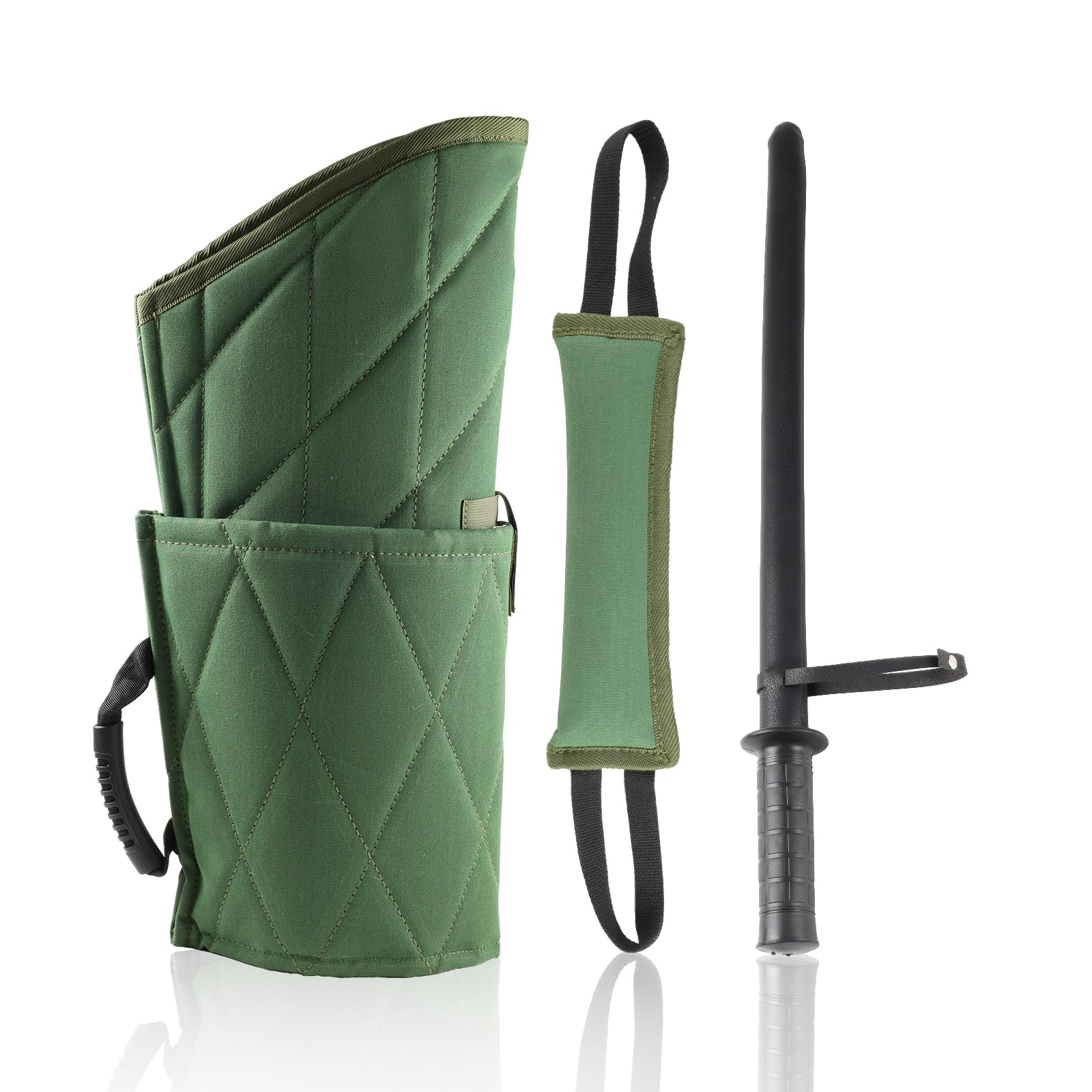
Three pieces, two handles, and a detachable middle section that changes how the sleeve reads.
The kit is 1 bite sleeve, 1 training stick, and 1 dog bite toy. The sleeve measures 25 x 11.8 inch, sized for Police K9 lines, German Shepherd pups and young dogs. Its distinguishing feature is the middle section, which detaches — and the bite area is marked by stitching so the dog knows where to aim. Two handles, outer and inner, mean you can wear it on either arm and the outer handle doubles as a wall hook.
Materials are canvas over cotton padding, and that is a meaningful step down in toughness from the jute-and-foam construction on the MelkTemn sleeve above. The canvas is breathable over your arm, which helps on a warm training day, but it doesn’t hold up the same way against a serious grip.
Two things a buyer should not gloss over. First, the sleeve runs big — the 25 inch length on a smaller dog means less of it gets bitten. Second, a sleeve like this asks to be a tugging tool, not a chew toy — the maker’s own instruction is to put it away the moment the session ends, because leaving a dog to keep chewing on it will shred the fabric quickly.
Best fit: someone starting a young dog on tug-and-bite work who wants sleeve, stick and toy together and won’t be running every-day sessions.
Known limit: canvas over cotton wears before jute over foam does on a powerful dog.
The right three-piece kit if: you’re introducing a puppy or young dog to tugging and don’t need protection-grade durability yet.
The one to pass on if: your dog bites hard and often — canvas is not the shell for it.
7. SportDOG SportTrainer 875 Remote Dog Trainer, 1/2 Mile Range

Half a mile of reach, ten stimulation levels, and a collar that goes under water.
A remote trainer is only useful if the signal still reaches when your dog is working cover fifty yards past the fence line. The SportTrainer 875 gives you a 1/2 mile range, which covers field training and hunting with close-working dogs. It fits dogs 8 pounds or larger with neck sizes of 5-22 inch, and you can expand the same handheld to run up to 3 dogs with add-a-dog collars.
The handheld carries an OLED screen — an easy-to-read display that shows the selected dog, the static stimulation level, and battery status at a glance. Ten levels each of continuous and momentary static are on tap, alongside vibration and tone, so you can cue a soft dog without ever using static at all.
Water is where this earns its field reputation. The collar is submersible to 25 feet using DryTek technology, so a dog that swims a pond mid-session keeps working. The lithium-ion packs charge in 2 hours and run 50-70 hours per charge, with low battery indicators on the system. Battery life is where opinion splits — some get days, some get a day and a half out of a charge.
Where it earns trust
- 1/2 mile range suits real field work, not just the backyard
- Submersible to 25 feet — pond and rain work are fine
- 10 levels of continuous and momentary static plus vibration and tone
- Expandable to 3 dogs on one handheld
What to weigh
- Recharge claims vary — 50-70 hours is the spec, real-world use splits
- The handheld is the pricier side of the e-collar market
- Neck strap fit stops at 22 inch, so the biggest necks need a different collar
Pick this when: your training happens outdoors at distance and water is part of the picture.
Look elsewhere if: you train in a fenced yard, where the range you’re paying for never gets used.
8. Dogtra ARC-X E-Collar

A collar thinner than most, rated to survive water at pressure, with 100 notches of control.
If your dog is a giant breed or a large dog with a sensitive neck, bulk on the collar becomes a real issue. The ARC-X is 30% slimmer than Dogtra’s 1900X and weighs 2.75 oz, with a curved receiver that sits close against the neck. The strap is Biothane — a coated webbing that wipes clean and doesn’t soak up water or mud like fabric does. It’s sized for Giant, Large and Medium breeds, and fits dogs 15 lbs and up.
The electronics are where this pulls ahead of the SportDOG in granularity: 100 stimulation levels here versus 10 on the SportDOG. It gives you Nick, Continuous and XPP Vibration modes, with Boost and Level Lock for precision control on a dog with a tricky temperament. Range is 3/4 mile, and the same remote expands to train up to 3 dogs.
The waterproof rating is the standout spec — IPX9K. That’s a protection code for high-pressure, high-temperature water jets, not just a splash rating. An LED beacon and audible tone keep the dog visible in low light and brush. The honest constraint: this is a training tool, not a tracking one. If you need to know where the dog is on a map, the collar below covers that.
Why it earns its slot: the combination of a slim receiver, Biothane strap and IPX9K rating is what makes it a good fit for large dogs working wet ground.
The caveat: 100 levels means a bigger learning curve on setup than a 10-level system.
Best for: large dogs that need minimal collar bulk and precise graduated control in wet field conditions.
Think twice if: you want a simple dial-it-and-go trainer — this is a finer-grained instrument.
9. Garmin Alpha TT 25, GPS Dog Tracking & Training Collar

The one that tells you where the dog is from nine miles away, not just corrects it.
Tracking is a different job from training, and the Alpha TT 25 does both. Paired with a compatible Garmin handheld, it sends training commands and location data up to 9 miles, with position updates as frequent as 2.5 seconds. Compare that with the 3/4 mile on the Dogtra and 1/2 mile on the SportDOG — those two correct a dog you can see; this one lets you correct a dog you can’t.
The training side is 18 levels of continuous or momentary stimulation plus audible tone and vibration. The collar itself is rugged but slim enough to fit large and small breeds, with a user-replaceable flex band. A large multicolor LED in yellow, magenta, cyan, white, green, red or blue identifies the dog in the dark. When it charges on Wi-Fi at home, it updates automatically.
Battery is where this gets genuinely interesting for long days. Running dynamic tracking that adjusts on the dog’s movement, a standard pack lasts up to 68 hours, and the upgraded expanded pack doubles that to 136 hours. The packs are user-replaceable. Two things you buy separately: the handheld unit, and the fact that this is a GPS product, so the electronics carry a premium over a pure e-collar.
The reason to pay more: 9 miles of range and a 2.5-second refresh are field-trial tooling, and the 68-hour standard battery covers a weekend out without a charge.
Read the fine print: the handheld is sold separately — this collar does nothing without one, so budget for the pair.
Built for: hunters and trial handlers whose dogs range out of sight and who need to find them, not just call them.
Not the answer for: a fenced-yard trainer — you’d be paying for GPS range you never use, plus a separate handheld.
Know the Specs
Girth measurement vs. weight
Neck and chest girth are tape measurements in inches, taken around the body, and they decide fit far more reliably than weight does. A vest cut for 24-39 inch chest like the WINSEE and 32-39 inch chest like the JVA Pro will land differently on similarly sized dogs. Take both girth measurements before you open the size chart.
MOLLE webbing
MOLLE is a grid of horizontal webbing rows that you thread straps through. It’s what lets you bolt on pouches, water bottles and gear, and the more panel area, the more you can attach. A vest with large MOLLE coverage gives you flexibility; a smaller harness like the OneTigris Medium gives you space for saddle pouches and little else.
Denier count (D)
The D number on nylon is the thread weight. 1000D is a heavy weave and 1700D is heavier still, which translates to abrasion and tear resistance when a dog pushes through brush or a fence line. Thicker fabric adds a bit of weight and stiffens up the fit.
Waterproof rating codes
IPX9K is a protection code for high-pressure, high-temperature water jets. A submersible depth like the SportDOG’s 25 feet tells you how far under it can go. Both describe water resistance at different pressures — neither is an invitation to leave any collar underwater for hours.
Stimulation levels on a training collar
The number of static levels sets how finely you can dial the correction. Ten levels is a small dial with big steps; 100 is a fine dial with small steps. More steps suit sensitive dogs and precise training, but take longer to set up.
Range, refresh and battery hours
Range is the distance the remote stays connected to the receiver. Refresh is how often the receiver reports its position — 2.5 seconds on the Garmin is tight enough to follow a moving dog. Battery hours are what you get before the receiver needs a charge, and dynamic tracking is a feature that stretches those hours by matching the report rate to the dog’s movement.
Common Questions
How do I size a MOLLE vest for my working dog?
Are metal buckles really stronger than plastic ones on a dog vest?
Can I attach a GoPro or water bottle to a MOLLE dog vest?
What age can a puppy start using a bite sleeve?
What does the IPX9K rating on the Dogtra ARC-X actually mean?
Do I need a handheld unit for the Garmin Alpha TT 25 collar?
How long does an e-collar battery last on a full charge?
What is the difference between a tracking collar and a training collar?
How many patches come with a service dog vest?
Will a bite sleeve fit on either arm and over a jacket?
The Bottom Line
For most handlers, the winner in working dog equipment is the WINSEE Tactical Dog Harness with Dog Leash — it’s the only pick here that arrives as a complete working kit, with metal shoulder buckles, three D-rings, a training leash and ten patches in one box. If you work a service dog that needs to carry its own supplies, the OneTigris Service Dog Vest Harness in 1000D nylon with saddle pouches and an ID window is the more sensible shape. And if the dog ranges out of sight, the Garmin Alpha TT 25 with up to 9 miles of tracking is the one worth the premium.
Measure neck and chest girth before you check out. Girth numbers, not body weight, decide whether a vest sits straight or wears wrong, and every pick above has its size range spelled out for exactly that reason.
How we choose
We do not accept paid placement. Every pick is matched to a real buyer and a real use-case; we do not hands-on test units.
Sources
Specifications: manufacturer listings and product documentation. Review insights: verified customer reviews, as of November 2026. Pricing: not shown on this page (it changes often); check the current price via the retailer link.
As an Amazon Associate, Tactical Gear Guy earns from qualifying purchases. This does not affect which products we feature.