Specs are compiled from manufacturer listings and verified buyer reviews and can change over time — please confirm the key details on the product page before buying.
The hardest part of buying a cable machine is not the money — it is the delivery. These are freight-shipped steel frames that arrive in two or three crates, weigh hundreds of pounds, and take an afternoon to bolt together. Get the pulley system wrong and you live with a sticky cable on every single rep. Get the footprint wrong and it will not fit the garage you cleared out for it. So the real question is this: how much cable travel, how many pulley height positions, and how many square feet of floor do you actually need for the training you do? Answer those three numbers and most of the list eliminates itself.
This guide is built by comparing the manufacturers’ published specifications and the patterns across verified customer reviews, so you get each pick’s real strengths and trade-offs instead of marketing spin.
Below you will find thirteen cable stations sorted by what each one genuinely does best, from apartment-friendly crossovers to dual-stack commercial frames, with the pulley travel, resistance limits, and assembly realities spelled out in plain terms so you can pick a workout cable machine once and stop shopping.
Top Picks

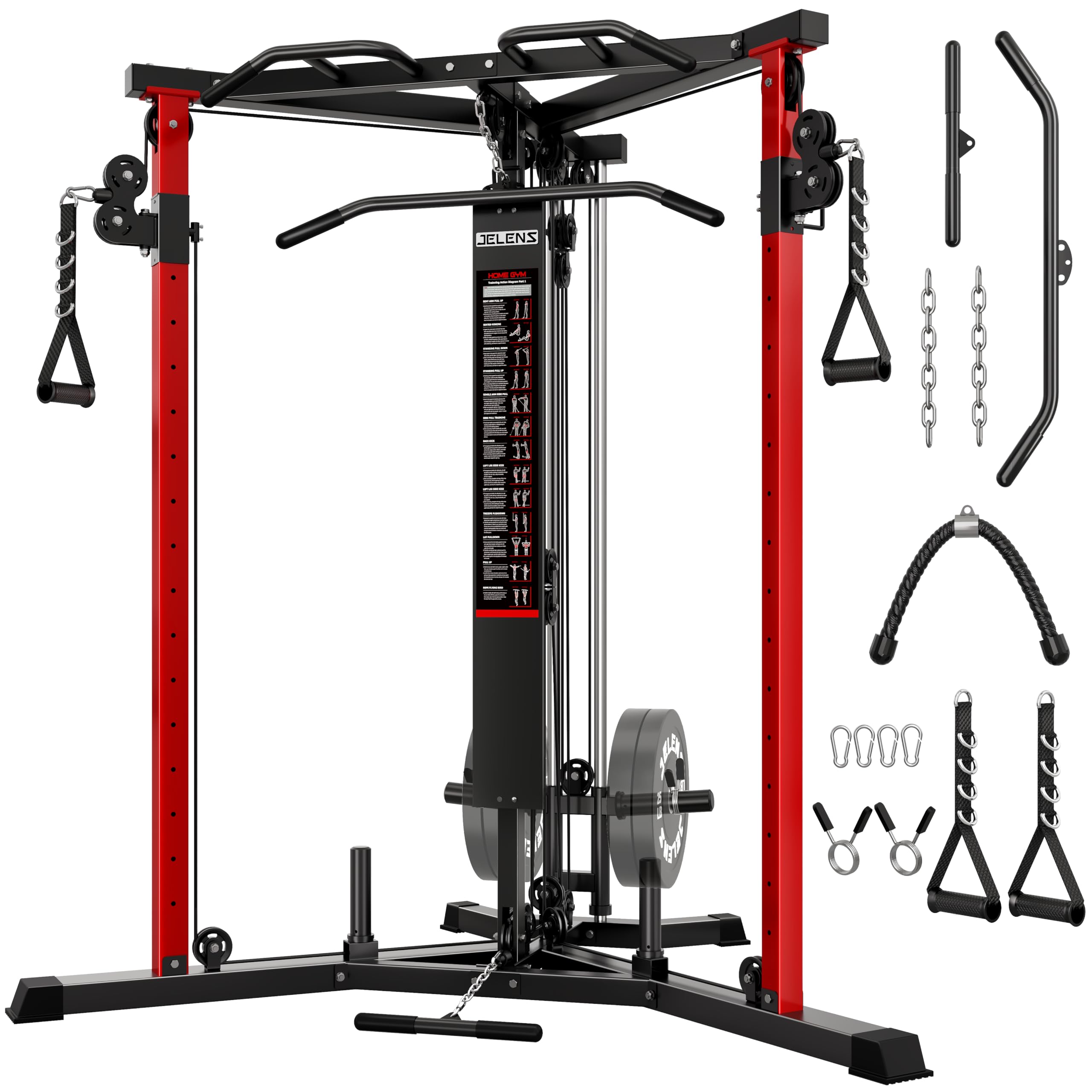

How To Choose The Best Workout Cable Machine
A cable machine is really three purchases bundled together: a frame, a resistance source, and a pulley system. Buyers obsess over the frame colour and skip the pulleys, which is backwards. The pulleys and cable are the parts you touch on every rep, and they are the hardest thing to upgrade later. Here is how to think about each decision before you commit floor space to 800 pounds of steel.
Start with floor space, not the weight stack
Measure your wall to wall first, then read the depth and width figures on the listing. A crossover with a 64-inch depth needs a genuinely open bay, while a compact trainer can tuck against a wall. Some listings also publish a square-footage figure, which is the fastest sanity check — a frame occupying around 12 square feet slides into a small apartment gym, while a wide commercial crossover will not. Leave room to walk behind the machine and to lie a bench down in front of it.
Understand the pulley ratio before you compare stack numbers
A 2:1 pulley ratio means the cable travels two inches for every inch the stack moves, so the resistance you feel at the handle is roughly half the stack weight — smooth and fast, good for flys and crossovers. A 1:1 ratio means the weight you pin is the weight you lift, which is what you want for rows and presses. Machines with independent pulleys let you run 1:1 on both sides and train one arm at a time. Compare ratios before you compare stack weights, because a 165 lb stack on a 1:1 machine can feel heavier than a larger stack on a 2:1.
Count the pulley height positions
Every adjustable height open up a new exercise. Fifteen positions covers seated rows and high flys; twenty or more covers low-to-high chops, face pulls, and ankle work as well. The best crossovers publish a range like 12 inches to 75 inches, which lets you drop the pulley to floor level for leg work and raise it above shoulder height for lat pulldowns. Each added position open up another exercise, so count them before you compare stack weights.
Plate-loaded or selectorized stack
Plate-loaded machines use your existing weight plates on sleeves or a carriage, which keeps the frame lighter and cheaper but requires you to own plates. A selectorized stack has the weights built in — pull one pin and you are done, with no plate shuffling between sets. Built-in stacks cost more up front, but they make drop sets and supersets genuinely fast. If you already own a bar and plates, plate-loaded is the smarter buy.
Side-by-Side Comparison
| Model | Best For | Resistance Source | Pulley Positions | Footprint (D x W x H) | Amazon |
|---|---|---|---|---|---|
| XMARK Commercial Cable Machine★ Best Overall | Dual independent stacks | Dual 200 lb stacks | 19 heights (12″–75″) | 43.5″D x 65″W x 83″H | Amazon |
| CC01 Cable Crossover MachineSmall-Space Pick | Small-space crossovers | Plate-loaded (210 lb) | 15 levels | 64.17″D x 53.94″W x 81.89″H | Amazon |
| Body-Solid Best Fitness Functional TrainerEasiest Build | Easiest assembly | 190 lb stack | 180° swivel pulleys | 39″D x 112″W x 82″H | Amazon |
| DONOW Cable Crossover Machine | Independent dual pulleys | Dual cable system | 16 heights | 56″D x 79.7″W x 81″H | Amazon |
| ROBORE Home Gym System | Beginners leaving the gym | 160 lb stack | High / mid / low | 66″D x 38″W x 79″H | Amazon |
| Mikolo HR06 Power Cage | Cage plus cable combo | 1:1 dual pulley | 30 heights (2″ spacing) | 61″L x 53.4″W x 86″H | Amazon |
| Mikolo Home Gym Pro Station | Max exercise variety | 152 lb stack | High / mid / low | 75″D x 36.3″W x 80″H | Amazon |
| Valor Fitness BD-61 | Existing plate owners | Plate-loaded (200 lb) | 17 positions | 56″D x 50″W x 81″H | Amazon |
| Roygym Smith Machine | All-in-one training | 1:1 dual pulley | 20 positions | 57″D x 65.7″W x 87.4″H | Amazon |
| Centr Functional Trainer | Compact mid-size frame | 160 lb stack | 33 vertical positions | 59.4″D x 64.5″W x 81.5″H | Amazon |
| Titan Fitness Functional Trainer | High capacity plate loading | Plate-loaded (660 lb) | Dual pulley, 1:1 / 1:2 | 53″D x 61″W x 81″H | Amazon |
| Body-Solid Powerline PFT100 | Dual independent stacks | Two 160 lb stacks | High / low pulley | 42.3″D x 62.6″W x 83″H | Amazon |
| FTX Functional Trainer | Smallest full trainer | Two 165 lb stacks | Sliding pulleys | 54″D x 40″W x 82″H | Amazon |
Detailed Reviews
1. XMARK Commercial Cable Machine Functional Trainer
Our pick — 4.5+★ from 600+ verified ratings; the strongest balance of quality and price.
Two independent 200 lb stacks and a pulley that slides from knee height to overhead — this is the closest thing to a commercial gym floor you can put in a garage.
Two hundred pounds per side, running on a 2:1 ratio, means the resistance at the handle is smooth and quick rather than dead-heavy. Each stack works on its own, so single-arm rows and single-leg kickbacks are real options instead of workarounds. A single pin swaps the weight, which is what makes drop sets practical mid-session. That dual-stack setup is also where the XMARK pulls ahead of the Body-Solid Best Fitness trainer, which carries a single 190 lb stack — 200 lb versus 190 lb per side, and two independent sides versus one.
Nineteen pulley heights span 12 inches to 75 inches, with swivel pulleys and 81 inches of cable travel. Drop the pulley to 12 inches and you can do low-to-high chops and ankle work; raise it to 75 and pulldowns and high flys are on the menu. The frame measures 43.5″D x 65″W x 83″H and weighs 800 pounds, so this is a dedicated-bay machine, not a corner unit. Freight shipping with a scheduled delivery appointment is how it arrives.
Everything you need to start is in the crate: triceps rope, long bar, short bar, hand straps, long strap handles, ankle straps, and a leg strap. The built-in pull-up bar has angled and straight grips, and the 60-inch handle spacing leaves room for a bench in front. The catch is the freight and the build: an 800 lb frame means a two-person, half-day assembly, so schedule the crate drop before the truck arrives. Owners consistently credit the steel and welding for the frame’s 4.5+ star rating across 600+ reviews.
Where the steel earns its keep
- Two 200 lb stacks that adjust independently for unilateral work
- 19 pulley heights from 12″ to 75″ — full upper, lower, and core coverage
- Complete attachment kit included, so no extra shopping day one
- Swivel pulleys with 81″ of cable travel keep resistance steady
The part nobody mentions at checkout
- 800 lb frame — plan the delivery and a two-person build
- Needs a dedicated bay; 65″ of width will not squeeze into a closet gym
- Bench is sold separately, and 60″ handle spacing sets the minimum bench size
Own this if: you want one machine that covers presses, rows, flys, and leg work on two independent resistance stacks.
Check your bay first: 43.5″D x 65″W x 83″H plus walking room behind it is non-negotiable.
2. CC01 Cable Crossover Machine with High and Low Pulley System
A triangular frame that claims a full crossover experience in roughly the floor area of a dining table.
The footprint is the headline: 12.1 square feet, with a 64-inch training bay at the front and a 210 lb cable-spanning capacity. Against the Body-Solid Best Fitness trainer, which measures 39″D x 112″W x 82″H, this frame’s 64.17″D x 53.94″W x 81.89″H is a real difference in how much wall the machine claims — you get the same open stance with far less width.
The pulley system runs PU-coated steel cables on premium pulleys with 15 height adjustment levels, which covers seated rows, lat pulldowns, chest flys, and the rest of the crossover menu. The 50×50mm commercial steel tubing with a 1.5mm wall carries the main frame at 146 lb, and the rated numbers break down as 105 lb for plate storage and 500 lb for the detachable pull-up bar. It ships with a pull-down bar, row bar, and pull-up handles, plus a top hook to keep them tidy. Plan on two or three people and roughly 1.5 hours for the build.
The honest caveat is the manual, which reviewers consistently call rough. Assembly is the one thing reviewers push back on — the instructions are rough — so watch any available video before you start. The warranty runs one year. What consistently comes through is the build quality and the value of what arrives in the boxes.
Space maths in your favour: 12.1 sq ft with a 64-inch front bay is close to a full crossover in apartment-grade floor space.
Budget an evening: line up two helpers and treat the manual as a starting point, not a map.
Best matched to: a spare room or apartment gym where every square foot has to justify itself.
Think twice if: you want zero-guesswork instructions — the paperwork here is the weak link.
3. Body-Solid Best Fitness Functional Trainer
The machine that shows up and goes together without a fight — a rare thing at this size.
Body-Solid built this on a 190 lb weight stack and a pulley system that swivels more than 180 degrees top and bottom, with patented nylon bushings and eight sealed ball bearing, high-resin pulleys. In practice, that means you can pull in any direction without the cable binding or the pulley fighting back. The frame measures 39″D x 112″W x 82″H, and that width is the one thing to measure twice — this is a wide crossover, not a compact trainer.
What people actually talk about is the build process. Assembly comes up more than any other subject in the feedback, and it lands on the positive side, which is unusual for a steel frame this size. Stability shows up next: the frame holds weight without flexing, and garage-gym owners note it tolerates the temperature swings and the concrete floor without drama. Instructions and range of motion split opinion, so expect to fine-tune the pulley travel once it is standing.
Exercise coverage runs from pec fly and crossover through upright rows, shoulder presses, close-grip pulldowns, bent-over rows, ab crunches, and glute kickbacks. The 10-year manufacturer warranty on the frame and 1-year on parts is the kind of backstop you want on a long-term purchase.
Assembly that behaves: the standout is how trouble-free the build is for something this heavy — most people are training the same day they finish it.
Measure the wall: 112 inches of width rules out narrow rooms, but the reward is a stable, garage-ready frame.
Reach for this if: you have a wide bay and want a straightforward build plus 10 years of frame coverage.
Look elsewhere if: 112 inches of width does not clear your walls — check that figure before ordering.
4. DONOW Cable Crossover Machine

Two pulleys that move on their own, so one arm can work while the other rests.
Sixteen height positions on dual stirrup handles with rolling bearings is the core of this machine. Two nylon-coated steel cables run on independent pulleys, which opens up chops, lifts, rotational work, and any exercise where the two sides should not be locked together. The frame is built from commercial-grade steel at more than 250 lb, measuring 56″D x 79.7″W x 81″H.
Exercise coverage is broad: triceps pulldowns, overhead triceps extensions, bicep curls, standing rows, close-grip rows, chin-ups, and lat pulldowns all work off the same frame. The 16 positions let you take the pulley from high for pulldowns down to low for curls and rows without swapping attachments. It ships in three separate boxes, so coordinate the delivery day.
The build is where opinions divide. Cable wire connections trip people up during assembly, even with the video and printed manual included, so give yourself a full afternoon and a second set of hands. Once it is running, the pulleys are the part that earns praise — smooth, consistent travel on both sides. The warranty runs two years.
What the dual-cable layout buys you
- Two independent pulleys for unilateral and rotational work
- 16 height positions with rolling-bearing stirrup handles
- Over 250 lb of commercial-grade steel holding the frame steady
- Two-year warranty cover
Where the afternoon goes
- Cable routing is the sticking point in assembly — follow the video closely
- Three separate boxes means delivery timing is unpredictable
- Pulley smoothness draws mixed reactions across owners
The right fit: you train rotational and single-side movements and want independent cable travel.
Set expectations: the cable wiring during assembly needs patience and a second pair of hands.
5. ROBORE Home Gym System with 160LB Weight Stack
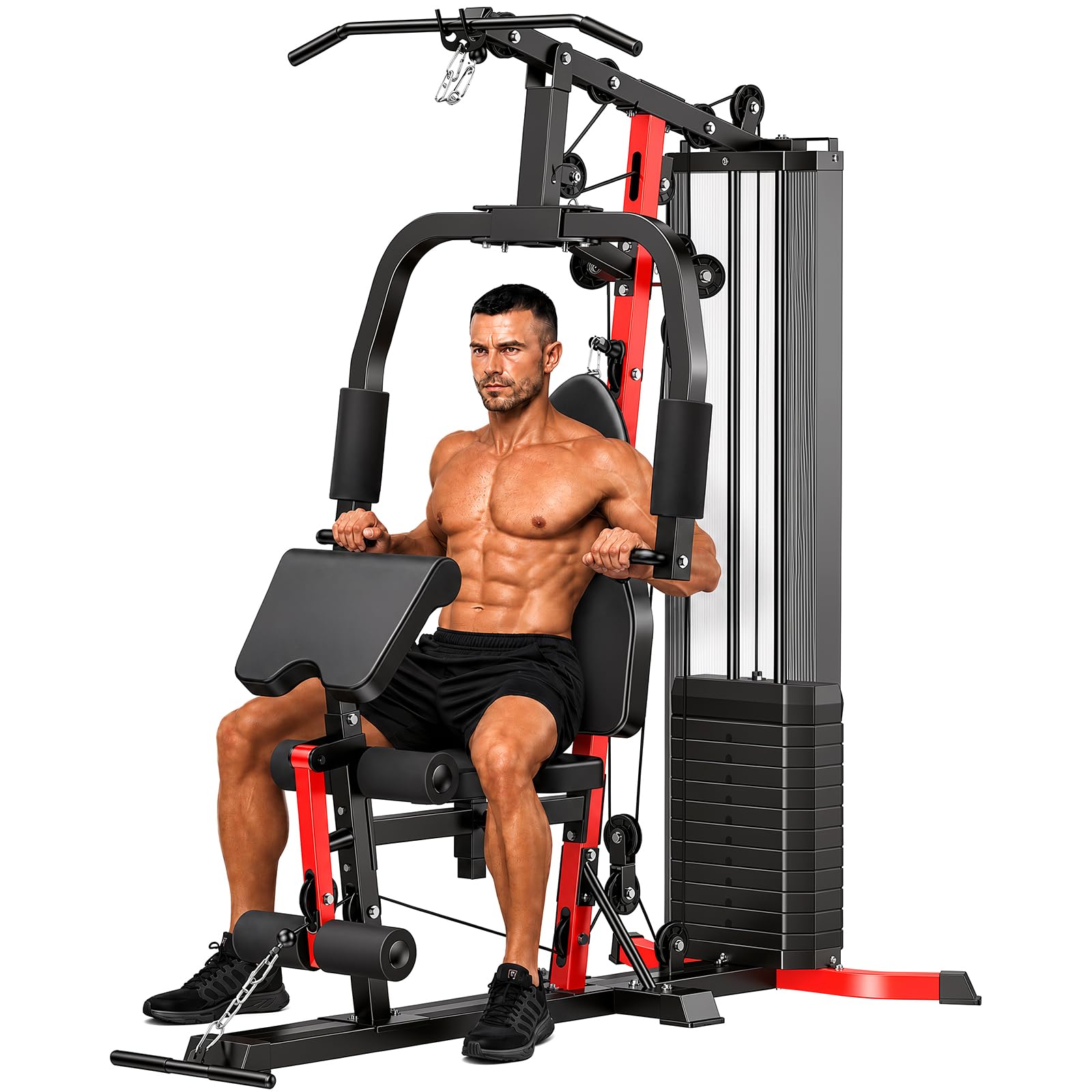
A selectorized stack and a preacher pad in a footprint narrow enough for a spare bedroom wall.
A 160 lb weight stack is more built-in resistance than many 150 lb stations in this class, and the selectorized design means you pin the weight and go — no plate loading between sets, which is what makes progressive overload and drop sets practical at home. The frame measures 66″D x 38″W x 79″H, and that 38-inch width is the part that makes it livable in a spare room.
The exercise list is long for a single station: chest press, pec fly, preacher curl, wide and close-grip lat pulldown, seated low row, leg extension, cable lateral raise, triceps pressdown, cable curls, and seated cable ab crunch. High, mid, and low pulley options let you shift from pulldowns to rows to accessory work, and the included lat bar and short row bar cover upper-body pulls. The stack is guarded and the base is non-slip for repeated home sessions.
The recurring gripe is assembly time — the boxes arrive as a multi-part build and some buyers report it stretching out over a long day. Occasional missing parts turn up too, so inventory the boxes before you start. Once it is up, the functionality and the value both hold up well, and beginners find the adjustable seat and removable preacher pad forgiving.
What the stack removes: no plate shuffling at all — the pin does the work, which matters most on drop sets.
Clear your calendar: this is a multi-box build, so count the parts before the first bolt goes in.
Best for: a first home strength routine where quick weight changes matter more than maximum ceiling load.
Go in prepared: plan for a long assembly and confirm every box arrived before you start.
6. Mikolo HR06 Power Cage with Aluminum Pulleys
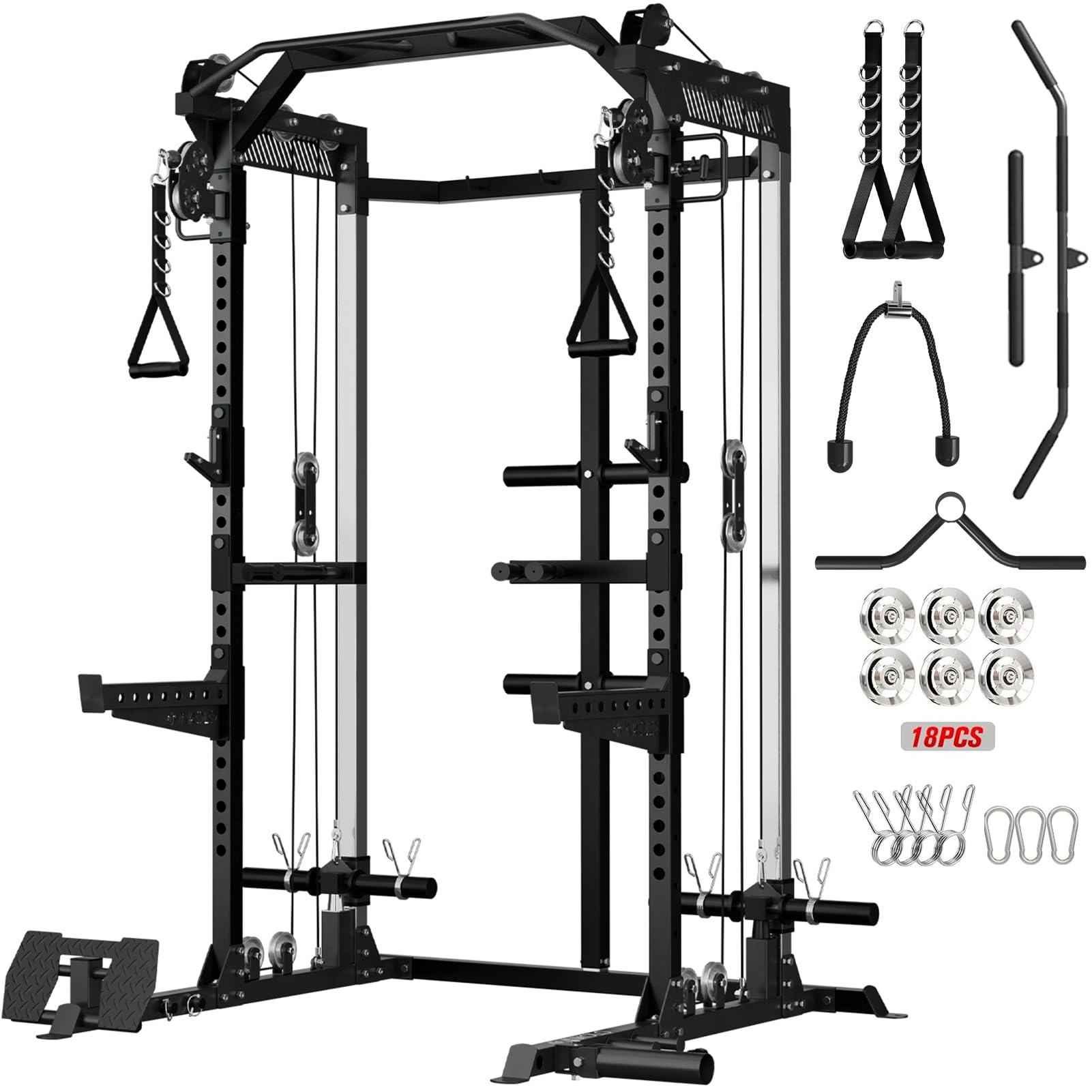
A squat cage that also runs independent 1:1 cables — two machines sharing one footprint.
The independence is the story: a 1:1 dual pulley system on both sides means the weight you load is the weight you lift, and each side operates on its own for supersets and partner training. All-aluminium pulleys cut friction, run quieter than steel or plastic, and resist corrosion and squeaking over time. It pairs that with a power rack rated to a maximum weight capacity of up to 2000 lbs on a frame with 2mm tube thickness.
Thirty height options at 2-inch hole spacing make this the most adjustable frame here, and digital markers on the posts let you find your setting fast. The 2″ × 2″ column width is the standard accessory size, so you can add third-party attachments. The half-rack footprint is smaller than a conventional power rack, and the mid-frame weight storage both organises plates and adds stability.
Beyond cables, it doubles as a multi-grip pull-up bar and a 360° landmine, which is useful for rotational training. The build is where the value lands — assembly gets called straightforward and the instructions legible. One detail worth knowing: the landmine attachment bolts sit under the frame so it does not lay perfectly flat on the floor.
Two tools, one frame: squat rack, pull-up bar, functional trainer, and landmine in one footprint is a lot of training for one purchase.
A small floor note: those landmine bolts keep the base slightly off the ground, so plan for a thin shim or a mat.
Pick this if: you want free-weight squatting and cable work without buying two separate frames.
Worth knowing: the 1:1 ratio means heavy cable weights feel heavy instantly — check your working loads.
7. Mikolo Home Gym Pro Station with 152LBS Weight Stack
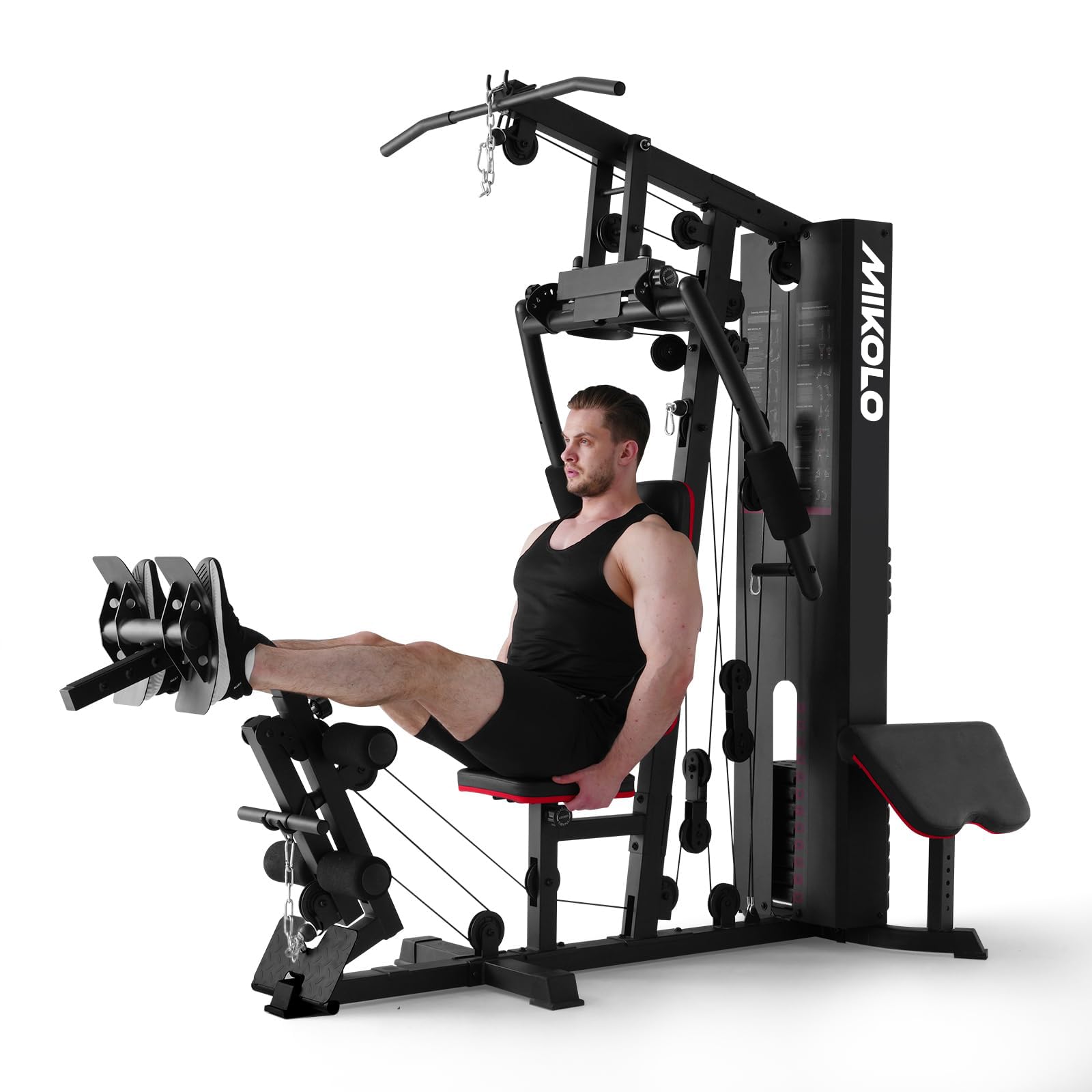
Pec fly, leg press, lat pulldown, and preacher curl all on one station — the full commercial circuit at home.
Ninety-plus exercises is the claim, and the component list backs it: pec fly, lat pulldown, low row, chest press, leg extension, leg press, preacher curl, core trainer, calf training, seated row, and mid row. Built-in resistance comes from a 152 lb weight stack, which removes the plate-shuffling between sets that eats time in a superset circuit. The frame is 14-gauge steel with the counterweight block protected by a steel sheet, measuring 75″D x 36.3″W x 80″H.
That 36.3-inch width is the standout for a station with this much function. It is narrower than most crossover frames here, so this is a machine for a wall in a spare room rather than a wide bay. The preacher curl pad and leg press accessories are removable, and a professional bearing on the cable bar reduces wrist stress during curls and rows. Handles include two D-handles, a short cable bar, a lat pulldown bar, a triceps rope, and a chain attachment, and a movement guide is included for programme ideas.
Assembly is the point of friction. Owners find it sturdy and worth the outlay, but the build is long and not always intuitive, and adjustability draws a few complaints. Set aside real time and read the assembly video access before starting.
What the frame delivers
- 152 lb selectorized stack for fast drop sets and supersets
- 90+ exercises covering chest, back, legs, arms, and core
- 36.3″ width makes it a wall-hugger for a spare room
- Removable preacher pad and leg press accessories add variety
What it asks of you
- Assembly takes real time — watch the video access before you start
- Adjustability leaves some owners wanting smoother setup
- 75″ depth means it needs front clearance in the room
Built for: a lifter who wants the broadest exercise menu on a narrow wall footprint.
Budget your weekend: plan on a long build, but the 36.3″ width earns the trouble in a tight room.
8. Valor Fitness BD-61 Cable Crossover Machine

Seventeen pulley positions on a plate-loaded frame that takes the weights you already own.
Plate-loaded means the resistance comes from your own plates: a 200 lb tension limit on sleeves that accept both standard 1-inch and Olympic 2-inch plates via included adapter sleeves. If you already own a bar and plates, this is the lower-cost route to a crossover, and adding resistance is a matter of sliding another plate on. The frame measures 56″D x 50″W x 81″H and weighs 174 pounds.
Seventeen adjustable pulley positions cover upper-body, lower-body, and core work, and a dual-track guide bar system keeps the cable travel stable. The package includes a pull-up bar, lat pulldown attachment, curl/row bar, single strap handles, weight storage pegs, and floor mounting hardware — a complete station without needing a second machine. Exercisers find the versatility is the real draw: most of the movements you would do in a commercial gym are accessible here.
The honest trade-off is the assembly instructions, which draw strong criticism. Assembly instructions draw strong criticism, and threading the cables is the fussy part of the build. Pulley smoothness splits opinion, so adjust the guide tracks carefully once it is standing. The 200 lb ceiling also means very strong lifters may eventually want more resistance than the sleeves allow.
Where your plates pay off: 200 lb of resistance from weights you already own, no stack purchase required.
The cable-threading job: give the instruction manual a wide berth and watch any available video instead.
Suits the plate owner: standard and Olympic plates both fit, so a garage with weights already stacked up just gained a crossover.
Know the ceiling: 200 lb of resistance is generous for most lifters but not for the very strongest.
9. Roygym Smith Machine with Dual Pulley Cable Crossover
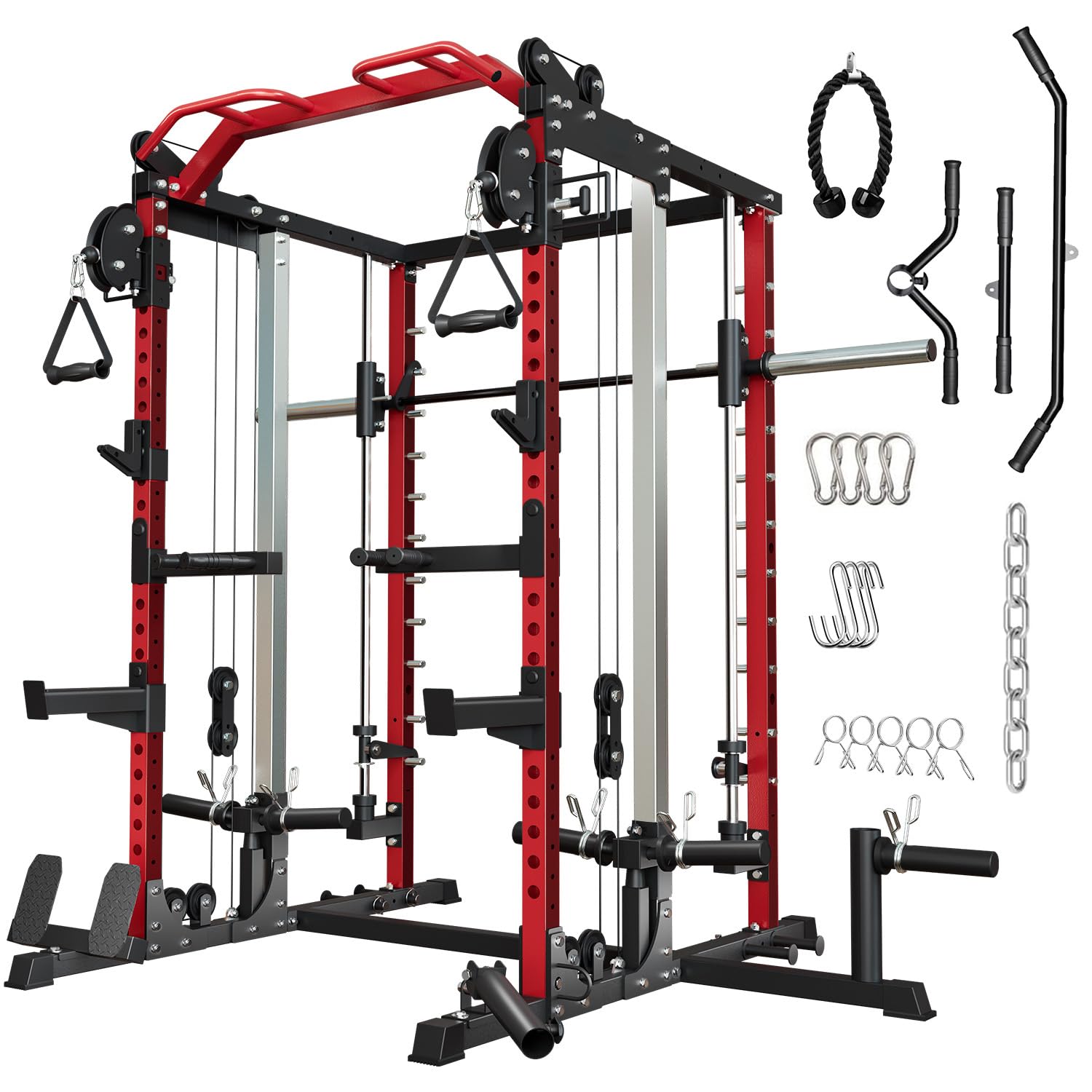
Smith bar, squat cage, cables, and dip bars crammed into 18.3 square feet.
The Smith bar glides on premium linear bearings with 9 adjustable height positions and built-in safety stops. That combination is the whole point: you get controlled, stable lifts for squats and presses at any fitness level, with a bar path that stays fixed. A 1:1 dual pulley system with 20 adjustable positions adds cables that handle both unilateral and bilateral movements.
For the floor space, this is the densest package on the list at 18.3 square feet, measuring 57″D x 65.7″W x 87.4″H and weighing 283.7 pounds. The accessory count is the real argument — Smith bar, 360° landmine, battle rope anchor, five weight storage pins, barbell holders, pull-up bar, lat pulldown bar, T-bar row handle, straight bar, triceps rope, two cable handles, four band pegs, foot board, two J-hooks, two safety arms, two dip bars, a chain, and five barbell spring clamps.
Assembly is where the feedback lands positively, which is not the usual story for a frame this complex. The smoothness of the Smith bar and the quality of the steel are the recurring highlights. Ease of use is the split point — a machine with this many stations takes time to learn, so budget a few sessions before everything feels natural. Delivery arrives in three packages, potentially on different days.
The accessory haul: 17 items bundled in, including the Smith bar, landmine, and dip bars — you will not buy extra attachments for a while.
Learning curve ahead: the frame assembles cleanly but needs a few sessions before every station feels fluent.
The best fit: a lifter who wants Smith-machine squats and presses plus cable work in one 18.3 sq ft footprint.
Watch the delivery: three packages can arrive on different days — schedule accordingly.
10. Centr Home Gym Functional Trainer

Thirty-three vertical settings and 165 pulley adjustments on a low-profile frame for a spare room.
A 160 lb weight stack and two adjustable pulleys form the resistance base, with 33 vertical positions and 165 pulley adjustments. That count is genuinely high for a compact trainer — it means you can dial in the exact handle height for each exercise rather than settling for the nearest notch. Industrial-grade steel with a matte black powder coat finish holds the frame, which measures 81.5″ H x 51″ W x 62″ L and weighs 312 lbs.
The pulley system is built for frictionless movement, which matters when you are changing height constantly across a session. Coverage spans the hundreds of exercises a functional trainer supports, from chest flys and rows to lower-body cable work. The compact footprint is the differentiator for buyers comparing this against the wider crossover frames on the list.
Two practical notes. First, Amazon may request payment verification after you order, and that step needs completing promptly to avoid cancellation. Second, the 160 lb stack sets the ceiling — that is generous for most training but caps very strong lifters. The trade-off for the low profile is that the 51-inch width is the tightest of the full-size frames here.
Adjustment range is the draw: 165 pulley adjustments means each exercise gets its own setting, not a compromise.
Two details to handle: complete the payment verification after ordering, and check the 160 lb ceiling against your working weights.
Built for: a space-limited home gym where a low profile and fine adjustment range matter more than raw stack weight.
Note the ceiling: 160 lb of resistance is plenty for most, less so for advanced lifters.
11. Titan Fitness Plate-Loaded Functional Trainer

Dual Olympic plate sleeves that hold 660 lb, with a switchable pulley ratio for heavy or high-rep work.
Six hundred and sixty pounds of capacity across dual Olympic plate sleeves is the headline for any lifter who already owns plates and lifts heavy. The pulley system is switchable between a 1:1 ratio for strength work and a 1:2 ratio for a lighter, more controlled feel on high-rep sets. Fiberglass-reinforced pulleys deliver fluid pulls across a full range of motion. The frame measures 53″D x 61″W x 81″H and weighs 178 pounds, with a wide base for stability.
Accessories cover most movements: a multi-grip pull-up bar, lat bar, dual stirrups, low row station, rope handle, and ankle strap. The low row station is a genuine plus on a plate-loaded trainer, because it saves you lying on the floor for rows. A 61-inch width is among the more compact footprints here for a plate-loaded frame with this capacity.
The catch is data — with a small owner sample on the listing, there is less feedback to go on about assembly quirks than on the more-established frames. Plan on the usual two-person build and inspect the crate at delivery. The 660 lb ceiling, though, is a genuine long-term hedge and it clears every other resistance figure on this page.
Why heavy lifters look here
- 660 lb plate capacity across dual Olympic sleeves
- Switchable 1:1 and 1:2 ratio for strength or endurance work
- Fiberglass-reinforced pulleys for fluid, full-range pulls
- Low row station and multi-grip pull-up bar included
What to weigh up
- Limited owner feedback — less to learn from before ordering
- Plate-loaded, so you need your own plates to open up the capacity
- Assembly is a two-person job at 178 lb of steel
For the heavy lifter: 660 lb of plate capacity plus a 1:1/1:2 switch is a long-term ceiling most frames here cannot match.
Only if you own plates: without weights to load, the capacity advantage does nothing.
12. Body-Solid Powerline Cable Crossover PFT100

Two independent 160 lb stacks on an extra-wide frame that lets each arm train entirely on its own.
Dual independent weight stacks with a 1/2: 1 weight ratio give you dedicated resistance on each side, which is what makes true isolateral movements possible here. Two 160 lb stacks means each handle gets its own load, so a single-arm press or a one-legged kickback trains exactly as it would in a commercial gym. The frame measures 42.3″D x 62.6″W x 83″H and weighs 476 lbs with an electrostatically applied powder coat finish. Maximum weight recommendation is listed at 210 pounds.
Exercise range runs wide: cable crossovers, shoulder presses, pull-ups, pec flys, bench, incline, upright rows, deltoid raises, seated rows, ab crunches, oblique bends, triceps pressdowns, calf presses, reverse flys, and glute kickbacks. The extra-wide mainframe is what gives the crossover its open stance and keeps the machine stable through heavy cable work. Both stacks are selectorized, so a pin changes the weight and drop sets happen fast.
Assembly comes up as one of the brighter parts of the ownership story — it goes together without a saga. The pulleys glide smoother than the low-profile look of the frame suggests. Where owners want more is the pulley travel: the crossover runs a high/low pulley layout rather than a sliding tower, so the height range is not as granular as the more adjustable frames on this list. The 10-year frame warranty and 1-year parts cover adds assurance for a long-term machine.
What two stacks buy you: genuine isolateral training — each arm loads and pulls on its own, with no shared cable dragging the other side.
The range-of-motion caveat: a high/low pulley layout is not as adjustable as a 19- or 30-position tower, so if exact handle heights matter to you, compare the travel figures.
Ideal for: a lifter who trains single-side and wants two independent 160 lb stacks without buyer’s remorse.
Consider the trade: if precise pulley heights drive your programme, a machine with more adjustment positions will serve you better.
13. FTX Functional Trainer by Inspire Fitness

A full dual-stack trainer in 40 inches of width — the tightest full functional trainer on this list.
Two 165 lb weight stacks with sliding pulleys and a pull-up bar arrive in a footprint that measures 54″D x 40″W x 82″H. That 40-inch width is the defining number here, because it is narrower than every other full-featured trainer on this page. With both stacks independent and sliding pulleys, you get hundreds of strength and resistance exercises in the space of a narrow wall. The frame weighs 544 pounds and is rated to a maximum weight recommendation of 165 pounds per stack.
Four accessories are included: a triceps rope, two deluxe D handles, a dual hook curl bar, and a chin/dip belt. There is also a built-in shelf to secure your phone or tablet during a session, and a rack to keep the accessories tidy between workouts. The package also includes a 3-month subscription to Centr’s digital platform, which covers 1900+ workouts, meal planning and nutrition advice, and mindfulness tools. The pulley system is built for friction-free pulls, so each rep feels smooth rather than notchy.
The recurring positive is quality and versatility. Owners find it holds up as a long-term home gym anchor, and assembly is a bright spot rather than a chore. The honest trade-off is the 165 lb per-side stack ceiling, which caps advanced strength work but covers most home programmes. The 40-inch width also means less side-to-side room at the handles than a 65-inch-wide crossover.
What the narrow frame gives back
- 40″ width — the tightest full functional trainer here
- Two 165 lb stacks with sliding pulleys
- Phone/tablet shelf plus a built-in accessory rack
- 3-month Centr subscription with 1900+ workouts bundled
The honest limits
- 165 lb per stack caps advanced strength work
- 40″ of width narrows the side-to-side stance at the handles
- 544 lb frame still needs a solid floor and two-person build
The space-first pick: a genuine dual-stack trainer that fits where no wide crossover will go.
The one caveat: if your lifts run heavy, 165 lb per side will eventually max out.
Know the Specs
Pulley ratio and what you feel at the handle
The pulley ratio describes how far the cable travels for every inch the resistance moves. A 2:1 ratio means the load you feel is roughly half of what is pinned, which gives a fast, smooth pull — good for flys and crossovers. A 1:1 ratio means the weight you select is the weight you lift, so heavy rows and presses feel exactly as heavy as the number suggests. Several machines here run 1:1 for that reason, and a few plate-loaded trainers switch between 1:1 and 1:2. Compare ratios before you compare stack weights, because a smaller stack on 1:1 can feel heavier than a bigger stack on 2:1.
Selectorized stack versus plate-loaded sleeves
A selectorized stack has the weights built into the machine — you pull one pin and change the load, which makes drop sets and supersets fast. A plate-loaded machine has sleeves or a carriage that accepts your own plates, which keeps the frame lighter and the cost lower but requires you to own the plates. If you already have a bar and a rack of plates, plate-loaded is the smarter route. If you want speed and simplicity between sets, a built-in stack is worth the trade in frame weight. The capacity figures on a plate-loaded trainer, like the ones on these listings, describe the maximum resistance the sleeves will hold, not a built-in stack.
Pulley height positions and exercise coverage
The number of adjustable pulley positions determines how many exercises you can actually perform cleanly. A 15-position crossover covers seated rows, pulldowns, and chest flys; a 19- or 30-position tower lets you drop the pulley low for chops and ankle work and raise it overhead for high flys. A wider range, like 12 inches to 75 inches on one machine here, is the difference between a machine that does upper-body work only and one that covers legs and core too. Read the range, not just the count.
Footprint and delivery reality
Measure the wall and the swing room before anything else. Depth figures in the 50- to 75-inch range are typical for a crossover, while a compact trainer can squeeze into a narrow bedroom wall. Width matters most for a crossover that needs an open stance: a 112-inch frame will not fit a narrow garage bay, but a 40-inch full trainer will. Most of these frames ship by freight with crated delivery and require a scheduled appointment, and the heavier ones need two people for assembly. Plan the delivery day before you order, not after.
Common Questions
Will a cable machine fit in a single-car garage?
What pulley ratio should I choose for heavy rows and presses?
How many pulley height positions do I actually need?
Can I use my existing weight plates on a plate-loaded cable machine?
How long does a cable machine take to assemble?
Is a selectorized weight stack better than plate loading?
Does a cable machine replace free weights?
Will the cables or pulleys wear out over time?
What is the maximum weight a home cable machine can handle?
Do I need to bolt a cable machine to the floor?
The Bottom Line
For most people building a home strength setup, the workout cable machine winner is the XMARK Commercial Cable Machine because two independent 200 lb stacks on a 2:1 ratio cover almost every lift you would do on a commercial floor, with 19 pulley heights from 12 inches to 75 inches for full-body work. If tight floor space rules your spare room, the CC01 Cable Crossover delivers a full crossover stance in 12.1 square feet, and if you already own plates, the Titan Fitness Functional Trainer gives you a 660 lb ceiling that clears every other frame here. One last thought: the higher-rated picks in this category are the ones with the most owner experience behind them, and a machine that earns long-term reviews across hundreds of homes is usually the one worth the freight day.
How we choose
We do not accept paid placement. Every pick is matched to a real buyer and a real use-case; we do not hands-on test units.
Sources
Specifications: manufacturer listings and product documentation. Review insights: verified customer reviews, as of November 2026. Pricing: not shown on this page (it changes often); check the current price via the retailer link.
As an Amazon Associate, Tactical Gear Guy earns from qualifying purchases. This does not affect which products we feature.