Specs are compiled from manufacturer listings and verified buyer reviews and can change over time — please confirm the key details on the product page before buying.
Numb fingertips halfway through a job is the real enemy, not the temperature itself. The quickest fix is a glove with real insulation and a leather or coated shell that keeps wind and wet out. The picks below cover every kind of winter work, from steering a truck to shoveling a driveway to hauling freight in a freezer. The Kinco 1927 holds 4.5+ stars across 500+ ratings, and it sits mid-tier on price.
This guide is built by comparing the manufacturers’ published specifications and the patterns across verified customer reviews, so you get each pick’s real strengths and trade-offs instead of marketing spin.
Insulation weight, leather type, cuff design, and true sizing decide whether you finish the shift warm or miserable. That is the whole framework this guide uses to sort the best work gloves for the winter into pairs you can trust.
Top Picks


How to Choose the Best Work Gloves for the Winter
A winter work glove has to do three jobs at once: hold warmth, keep wind and wet out, and let your fingers still work. Most pairs fail one of those. Knowing which one matters most for your day narrows nine options down fast.
Start with the insulation, not the bulk
Warmth usually comes from a thin synthetic layer, not from padding. Look for a stated insulation weight in grams — 100-gram 3M Thinsulate is the common benchmark in this category. That figure describes how much filling sits between your skin and the shell. A higher number tends to mean more warmth and less finger feel, so heavy insulation suits slow cold-weather tasks better than fine work with small bolts.
Match the cuff to your cold
Cold air sneaks in at the wrist before it reaches your fingers. A knit wrist pulls tight and seals the gap on its own. An elastic wrist strap lets you cinch it down. A gaiter cuff with a drawstring extends up the arm and is the most protection you can get in this category — it is what you want for deep snow or a blast of freezer air.
Leather versus coated shells
Grain cowhide and pigskin resist abrasion and punctures, which is why they dominate hard outdoor jobs. Waterproof polyurethane shells do not soak up water at all and stay flexible, but they grip differently. If your work is wet and cold, a coated waterproof shell is the smarter pick. If it is dry but rough, leather lasts longer.
Fabric weight and dexterity trade-off
Thicker fabric weight means more durability and padding, and less finger feel. A glove listed as heavyweight favors hard tasks. A medium-weight pair keeps more control for driving or handling small tools. Decide which one you actually need before you buy, because you cannot have both at full strength.
Fit changes the warmth
A glove that is too loose traps cold air and slides. One that is too tight blocks blood flow and your fingers feel cold even in good insulation. Sizing is the most common disagreement in this category, so check the size chart and lean toward the brand’s stated fit. Pull-on designs generally relax slightly with wear.
Side-by-Side Comparison
| Model | Best For | Insulation | Shell Material | Cuff | Amazon |
|---|---|---|---|---|---|
| Kinco 1927★ Best Overall | All-round cold-weather work | Heatkeep thermal lining | Pigskin and canvas | Safety cuff | Amazon |
| Wells Lamont Heavy Duty ThinsulateWorkhorse Pick | Ranch and construction work | 100-gram 3M Thinsulate | Grain cowhide leather | Extra-long knit wrist | Amazon |
| toolant Insulated LeatherSnow-Day Value | Snow removal and daily warmth | Insulated lining | Leather | — | Amazon |
| Wells Lamont Insulated Cowhide XL | Driving and snow blowing | 100-gram 3M Thinsulate, fleece lining | 100% grain cowhide | Elastic knit wrist | Amazon |
| Mechanix Wear ColdWork Durahide | Shop and warehouse work | C40 3M Thinsulate | Durahide DRY cowhide | Elastic cuff | Amazon |
| SHOWA TEMRES 282-02 | Wet and deep-snow work | Acrylic fleece liner, rated to -58°F | Polyurethane, waterproof | Gaiter with drawstring | Amazon |
| Carhartt Insulated Knit Cuff | Everyday winter jobs | Ultrasoft insulation | Reinforced shell, grippy palm | Fleece cuff, adjustable strap | Amazon |
| Vgo CA7722FW | Impact-heavy outdoor work | Lined, rated to -4°F | Leather with impact guards | — | Amazon |
| RefrigiWear Extreme Freezer | Freezer and deep cold | Insulated, rated to -30°F | Neoprene and synthetic leather | Adjustable stretch neoprene | Amazon |
Detailed Reviews
1. Kinco Leather Work and Ski Gloves (1927)
Our pick — 4.5+★ from 550+ verified ratings; the strongest balance of quality and price.
The pair that keeps your hands and wrists out of a cold blast.
The Kinco 1927 earns the top spot because its pigskin palm keeps gripping after the surface gets scuffed, and its Heatkeep thermal lining (a layer that traps your body heat) keeps your hands warm while it does. The canvas back lets the glove flex instead of stiffening up in the cold, so you can still close your hand around a shovel handle. A safety cuff covers the wrist, and an elasticized back with a shirt-style detail keeps the glove snug to your hand.
Warmth is the most-praised trait in the reviews, with hands and wrists staying protected from cold air the single most repeated point. Value also comes up a lot, because these hold up beyond the price you pay for them. The wearers who rave hardest are the ones working outside in moving cold air rather than standing still.
The honest catch is fit. Sizing is the one point reviewers split on, with a fair share finding the glove on the large side. Try the size chart against a measured hand rather than guessing, and if you sit on a boundary, size down. A glove that is too loose lets cold air circulate and defeats the whole lining. Its 4.5+ stars across 500+ ratings is the strongest review record in this group.
What earns its spot
- Heatkeep thermal lining plus a pigskin palm gives warmth and real abrasion resistance
- Safety cuff and elasticized back seal the wrist end well
- Warmth is the most-praised trait of the glove by a wide margin
The one thing to plan around
- Fit runs generous for some, so sizing down is a real possibility
- Canvas back is not a waterproof shell — expect it to soak in slush
Buy it for: all-round cold outdoor work where you want leather durability and steady warmth.
Look elsewhere for: wet, sloppy snow where you need a fully waterproof shell.
2. Wells Lamont Men’s Heavy Duty Leather Winter Work Gloves
Built like a ranch glove, but with insulation that actually holds heat.
Inside the shell sits 100-gram 3M Thinsulate — a synthetic fill that traps warmth without turning your hand into a mitt. The outside is an abrasion-resistant grain cowhide, so scraping against wire, wood, or concrete does not chew through the palm. A fleece lining sits against your skin. The Gunn cut and winged thumb are pattern details that let the leather fold naturally instead of bunching at the knuckles.
Durable construction is the most-praised trait here. Durable construction is the quality buyers keep coming back to in their feedback, and warmth follows right behind it. The extra-long knit wrist is underrated — it reaches further up your arm than a standard cuff and seals out the cold that otherwise creeps down your sleeve. Farming, ranching, driving, and heavy equipment operation are all squarely in its lane. It weighs in as the heavyweight fabric class, which is exactly why it feels solid in your hand.
Compared with the Kinco above, this one leans heavier and more agricultural in feel, while the Kinco is a touch more flexible for mixed use. Neither is waterproof. The Wells Lamont’s pull-on closure has no strap to cinch, so the knit wrist is your only seal. If you want adjustable closure at the wrist, look at the Carhartt or the Vgo. For dry cold and rough work, this pair is hard to argue with.
Where the money goes: into abrasion resistance and a longer wrist seal, not into gadgets. It is a straightforward leather glove with real insulation, and that simplicity is a feature.
One thing to know: An abrasion level of 3 is a moderate durability rating, not the top of the scale — ideal for hard work, not for constant razor-sharp contact.
The right call if: your winter work happens on a farm, a jobsite, or behind the wheel in dry cold.
Keep shopping if: you need a waterproof membrane or a cinchable wrist strap.
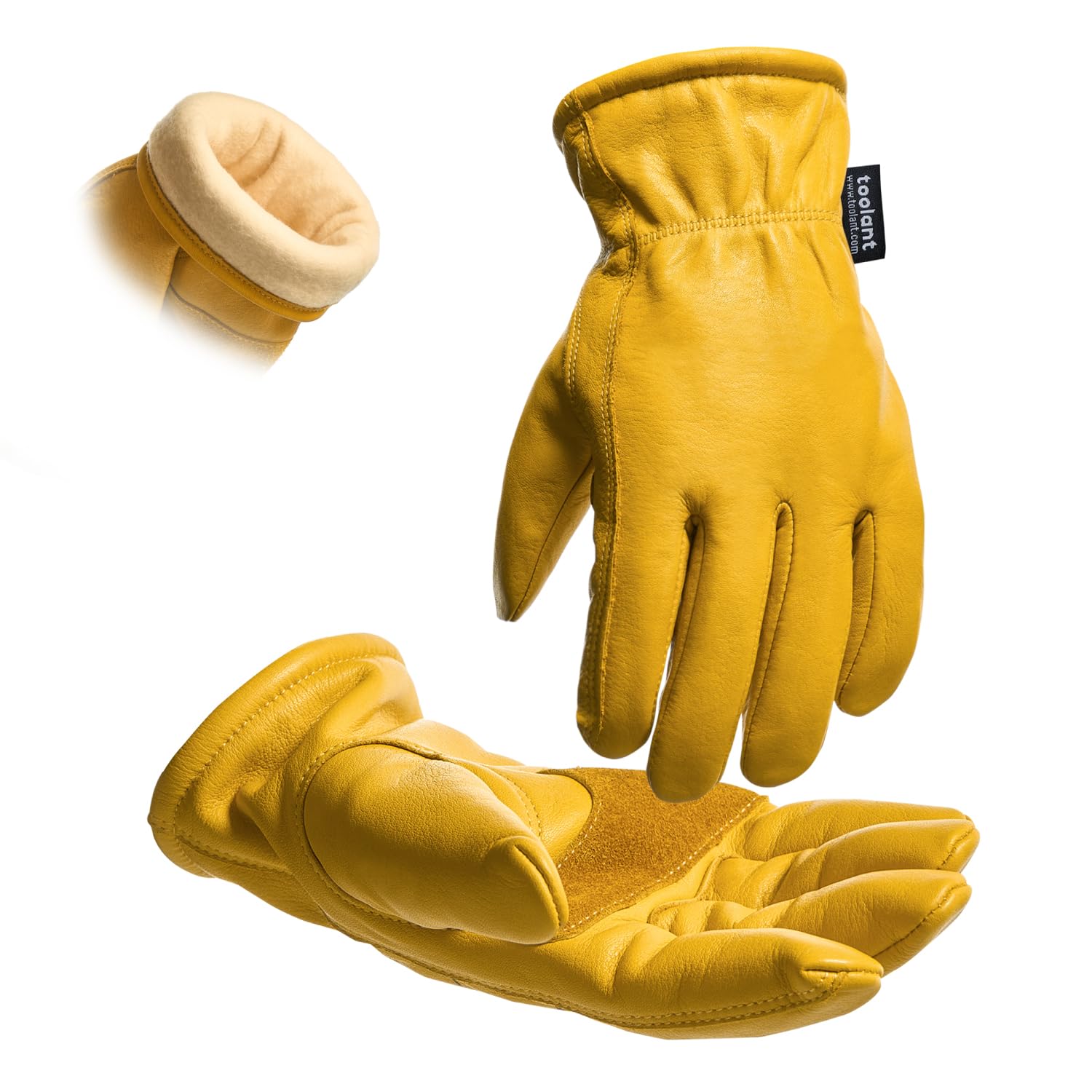
3. toolant Winter Work Gloves for Men, Insulated Leather
The leather glove that does not feel like a compromise at its tier.
Leather is the defining move on the toolant pair. Buyers describe the leather as looking and feeling like the real thing, and that material is what makes it suited to driving, daily warmth, outdoor work, snow removal, and farm chores all at once. A water-resistant finish means slush beads up rather than soaking straight through. The insulated build keeps your fingers from stiffening on a cold steering wheel.
The qualities that earn the most praise are the leather quality and the warmth. The people happiest with it are the ones who spend their winter days moving between cold tasks rather than sitting in one spot. Snow-shoveling duty is where the value argument is easiest to make, because the glove handles the wet and the cold at the same time. It sits comfortably in the mid-tier, and the softness and material draw regular mentions in the feedback.
Sizing is where you have to pay attention. Several buyers report these run small, and that is the one recurring complaint. If you are between sizes, go up. A tight leather glove will not give your hand room to warm up, so an oversized shell is the lesser evil here. Set against the Wells Lamont above, this one wins on leather feel and water resistance but loses on sizing reliability — the fit is the trade-off.
The value argument: genuine-feeling leather with a water-resistant finish is uncommon at this tier, and it covers driving, shoveling, and farm work without complaint.
The trade-off you accept: sizing consistency. Order up if you are on the line between sizes.
Reach for this if: you want leather feel and water resistance without moving up a tier.
Size up if: you are between sizes, because the fit runs small.
4. Wells Lamont Insulated Cowhide Leather Work Gloves X-Large

Warmth that does not cost you your grip on the wheel.
Two things separate this pair from the heavy-duty Wells Lamont above: the fabric weight and the leather. This one is medium weight rather than heavyweight, so the shell is more flexible in your hand. The palm is 100% grain cowhide, and the lining combines fleece with 100-gram 3M Thinsulate for warmth without the bulk that makes you fumble small tools. The Gunn cut ergonomic design keeps the leather folding with your hand instead of fighting it.
Warmth is what owners talk about most, with durability right behind. The glove survives a full season of hard use, and the softness of the leather matters more than you would expect when you are wearing them all day. An elastic knit wrist pulls the cuff snug so it does not slide. Driving, snow blowing, construction, and everyday winter tasks are all on the label. The AnsI/ISEA abrasion level of 3 gives you a moderate benchmark for wear and tear.
Now the honest part: this is the glove with the most-fit-discussion in the entire group. Sizing draws the largest share of commentary, and it is mixed rather than glowing. The elastic knit wrist helps because there is no strap to micro-adjust. As an X-Large, it suits a larger hand, but check your measurement against the chart before you commit. A pair that fits right is warm; a pair that is sloppy is not.
Why this one earns its place
- Grain cowhide palm with a fleece and Thinsulate lining — warm with genuine finger feel
- Medium fabric weight keeps dexterity for driving and handling tools
- Soft leather and season-long durability both draw consistent praise
Read before you order
- Fit draws the most discussion in this group and the response is split
- Elastic knit wrist has no cinch strap to tighten for a custom seal
Fits your routine if: you drive in the cold and still need real finger control.
Check the size chart first: fitting is the one place this glove asks you to be careful.
5. Mechanix Wear ColdWork Durahide Insulated Driver Gloves

A work glove that wears like a driving glove on a frozen jobsite.
The shell is Durahide DRY cowhide — a leather built for abrasion resistance, so power tools and rough building materials do not eat through the palm. Inside, C40 3M Thinsulate synthetic down does the warming, with a soft Sherpa liner against your skin. The stretch is in the elastic cuff, which helps you pull the glove off between tasks without a fight. Mechanix Wear also lists it as breathable from the first wear rather than needing a break-in period.
Fit is the highest-praised trait on this glove, ahead of the Sherpa lining. That matters, because a winter driver glove lives or dies on how well it hugs your hand. The Sherpa lining adds warmth without turning it into a bulky mitt. The target uses are the shop, the warehouse, and landscaping once the temperature falls.
The catch is material expectation. Some buyers point out that the leather is not the real thing, and construction feedback splits as a result. If you insist on genuine grain cowhide, the Wells Lamont and Kinco picks above deliver that. If you care more about a snug fit and a soft liner, this glove delivers it. It holds 4.5+ stars from 250+ ratings.
Why the fit wins: an elastic cuff and Sherpa liner make this the glove you forget you are wearing, which is the real test of a winter work pair.
Set your expectation: the Durahide shell reads as leather to some and synthetic to others, so buy it for the fit and abrasion resistance, not the material label.
Great match for: shop, warehouse, and landscaping work where a close fit beats a workboot feel.
Think hard if: genuine cowhide leather is a deal you will not bend on.
6. SHOWA TEMRES 282-02 Waterproof Insulated Winter Work Gloves

The glove for deep snow, wet pipes, and a cold that will not quit.
Two numbers stand out on this pair. The acrylic fleece liner is rated for warmth down to -58°F (-50°C), and the polyurethane shell is fully liquid-proof while still letting moisture escape. That combination is the whole point: a glove that stays bone-dry and sweat-free during high-effort work rather than trapping your own sweat and going cold. The 50% PU, 50% Acrylic construction is what keeps the coating flexible in freezing temperatures instead of cracking.
The cuff is a standout design. A built-in nylon sleeve with an adjustable drawstring toggle seals around your arm or jacket sleeve, so snow, ice, and debris stay out. For deep snow, ice fishing, or skiing, that gaiter makes a bigger difference than extra insulation. Warmth and waterproofing are the two traits that earn the most praise, and the textured palm gives a secure grip on wet pipes and frozen tools. The ergonomic shaping is meant to cut hand strain over long shifts.
The sizing is the recurring issue. Fit is the one aspect that draws mixed response, with several buyers saying it runs small. Measure your hand and order up if you are near a boundary. There is no leather here, so if abrasion resistance against sharp edges is your main worry, a cowhide pair serves you better. For cold and wet together, though, few gloves in this group make a stronger case.
The strengths that lead
- Rated to -58°F (-50°C) with a breathable, waterproof PU shell
- Drawstring gaiter cuff seals against snow and wind at the sleeve
- Textured grip holds wet pipes and frozen tools
What to weigh
- Sizing tends to run small, so order up if in doubt
- No leather palm, so sharp abrasive edges are harder on it than cowhide
Pick this one for: wet cold, deep snow, and ice fishing where dry hands are everything.
Move on if: your main risk is sharp, abrasive material rather than water.
7. Carhartt Men’s Waterproof Insulated Knit Cuff Glove (A511)

The all-purpose winter glove with a nose wipe and a glove clip built in.
Carhartt’s A511 is an all-purpose winter glove with a waterproof insert, ultrasoft insulation, and sweat-wicking technology working together. The shell is reinforced for durability, and a grippy palm keeps your grip when you are working outside on a cold day. Soft fleece cuffs with adjustable wrist straps let you seal out snow and slush. There is also a clip off the wrist to keep the pair together when they are off your hands, plus a nose wipe for cold-morning comfort.
Build quality is the most-praised trait by a wide margin, with warmth right behind it. This is the most-discussed glove in the entire article by sheer volume, and it earns that attention with broad satisfaction. Value comes up a lot because it goes beyond a one-season glove. The nose wipe and the clip are small touches, but they are the kind of detail that shows a maker thought about a real winter day. It covers everyday cold-weather jobs, from shoveling to running errands to light construction.
Two caveats are worth naming. Sizing is mixed, with some buyers finding it runs small for large hands. Water resistance also draws split response, since some hands stay dry while others do not. Set against the SHOWA above, this one is more of a general-purpose glove and less of a deep-snow specialist — the SHOWA gaiter beats the Carhartt fleece cuff for sealing out snow. If you want a glove that does a bit of everything, this is the safest bet in the group.
Why it wins the crowd: a waterproof insert plus a knit-cuff seal and a grippy palm make it the glove that handles almost any winter errand without complaint.
The caveat to know: water resistance is not universal here, so if you are plunging your hand into slush, a glove with a gaiter cuff covers you better.
Go here when: you want one glove for errands, shoveling, and light jobs without thinking it through.
Try the size up if: you have larger hands, because the fit runs small for some.
8. Vgo -4°F Men’s Lined Leather Impact Winter Gloves (CA7722FW)

Leather gloves with armor, rated for a hard freeze at -4°F.
The Vgo CA7722FW is built for the intersection of crash protection and cold. The temperature rating sits at -4°F, which puts it in serious-cold territory. This is a leather glove with impact protection, aimed at auto industry work, power tools, motorcycling, utility crews, construction, logistics, warehousing, driving, forestry, carpentry, ranching, landscaping, and DIY heavy-duty tasks. If you need protection from a bump as much as warmth, it belongs on your short list.
Warmth is the highest-praised quality here, with durability and waterproofing following — the glove holds up in rain and snow alike. The functionality and water resistance both draw positive feedback from the buyers who lean on it in wet, cold conditions. The blend of warmth plus impact protection is the real argument. This is a glove for someone taking the blows of hard winter work, not a glove for a stroll.
The honest part is durability. Feedback splits: some pairs hold up, and some fall apart within a couple of months. That split is the trade-off, and it is why this glove sits lower than the better-settled picks. If you want the same warmth with a longer track record, the Carhartt above is the safer play. The Vgo’s edge is the impact protection and the -4°F rating, not the long-term wear.
What it does well: leather warmth plus impact protection at -4°F makes it a sensible choice for cold, physical work where the hand takes knocks.
The honest trade-off: durability is inconsistent across buyers, so buy it for the protection and accept it as a hard-use glove.
Best if: you work cold, physical jobs where impact protection matters as much as warmth.
Reconsider if: you plan to lean hard on longevity and want the steadiest record.
9. RefrigiWear Insulated Extreme Freezer Gloves

Built for cold storage air, where the temperature never lets up.
The headline is the rating: built for use down to -30°F, aimed at cold storage facilities and outdoor environments that do not warm up. This glove is not for a mild winter morning; it is for someone standing inside a freezer for a shift. It adds impact protection on the fingers, knuckles, and back of the hand. A silicone palm grip keeps your hold on icy tools and surfaces, and a Kevlar-reinforced thumb crotch adds wear resistance where gloves typically fail first. The neoprene and synthetic leather shell is built for tough conditions.
The pre-curved ergonomic fit is what lets you keep your fingers moving in a deep freeze. An adjustable stretch neoprene cuff seals against the cold and lets you take the glove off when you step back out. The build quality and functionality are the highest-praised traits here. Someone whose hand aches by the end of a shift will find the intended strain reduction welcome. Construction workers and logistics crews hauling in a cold room are exactly who this is for.
Two real limitations come with the extreme rating. Warmth and durability both split in the feedback — for every buyer who stays warm and works it hard, there is one who finds it cold or too quick to wear. The bulk is the other cost: it is a big glove, and fine fingertip work is not what it does. It is also not waterproof. Set against the SHOWA above, the RefrigiWear wins on impact protection and the deeper cold rating, but the SHOWA is easier to wear in wet conditions and less bulky.
The job it was built for: a -30°F rating, impact guards, and a Kevlar-reinforced thumb crotch make it a freezer-shift glove first and a general winter glove second.
Be honest with yourself: it is bulky and not waterproof, so buy it for the freezer, not for shoveling a driveway.
Designed for: freezer work and extreme cold where impact protection matters.
Only buy if: you accept the bulk and the non-waterproof shell as part of the package.
Know the Specs
Insulation weight in grams
The gram figure describes how much synthetic fill like 3M Thinsulate sits inside the glove. A 100-gram fill is the common mid-weight benchmark. More fill means more warmth and less finger feel, so heavy fill suits slow cold work better than small-screw tasks. Manufacturers state a rating like -4°F or -30°F, and that figure describes the cold the glove is designed for rather than a comfort promise for every wearer.
Shell material and abrasion resistance
Grain cowhide and pigskin resist scuffs and punctures, which is why leather dominates tough winter work. A waterproof polyurethane shell does not absorb water and stays flexible in freezing temperatures, which helps in snow and slush. The AnsI/ISEA abrasion level is a standard durability rating: a higher number means more resistance to rubbing wear. Level 3 is a moderate rating, suited to hard tasks without being extreme.
Cuff design and cold sealing
The cuff is where most cold air enters. A knit wrist pulls tight. An elastic wrist strap lets you cinch it down. A gaiter cuff with a drawstring extends up the sleeve and gives the most protection of the three. Choose the cuff to match your wetness: dry cold suits a knit wrist, deep snow and wet work need the gaiter.
Fit and sizing
Fit is the most common point of disagreement in this category, and it directly affects warmth. A loose glove traps cold air, and a tight one restricts blood flow. Check the size chart against a measured hand, and if you sit between sizes, read the reviews for that specific model. Pull-on gloves often relax slightly over time.
Common Questions
Is leather or waterproof polyurethane better for winter work gloves?
What does a -30°F or -58°F glove rating actually mean?
Do insulation grams like 100g 3M Thinsulate mean more warmth?
Why do so many reviews say winter work gloves run small?
What is the difference between a knit wrist and a gaiter cuff?
Can I wash insulated leather winter work gloves?
Are impact guards and a Kevlar-reinforced thumb worth having?
Do winter work gloves need to be waterproof?
How do I keep cold air from creeping in at the wrist?
What should a warehouse worker buy for freezer shifts?
The Bottom Line
For most people buying the best work gloves for the winter, the winner is the Kinco 1927 because its Heatkeep lining and pigskin palm deliver real warmth and durability at a mid-tier spot. If wet and snow are your reality, reach for the SHOWA TEMRES 282-02 — its waterproof shell and drawstring gaiter cuff are built for exactly that. And for a deep-cold shift in a freezer, the RefrigiWear Extreme Freezer with its -30°F rating and impact protection is the one to grab. Match the cuff and shell to your conditions and any of these nine will hold up.
How we choose
We do not accept paid placement. Every pick is matched to a real buyer and a real use-case; we do not hands-on test units.
Sources
Specifications: manufacturer listings and product documentation. Review insights: verified customer reviews, as of November 2026. Pricing: not shown on this page (it changes often); check the current price via the retailer link.
As an Amazon Associate, Tactical Gear Guy earns from qualifying purchases. This does not affect which products we feature.