Specs are compiled from manufacturer listings and verified buyer reviews and can change over time — please confirm the key details on the product page before buying.
A day beside a mower deck or a nail gun leaves your ears ringing — that ringing is hearing damage, and it accumulates. A proper pair of earmuffs drops the roar to a safe level while still letting a warning shout through. This guide breaks down nine real-world picks, from budget passive muffs to electronic models that amplify speech and cut the shot.
This guide is built by comparing the manufacturers’ published specifications and the patterns across verified customer reviews, so you get each pick’s real strengths and trade-offs instead of marketing spin.
You’ll see how noise reduction ratings actually work, why a slim earcup clears a rifle stock or a hard hat, and which pair suits a mower deck versus a range bench. Here is the honest breakdown of the best work ear protection you can strap on before the noise starts.
Top Picks


How To Choose The Best Work Ear Protection
Most first-time buyers grab the highest NRR on the shelf and assume more blocking is always better. It isn’t. A muff rated for extreme blocking also blocks the warning shout, the backup alarm, and the range officer’s command. The right pair balances how much noise it kills against how much of the world you still need to hear.
Match the muff to the job, not the loudest number
A lawn crew, a woodshop, and a gun range all produce damaging noise, but they ask different things of your ears. Around machinery you mostly want steady suppression. On a range you want the shot muted but conversation preserved. Electronic muffs solve the second problem by amplifying quiet sounds and clipping the loud spike, while passive muffs simply lower everything.
Check the earcup profile before anything else
If you shoot rifles or wear a hard hat, a fat earcup gets in the way and breaks the seal — a broken seal means the rating on the box no longer applies to you. Low-profile, cut-out cups sit flush against the stock or the helmet so the cushion stays pressed to your head. A flush cup keeps the cushion sealed to your head, which matters more than any NRR number on the box.
Think about headband pressure over a full shift
A muff that clamps hard feels secure for ten minutes and unbearable by hour six. Look at how the headband distributes weight — a stainless band that spreads the load, pivoting cups that tilt to follow your head, and soft foam cushions all matter more than the raw clamp force. A muff you take off protects nothing, so comfort decides how much protection you actually get.
Side-by-Side Comparison
| Model | Best For | Noise Reduction | Weight | Power / Type | Amazon |
|---|---|---|---|---|---|
| Walker’s Razor Slim Electronic Muff★ Best Overall | All-around shop and range | 23 dB NRR | 12.63 oz | 2 AAA (electronic) | Amazon |
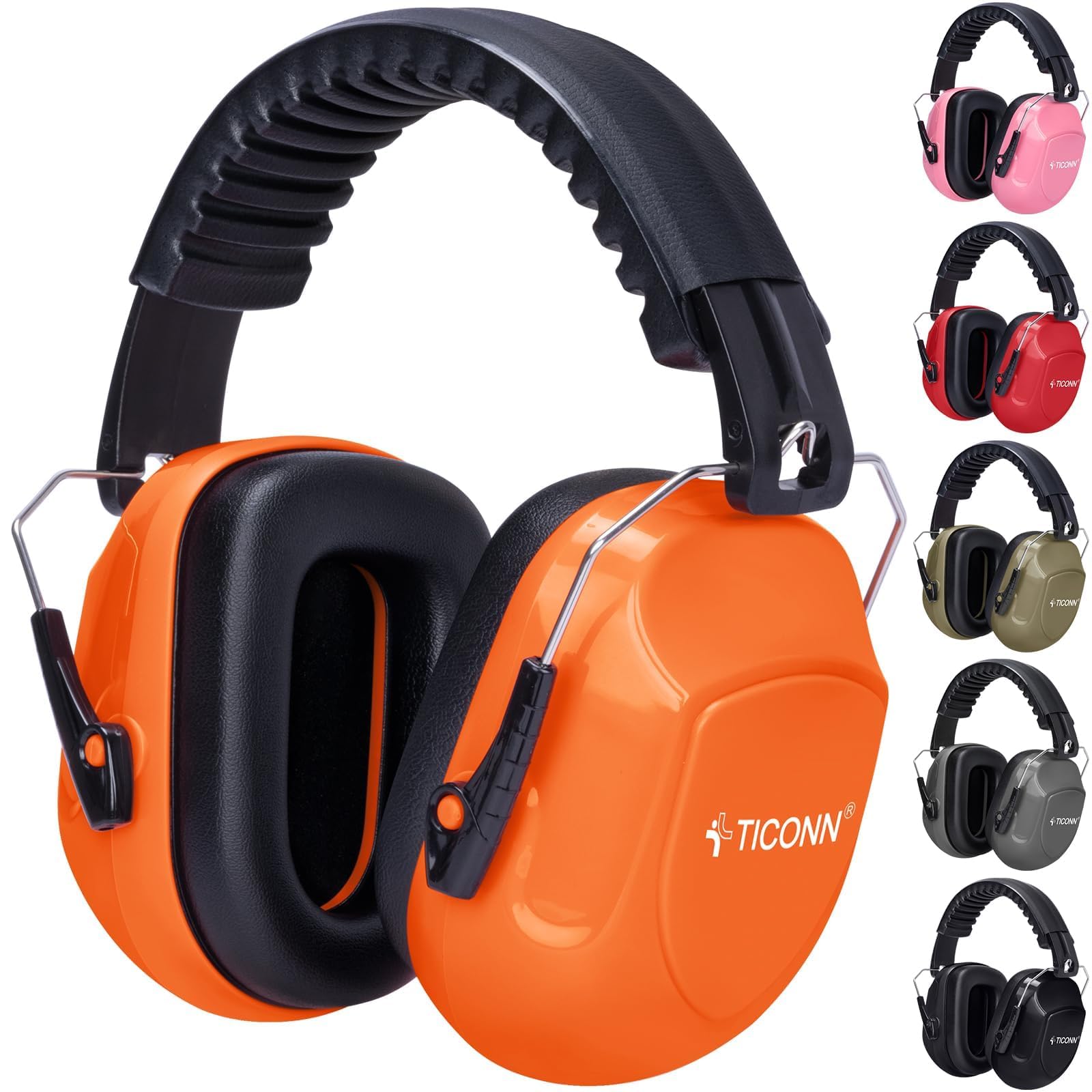
| TICONN Noise Cancelling Ear MuffsBest for Mowing | Mowing and lawn work | 26 dB NRR / 33 dB SNR | 11.99 oz | Passive | Amazon |
| PROHEAR 016 Safety EarmuffsSlim and Light | Rifle shooters on a budget | 26 dB NRR | 7.36 oz | Passive | Amazon |
| Dewalt DPG62-C Interceptor | Tractor and equipment operators | — (muffling, no NRR listed) | — | Passive | Amazon |
| ProCase Extra Large SNR 37dB | Big heads and hearing-aid wearers | 30 dB NRR / 37 dB SNR | 0.41 kg | Passive | Amazon |
| 3M Peltor Optime 105 | Extreme noise up to 105 dBA | — (rated to 105 dBA) | 12.32 oz | Passive | Amazon |
| Qozybuds Bluetooth 6.0 Headphones | Music while you mow | 30 dB SNR | — | Rechargeable 1200mAh | Amazon |
| 3M PELTOR X5 Series | Hard hat and helmet mounting | 21 dB NRR | — | Passive | Amazon |
| Howard Leight Impact Sport | Range commands and hunting | 22 dB NRR | — | 2 AAA (electronic) | Amazon |
Detailed Reviews
1. Walker’s Razor Slim Electronic Muff
Our pick — 4.5+★ from 85,500+ verified ratings; the strongest balance of quality and price.
The electronic muff that quiets the bang but hands back the conversation.
If you want one pair to cover a weekend at the range and a weekday in the shop, this is the pair that does both because it actively listens rather than just blocking. Two Hi-Gain omnidirectional microphones (small mics that pick up sound from every direction) feed the electronics so speech comes through clear while the loud spike gets clamped down. The 23 dB NRR (Noise Reduction Rating, the standard measure of how much sound a muff blocks) puts it in solid protective territory for steady machinery and range work.
What earns it the top slot is the slim, low-profile earcup. It clears a rifle stock and a hard hat without breaking the seal against your head, which is the whole game when a fat cup would ride up and leak sound. A sound-dampening composite housing helps keep the shell from ringing, and a 3.5mm audio input jack lets you plug in a scanner or music source. Two AAA batteries come in the box, so it works the moment you unbox it.
Comfort holds up over long stretches — gunshots drop to a comfortable level and the headband doesn’t punish you after an hour. The catch worth knowing: this is the heaviest electronic option here at 12.63 ounces, and that weight sits on your head all shift. Compared with the feathery PROHEAR 016 below at 7.36 ounces, you’re trading ounces for the electronics. For most buyers that trade is worth it, but if all-day lightness is your priority, look at the passive picks.
Where it earns the top spot
- Electronic mics amplify speech and cut the loud spike so you hear commands and warnings
- Slim low-profile earcups clear a rifle stock and hard hat without breaking the seal
- 3.5mm audio input for a scanner or music source, with two AAA batteries included
- Composite housing dampens shell ring; the field-standard choice for range and shop duty
What to weigh before you commit
- At 12.63 ounces it’s the heaviest electronic pick here — noticeable across a full shift
- 23 dB NRR is solid but sits below the heavy passive blockers for extreme machinery
- With fewer total ratings than the budget options, its top score rides on a smaller crowd
Reach for this if: you want one electronic muff for range days and shop work, with speech amplification built in.
Look elsewhere if: you need maximum lightweight comfort for an eight-hour passive shift — go passive and light.
2. TICONN Noise Cancelling Ear Muffs for Adults
The passive muff that turns a screaming mower deck into a background hum.
Lawn crews and weekend mowers are the target here, and the numbers back it up: a 26 dB NRR rating paired with a 33 dB SNR (Signal-to-Noise Ratio, the European-style measure of how much noise the muff knocks down) puts real distance between your ears and the engine. The fit is what wins people over — soft memory foam cushions and an adjustable headband lock a secure seal on all head sizes, which is exactly what keeps the rating honest while you’re pushing a mower.
The build is tougher than the light weight suggests. A high-quality ABS shell and reinforced metal frame survive a 1.5m/4.9ft drop test, resist cold down to -20°C/-4℉, and hold up to heat at 50°C/122℉. On a hot summer mow that heat tolerance matters more than you’d guess. The compact foldable design folds flat for stashing in a toolbox or truck cab, and it covers hunting, sleeping, gardening, and air travel as well as the obvious lawn duty.
The honest trade-off: this is a passive muff, so it lowers everything uniformly — you give up electronic speech amplification. For steady engine noise that’s no loss at all. It’s only a real limitation if you need to hear a teammate across a noisy site while you work.
The smart call for: anyone who wants serious passive blocking for mowing, gardening, or shop noise and folds the muffs away when done.
Skip the electronics hunt: if conversation while working is a must, an electronic pick like the Walker’s above covers that need.
3. PROHEAR 016 Ear Protection Safety Earmuffs
At 7.36 ounces, the featherweight that clears a rifle stock without dragging your head down.
Rifle shooters who hate a heavy muff riding on their skull get the obvious answer here. At 7.36 ounces this is by far the lightest pick in this lineup — versus the Walker’s electronic muff above at 12.63 ounces. That difference is the point: less headband pressure means you keep the muffs on instead of pulling them off for relief.
It isn’t just light. Low-profile cut-out earcups are built for firearm stock clearance, so you can shoulder a rifle without the cup fighting the wood. The 26 dB NRR carries a certified 26dB NRR (Noise Reduction Rating, a standard measure of noise blocking) backed by ANSI S3.19-1974, the US safety standard for ear protection, and CE EN 352-1, its European counterpart. A sound-dampening composite housing turns outside noise down rather than letting the shell ring.
The maintenance angle is a quiet winner: replaceable snap-in ear cushions mean you can refresh the foam without replacing the whole muff. Padded headband and rubberized coating keep the feel soft-tough over time. Functionality and build quality are the things that keep this pair ticking over months of use. Just go in knowing the passive design lowers everything, so a range command at distance won’t get amplified the way an electronic pair would.
The case for the featherweight
- 7.36 ounces — the lightest pair here, so the headband fades away over a long session
- Low-profile cut-out earcups clear a rifle stock; passive 26 dB NRR carries the rating honestly
- Replaceable snap-in ear cushions let you swap foam instead of buying a new muff
Be aware
- Passive only — it lowers everything, so distant speech isn’t amplified the way electronics do it
- The slim cups mean this pair is tuned for range work, not the deafening end of heavy machinery
Ideal for: the shooter or range regular who wants feather-light muffs that clear the stock and still carry a certified rating.
Look elsewhere if: you want electronic speech amplification — go with the Walker’s or Howard Leight for that.
4. Dewalt DPG62-C Interceptor Protective Safety Earmuff
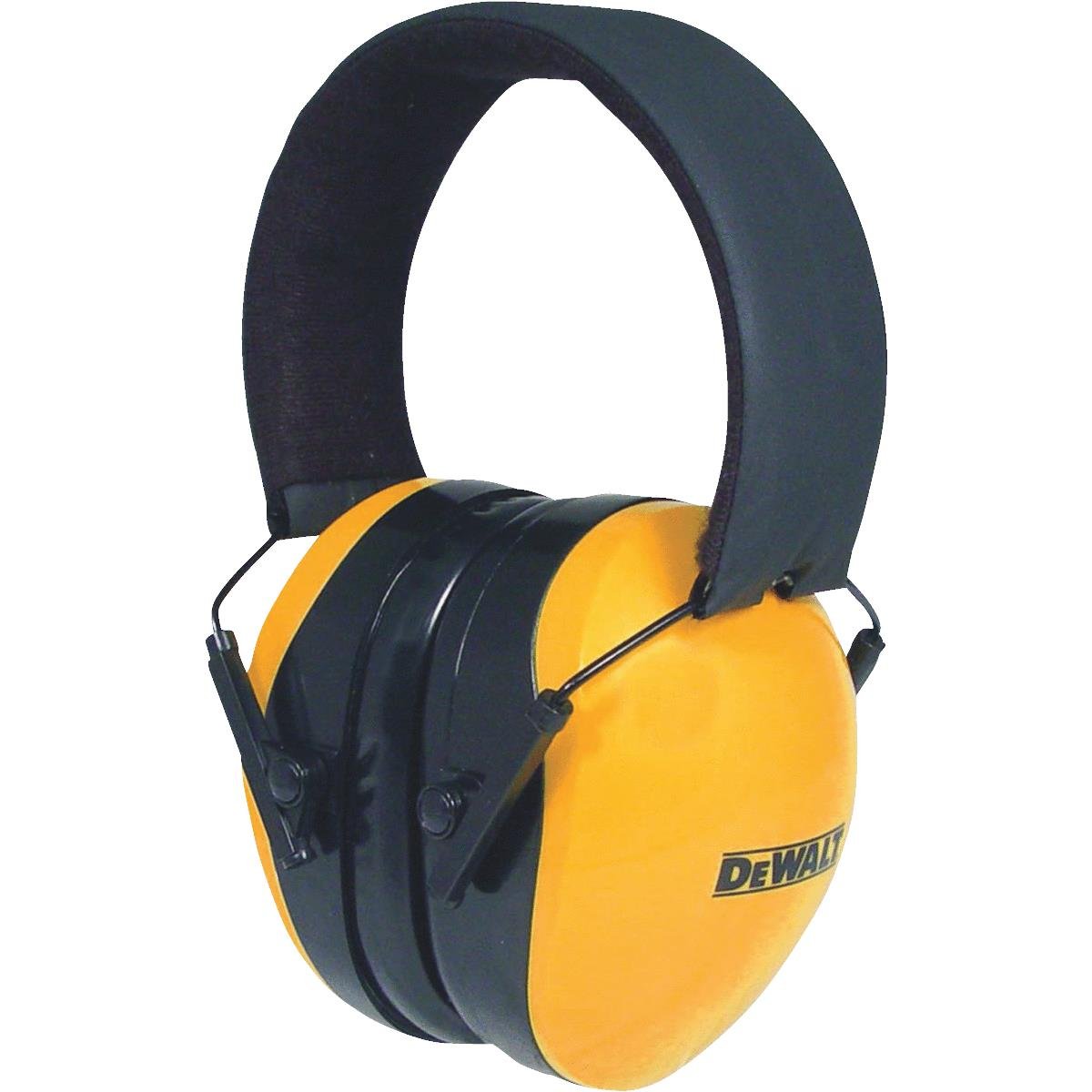
The muffle that tractor operators forget they’re wearing.
Run equipment all day and the noise stops being a nuisance and starts being a grind. What makes people reach for this Interceptor is the muffling — it tames loud engine and machine drone, and it does it on a tractor as easily as on a mower. The comfort padding is the second win: it sits light enough to forget while a diesel engine drones under you all shift.
This is a Radians-built safety muff with a background in industrial and construction PPE — the kind of gear made for carpenters, painters, and someone running a tractor. It’s a straight passive design: no electronics, no batteries, nothing to charge or lose. For steady, predictable machinery noise that’s the right answer, and for the buyer who wants a no-fuss muff that just works and stays out of the way.
What it does well: quiet down loud drudgery and stay comfortable while it does it — the two things a long equipment shift actually demands.
The fit-and-finish note: it’s a passive muff tuned for steady noise, so don’t expect speech amplification or a fit customized to a hard hat. For a plain, tough earmuff on a tough job, that’s a fair deal.
Best matched to: tractor operators and equipment users who want a simple, comfortable passive muff with no charging routine.
Pass if: you need amplified conversation or helmet-specific mounting — this one is a plain passive muff through and through.
5. ProCase Extra Large SNR 37dB Noise Cancelling Headphones

Built roomy on purpose — the block that finally fits a big head without squeezing.
Start with the quiet: a 30 dB NRR and 37 dB SNR rating make this the strongest noise-reduction number in this lineup — versus the Walker’s 23 dB NRR. According to the maker that rating carries ANSI S3.19 (US) certification. On paper it’s the best blocker here, and in practice it earns its keep wherever sound needs to go away completely — an industrial floor, an airfield, or a study session you can’t escape.
But the real draw is the size. The oversized, elastic headband with a retractable design gives generous room over the head and a soft landing on the ears, so a wearer with a big head finally stops feeling pinched. The soft imitation-leather cups with thickened foam spread the pressure out and let your ears breathe. That matters over long wear, and it’s why these work for want-to-be-quiet tasks as well as loud ones.
Its ability to sit over in-ear earbuds is a genuine plus for anyone who wants music or a hearing aid under the muff. The padding is the one point that draws mixed feedback — some find the thickened foam great, others want it a touch different. Overall clean and comfortable long-term, this is the pick when blocking power tops your list and a standard-size muff has never fit right.
Why the size wins votes: oversized and roomy enough for a big head, with retractable adjustment and breathable foam — and it clears a pair of earbuds underneath.
One fit caveat: the padding pulls mixed opinions, so if foam thickness is a dealbreaker for you, consider a slim passive pick like the PROHEAR 016 instead.
Made for: big-headed wearers, hearing-aid users, and anyone who wants the strongest blocking number here over in-ear buds.
Not the one if: you want slim cups that clear a hard hat — the generous size is the point, and it isn’t built to tuck under a helmet.
6. 3M H10A Peltor Optime 105 High Performance Ear Muffs

Engineered for the deafening end of the spectrum — noise levels up to 105 dBA.
Some jobs sit right at the edge of what ears can take, and this is the muff for that zone. It’s built for noise levels up to 105 dBA (A-weighted decibels, the scale used to measure loudness as your ear actually perceives it). That’s a job-site-to-full-blast-furnace kind of noise. At the center of it is double-shell technology — two layers of shell working together to keep sound out rather than one thin wall.
For steady industrial noise, the design earns its keep. The stainless steel headband distributes weight for a low-pressure fit, and earcup pivot points tilt to follow the shape of your head for a better seal. That combination makes it comfortable on an indoor shooting range as easily as on a loud factory floor. It’s the no-nonsense passive blocker for the buyer whose priority is maximum suppression over features.
The strong point: double-shell construction and a tilting, weight-distributed headband — engineered for noise up to 105 dBA and comfortable while it works.
The honest fit note: sizing draws mixed opinions — some find it comfortable, others don’t get a good fit. It’s also a plain passive muff, so if you need speech amplification or slim stock clearance, look to the electronic or low-profile picks.
Go for this if: you face extreme, steady machinery noise and want a dedicated passive blocker rated for it.
Think twice if: fit is hit-or-miss for you — try to confirm sizing, and steer toward the oversized ProCase if a standard fit never sits right.
7. Qozybuds Bluetooth 6.0 Hearing Protection Headphones

Bluetooth muffs that keep the mower out and your playlist in.
Here’s the pair for the person who wants protection and a soundtrack in one headset. A 30 dB SNR (Signal-to-Noise Ratio, a measure of how much background noise the muff knocks down) handles the noise-reduction side. The Bluetooth 6.0 connection (a newer, more stable wireless standard) links to your phone. The battery is the headline: a 1200mAh rechargeable cell pushes up to 120 hours of playtime, and a quick five-minute charge buys you four hours of music.
The controls are built for real work rather than delicate taps. Large buttons are sized so you can work them with gloves on — handy for weeding, mowing, construction, or woodworking when your hands are busy or dirty. It supports Siri and Google Assistant for hands-free calls, music, and texts, and the dynamic driver (the speaker that produces the sound) delivers stereo audio. These muffs also play well with a long shift: comfortable on the ears without clamping, with a fit that doesn’t turn into a vice.
Sound quality rounds out the package — clear music and book listening, and noise that drops to a fraction of what it was. Owners also love that the charge stretches over a week of use. Buyers do flag durability as the one soft spot, so treat the headband and cups with some care. For mowing, studying, and woodworking with background tunes, it’s a versatile tool.
The playlist-and-protection package
- 30 dB SNR noise reduction with Bluetooth 6.0 audio for music and hands-free calls
- Up to 120 hours of playtime on a 1200mAh battery; five-minute fast charge buys four hours
- Large buttons work with gloves on; supports Siri and Google Assistant
- Comfortable, non-clamping fit for long mowing or workshop sessions
Where it asks care
- Durability draws mixed feedback — treat the headband and cups gently
- It’s a passive-style blocker under the audio, so it won’t amplify outside speech like an electronic muff does
- Larger buttons and electronics add bulk compared to a bare passive muff
The one for: mower jockeys and woodworkers who want Bluetooth music and calls under one protective headset.
Not for you if: you want pure, feature-free blocking with nothing to charge or wear out — a plain passive muff is simpler.
8. 3M PELTOR X5 Series Ear Muffs

The 3M X5 that clips onto a hard hat and stays comfortable through loud shifts.
If your workday means a helmet plus an ear muff, this is where the X Series earns its place. The design is built for tough jobs where loud sounds come at you all day — construction, manufacturing, automotive. A 21 dB NRR (Noise Reduction Rating, the standard measure of how much sound is blocked) is the number to keep in mind, and the adjustable cups angle to create a fit customized to the worker’s head. That adjustability is what makes it snap onto a helmet and still sit right.
The quality reads as 3M’s industrial pedigree — it’s available across over-the-head, hard-hat-attached, and behind-the-head versions, so you can match the model to how you wear a helmet. On a helmet it’s easy to install, and it blocks more sound than people expect. Comfortable enough that whole workdays pass in it and it’s rated for the noise it’s aimed at.
Here’s the honest catch, and it’s the big one: this is a heavy muff, and buyers do flag the weight. If a lighter helmet-mounted option exists, that’s the trade to weigh. Sizing also draws mixed feedback — some fit nicely, but it doesn’t work with full-brim hard hats. Know your helmet style before you commit.
Built for the helmet: adjustable, angle-and-tilt cups that fit a hard hat and hold a seal through construction-grade noise.
The weight and fit caveat: it’s a heavy muff, and it won’t work with full-brim hard hats — check your helmet before ordering.
Pick this if: you wear a hard hat and want a muff that mounts cleanly to it for loud construction or manufacturing work.
Look elsewhere if: you wear a full-brim helmet or find a heavy muff hard on your neck over a whole shift.
9. Howard Leight by Honeywell R-01526 Impact Sport Earmuffs

It hears the range officer, then slams shut when the shot goes off.
For range work this is the electronic design many regulars reach for. Built-in directional microphones (mics aimed to pick up sound from a set direction) lift voices and range commands to a safe 82 dB, so you can hear instructions while you’re shooting. When ambient sound passes 82 dB, the electronics cut the amplification automatically — so a gunshot gets muted and a conversation doesn’t.
The 22 dB Noise Reduction Rating (NRR, the standard measure of how much noise is blocked) tells you how much it takes off the top. Low-profile earcups clear a firearm stock, the adjustable headband holds a secure fit, and the compact folding design stows in a range bag. A 3.5mm AUX input and cord let you plug in an MP3 player or scanner, and an integrated power/volume knob runs the whole show.
Battery life is down to earth: two AAA batteries included, an automatic shut-off after 4 hours to protect the charge, and roughly 350 hours of life on a set. It works well with name-brand AAA cells. As with any electronic muff, if the unique long-term fit bugs you, it’s worth confirming how the cups sit on your head. For hearing a range command and still blocking the bang, this one does its job cleanly and comfortably.
The range companion: directional mics amplify commands to a safe 82 dB, auto cutoff at that level, and a 22 dB NRR handles the actual suppression.
Battery and fit notes: about 350 hours on two AAA batteries with a 4-hour auto shut-off — but fit is the one spec that lands differently from head to head.
Choose this for: range days and hunting where hearing the command matters as much as blocking the bang.
Not your pick if: you only need a plain passive muff with no batteries to think about — the electronic smarts are the reason to buy this one.
Know the Specs
What the NRR Number Actually Means
The Noise Reduction Rating is a number on the box that estimates how many decibels the muff knocks off the noise you’re in. It’s a standard number you can compare across products — so a 30 dB NRR muff blocks more than a 23 dB NRR one, but neither seals perfectly on your own head. Real blocking depends on the fit: a muff that breaks the seal because it hits your stock or helmet gives you less than the box number. Treat the NRR as a starting point for comparing, and treat a snug fit and a comfortable headband as the real guarantee.
Electronic Muffs vs Passive Muffs
A passive muff just blocks sound — no batteries, nothing to lose, and it works the instant you put it on. An electronic muff adds small microphones and circuitry: it amplifies quiet sounds and speech so you can hear commands, but it clamps down when loud sound crosses a set level. That’s useful on a range or a noisy site where you need to hear a warning; it’s overkill for steady engine drone where nobody’s talking to you. Electronic muffs also run on batteries, most here on AAA cells, which is one maintenance routine to keep in mind.
Common Questions
Will electronic earmuffs actually let me hear a range officer while still blocking gunshots?
How long do the batteries last in work earmuffs like these?
Will slim low-profile earcups really clear a rifle stock?
Can I wear these earmuffs over my hearing aids or earbuds?
Which earmuffs are best for mowing the lawn all season?
Can I mount these earmuffs on a hard hat or helmet?
What’s the difference between the NRR and SNR numbers on the box?
Are the foam cushions replaceable on these earmuffs?
Do earmuffs with a higher NRR cost me the ability to hear warnings?
How do I get the best seal and the most comfort out of my earmuffs?
The Bottom Line
For most working buyers, the work ear protection winner is the Walker’s Razor Slim Electronic Muff because it combines electronic speech amplification with a slim profile that clears a rifle stock and a hard hat without breaking the seal — one pair for range days and shop work. If you want featherweight comfort on the range, grab the PROHEAR 016 at a certified 26 dB NRR and just 7.36 ounces. And for the loudest industrial noise you can throw at your ears, the ProCase Extra Large carries the strongest blocking number here with a 30 dB NRR and generous sizing.
The one nudge: the Walker’s earns its spot on the strength of being the field-standard, field-ready electronic muff — if you want a single do-it-all pair, that’s the smart buy, and the budget-friendly TICONN and PROHEAR hold their own as the value plays that won’t let you down.
How we choose
We do not accept paid placement. Every pick is matched to a real buyer and a real use-case; we do not hands-on test units.
Sources
Specifications: manufacturer listings and product documentation. Review insights: verified customer reviews, as of November 2026. Pricing: not shown on this page (it changes often); check the current price via the retailer link.
As an Amazon Associate, Tactical Gear Guy earns from qualifying purchases. This does not affect which products we feature.