Specs are compiled from manufacturer listings and verified buyer reviews and can change over time — please confirm the key details on the product page before buying.
Mixing a home stereo into pro audio gear usually means one thing: a cable that fights you. The trouble is almost never the gear — it is the interconnect between an RCA jack and a 3-pin XLR port, and picking the wrong one leaves you chasing hum, crackle, or a connector that stops locking after a month. This guide covers what genuinely matters in an XLR to RCA cable: which signal direction it actually passes, whether the shielding holds up, how long the run needs to be, and which lengths and plug combinations simply will not fit your rack. Below you get nine real cables, sorted by what each one is genuinely good at, so you can buy once instead of buying three times.
This guide is built by comparing the manufacturers’ published specifications and the patterns across verified customer reviews, so you get each pick’s real strengths and trade-offs instead of marketing spin.
Most buyers get burned by one detail nobody prints on the box: an RCA-to-XLR lead passes an unbalanced signal and cannot magically turn it into a balanced one. That single fact decides whether your run is quiet or buzzing, and it drives the wiring, shielding, and length notes on every pick below.
Top Picks


How To Choose The Best XLR to RCA Cable
Start with the connector count, not the brand. A single XLR-to-dual-RCA cable splits one mono signal across two RCA plugs. A dual-XLR-to-dual-RCA cable carries a stereo pair, left and right, in one jacket. Buy the wrong count and a stereo source collapses into one mono feed, so one speaker gets both channels summed.
Direction: which end plugs into what
Most of these leads work in both directions, so an XLR male plug can feed an RCA input and an RCA output can feed an XLR input. The catch is that the signal stays unbalanced either way. Wire it XLR pin 2 to the RCA center pin, and pins 1 and 3 to the RCA shield, and you get sound. Try to force a balanced connection through an RCA plug and you get hum instead.
Length is a noise decision
A short run in a home rack is forgiving. A long run beside power cables and dimmer packs is not. The Cable Matters dual splitter at 10 feet and the belipro dual cable at 20 feet cover the long jobs, while the 1-foot and 2-foot leads suit tight patch bays where a coil of slack would just tangle. Pick the shortest length that reaches with a few inches of slack at each plug, so the connectors are not under tension.
Shielding and conductor gauge
Look for oxygen-free copper conductors and a foil plus braid shield. A 20 AWG conductor with 4N oxygen-free copper is the common spec in this range, and it is plenty for line-level audio. Braided nylon or flexible PVC jackets matter too — a stiff cable that will not coil is a cable you stop carrying to gigs.
Side-by-Side Comparison
| Model | Best For | Connector Pair | Length | Conductor | Amazon |
|---|---|---|---|---|---|
| Tisino 2 RCA to XLR Male Y-Splitter★ Best Overall | Tight racks and gig bags | 2 RCA to 1 XLR Male | 3.3 ft | 20 AWG OFC | Amazon |
| Cable Matters Dual XLR to RCA, 6ftStereo Standard | Stereo home-audio runs | 2 XLR Female to 2 RCA Male | 6 ft | OFC, braided shield | Amazon |
| DISINO Female XLR to Dual RCA Y SplitterSubwoofer Split | Subwoofer and speaker splits | 1 XLR Female to 2 RCA Male | 3 ft | 20 AWG OFC | Amazon |
| Cable Matters Dual RCA to XLR, 10ft | Long runs to a mixing board | 2 RCA to 1 XLR Male | 10 ft | OFC, braided shield | Amazon |
| Mugteeve Dual XLR Female to Dual RCA Male | Splitting a stereo pair apart | 2 XLR Female to 2 RCA Male | 3.3 ft | Spiral OFC, foil shield | Amazon |
| HUALEU 2-Pack RCA Female to XLR Male | L/R pairs on a patch panel | 2 RCA Female to 2 XLR Male | 1 ft | OFC, foil shield | Amazon |
| WJSTN RCA to XLR Male, 2-Pack | Pro gear into consumer inputs | 2 RCA Male to 2 XLR Male | 2 ft | 20 AWG OFC twisted pair | Amazon |
| GEARit Dual XLR to Dual RCA, 6.6ft | Mixers and amps with a warranty | 2 XLR Female to 2 RCA Male | 6.6 ft | OFC, spiral copper braid | Amazon |
| belipro Dual Female XLR to RCA, 20Ft | Long room-to-room runs | 2 XLR Female to 2 RCA Male | 20 ft | 4N OFC | Amazon |
Detailed Reviews
1. Tisino 2 RCA to XLR Male Cable
Our pick — 4.5+★ from 750+ verified ratings; the strongest balance of quality and price.
One cable that turns a stereo RCA pair into a single XLR male plug without adding a spaghetti of adapters.
The case for the Tisino starts with its job: it takes two RCA plugs and merges them onto one 3-pin XLR male connector, which is exactly what you need when an amplifier or mixer only offers XLR in. The wiring follows the standard unbalanced layout — pin 2 carries the center RCA signal, while pins 1 and 3 tie to the RCA ring and serve as earth. Tisino is refreshingly blunt that a balanced RCA-to-XLR adapter is not physically possible, so you know upfront what you are buying.
Under the jacket sits 20 AWG 4N oxygen-free copper (a thick, low-resistance copper conductor) with multiple shielding layers, and the point of all that is simply a quiet line into your amp. The jacket is where this cable earns its keep. The rubber and nylon braid jacket measures 6.0mm across, and it stays flexible enough to coil quickly at the end of a set rather than kinking into a spring. That flexibility matters if the cable gets coiled into a gig bag after every set.
The catch is length. At 3.3 feet this is a patch-cable reach, not a run that crosses a stage, and it also weighs 0.12 kg — noticeably less cable than the 0.15 kg Cable Matters dual splitter, which is fine on a rack shelf but means less jacket mass in the hand. If your equipment sits more than arm’s length apart, plan on a longer lead. For anyone patching a Denon receiver or a Klipsch subwoofer into an XLR input, though, this is the tidy, no-adapter answer.
What earns its keep
- Two RCA into one XLR male in a single molded lead, so no adapter stack to loosen
- 20 AWG 4N oxygen-free copper with shielding for a clean, low-noise line
- Flexible 6.0mm braided jacket coils without tangling after a gig
- Standard unbalanced pinout: pin 2 to RCA center, pins 1 and 3 to the ring
Where it stops short
- At 3.3 feet it is a patch-length cable, not a long room run
- Unbalanced only — it will not convert a signal into balanced audio
Reach for this if: your amp, receiver, or subwoofer is within a couple of feet of the RCA source and you want one clean molded cable.
Look elsewhere if: the two devices sit across a room — you need the longer runs further down this list.
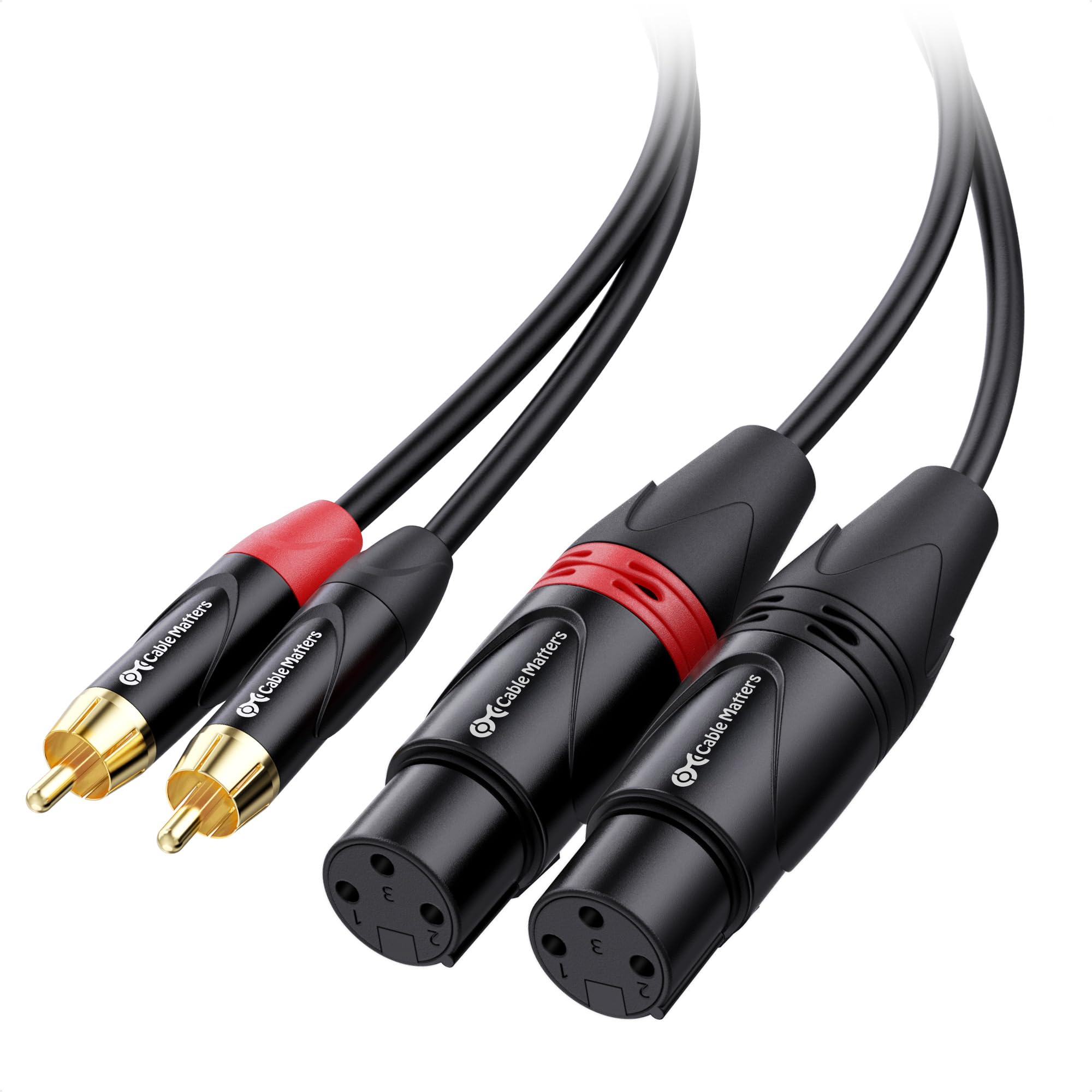
2. Cable Matters Dual XLR to RCA Cable
A stereo pair in one jacket — two XLR female ends feeding two RCA male plugs, wired left and right.
For a full stereo hookup, this is the shape you want. The dual-channel layout carries separate left and right unbalanced analog signals, so a DAC, preamplifier, or receiver feeds two powered speakers or an amp without you buying and labeling two single cables. The locking XLR female connectors are the detail that matters in practice: they click into place and stay put, which you notice the first time someone walks past the rack.
Cable Matters is honest about the electronics — it adapts between RCA and XLR connectors but does not convert an unbalanced signal into a balanced one, and it asks you to confirm the pinout matches your equipment before use. Inside are oxygen-free copper conductors with braided shielding against interference, gold-plated RCA male plugs with split-blade shields for a snug grip, and molded strain relief at both ends. The flexible PVC jacket routes easily around the back of a home-audio cabinet.
Durability is the one honest grey area. Most of these hold up for years of light handling, but there is at least one report of a lead failing after only a couple of uses — worth knowing if the cable will be plugged and unplugged constantly rather than left in place. At six feet it also splits the difference between a patch lead and a proper run. Compare it to the Tisino above: same territory, but this one gives you a matched stereo pair instead of a mono split into two RCA.
The stereo argument: two channels, one jacket, locking XLR ends and gold-plated RCA plugs — for a receiver feeding an amp, nothing here needs a second purchase.
Mind the flex point: keep it plugged in rather than coiled into a bag every night, and this lead will outlast the gear around it.
The straightforward pick: a home-audio or small-studio stereo link that stays put on a shelf.
Not your cable if: you pack and unpack a rig weekly — the molded ends prefer a quiet life.
3. DISINO Female XLR to Dual RCA Cable
The split sits 19.6 inches from the XLR end, so both RCA plugs reach a subwoofer without bending.
Here is a detail most Y-cables hide: where the fork actually happens. On this DISINO the split point sits 19.6 inches (50 cm) from the XLR end, leaving you a generous gap before the legs divide. If you are feeding a Klipsch subwoofer or a pair of RCA inputs that are spaced apart, that extra reach is the difference between a clean install and a stretched, half-plugged connection.
The connector finish is 24k gold plating, and the copper shell blocks interference so the signal arrives with as little loss as an unbalanced line allows. Inside runs the same 20 AWG 4N oxygen-free copper you find on the best cables at this level, with foil and metal braid shielding plus a cotton yarn wrap to cut noise. DISINO also uses polyethylene insulation, which its spec sheet ties to improved high-frequency response. The 6.0mm PVC jacket is thick and elastic enough to stay cooperative.
Like every lead in this group, it is unbalanced only — DISINO says plainly that a balanced RCA-to-XLR adapter is not achievable, so treat that as a spec, not a shortcoming. At 3 feet it is a short splitter, which suits a sub sitting near an amp but rules out anything across the room. Set beside the Tisino above, the difference is the fork: this one hands you two RCA legs, the Tisino hands you one XLR male.
Built into the split
- Fork begins 19.6 inches from the XLR plug, giving both RCA legs real slack
- 24k gold-plated connectors with a copper shell for a tight, low-loss fit
- 20 AWG OFC with foil plus braid shielding and a cotton wrap against hum
The honest limits
- 3-foot total length — a patch cable, not a room-spanning run
- Splits one XLR signal to two RCA, so it is not a stereo pair
Right tool when: a subwoofer or two closely spaced RCA inputs need feeding from one XLR output.
Wrong tool when: you need left and right carried separately — buy a true dual cable.
4. Cable Matters Dual RCA to XLR Cable
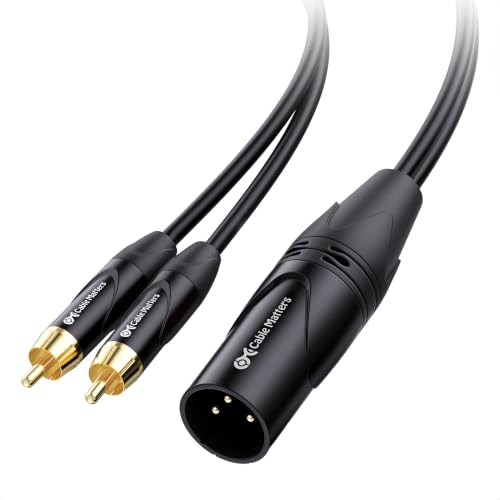
Ten feet of braided splitter built for the walk from a DVD player to a mixing board.
When the source and the board are not neighbors, this is the cable that solves it. At 10 feet it is more than triple the reach of the 3-foot DISINO splitter a few spots up — a real difference when the consumer gear sits on a shelf and the mixer is across the room. Cable Matters pitches this squarely at that job: DVD and Blu-ray players and similar home equipment feeding mixing boards, speakers, and other pro audio gear over an unbalanced connection.
The dual RCA ends merge into one 3-pin XLR male connector, gold-plated throughout, with the braided jacket doing the mechanical work. Metal connectors on the RCA side are built to survive being plugged and re-plugged as you swap sources. One spec to keep in mind is weight: at 0.15 kg this carries a bit more jacket and shielding than the 0.12 kg Tisino, which is what you want in a longer lead that has to resist its own sag.
A long cable is also a long antenna, so route it away from power leads and dimmer packs where you can. The trade-off against the shorter picks is simple bulk — 10 feet of jacket is more to coil and store. But if you have been contorting behind a cabinet with a 3-foot lead, that extra length is worth it.
Reach, resolved: a 10-foot run with gold-plated ends and a braided jacket that assumes it will be handled.
Keep it tidy: a run this long picks up more ambient noise, so dress it clear of power cabling.
Made for: home theater gear that needs to reach a mixer or powered speaker across the room.
Overkill if: both boxes sit on the same shelf — the short leads save you the coil.
5. Mugteeve Dual XLR Female to Dual RCA Cable
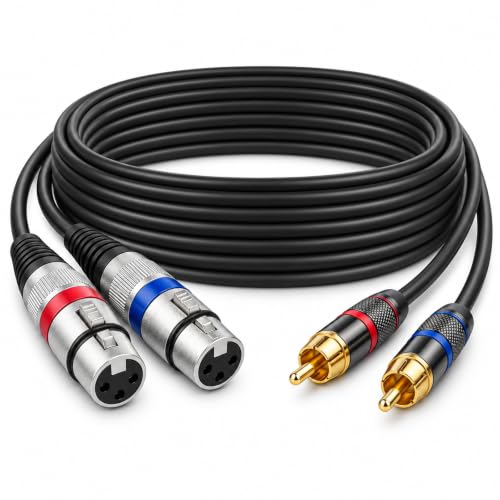
Two cables in one jacket that peel apart into separate leads exactly when you need them to.
This is the cable for the install you cannot quite predict. It ships as a single dual lead — two 3-pin XLR female connectors on one end, two gold-plated RCA male plugs on the other — but the jacket peels apart, so you can split it into two separate RCA-to-XLR cables if the run needs to go in different directions. That peel-apart jacket is rare at this price and useful when one stereo output feeds two destinations that sit apart, like a karaoke speaker and a studio monitor.
Both ends carry red and blue color-coding rings, which sounds minor until you are patching in dim light and need left and right the first time. The shielding is a double design: the core is fully covered by aluminum foil and a spiral oxygen-free copper layer, so outside interference has two barriers to cross. Mugteeve also builds in a drag-proof connector solution at both ends, so the internal wire resists being pulled out — a sensible move for a cable headed to an important event. The black PVC coating feels soft rather than armored.
Treat it as a reliable workhorse for a fixed or semi-fixed setup rather than a cable you yank out nightly. Priced in the same band as the DISINO, it buys you a stereo pair where that one gives a mono split.
Why it earns a slot
- Peel-apart jacket lets one dual cable become two separate runs
- Red and blue rings keep left and right sorted in low light
- Double shielding — aluminum foil plus spiral OFC — blocks interference
- Drag-proof connectors resist the internal wire pulling loose
Fastened with a caveat
- 3.3-foot length limits it to local patching
- Soft PVC jacket favors a settled setup over rough handling
Grab it for: a stereo XLR-to-RCA link where the two legs may need to travel different paths.
Think twice for: a stage rig that gets torn down and coiled every night.
6. HUALEU 2-Pack 1Ft RCA Female to 3Pin XLR Male Audio Cable

A one-foot pair, one red and one black, for labeling left and right on the back of a rack.
Short, paired, and color-coded — that combination is why this HUALEU two-pack belongs in a rack build. You get two identical 1-foot RCA female to 3-pin XLR male cables, one with a red plug and one with a black, so left and right stay sorted from the moment you patch in. In a dense patch bay where six or eight connectors live shoulder to shoulder, that is worth more than extra length.
The plugs use a thickened metal shell for durability, and the gold-plated connectors are chosen for lower resistance and better contact, which keeps the signal clean across a short jump. The conductor is oxygen-free copper with aluminum foil shielding, wrapped in a cable measuring 0.17 inches across — thin enough to fit behind crowded gear. HUALEU notes this is an unbalanced method passing an RCA signal to a XLR-interface amplifier, and the cable does not care which direction the signal flows, so either end can be an input or an output.
The obvious catch is the one-foot length: this is patch-bay furniture, not a cable that leaves the rack. Under a foot of slack also means you need the two ports close together, or the cable will pull. Also note, the two plugs you get are RCA female to XLR male, which is the opposite gender mix from most leads here — check your ports before ordering.
Rack-console logic: two color-matched leads that keep a left/right pair straight on day one.
Gender check: RCA female and XLR male — confirm your jacks match before you commit.
Perfect fit: a patch bay or amp input bay where two ports sit inches apart and L/R needs to stay obvious.
Mismatch if: you need to span more than a foot, or your gear ends are opposite genders.
7. WJSTN RCA to XLR Male Cable 2-Pack
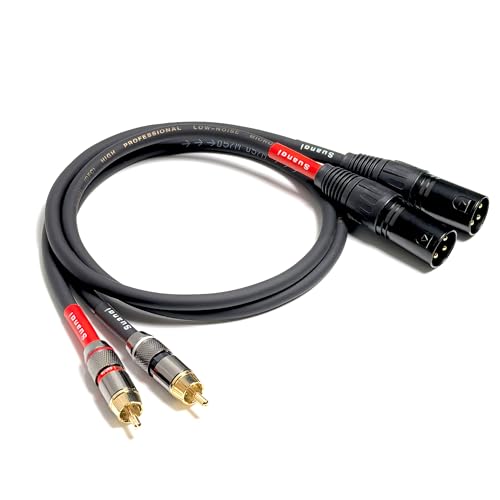
Twisted-pair construction at 20 AWG, the spec that does the most to reject static and popping.
The build detail that sets this WJSTN apart is its twisted pair. The conductors are 4N oxygen-free copper at 20 AWG, twisted together rather than run straight, with a high-density shielding and aluminum foil layer on top. The reason that matters in plain terms: twisting the pair plus the foil shield gives electromagnetic and radio-frequency interference two different structures to fight, which is how the maker gets to the “no static or popping” claim. For a cable that runs past power supplies, that is the spec to buy on.
It arrives as a two-pack of 2-foot RCA male to XLR male cables, one red and one black, so you can wire a stereo pair straight out of the bag. The connectors are 24K gold-plated for solid contact, and rubber strain relief at each end extends the life of the joint where most cables eventually fail. The PVC jacket stays flexible and coils small.
The clear purpose here is getting pro audio signal into consumer inputs, or the reverse — the kind of mismatch a lot of home setups create. Two feet is enough to cross a small rack but not a room; if you need more, step up to the 10-foot or 20-foot picks. One thing to verify: the XLR end is male and the RCA end is male, so make sure your ports accept that pairing.
What the shielding buys
- Twisted-pair 20 AWG OFC plus high-density foil shield targets EMI and RFI static
- Two cables — red and black — so a stereo pair is done in one pack
- 24K gold-plated plugs with rubber strain relief for a joint that lasts
The trade-off
- 2-foot reach is rack-only, not a long interconnect
- Male XLR to male RCA — worth double-checking against your sockets
Best matched to: bridging pro audio gear and consumer inputs where interference is a real worry.
Skip the stretch: if your gear needs more than two feet of cable, this pair will not make it.
8. GEARit Dual XLR to Dual RCA Cable
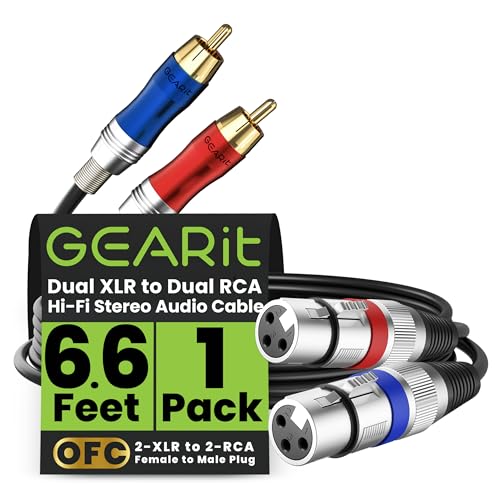
The only cable here that backs itself with a limited lifetime replacement warranty.
Buying a cable is a bet that it will still work next year, and GEARit is the one pick that puts that bet in writing. It carries a Limited Lifetime Replacement Warranty plus a 30-day money-back offer, so a dead lead is a support call, not a write-off. That coverage is the reason this sits at the top of the price band — you are paying a little more for the promise behind it.
The spec sheet is solid on its own terms: oxygen-free copper conductors with a spiral braided copper shield to keep interference out, polyethylene insulation for improved frequency response, and heavy-duty metal connectors with molded strain relief. The 6.0mm soft PVC jacket balances flexibility against durability. The dual XLR female to dual RCA male format carries a stereo pair, and GEARit lists broad compatibility — harmonizers, digital mixers, patch bays, preamps, speakers, preamps, and AV receivers.
The one honest grey area is reliability. The reviews trend toward good-quality reports, with the occasional mixed note, so the lifetime warranty is doing real work here rather than sitting on a perfect record. At 6.6 feet it is the longest of the stereo dual leads, giving it more placement room than the 6-foot Cable Matters above. That extra length plus the coverage is the value case.
The warranty angle: a dual 6.6-foot stereo cable with spiral braid shielding and a limited lifetime replacement behind it.
Why the guarantee matters: with the odd mixed durability note in circulation, coverage turns a maybe into a safe call.
Peace-of-mind pick: a stereo mixer-to-amp run where you want the safety net of a replacement warranty.
Weigh the premium: if you never expect to use a warranty, the shorter dual leads cover the same job.
9. belipro Dual Female XLR to RCA Cable 20Ft

Twenty feet of dual XLR-to-RCA, built for the run from one side of a room to the other.
When nothing shorter will reach, this is the lead. The belipro runs 20 feet — double the 10-foot Cable Matters splitter earlier in the list — and carries two XLR female connectors to two RCA male plugs as a stereo pair. The use cases belipro names are the practical ones: mixer or microphone line output to a recorder or amplifier, a DJ controller into an amp, or home theater gear wired into pro audio equipment.
The conductor is 4N oxygen-free copper with shielding, chosen for conductivity and signal clarity, and belipro points that spec at studio recording and live performance. The dual format means left and right travel together in one jacket, so you are running one cable, not two. That is a meaningful convenience across a 20-foot span where a pair of loose leads would tangle and pull apart.
A 20-foot unbalanced run deserves a warning you do not get on the short patch leads: the longer the cable, the more it can pick up. Keep this one clear of mains power lines and dimmer racks, and it will behave. It also needs room to coil, so plan for storage. For a fixed install where the two boxes are simply far apart, this is the straight answer.
Where twenty feet helps
- 20-foot reach covers room-to-room gear that shorter leads cannot join
- Dual stereo pair in a single jacket instead of two loose cables
- 4N oxygen-free copper with shielding for a clean line
What to plan around
- Long runs collect more noise — route away from power cabling
- Takes real space to coil and store between gigs
Choose it when: distance is the whole problem and you need a stereo pair to travel 20 feet.
Measure first: if a 10-foot lead would do, the shorter and easier-to-store option wins.
Know the Specs
Balanced vs. Unbalanced
An unbalanced cable carries one signal conductor plus a shield that acts as the ground return. Every RCA-to-XLR adapter on this list is unbalanced by nature, which is why a 3-pin XLR connector has to fake the balance. The signal goes to the RCA center pin, and the shield takes the return path. A balanced cable uses two signal conductors and a shield to cancel noise, but an RCA jack only has two contacts, so it cannot support that. If your run is long and noisy, a balanced setup would be the fix — not a longer RCA cable.
Oxygen-Free Copper and AWG
Oxygen-free copper is copper refined to carry very little oxygen, which keeps it highly conductive and resistant to corrosion over time. AWG stands for American Wire Gauge, and a lower number means a thicker conductor. In this range you will see 20 AWG OFC, which is plenty for line-level audio and gives the cable low resistance. The 4N label simply means four nines of purity — 99.99% copper — and it is the benchmark to look for.
Shielding and Interference
Shielding is a conductive layer wrapped around the conductors to block outside electrical noise. A foil shield handles high-frequency interference, and a braided copper shield handles lower-frequency noise and adds physical protection. Many of the better cables here stack both, and the difference is audible when a long run passes near a power supply or dimmer. Twisted-pair construction is the other trick — twisting the two conductors makes them better at canceling the noise that does get through.
Common Questions
Can a balanced XLR signal connect to an RCA input?
Is a 20-foot XLR to RCA run too long?
What is the difference between the 2 RCA to XLR male cables and a dual XLR to dual RCA cable?
Will an XLR to RCA cable fix hum in my setup?
What does the 20 AWG 4N oxygen-free copper spec mean for audio?
Do I need gold-plated connectors on a short patch cable?
Will these cables work in both directions?
Can I split one XLR output to two RCA devices at once?
Which length should I buy if I am not sure?
Will a soft PVC jacket wear out faster than a braided one?
The Bottom Line
For most setups, the xlr to rca winner is the Tisino 2 RCA to XLR Male Y-Splitter — a single molded lead with 20 AWG oxygen-free copper, a flexible 6.0mm braided jacket, and a clean unbalanced pinout that slots between consumer gear and an XLR input without an adapter stack. If you need a matched stereo pair for a home rack, the Cable Matters Dual XLR to RCA, 6ft carries left and right in one jacket with locking XLR ends. And when the two boxes simply sit far apart, the belipro 20-foot dual cable closes the gap in a single run.
One last nudge: buy the length that matches your rack, not the longest cable in the listing. The shortest lead that reaches is the quietest and the easiest to live with.
How we choose
We do not accept paid placement. Every pick is matched to a real buyer and a real use-case; we do not hands-on test units.
Sources
Specifications: manufacturer listings and product documentation. Review insights: verified customer reviews, as of November 2026. Pricing: not shown on this page (it changes often); check the current price via the retailer link.
As an Amazon Associate, Tactical Gear Guy earns from qualifying purchases. This does not affect which products we feature.