Specs are compiled from manufacturer listings and verified buyer reviews and can change over time — please confirm the key details on the product page before buying.
You want one box that keeps a tent warm overnight and still lets you cook a proper meal inside it. That is the whole promise of a wood heater and oven combo, and only a handful of units actually deliver both jobs without smoking you out. Below you get two real contenders, side by side, with the numbers that decide which one belongs in your setup.
This guide is built by comparing the manufacturers’ published specifications and the patterns across verified customer reviews, so you get each pick’s real strengths and trade-offs instead of marketing spin.
Both stoves here burn wood and pellets, both carry a built-in oven, and both fold down for transport. The difference sits in firebox size, burn duration, and how much chimney hardware lands in the box. Here is the honest read on the best wood heater and oven for cold-weather campers.
Quick Picks
- CAMPJOURNEY Wood Stove Tent Stove — Best Overall
- Greenstovehori 5 Max Outdoor Pellet Stove — Best For Ice Camping
How To Choose The Best Wood Heater and Oven
A combo stove has to do two jobs at once: hold heat through a freezing night and give you a flat, hot surface for real cooking. Most buyers get this wrong by shopping on looks. The stove that heats a small tent beautifully can starve you of cooking space, and the one with the big oven can eat wood faster than you can split it.
Firebox Size And Burn Duration
Firebox volume is the number that decides your night. A large firebox that swallows long logs holds heat longer between refills, which means fewer 3 a.m. wake-ups in a cold tent. Look for a stated burn duration and check whether it was measured with wood or with pellets, because the two fuels behave very differently.
Steel Thickness And Heat Warp
The top plate takes the worst of the heat, so its thickness in millimeters matters more than the marketing name on the steel. A thicker top plate resists warping when the stove runs hot for hours. A thicker body holds shape through repeated heating and cooling cycles. Stainless resists corrosion, which counts if your stove lives in a damp gear shed between trips.
Smoke Control And Tent Safety
A stove inside a fabric shelter lives or dies on smoke control. Riveted seams, a door vent, and a spark arrestor at the chimney top are the parts that keep sparks off your canvas and smoke out of your sleeping bag. A fireproof mat and gloves in the box are not extras here, they are part of running the thing safely.
Side-by-Side Comparison
| Model | Best For | Firebox / Fuel Capacity | Stated Burn Time | Weight | Amazon |
|---|---|---|---|---|---|
| CAMPJOURNEY M6 Wood Stove with Oven and Table | Long winter nights in a large tent | 2100 cu in, fits 10-inch logs | 6+ hours | 50.7 pounds | Amazon |
| Greenstovehori 5 Max Outdoor Pellet Stove with Oven | Ice fishing and quick, controlled heat | Enlarged pellet box | 4–6 hours | 48.5 pounds | Amazon |
Detailed Reviews
1. CAMPJOURNEY Wood Stove with Oven
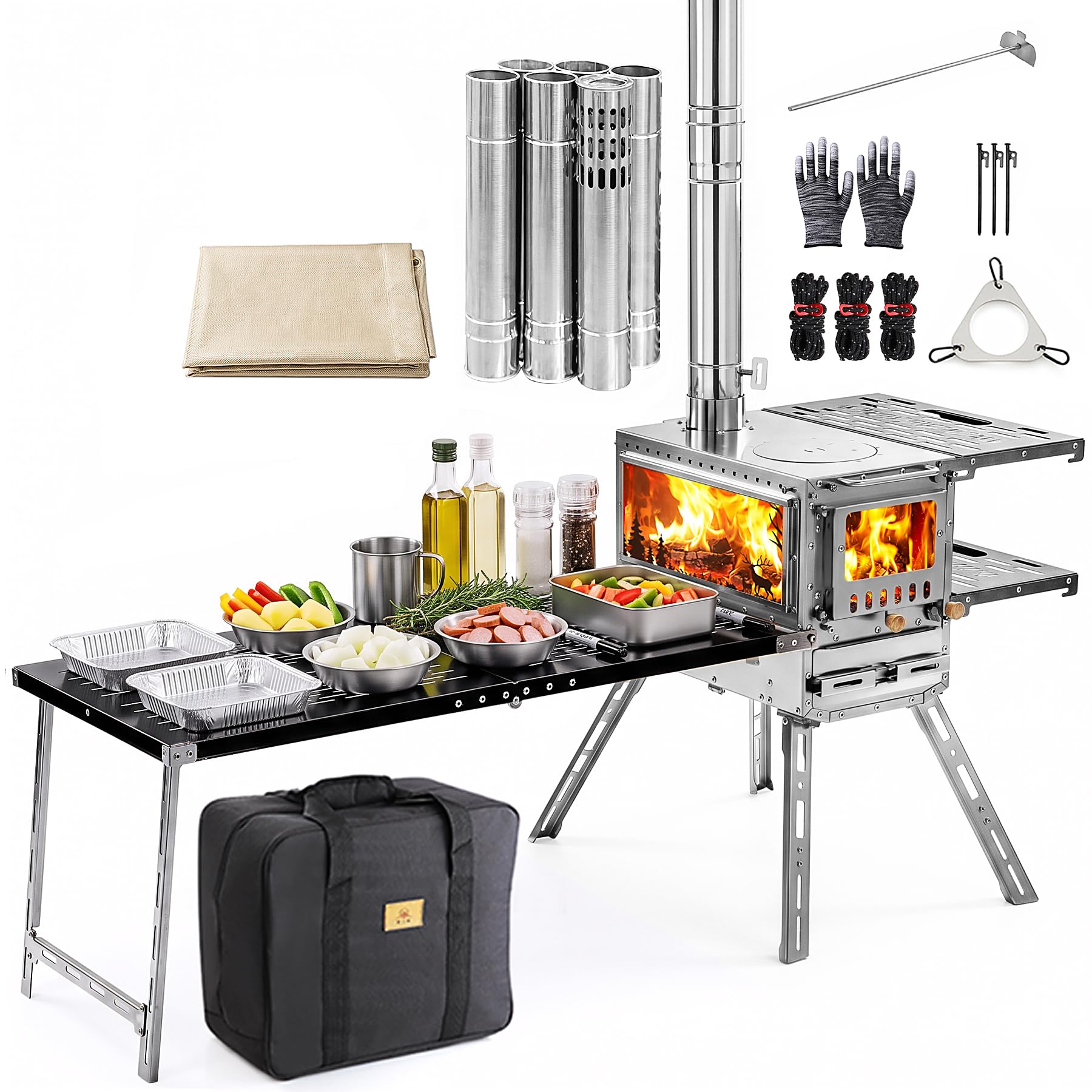
A 2100-cubic-inch firebox that lets you sleep instead of stoking all night.
Here is the number that decides your night: a 2100 cubic inch firebox (the open chamber where the wood burns) that takes 10-inch logs. That volume buys you a stated 6+ hours of steady heat, the difference between waking once and waking four times. For a winter tent camper, an ice fisher, or a hunter holed up in a wall tent, that single figure does more work than any badge on the lid.
The build reads equally serious. The top plate measures 4.8mm in a double-layer design, and the body runs 1.8mm, both in 304 stainless steel with a silver finish that resists corrosion. In plain terms, the 4.8mm top plate is thick enough to fight warping, and the 1.8mm walls hold their shape through season after season of hot-cold cycling. Owners praise the construction more than anything else, and that reputation lines up with the metal on the spec sheet.
Cooking is where this unit separates from a plain heater. You get a built-in oven with its own thermometer, a removable circular cooktop for pots and pans, and an open-flame surface for direct grilling. The microcrystalline glass window is rated to 2192°F (1200°C), so you can watch the flame without opening the door and dumping your heat into the tent. The box also ships with a 98-inch six-section chimney, an IGT folding table, an ash collector and rake, gloves, a fireproof mat, guy lines, stakes, and a nylon storage bag — a complete kit rather than a stove plus a shopping list.
One choreography note the maker flags directly: if you fit the optional pellet burner (sold separately), you must add 10 sections of chimney pipe, close every air inlet on the stove, and open only the damper on the pipe. Skip that setup and smoke will leak. It is a real step, not a footnote. On weight, this stove lands at 50.7 pounds against 48.5 pounds for the Greenstovehori below — a couple of pounds you feel on a long carry but barely notice loading a truck.
Where This Stove Earns Its Place
- 2100 cubic inch firebox fits 10-inch logs and holds heat for a stated 6+ hours
- 4.8mm double-layer top plate and 1.8mm body in 304 stainless resist warping and corrosion
- Three cooking modes in one unit: built-in oven, removable cooktop, open flame
- Ships with a 98-inch chimney, IGT table, fireproof mat, gloves, and storage bag
What To Weigh Before Buying
- 50.7 pounds is a two-hand lift into the truck bed
- Pellet burner is sold separately and demands a specific chimney and vent setup
- Window and oven add parts to clean after a greasy cook
Buy this one if: you heat a large tent or wall shelter overnight and want to cook real food without hauling a second stove.
Think twice if: you pack light on foot — the 50.7-pound body and 98-inch chimney kit reward vehicle-based trips.
2. Greenstovehori 5 Max Outdoor Pellet Stove
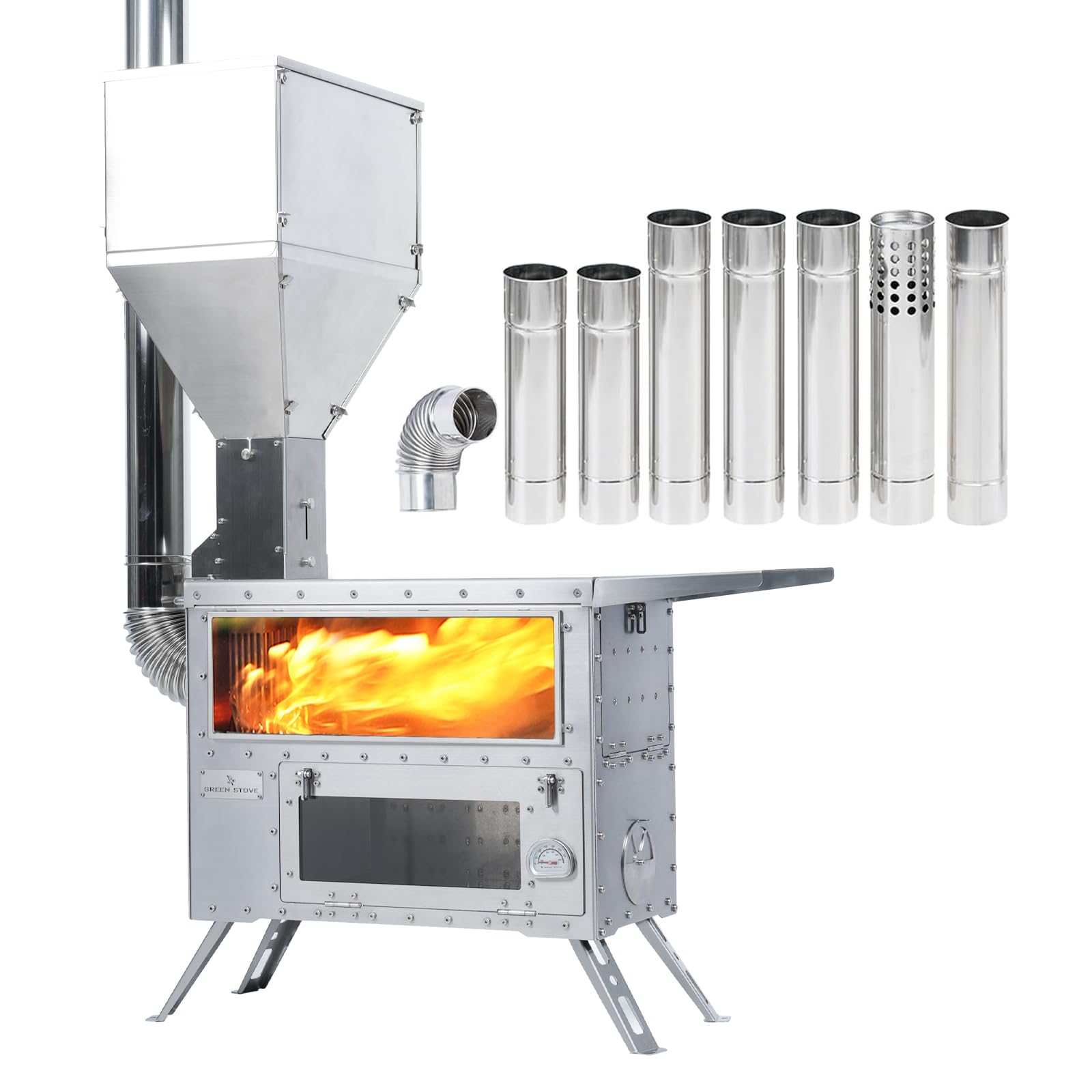
A pellet feeder built for ice shacks, with quick, dialed-in warmth.
Ice anglers want heat fast and want it controlled, and that is exactly where this stove aims. A full load of pellets in the enlarged hopper runs a stated 4 to 6 hours, so you set your burn and get back to the tip-ups. The interior uses a U-shaped structure to hold heat and keep the burn stable instead of dumping warmth straight up the chimney. On the heat side, buyers rate output second only to the build, and the review pages back that up.
Where the CAMPJOURNEY above gives you a cavernous 2100 cubic inch wood firebox, this one trades that volume for pellet-fed precision. Instead of a chimney damper, this version uses a pellet Sheep Horn Bolt to set the fuel feed rate, which lets you dial combustion power up or down. The bigger oven and tune rear panel are pitched at larger tents and longer outdoor sessions. At 48.5 pounds it undercuts the CAMPJOURNEY’s 50.7 pounds, a small edge when you are dragging gear across ice.
The chimney set comes with real lengths spelled out: two 2.95 × 12.6 inch tubes, two 2.75 × 15.75 inch tubes, one 2.95 × 15.75 inch tube, an adjustable 2.75–2.95 inch adapter, a 2.95 × 15.75 inch windproof tube, and a 2.75 inch 90° elbow. That elbow matters in a low tent where the pipe has to turn before it exits. The stainless body keeps its shape and resists rust through wet, freezing cycles.
The honest catch is maintenance. The pellet cage is a replaceable part, and steady high-temperature use wears it over time — replacements are bought separately, so plan for that as a wear item rather than a one-time purchase. The chimney damper is also gone from this version, which means anyone used to a damper lever has a new habit to learn on the feed bolt. Neither is a flaw in the build; both are things to know going in.
What wins people over: the combination of an enlarged pellet hopper, a stated 4–6 hour burn, and a U-shaped interior that keeps warmth in the tent instead of losing it up the pipe.
The trade-off to size up: a precision pellet feed asks a little more attention than tossing logs in, and the replaceable cage is a long-term cost the wood-first buyer never touches.
Reach for this if: you run an ice shanty or a hot tent and want pellet-fed heat you can tune with a bolt instead of a damper.
Look elsewhere if: you burn mostly split wood and want the biggest log-swallowing firebox in the pair.
Know the Specs
Firebox Volume And Burn Time
Firebox volume, measured in cubic inches, tells you how much fuel fits at once, and that drives how long the stove holds heat between refills. A larger chamber that takes long logs stretches your sleep. A pellet hopper works differently: it feeds fuel at a set rate, so its burn time depends on the feed setting rather than log size. Read whichever figure applies to the fuel you plan to use.
Steel Thickness And Heat Rating
Top plate thickness in millimeters is the wear point on any wood stove, because the hottest flames hit it directly. A thicker plate resists warping over seasons. Body thickness protects the walls from heat distortion. The glass rating, given in degrees Fahrenheit and Celsius, tells you how hot a viewing window can safely run — useful when you want to check the flame without opening the door.
Common Questions
Can a wood heater and oven combo be used safely inside a tent?
How long will a full firebox actually burn overnight?
Is a wood stove or a pellet stove better for ice fishing?
Do I need extra chimney pipe to run pellets in the CAMPJOURNEY stove?
What does the 304 stainless steel rating mean for a tent stove?
Can I cook a full meal on these stoves or just boil water?
How heavy are these stoves to move between trips?
Does the pellet cage or glass window need replacing over time?
Can these stoves burn both pellets and wood?
What is the difference between the U-shaped interior and a standard firebox?
The Bottom Line
For most cold-weather campers, the wood heater and oven winner is the CAMPJOURNEY M6 because its 2100 cubic inch firebox and stated 6+ hours of heat mean fewer night-time refills, and it throws in a 98-inch chimney, IGT table, and three cooking modes in one kit. If pellet-fed control is what you are after, the Greenstovehori 5 Max gives you a 4–6 hour burn you tune with a feed bolt, a lighter 48.5-pound body, and a bigger oven. Either way, match the fuel type and chimney length to your shelter before the first cold trip.
How we choose
We do not accept paid placement. Every pick is matched to a real buyer and a real use-case; we do not hands-on test units.
Sources
Specifications: manufacturer listings and product documentation. Review insights: verified customer reviews, as of November 2026. Pricing: not shown on this page (it changes often); check the current price via the retailer link.
As an Amazon Associate, Tactical Gear Guy earns from qualifying purchases. This does not affect which products we feature.