Specs are compiled from manufacturer listings and verified buyer reviews and can change over time — please confirm the key details on the product page before buying.
If you sit eight hours a day and your lower back starts complaining by mid-afternoon, the chair is usually the culprit, not you. The right ergonomic workstation chair lets you pull the lumbar pad into your own curve, drop the seat until your feet reach the floor, and recline when you need a break. The wrong one leaves you shifting every twenty minutes, which is why so many buyers replace an entry-level seat within a year.
This guide is built by comparing the manufacturers’ published specifications and the patterns across verified customer reviews, so you get each pick’s real strengths and trade-offs instead of marketing spin.
What follows is a shortlist of eleven seats, sorted by who they actually fit. Each one is broken down by its most decisive adjustment — lumbar travel, seat depth, or weight rating — so you can match a chair to your measurements.
Top Picks

How To Choose The Best Ergonomic Workstation Chair
Most buyers pick a chair that looks supportive, then find the real problem three weeks in: the seat is an inch too deep, the lumbar pad sits above their curve, or the arms lock in a position that forces the shoulders up. Buying well starts with your own measurements — lower-leg length, torso length, seat depth — not the photo.
Start with seat height, not the backrest
The seat height range tells you whether your feet will touch the ground while your thighs stay level. A chair whose seat bottom sits around 18.8″ suits shorter frames better than one starting near 20.1″. If the range tops out in the low twenties, taller users get a comfortable typing posture instead of a knee-angled slouch. Measure your lower leg — floor to the crease behind the knee — and match it to the low end of the range.
Seat depth decides whether your back reaches the lumbar pad
Seat depth is the front-to-back measurement of the cushion. Too deep and the edge digs behind your knees while your back floats off the pad; too shallow and your thighs take all the load. Sliding seat depth is the feature that fixes this, and it lets one chair serve two people of different heights. A fixed 18.9″ depth works for many average frames, while a sliding mechanism that travels roughly two inches covers far more body types.
Read the lumbar adjustment travel, not just the word “lumbar”
Nearly every chair in this category claims lumbar support. What separates them is how far the pad moves. Two-way adjustment (up and down plus forward and back) lets you press the pad into your actual curve. A pad that only slides vertically may still sit above the small of your back if you are shorter than the designer assumed. Look for a stated travel figure in inches, then check your own torso length.
Weight rating and certification are two different promises
A weight rating tells you the load the frame is built to carry. A BIFMA X5.1 certification is a separate durability test covering repeated cycling, tilt and base strength. Seeing both is better than seeing either alone. If you are near the top of a chair’s rated load, size up to a big-and-tall build rather than pushing an average frame to its limit.
Match the armrest type to your desk habit
Height-only arms suit simple desk work. 3D arms add forward/back and in/out travel so your elbows land under your shoulders. Flip-up arms matter if you tuck the chair under the desk to reclaim floor space. Pick the arm type that matches your routine — an adjustable arm you never touch is just extra hardware.
Side-by-Side Comparison
| Model | Best For | Seat Height Range | Lumbar Support | Weight Rating | Amazon |
|---|---|---|---|---|---|
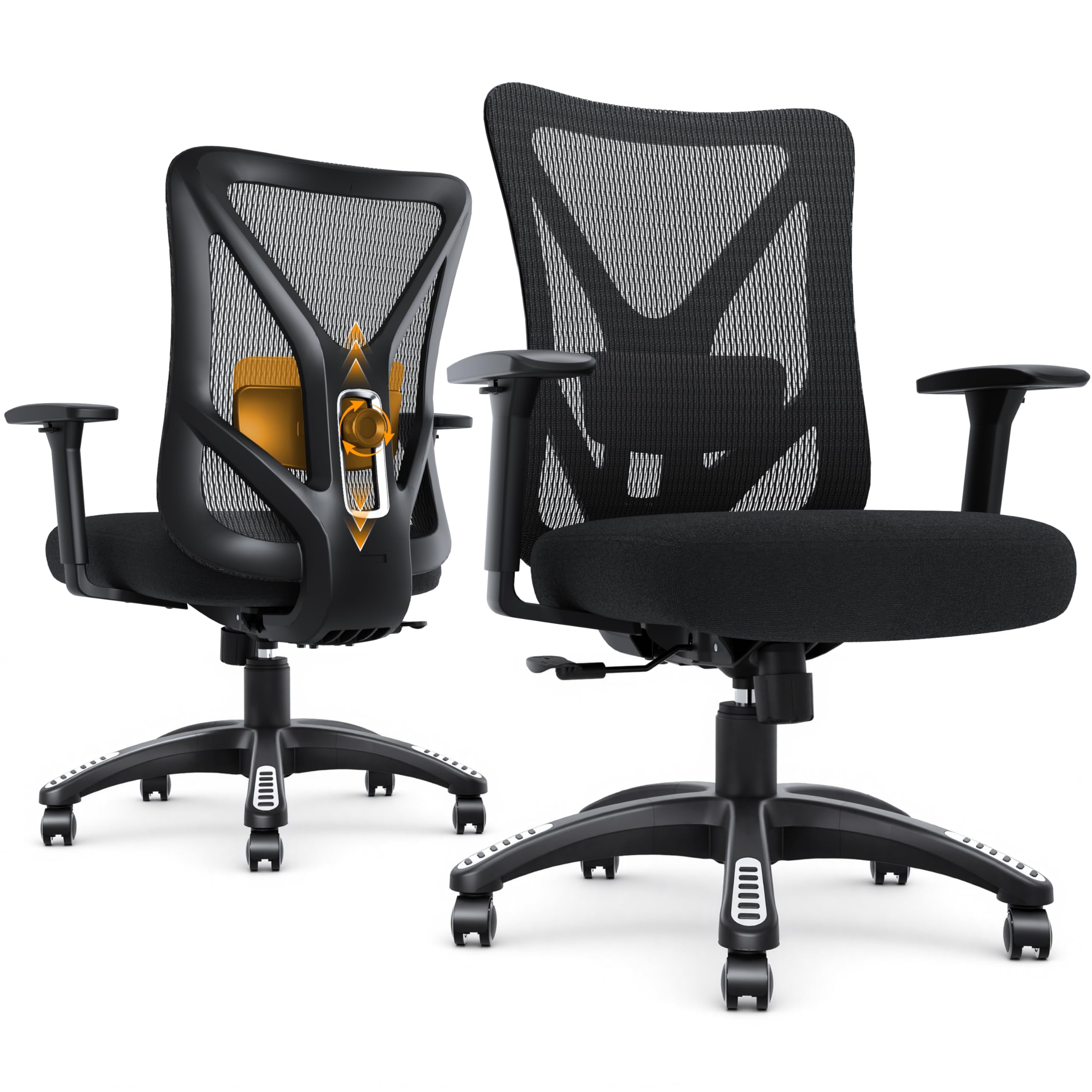
| MOLENTS Ergonomic Mesh Office Chair★ Best Overall | All-day desk work with full adjustability | 19.5″ – 23.3″ | 2-way adjustable | — | Amazon |
| X XISHE Mesh Desk ChairBest Value | Small home offices needing space-saving arms | 18.8″ – 22.63″ | Curved backrest | — | Amazon |
| HYLONE 400lb Big and Tall ChairHeavy Duty Pick | Heavier users and taller frames | Adjustable (range not stated) | Tailored lumbar support | 400 lb | Amazon |
| Staples Kroy Ergonomic Mesh Task Chair | Cool mesh seating with tilt lock | 18.9″ – 22.76″ | Adjustable lumbar support | 275 lb | Amazon |
| YFO Home Office Leather Chair | Upholstered comfort and quiet casters | Adjustable (range not stated) | Lumbar support cushion | — | Amazon |
| ProtoArc EC200 | Body-type-specific fit with sliding seat | Adjustable (range not stated) | 2.36″ height + 0.8″ depth | Under 220 lb | Amazon |
| GABRYLLY Reclining Chair with Footrest | Napping and reclining between tasks | 42.7″ – 48.8″ overall height | 3″ vertical + 1.6″ horizontal | 300 lb | Amazon |
| COLAMY Ergonomic Mesh Office Chair | High-back executive seating with 4D arms | Adjustable (range not stated) | Adjustable lumbar support | 300 lb | Amazon |
| FLEXISPOT ErgoX Premium | Wide height and weight range with footrest | 20.1″ – 22.4″ | Dynamic lumbar support | 400 lb | Amazon |
| SIHOO B300 Pro | Followers of your body weight across the recline | 18.42″ – 21.77″ | 4-way spring-assisted | — | Amazon |
| Branch Ergonomic Chair | Eight-point adjustment in a modern shell | Adjustable (range not stated) | Adjustable lumbar position | — | Amazon |
Detailed Reviews
1. MOLENTS Ergonomic Mesh Office Chair
Our pick — 4.5+★ from 400+ verified ratings; the strongest balance of quality and price.
The seat that gives your lower back its own set of dials instead of one fixed pad.
Start with the number that shapes everything else on a workstation chair: the seat height range. This one runs from 19.5″ to 23.3″, which puts the cushion within reach for a wide spread of leg lengths. The seat itself measures 18.9″ deep and 19.8″ wide, so an average frame gets full thigh support without the front edge pressing behind the knee. For a standard desk setup, that combination is why this MOLENTS model earns the top slot.
What wins people over is the lumbar plate, which moves up and down as well as forward and back. That two-way travel lets you press the pad into the curve of your own lower back rather than accepting wherever the designer parked it. The 3D armrests add their own flexibility — depth adjustment means the arm pads slide forward and back, so your elbows land under your shoulders at the keyboard instead of floating. The backrest also reclines across three positions between 90° and 120°, letting you drop into a lean-back for a call without leaving the chair. The crowd favorite sits at 4.5+ stars across 400+ ratings.
The honest trade-off is the height adjustment mechanism, which is the one area where owner feedback splits. Assembly draws plenty of praise — one adult can put it together in about 15 minutes with the included tools — and the build feels solid once it is standing. A handful of buyers find the gas lift less crisp than they wanted, so if you already know you need a shorter or taller cylinder than stock, the maker will swap it when you send your order number. That is worth doing at the start rather than after you settle into a habit.
Where this chair earns its keep
- Two-way lumbar travel (up and down plus forward and back) lets you fit the pad to your own curve
- Seat height span of 19.5″ to 23.3″ covers a broad range of leg lengths
- 3D armrest depth adjustment keeps elbows aligned while typing
- Three recline positions from 90° to 120° for switching between work and rest
- About 15 minutes to assemble with the included tools
What to weigh before you buy
- The height adjustment mechanism is the one point where feedback splits
- The sliding arm panels are not fixed — the maker offers alternatives on request
- No stated weight rating in the published spec sheet
Reach for this if: you want one chair that fits your back, your arms and your recline angle without paying the premium tier.
Look elsewhere if: you need a stated heavy-duty weight rating or a fixed arm panel from day one.
2. X XISHE Mesh Ergonomic Desk Chair
Flip the arms up and this seat disappears under a small desk.
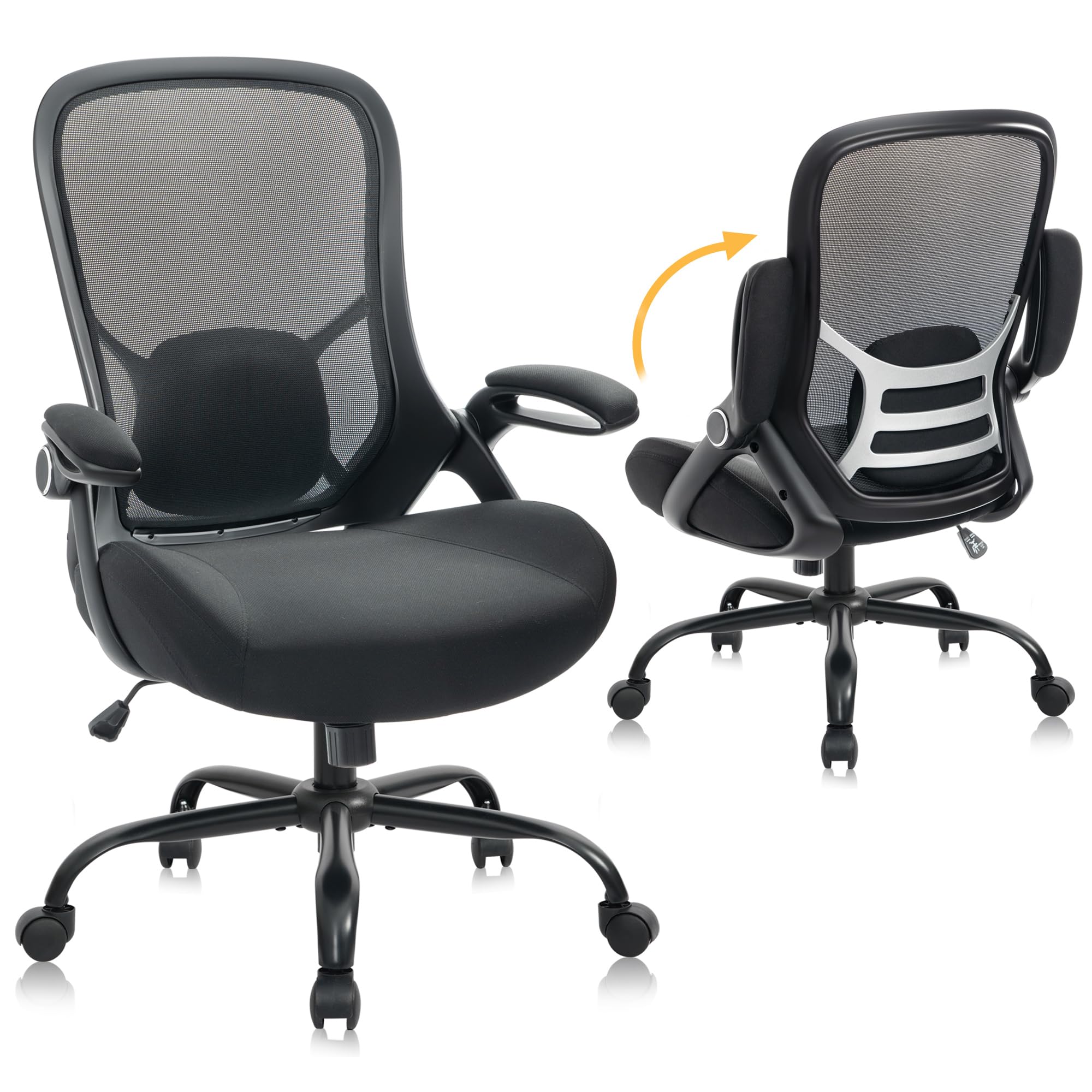
If your work setup lives in a bedroom corner, the arms are the deciding factor. These flip up through 90°, so the chair rolls clean under the desk and gives you the floor back. The seat height runs 18.8″ to 22.63″ via a gas lift, which suits a range of frames without any tools. Compared with the MOLENTS above, this one starts 0.7″ lower at the bottom of its span and tops out below it as well.
Comfort is where this chair has its following — a thick high-density cushion under PU leather, paired with a breathable mesh back that keeps air moving across your shoulders. The curved backrest runs the full spine and the rocking function lets you lean back during a break. Review pages repeatedly describe it as a classic black office chair that fits the room. Assembly is straightforward; setup with the included tools runs about 20 to 30 minutes.
Nylon casters roll in every direction and are gentle on hardwood, which matters if you are rolling back and forth all day on a finished floor. The compromise is adjustability depth: you get height and tilt but not seat-depth or lumbar-travel tuning, so very long-legged users may want more control. For a modest desk in a small room, that trade is easy to accept.
The flip-up advantage: the 90° arms reclaim floor space in a tight room, and the 18.8″ to 22.63″ seat range covers most adults without a tool change.
The honest limit: height and tilt are the whole adjustment menu here — no sliding seat and no adjustable lumbar plate.
Go this route if: your desk sits in a tight corner and the chair has to vanish when you are done.
Pass if: you need the lumbar pad to move to a specific spot on your back.
3. HYLONE 400lb Big and Tall Office Chair
A 400 lb rating and a 5″ seat cushion for frames that overload standard chairs.
The headline figure here is the load rating: 400 lb, built into a chair described for users roughly 5’5″ to 6’2″. A 28″ five-star base widens the footprint so the chair stays planted even at the top of its height range. That stability is the point — a big-and-tall seat that rocks under you is worse than a smaller one that holds firm.
The cushion is 5″ thick with high-quality sponge that the maker says resists deformation over long use. The nylon mesh back keeps airflow moving through warm months, and the seat board is made from FSC-Certified wood. Flip-up arms let you tuck the chair under the desk. Assembly takes about 30 minutes, and the maker backs the parts for 24 months.
Back support is the mixed note: the backrest does not lean back as far as some buyers expect, so if a deep recline is your habit, look at the GABRYLLY below. Height and cushion feel land in a similar mixed zone across feedback, which usually signals a fit question rather than a build problem. If you sit on the shorter side of the stated range, confirm your leg length against the seat height before committing.
The engineering case: a 400 lb rating, a 28″ base and a 5″ sponge cushion make this the right answer for heavier users who have flexed cheaper frames.
The fit note: the backrest stays fairly upright — a shallow recline is the design, not the defect.
Built for: heavier or taller users who want a stable base and a thick seat that holds its shape.
Not your chair if: you want to stretch out into a deep lean-back position.
4. Staples Kroy Ergonomic Mesh Task Chair
Mesh under the seat as well as behind it, so nothing traps heat.
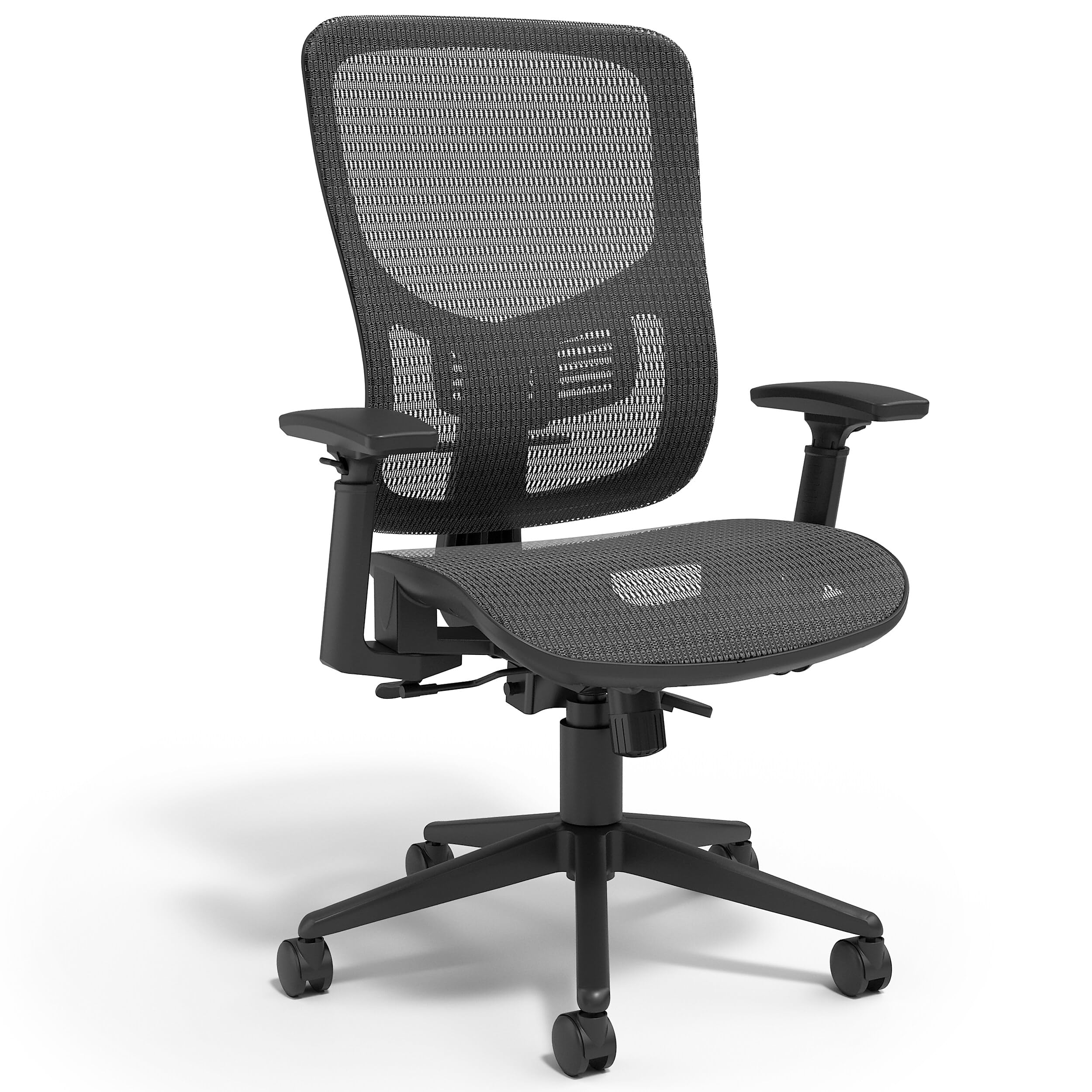
Most chairs in this category put mesh on the back and foam under you. The Kroy runs mesh through both the back and the seat, which keeps airflow moving underneath during a long shift. The seat adjusts between 18.9″ and 22.76″ in height, and the chair carries a 275 lb rating on a five-point base. A 5-year limited warranty covers the frame.
Seat dimensions run 19.59″ wide by 16.54″ deep. That depth figure is the one worth checking against your own leg length — it is shallower than the 18.9″ depth on the MOLENTS at the top of this list, so taller users may find their thighs hanging past the front edge. Lighter frames and shorter legs will likely notice the opposite: less pressure behind the knee.
The tilt mechanism does more than most at this level. You get adjustable tilt tension plus a tilt lock, so you can set the recline resistance and then lock it flat when you want to stay upright. Armrests adjust in height only, rounded in profile. Lumbar support moves to find your lower-back curve. For a greener-feeling seat that runs cool through summer, this one holds its ground.
Pick it for: a cool-running mesh seat with genuine tilt tension and lock control.
Think twice if: your legs are long — the 16.54″ seat depth is on the shallow side.
5. YFO Home Office Leather Chair

Brown leather and casters that roll like roller blades across a wood floor.
This is the chair for someone who wants the seat to feel like furniture, not office equipment. The leather finish and brown color carry the look, and the seat cushion is built from wooden boards, soft sponge and a spring pack under the upholstery. That spring layer is the difference you feel on hour four — it keeps the cushion from compressing into a flat pan.
The casters are the sleeper feature. They are rubber, built for wood floors, carpet and marble, and the motion is noticeably smooth and quiet. If you work in a shared space or a room below a bedroom, that matters more than any spec on the sheet. The seat is 22″ wide and 20″ deep, with armrests at 8.3″ — a generous footprint that suits a larger desk.
Fair warning on the size: the width is a genuine point of disagreement. Some buyers love the room; others find it too wide, and the lumbar padding draws split feedback too. If you have a narrow frame, measure your desk opening first. The chair can also be assembled without arms if you prefer to sit cross-legged, which makes it one purchase serving two setups.
What sells it: a spring-backed leather seat and near-silent rubber casters, in a footprint that fits larger desks.
The catch: at 22″ wide, the seat is roomy — narrow frames may find it oversized, and lumbar padding is not adjustable in travel.
Right for: buyers who want a quiet, upholstered chair that looks at home in a living space.
skip it if: you need a lumbar pad you can dial into a precise spot.
6. ProtoArc EC200

Built to one body range and engineered around a five-position seat slide.
Let us be direct about who this chair is for: people between 5’4″ and 6’0″, under 220 lb. Within that range, the EC200 does something few chairs at any tier offer — a seat that slides through five positions with 1.97″ of travel. That lets you set depth independently of height, so the front edge lands behind your knee and your back stays against the lumbar pad at the same time.
The lumbar plate adjusts 2.36″ in height and 0.8″ in depth, filling the curve of your lower back whether you are upright or reclined. The cushion is 55D high-density foam, a firmness grade chosen to resist sagging across long daily use. The recline works in four stages with lock positions at 90°, 105°, 120° and 130°, and a tension knob lets you tune resistance. A TÜV-tested Class 4 gas lift sits under the seat.
Comfort is the note that carries — buyers describe it as extremely comfortable and highly adjustable — but the lumbar is where feedback splits, and one of the recurring notes is that the pad could sit a little lower for some backs. Firmness lands as a point of debate for a few, so if you prefer a plush seat over a dense one, the leather YFO above may suit you better. Assembly is around 20 minutes with the included visual guide.
Why the engineers built it this way
- Five-position seat slide with 1.97″ of travel — genuine depth adjustment, not just height
- Lumbar moves 2.36″ vertically and 0.8″ in depth to reach your own curve
- 55D foam holds shape instead of bottoming out over time
- Four-stage recline with lock positions at 90°, 105°, 120° and 130°, plus tension control
- TÜV-tested Class 4 gas lift and a stated 5-year warranty
Who it does not fit
- Built to a stated 5’4″–6’0″ body range and a 220 lb ceiling
- The lumbar pad sits a touch high for some backs
- Dense 55D foam is firm — not the plush feel some buyers want
Designed for: the 5’4″–6’0″, sub-220 lb user who wants seat depth they can actually dial in.
Not the fit for: taller or heavier frames, or backs that need the lumbar pad sitting lower.
7. GABRYLLY Reclining Chair with Footrest
A retractable steel footrest that turns the desk into a napping station.
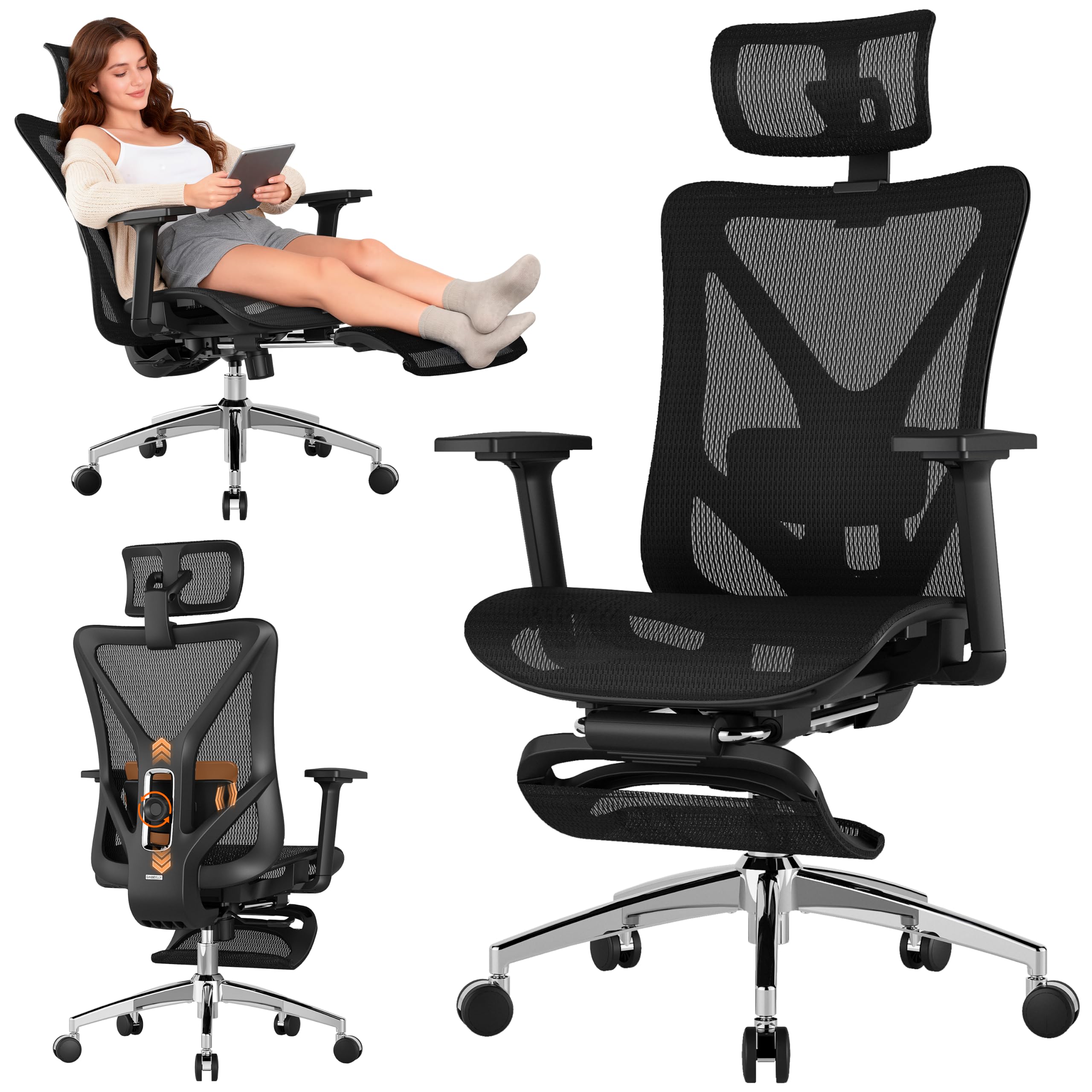
The number that sells this chair is 18.1″ — the extension of the retractable steel footrest. Pull it out, lock the backrest at 135°, and the chair becomes a place to lie back between calls. The recline works across three locked positions at 90°, 110° and 135°. The whole thing is rated to 300 lb and tested to SGS and BIFMA standards.
Lumbar support moves in two directions: 3″ vertically and 1.6″ horizontally. Armrests are 3D, adjusting up/down, front/back and in/out, and the headrest adapts in three ways — height, angle and bracket. The 27.5″ wide-diameter leg base keeps the chair planted even when you are reclined with the footrest out. Dimensions are 20.6″ × 19.1″ × 42.7″–48.8″, sized for users between 5’3″ and 6′. Assembly runs 15 to 25 minutes.
What gets noticed is simply the size of the thing — it is a big, full-coverage seat, and buyers consistently mention the comfort that comes with that span. The wheels are the recurring complaint: they work, but they are not the silent-rolling type on the YFO above. Plan on a floor mat if you have a hard surface and roll often.
The recline payoff: three locked angles up to 135° plus an 18.1″ footrest make this the one chair here you would genuinely nap in.
The trade to know: the casters are not silent — expect some rolling noise on hard floors.
For the napper: anyone who wants to lie back between tasks with their legs fully supported.
Skip the recline if: you need whisper-quiet casters or your floor space is tight.
8. COLAMY Ergonomic Mesh Office Chair

A high back, 4D arms and an aluminum base aimed at the executive desk.
This is the high-back option, built with Korean mesh that has real flex rather than the stiff weave you find on cheaper frames. The 4D armrests pivot as well as adjust, so you can angle the pads for typing, drawing or leaning back. The seat slides forward and back, which lets you press your back against the lumbar region while keeping pressure off the back of your knees. A Class 4 gas cylinder verified by SGS sits underneath, with a 300 lb maximum capacity.
The seat cushion is thick and molded from high-density foam, and the lumbar support uses high-elastic mesh with an adjustable device. A 4-position tilt lock covers the recline range you will actually use. The base is aluminum alloy with 360° swivel and smooth-rolling casters. With a 700+ rating history at 4.0+ stars, this chair has real buyers behind it, not just a launch campaign.
The honest read is that sturdiness and durability draw split feedback, with some reporting wear under regular use. Lumbar is also mixed — the core complaint is a tendency to tilt forward. If you want the executive silhouette and 4D arms, this fits that brief; if rock-solid long-term durability is your first priority, the Kroy or the ProtoArc give you a tighter, more consistent build story.
The executive setup: high back, 4D pivot arms, sliding seat and an aluminum base with a 300 lb capacity.
The fit note: lumbar support tilts some users forward — sit in it before you commit a full workday to it.
Choose this for: the tall back, 4D arms and polished look of an executive chair.
Weigh the risk if: you need a chair whose durability record reads consistently strong.
9. FLEXISPOT ErgoX Premium Ergonomic Office Chair
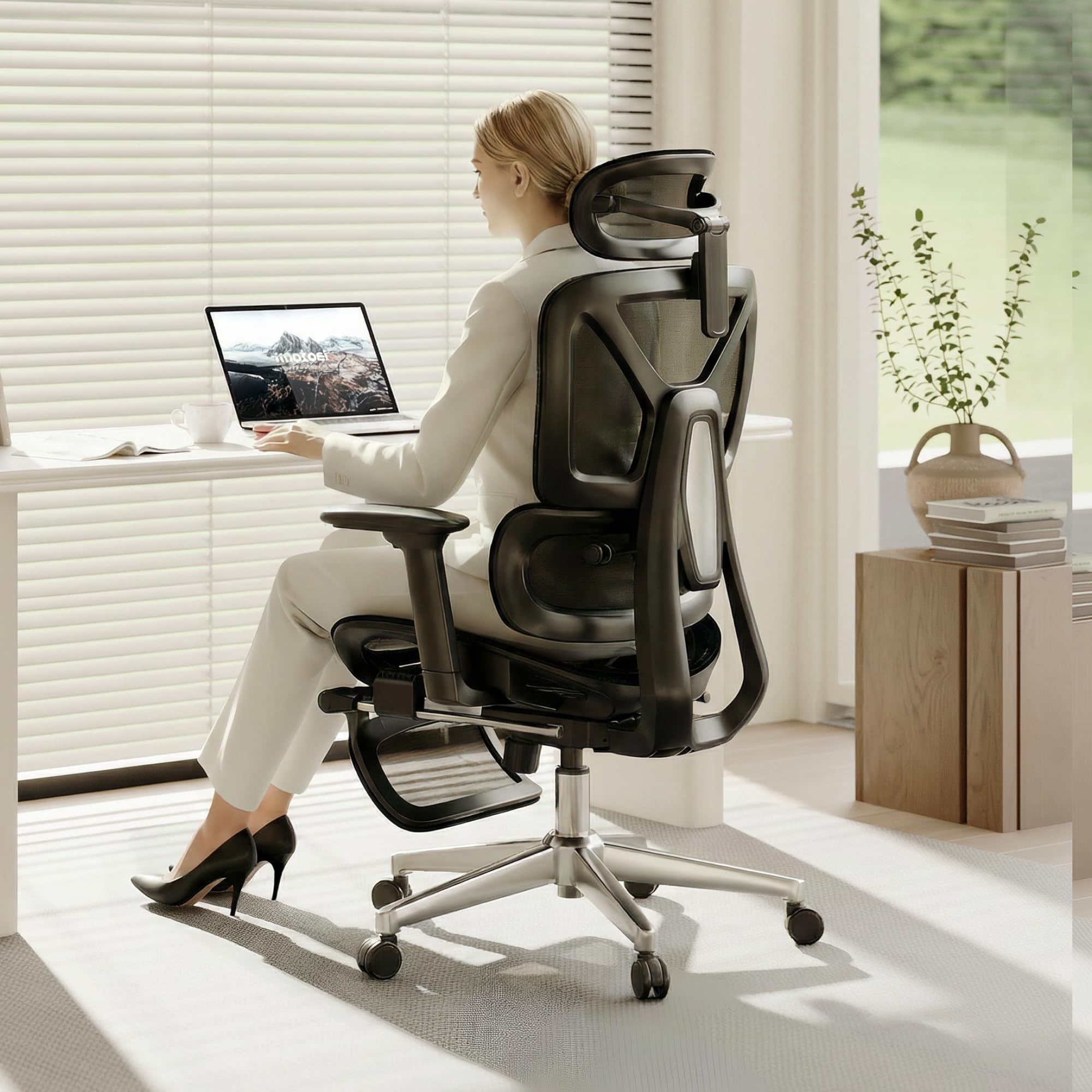
One chair that fits a wide height and weight spread, plus a nap footrest.
The spec sheet reads like a fit chart: seat depth adjusts 17″ to 20″, seat height 20.1″ to 22.4″, sized for users 5’1″ to 6’2″ with a 400 lb maximum weight limit. That range is why it lands in the premium tier — you get real adjustability across a wide spread of body types rather than a chair built for one average. The 3D armrests add height, forward/back and swivel adjustment.
Back support is 5 levels of adjustment, with dynamic lumbar support and a 3D adjustable headrest. There is a nap footrest, and tilt for leaning back. You choose between a mesh seat for airflow or a cushioned foam seat for a more cradled feel, and the class 4 gas lift is built for daily cycling. Reinforced nylon frame under the seat.
Comfort and back support are the strengths buyers return to, and the adjustability genuinely reshapes how you sit. Assembly is the friction point — it is more involved than most here, so plan an hour and a second pair of hands. Durability is a divided read too: the majority report it holding up, while a small number saw a failure early. If you want a chair that fits a range of bodies and stiffens less over time, this is a strong fit.
The fit range it covers
- Seat depth 17″ to 20″ and height 20.1″ to 22.4″ covers 5’1″ to 6’2″
- 400 lb maximum weight limit
- 5-level adjustable back with dynamic lumbar support
- Nap footrest and 3D adjustable headrest
- Mesh seat or cushioned foam seat option
What slows you down
- Assembly is more involved than most chairs in the tier
- Durability feedback splits — most hold up, a few failed early
- Premium price for the feature set
Best fit for: a shared desk where two people of different heights need one chair to work.
Not ideal if: you want a tool-free setup or a chair with an unbroken durability record.
10. SIHOO B300 Pro

Lumbar support that springs along with your body, not against it.
The B300 Pro’s calling card is a spring-assisted, 4-way lumbar system that adjusts in height and glides forward independently. Lean forward to type, sit upright for a meeting, or recline to recover — the pad follows without you resetting anything. The backrest height is independently adjustable too, so the lumbar lands where your spine actually curves. Seat depth ranges from 16.53″ to 18.5″ and seat height from 18.42″ to 21.77″.
A weight-sensing recline mechanism matches resistance to your body without a tension knob. The headrest is oversized and 3D, and the armrests are 6D — they rotate, slide, lift and flip up, which makes cross-legged sitting possible without removing them. A retractable footrest handles the leg stretch, and the seat is mesh so air keeps moving. BIFMA, SGS and TÜV testing is stated, with a 3-year warranty and 30-day returns.
The catch on this chair is armrest stability — that is the strongest reservation in the feedback, and the arms do not have a locking mechanism. The size is what earns the praise, so if you are a bigger-framed user expecting space, this delivers. If you tend to brace your weight on the arms to stand, expect a little give.
Where it is clever: a spring-assisted 4-way lumbar and weight-sensing recline that adapts as you shift position.
What to plan around: the 6D arms glide and do not lock — fine for resting, not for pushing up out of the chair.
Worth it for: someone who shifts posture constantly and wants lumbar support that follows along.
Look at another pick if: you need arms that hold firm when you push against them.
11. Branch Ergonomic Chair
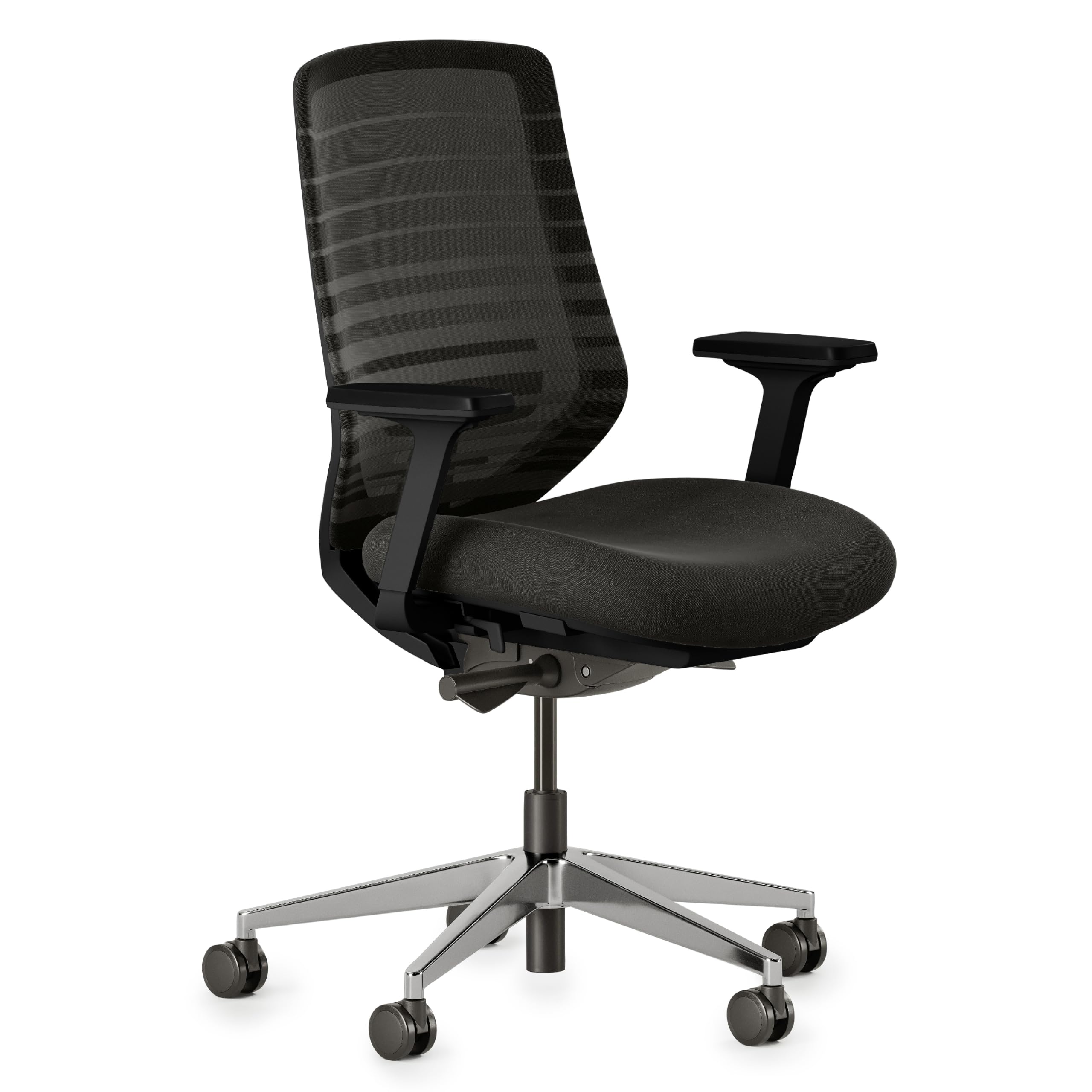
Eight adjustment points in a slim aluminum-framed package.
Branch keeps the frame lean — 27 pounds on an aluminum build — and puts the engineering into eight adjustment points. Recline, tilt tension, lumbar position and armrest placement all move, plus seat height and depth. The point of that count is fewer compromises: if you are between standard sizes, you can shift the setup rather than accept a near miss.
Breathable mesh covers the back, contoured cushioning sits under you, and the wheels roll smoothly. The look is minimalist and all black, which is the reason many buyers pick it for a visible home office. Assembly is described as straightforward thanks to clear instructions, and materials earn praise for quality.
The known concern is the hydraulic cylinder. Most chairs hold up, but a small number report a failure early on, so it is worth watching in the first few weeks. Adjustability and back support land mixed — some find the fit right, others want more range. If you are buying for the design-led setup and appreciate a slim frame, this is the one.
Ideal for: a sleek home-office setup that needs eight points of adjustment in a slim 27 lb frame.
Consider the alternative if: you want a chair with a longer track record on the gas cylinder.
Know the Specs
Adjustable lumbar support
Lumbar support is the pad or plate that presses into the small of your back. What varies between chairs is how far it travels. A two-way system moves up and down plus forward and back, so the pad reaches your own curve. A one-way pad only slides vertically, which may leave it above the small of a shorter back. Look for travel measured in inches — the GABRYLLY, for example, lists 3″ vertical and 1.6″ horizontal — then match it to your own torso length before you buy.
Seat depth and sliding seat mechanism
Seat depth is the front-to-back measurement of the cushion. Too deep and the edge digs behind your knee; too shallow and your back loses contact with the lumbar pad. A sliding seat lets you set depth independently of height, so both land correctly. The ProtoArc EC200 offers five positions with 1.97″ of travel, while a fixed-depth chair simply locks one number in. If you plan to share the chair with someone taller or shorter, a sliding seat is worth more than any other feature.
Weight rating and certification
A weight rating is the load the frame is built to carry — 275 lb on the Kroy, 400 lb on the HYLONE and ErgoX. A BIFMA X5.1 certificate is a separate durability test covering cycles, tilt and base strength, and a TÜV-tested Class 4 gas lift covers the cylinder. Seeing a rating and a certification together tells you the frame was built for the load and tested for the wear. If you sit near a chair’s ceiling, size up to a big-and-tall build.
Armrest types: 1D through 6D
Armrest adjustability is counted in directions. 1D arms move in height only. 3D adds forward/back and in/out travel, so your elbows land under your shoulders. 4D adds a pivot so the pads can angle. 6D, as on the SIHOO B300 Pro, adds rotation, slide, lift and a flip-up. More adjustment means more precise positioning — but only if you will use it. If you never touch the arms, a simpler pair saves hardware and money.
Common Questions
How do I know what seat height range I need for a workstation chair?
Is a sliding seat depth worth the extra cost on an ergonomic chair?
What does BIFMA X5.1 certification actually cover?
Will a mesh seat hold up as long as a foam cushion?
Can I put an ergonomic workstation chair on hardwood without scratching it?
What is the difference between 3D, 4D and 6D armrests?
How much weight can a big and tall workstation chair carry?
Does a heavier chair mean a sturdier workstation chair?
Can I remove the armrests from an ergonomic workstation chair?
How long does assembly take on an ergonomic workstation chair?
Is a footrest worth having on a workstation chair?
The Bottom Line
For most people shopping for an ergonomic workstation chair, the MOLENTS is the one to buy — two-way lumbar travel, 3D arm depth adjustment and a 19.5″ to 23.3″ seat span put it ahead of the pack, and it holds the highest grade on this list. If your desk lives in a tight corner, grab the X XISHE for its flip-up arms. And for anyone who wants to lie back between calls, the GABRYLLY with its 18.1″ footrest is the one to reach for.
The one word of advice worth carrying into checkout: decide your seat height range and depth before you fall for a color or a backrest shape. The Kroy at 16.54″ deep and the YFO at 20″ deep sit at opposite ends of the same decision, and neither will feel right to every body. Measure once, then match the chair to you.
How we choose
We do not accept paid placement. Every pick is matched to a real buyer and a real use-case; we do not hands-on test units.
Sources
Specifications: manufacturer listings and product documentation. Review insights: verified customer reviews, as of November 2026. Pricing: not shown on this page (it changes often); check the current price via the retailer link.
As an Amazon Associate, Tactical Gear Guy earns from qualifying purchases. This does not affect which products we feature.