Specs are compiled from manufacturer listings and verified buyer reviews and can change over time — please confirm the key details on the product page before buying.
Buying a band saw for woodworking is really a question of two numbers: how deep a cut you need and how wide a piece you need to push through it. Get those wrong and you own a machine that stalls on thick hardwood and forces you to buy again. Get them right and one saw handles curved cuts, straight rips, and resawing thick boards into thin panels for years.
This guide is built by comparing the manufacturers’ published specifications and the patterns across verified customer reviews, so you get each pick’s real strengths and trade-offs instead of marketing spin.
Below you’ll find nine saws sorted by what they actually do well, from compact benchtop units to full-size resaw machines. Every pick lists its true cutting depth and throat width so you can match the saw to your workshop. This breakdown of the woodworking band saw market focuses on what matters at the fence, not the spec sheet’s biggest font.
Top Picks


How To Choose The Best Woodworking Band Saw
Most first-time buyers assume horsepower is the whole story. It isn’t. A band saw’s real limits are its cutting depth (how tall a board slides under the blade guides) and its throat width (how far the workpiece can travel from blade to frame). A saw with modest amps but generous depth will out-work a punchier machine that chokes at four inches.
Start with cutting depth and throat width
Cutting depth decides whether you can resaw. If you plan to slice thick slabs into bookmatched panels, you need a saw rated for tall stock. Throat width sets how wide a curve or rip you can push through before the frame gets in the way. Write both numbers down before you shop, because no accessory fixes them later.
Then look at blade speed and speeds
Blade speed is measured in FPM, or feet per minute — how fast the blade loop travels past your wood. Slower speeds tend to suit dense hardwood, while faster speeds give a smoother finish on softwood. A two-speed saw lets you pick per board instead of compromising on one fixed speed.
Check the table and the fence setup
A tilting table lets you cut bevels without repositioning your whole body around the workpiece. Look for a cast table rather than stamped sheet metal, since cast iron or cast aluminum holds flat and resists vibration better. A fence gives you repeatable straight rips, and a miter gauge slot opens up crosscuts and angle work.
Do not overlook dust collection
Band saws throw fine dust off the wheels as well as the cut line. A dust port that accepts a standard hose keeps your shop breathable and stops sawdust packing into the lower wheel housing. Budget for a shop vacuum or extractor if you don’t already own one.
Side-by-Side Comparison
| Model | Best For | Cutting Depth | Motor Amps | Blade Speeds | Amazon |
|---|---|---|---|---|---|
| QD-KYOHO 10-Inch Dual-Speed★ Best Overall | Curves and bevels on benchtop space | 4-3/4 inches | 5.3 A | 1515 and 3280 FPM | Amazon |
| SHOPMAX 10-Inch BenchtopBest Budget Build | Solid steel build on a budget | 4.5 inches | 4.2 A | — | Amazon |
| SKIL BW9501-00 9-InchQuickest to Cut | Quick setup and clean small cuts | — | 2.8 A | 2 speeds | Amazon |
| Woodskil 9-Inch Benchtop | Value for light shop work | 3-1/2 inches | 3 A | 2500 FPM | Amazon |
| WEN BA3962 10-Inch | Deep benchtop cuts with a stand | 6 inches | 3.5 A | 1520 and 2620 FPM | Amazon |
| Rikon 10-310 10-Inch | Cast iron flatness and steel frame | — | — | — | Amazon |
| WEN BA1487 14-Inch | Full-size resaw on a mid-range budget | 8.85 inches | 9.5 A | 1480 and 3280 FPM | Amazon |
| JET JWBS-14SFX 14-Inch | Serious resawing and veneer work | 13 inches | — | — | Amazon |
| Laguna 14|12 14-Inch | Premium blade control and tracking | 13 inches | — | — | Amazon |
Detailed Reviews
1. QD-KYOHO 10-Inch Dual-Speed Band Saw (BS250B)
Our pick — 4.5+★ from 100+ verified ratings; the strongest balance of quality and price.
The benchtop saw with the biggest motor in its class and two speeds to match.
The first thing to know about this saw is its motor rating: 5.3 amps off a 120-volt supply, paired with a 1/2 HP rating. That is the highest current draw on this entire list — the SKIL BW9501-00 runs 2.8 amps, so the QD-KYOHO pulls roughly double. In plain terms, you get a saw that starts fast and does not bog down when the blade meets a dense board.
Depth and width are what make it useful rather than just strong. It cuts stock up to 4-3/4 inches tall and 9-5/8 inches wide, running a 70-1/2 inch blade. Compare that to the Woodskil’s 3-1/2-inch depth and you can see why the taller capacity matters: you can resaw a chunkier board here without flipping it. The dual speed selector sets 1515 FPM for hardwoods and 3280 FPM for a smoother finish on softwoods, so you match the blade speed to the timber instead of settling for one compromise.
What wins people over is how it behaves out of the crate — the setup process and overall build quality are the two things owners talk about most, and the motor performance leads the pack. The table is precision-ground cast iron on a steel plate frame, and upper and lower guides adjust both vertically and horizontally to keep the blade tracking where you set it. The two-sided fence assembly detaches so you can work from either side, and a 2.5-inch dust port takes a standard hose.
Where this saw pulls ahead
- 5.3-amp motor — the strongest current rating on this list, so thick stock rarely stalls it
- 4-3/4 inch cutting depth and 9-5/8 inch throat for real resaw work on a benchtop footprint
- Two speeds (1515 and 3280 FPM) let you switch from hardwood to softwood without a blade swap
- Quick-release blade tension cuts the time on blade changes and adjustments
What to expect
- Adjustability and vibration land as mixed notes — expect to spend time dialing the guides on arrival
- At 20.47″L x 17.56″W x 33.86″H it still wants a dedicated bench or stand
Take this one if: you want one benchtop machine that resaws tall stock and switches speeds for hardwood and softwood.
Expect some setup time: the guide adjustments reward patience — dial them in carefully before your first real cut.
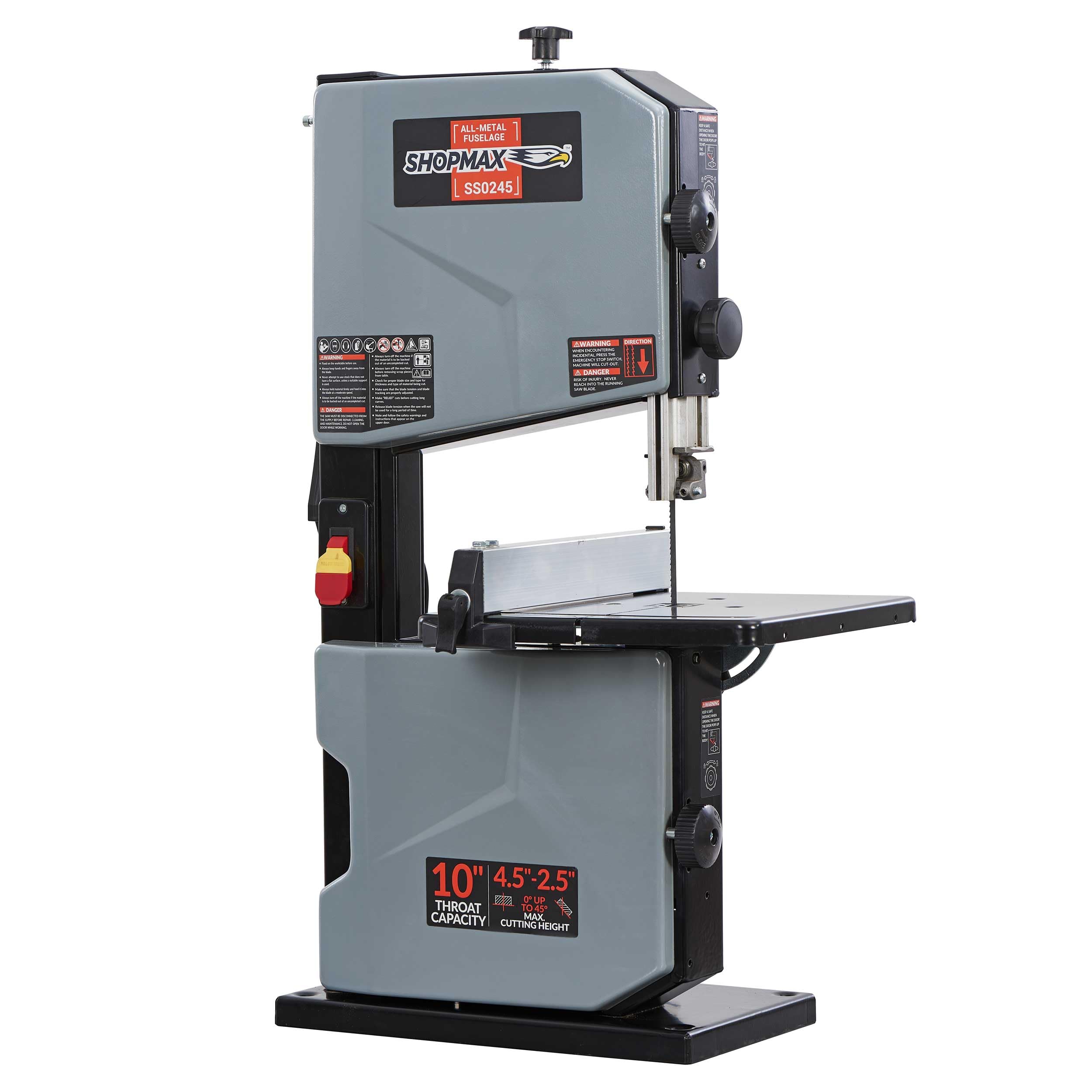
2. SHOPMAX 10-Inch Benchtop Band Saw
A steel-bodied benchtop saw that puts its money into the frame, not the feature list.
If your shop is a corner of a garage and your budget is tight, this saw’s pitch is simple: heavy-duty steel construction and a 4.2-amp induction motor. The induction design matters because it tends to run quieter than a universal motor of similar rating — useful when you are cutting in a shared space. Cuts go up to 4.5 inches deep and 10 inches wide, and the table angles to 45 degrees for bevel work.
The blade spec is worth a look because it sets your consumable cost. It runs a 67.4-inch blade with widths from 0.14 to 0.47 inches, so you have room to fit a narrow blade for curves or a wider one for straight rips. Ball-bearing guides keep the cut tracking accurately, and ShopMax’s own guidance is to lean on the included fence rather than a miter gauge for small saws — that gives more stability when you are cutting tight curves.
Build quality is what owners single out as this saw’s best trait, and the cutting performance draws a more divided reaction — it works well for plenty of buyers, but not everyone gets the same result. The saw arrives partially assembled with the hardware bag in the box, so plan a session to finish the build. It also connects to a ShopMax dust extractor (sold separately) through a dedicated suction connector, which keeps the workspace cleaner if you already own that extractor.
The honest trade-off: cutting performance is the one area that splits opinion, so set your expectations to match a fence-guided benchtop saw rather than a floor machine.
Who it fits: a hobbyist cutting curves and short rips who values a steel frame and a quiet induction motor.
Reach for this if: a solid steel build and a budget-friendly entry point matter more to you than a long feature list.
Look elsewhere if: you need deep resaw capacity — 4.5 inches is this saw’s ceiling.
3. SKIL BW9501-00 9-Inch 2-Speed Benchtop Band Saw
The saw that gets you cutting on day one with a window that shows blade tracking.
SKIL’s angle here is speed of ownership. The setup is quick and the saw is ready to run almost right away, which is the opposite of a machine that needs a weekend of alignment before its first board. A 2.8-amp induction motor drives a two-speed belt system with tool-free tensioning, so you change speed without hunting for a wrench.
The feature that earns its keep is the blade-tracking sight window — you can watch the blade ride the wheel as it spins, which turns a fiddly alignment job into a visual check. Precision ball-bearing and lower blade guides hold that tracking, rack-and-pinion table adjustment handles angle changes fast, and a miter gauge guides the workpiece for crosscuts. A steel base stabilizes the whole machine while you push stock through.
What buyers respond to is the build itself, then the smoothness of the cut — those two dominate the feedback. The dust port accepts standard 2-1/2-inch vacuum hoses, so a shop vac handles cleanup. The counterweight on the honest side is blade stability: blade wobble and long-term durability come up as the recurring gripes. It is a 9-inch saw, so treat it as the finish-cut machine in a small shop rather than a resaw workhorse. SKIL backs it with a 3-year limited warranty.
What it does best: fast setup plus a tracking window that lets you verify alignment by eye rather than by trial cut.
The recurring complaint: blade wobble — check your blade and guides early, and keep the tension where the manual says.
Best fit: a small shop that wants a 9-inch saw cutting clean curves and crosscuts within minutes of unboxing.
Think twice if: you need to resaw thick stock — that is not what a 9-inch machine is built for.
4. Woodskil 9-Inch Benchtop Band Saw (BS0901)
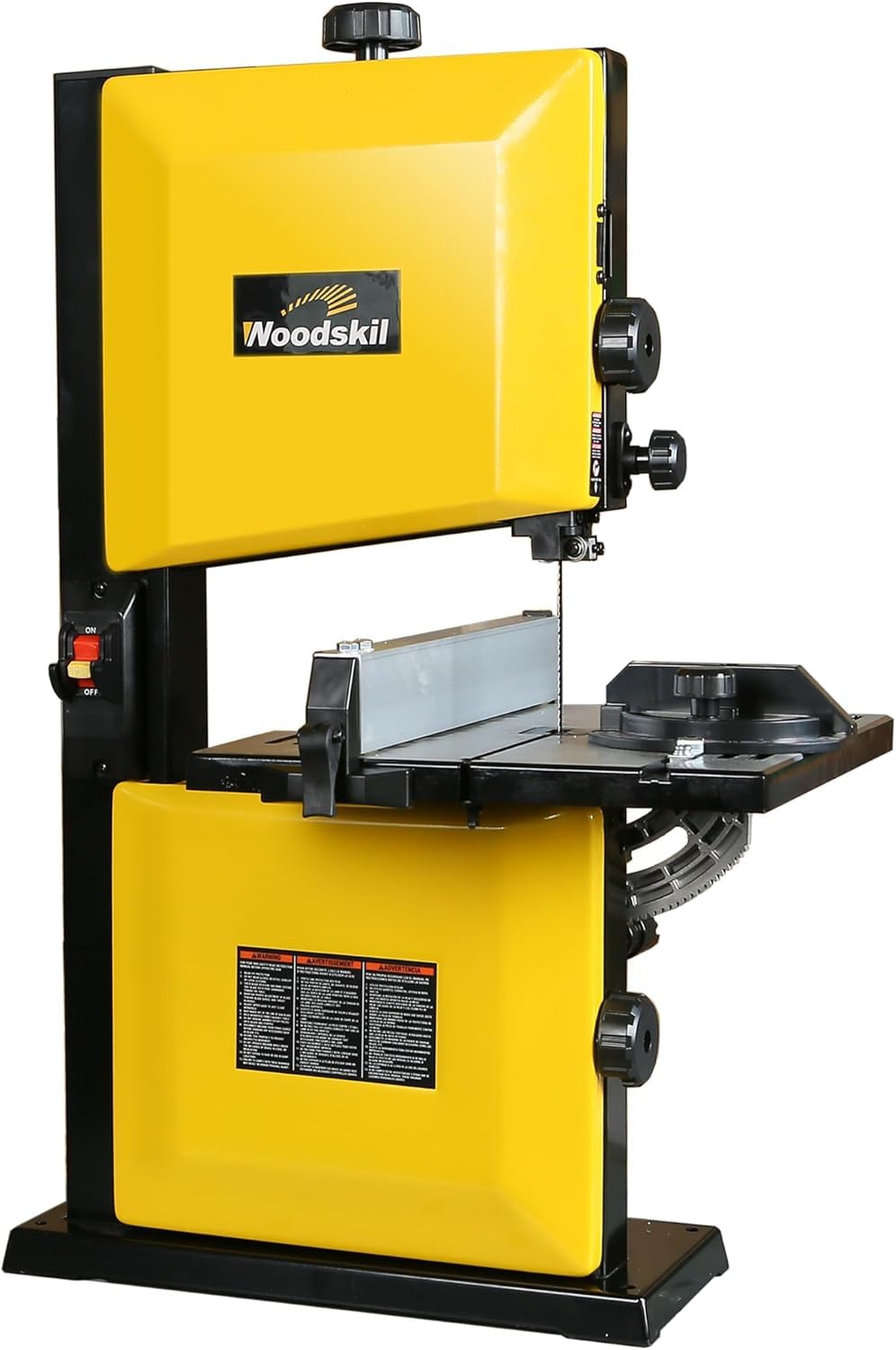
The lightest saw here, and the one that asks the least of your wallet and your bench.
Forty pounds. That is the number that defines this saw — it weighs roughly two-thirds what the Rikon 10-310 does at 61.8 pounds, and it is the lightest machine on this list. For a hobbyist who needs to shift the saw against a wall between projects, that matters as much as any motor spec.
At 3-1/2 inches of cutting depth and 9 inches of cutting width, it is a step behind the QD-KYOHO’s 4-3/4 inches and the SHOPMAX’s 4.5 inches. Push a board taller than that under the guides and you are out of luck. What it does deliver is a 1/2 HP motor running a 2500 FPM blade, a 59-1/2 inch blade loop from 1/8 to 3/8 inches wide, and 1720 RPM at the motor. The cast aluminum table tilts 0 to 45 degrees and carries a 120-degree miter gauge plus a rip fence for straight cuts.
This saw earns its keep on everyday stock: buyers report it “cuts through 3/4 inch stock like butter.” Quality and value for money are what people praise most, which explains why this machine keeps showing up in hobby shops. A 2-1/2 inch dust exhaust port (a wide opening that pulls sawdust away) and a dust brush on the saw wheel help keep the area cleaner. Blade durability is the weak spot worth knowing about: expect to replace blades more often under heavy use, and the table’s adjustability draws divided opinions. A sturdy steel base does its part to hold vibration down.
Why it earns its spot
- 40 pounds — the lightest machine in this guide, so it stores and repositions without a struggle
- Tilting cast aluminum table with a rip fence and 120-degree miter gauge for curves, rips, and angles
- 2500 FPM blade speed on a 1/2 HP motor that handles everyday stock cleanly
Where it stops short
- 3-1/2 inch depth limits you to thinner stock; real resawing is off the table
- Blade durability is the recurring gripe, so budget for replacements
Pick this for: a first band saw where light weight, low cost, and 3/4-inch stock cuts cover your projects.
Leave it for: anyone who needs to slice thick slabs — the depth ceiling decides that for you.
5. WEN BA3962 10-Inch Two-Speed Band Saw with Stand

Six inches of cutting depth in a benchtop frame — the middle ground most shops actually need.
A 3.5-amp motor sounds modest next to the QD-KYOHO’s 5.3 amps. Then you read the depth figure: this saw cuts up to six inches tall and 9-3/4 inches wide. That is more depth than any other 10-inch machine here, and it sits between the benchtop crowd and the full-size 14-inch saws. If your work involves boards thicker than four inches, this is the saw on the list that clears them without stepping up to a floor machine.
Two speeds — 1520 or 2620 FPM — let you slow down for dense hardwood or speed up for a smoother softwood cut. It runs 72-inch blades from 1/8 to 1/2 inches wide, so you can fit a narrow blade for scroll work or a wider one for straight rips. The 14-1/8 x 12-1/2 inch cast aluminum table bevels to 45 degrees, and the saw ships with a stand, a work light, a 3-in-1 dust port, a fence, a miter gauge, and a 3/8-inch blade with 6 TPI.
The catch is that it is still a benchtop-class saw with a tall cut capacity, which means gravity is doing you no favors at the limits. At 26.5″L x 21″W x 58.5″H on its stand, it takes a proper footprint — noticeably taller than the SHOPMAX at 32.83 inches high. The included work light is a real convenience for anyone cutting in a dim corner of a shop, and the 2-year warranty covers the machine.
Why it stands out: you get six inches of cutting depth on a 10-inch saw (the wheel size that sets the saw’s class). That is the practical balance for furniture stock that does not quite warrant a 14-inch machine.
What you give up: it is not cheap, and the stand makes it a fixed installation rather than something you stow.
Go with this: if your projects need five or six inches of cut depth and you have a permanent spot for a stand-mounted saw.
Pass on it: if you need portability — the stand and 58.5-inch height make it a fixture.
6. Rikon 10-310 10-Inch Band Saw with Stand

A saw built around a rigid frame and a machined table, for people who hate vibration.
Most benchtop band saws shake a little. Rikon’s answer to that is structural: a rugged welded steel column and frame, plus a machined cast iron table with a 3/4-inch by 3/8-inch miter gauge T-slot. A cast iron table holds its flatness better than stamped steel, and flatness is what keeps a straight cut straight over the length of a long board.
The blade changes are where the daily convenience lives. Spring-loaded, tool-less upper and lower guides mean you adjust the blade position without hunting for a hex key. A quick-release tension system and a large tension hand wheel let you release the blade between sessions — a good habit that helps blades hold their temper instead of stretching on the wheel. It runs 70-1/2 inch blades, the same length the QD-KYOHO uses.
Here is the number that shapes expectations: at 61.8 pounds, this is a substantial 10-inch machine — noticeably heavier than the 40-pound Woodskil. That weight is the point, since mass is what kills vibration, but it also means this saw lives where you put it. Assembly hardware and wrenches are in the box. Owners who make the jump tend to be the type who would rather align a cast table once than fight drift on every project.
What the money buys
- Machined cast iron table with a real miter gauge T-slot, for repeatable angle work
- Tool-less upper and lower guide adjustment plus quick-release tension
- Welded steel column and frame at 61.8 pounds — mass that dampens vibration
Where it asks for patience
- 61.8 pounds means it does not move around the shop easily
- A smaller review base than the mainstream benchtop saws, so tune it carefully to your own work
This is your saw if: cast iron flatness and a rigid steel frame matter more to you than a long list of extras.
Keep shopping if: you need the saw to be movable — the frame is deliberately heavy.
7. WEN BA1487 14-Inch Two-Speed Band Saw with Stand

Nine and a half amps driving a fourteen-inch frame — the step up to a real resaw machine.
One figure shows the jump from benchtop to floor saw: 9.5 amps (the motor’s current draw, a rough measure of cutting power). That is the highest motor rating in this guide, and it is what makes 8.85 inches of cutting depth and 13-3/8 inches of cutting width usable rather than theoretical. Resawing (slicing a wide board into thinner boards) on a benchtop saw means slowing down and hoping; here the motor has the torque to keep the blade moving through the cut.
Speed control is dialed for real stock. It runs at either 1480 or 3280 FPM (feet per minute, how fast the blade travels), and the blade range takes 100-3/4 inch loops anywhere from 1/8 to 1 inch wide. A one-inch blade is a serious resaw setup — none of the 10-inch machines here can run one. The 21-1/2 x 15-3/4 inch work table bevels to 45 degrees (tilts for angled cuts), and the package includes a blade tension gauge, a circle cutting guide, a flexible work light, a 3-in-1 dust port, a fence, a 1/2-inch blade, and a miter gauge.
Cutting hardwood is where owners say this saw comes alive, and the blade quality and power are the two things they praise most. Value for money ranks right behind — a fair reaction given what a 14-inch machine with these specs normally asks. The machine weighs 138.9 pounds on its stand, so it is a shop fixture. Build quality, blade adjustment, and mobility all split opinion, and the base draws particular note — check that the stand is square and level before you trust a long resaw.
The case for the BA1487
- 9.5-amp motor and 8.85-inch depth — the most capable cut in this guide without a premium price
- Runs blades from 1/8 to 1 inch wide, so a single saw covers scroll work and resawing
- Comes with a tension gauge and circle cutting guide that benchtop saws leave off
What to watch
- At 138.9 pounds it is a permanent installation, not a storable tool
- The base and blade adjustment draw divided feedback — spend time getting the stand right
You want this one: if you are ready to resaw wide boards and run a one-inch blade without moving up to the premium tier.
Skip the upgrade if: your work stays under four inches deep — a benchtop saw covers that.
8. JET JWBS-14SFX 14-Inch Woodworking Band Saw

Thirteen inches of resaw height and a capacitor-run motor built to slice veneer in one pass.
Thirteen inches. That single number separates this saw from everything cheaper on the list. A 1.75 HP capacitor-run motor turns a 116-inch blade loop and resaws material up to 13 inches tall in one pass, so you can slice thick slabs into bookmatched panels or veneer without a second machine. The WEN BA1487 tops out at 8.85 inches — this one clears four more inches of stock in a single go.
The table is the other serious upgrade. It is a 360 square-inch ground cast-iron surface that tilts 0 to 45 degrees right on a diecast-and-steel trunnion, so bevels hold their angle under load. A 13-1/2 inch throat capacity lets you swing wider workpieces past the blade. It runs 116-inch blades from 1/8 inch wide for tight scroll cuts up to 3/4 inch wide for fast resawing, with independently adjustable ball-bearing blade guides on both upper and lower positions.
Cutting thick stock is what this machine is known for — the performance is the thing people talk about, and owners describe it slicing through thick stock with almost no resistance. It ships with the band saw, steel stand, machined-aluminum resaw fence with an easy-read scale, and a hardware pack. Two things to plan around: the blade is sold separately, and the saw wants a 20-amp circuit at 115/230V. Some owners mention the blade drifting out of alignment, so budget time for guide setup. JET backs it with a 5-year warranty.
The standout spec: 13-inch resaw capacity in one pass (the height it can slice through in a single go) is the ceiling in this guide, matched only by the Laguna.
The follow-up question: does your shop have a 20-amp circuit? That requirement, plus a separately sold blade, shapes the real total.
Built for you: if you resaw slabs and cut your own veneer, and your shop can feed a 20-amp circuit.
Possible mismatch: if most of your work is curve cutting on thin stock — a smaller saw does that job for far less.
9. Laguna 14|12 14-Inch Woodworking Bandsaw
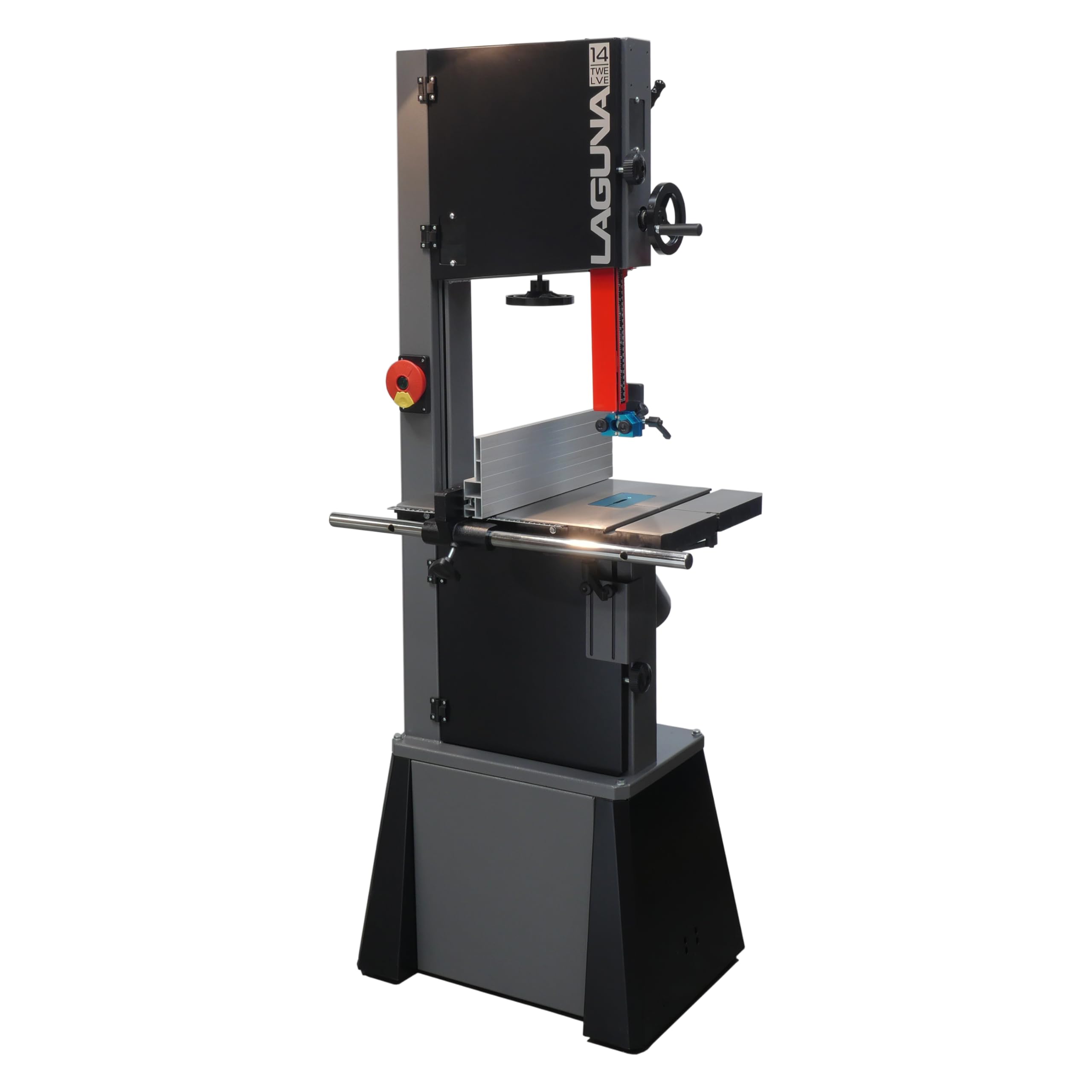
Ceramic guides, balanced wheels, and viewing windows — a saw built to hold a blade steady.
Blade drift is the enemy of every resaw cut, and Laguna attacks it with hardware. Ceramic Laguna guides plus a rack-and-pinion upper guide system keep the blade controlled through the cut. The wheels are electronically and dynamically balanced cast iron with one-piece polyurethane tires designed to run cooler, and cooler tires mean less blade fatigue over a long session.
Capacity matches the JET at 13 inches of resaw, with blade support from 1/8 inch to 3/4 inch wide. The motor is a 1-3/4 HP dual-voltage TEFC unit, pre-wired for 115V and able to run on 230V. The table is a micro-polished 21-1/2 by 16 inch surface on a heavy-duty cast trunnion that tilts 45 degrees right, 7 degrees left, with a positive stop at 90 degrees. Dual viewing windows let you watch tension and tracking while the saw runs, and a quick-release lever plus tension indicator handle blade changes.
Owners describe a sturdy base and consistently accurate cuts, backed by intuitive assembly and an easily adjusted fence. Instructions are generally clear, though some find them unclear, and blade adjustment draws divided views — note since this machine’s whole identity is blade control. At 258 pounds on its stand it is a fixed shop machine. The blade is sold separately, so factor that into your build-out before the first cut.
what separates it
- Ceramic guides and rack-and-pinion upper guide adjustment for steady blade control
- Dual viewing windows show tension and tracking with the saw running
- Table tilts 45 degrees right and 7 degrees left with a positive 90-degree stop
Plan around this
- Blade sold separately, so the first cut needs a blade purchase on top
- 258 pounds on the stand means it is not moving once placed
The right call when: you want a 14-inch saw with visible tension and tracking checks and ceramic guide control.
Think it over if: your shop lacks the room and the budget headroom that a 258-pound premium machine requires.
Know the Specs
Cutting depth and resaw capacity
Cutting depth is how tall a board slides under the blade guides — the spec that decides whether you can resaw. On benchtop machines it runs from 3-1/2 inches up to six inches, while full-size saws go to 8.85 and 13 inches. Buy for the tallest board you honestly plan to cut, because no blade or fence adds depth later.
Motor amps and horsepower
Amps measure current draw and hint at how the saw holds up under load. A 2.8-amp motor suits light cutting, while 5.3 amps and up keeps the blade moving through dense stock. Horsepower is the other half of the picture — a 1.75 HP motor on a 14-inch saw does work a 1/2 HP benchtop unit cannot.
Blade speed in FPM and two-speed drives
FPM stands for feet per minute — how fast the blade loop travels. Slower speeds tend to suit dense hardwood, while faster speeds give a smoother surface on softwood. A two-speed saw lets you pick per board: the QD-KYOHO runs 1515 and 3280 FPM, the WEN BA3962 runs 1520 and 2620 FPM.
Table material and tilt range
Cast iron and cast aluminum tables hold flat and resist vibration better than stamped steel, and flatness is what keeps a long cut true. Tilt range decides your bevel work — most saws here go to 45 degrees, while the Laguna also tilts 7 degrees left. A miter gauge slot in the table adds crosscuts and angle cuts.
Blade length and width range
Blade length must match the saw exactly, and the width range tells you what cuts are possible. Narrow blades — 1/8 to 1/4 inch — cut tight curves, while wider blades hold a straighter line for resawing. A saw that runs 1/8 to 1 inch blades covers both jobs; one capped at 3/8 inch is a curve-cutting machine.
Dust ports and shop cleanup
Band saws throw fine dust off the wheels as well as the cut line. A port sized for a standard 2-1/2 inch hose lets your shop vacuum handle it. Sawdust that packs into the lower wheel housing can cause tracking trouble, so a working dust connection saves more than just cleanup time.
Common Questions
How much cutting depth do I need for resawing boards?
Can a benchtop band saw cut curves as well as a floor-standing saw?
What blade width should I use for resawing versus scrolling?
Do I need a 230V outlet to run a 14-inch band saw?
How do I stop the blade from drifting on a straight cut?
What size dust hose fits these band saws?
Is a two-speed band saw worth it compared with a single speed?
How much space does a band saw with a stand take up?
Can these band saws cut metal or only wood?
How often should I change the blade on a band saw?
The Bottom Line
For one saw that covers most home-shop work without giving up depth, pick the QD-KYOHO 10-Inch Dual-Speed. Its 5.3-amp motor and 4-3/4 inches of depth handle everyday cuts, and two speeds let you switch from hardwood to softwood without a blade change. It holds the guide’s highest rating at 4.5+ stars across 100+ reviews, with owners praising its cutting performance and easy assembly.
If resawing thick slabs is your actual goal, go to the JET JWBS-14SFX instead, since 13 inches of resaw height on a 1.75 HP motor does work that no benchtop machine here can match. Score the budget instead and the Woodskil 9-Inch is the sensible entry, at 40 pounds and 3-1/2 inches of depth for lighter stock. Match the depth figure to the tallest board you plan to cut, and the choice makes itself.
How we choose
We do not accept paid placement. Every pick is matched to a real buyer and a real use-case; we do not hands-on test units.
Sources
Specifications: manufacturer listings and product documentation. Review insights: verified customer reviews, as of November 2026. Pricing: not shown on this page (it changes often); check the current price via the retailer link.
As an Amazon Associate, Tactical Gear Guy earns from qualifying purchases. This does not affect which products we feature.