Specs are compiled from manufacturer listings and verified buyer reviews and can change over time — please confirm the key details on the product page before buying.
You want wood passive speakers that sound good and look good, but first pick the cabinet finish you can live with, then check your amplifier can drive what’s inside. These speakers are unpowered, so nothing plays until you connect a stereo amp or AV receiver. The payoff: a wood cabinet with a decent woofer and tweeter gives you real stereo separation, proper bass, and furniture you won’t want to hide behind a curtain. The Polk Signature Elite ES20 pair is the one to beat here, a 4.5+ star crowd favorite with 800+ owners behind it.
This guide is built by comparing the manufacturers’ published specifications and the patterns across verified customer reviews, so you get each pick’s real strengths and trade-offs instead of marketing spin.
Driver sizes, impedance figures (how hard a speaker is for an amp to drive), and cabinet finishes change how a speaker sounds in a normal living room. Amplifier matching trips people up, so check that too. Every pick here is a genuine passive wood speaker. The right one for you depends on your room size and your amp’s power and ohm rating.
Top Picks


How To Choose The Best Wood Passive Speakers
The single most common mistake here is buying a beautiful pair of wood speakers and then discovering your amplifier cannot drive them properly. Sort that match first, and everything else falls into place.
Match the speaker to your amplifier, not the other way round
A passive speaker has no electronics of its own — it takes power from an external amp or receiver. Check your amp’s wattage and its supported impedance (the electrical load it can safely handle) before you buy. Some pairs here list 8-ohm nominal impedance, and low-impedance models like the DALI KUPID sit at 4 ohms, which needs an amp rated for it.
Woofer size and your room
The woofer is the larger driver that produces bass and midrange. A 3-inch square-frame woofer in a slim cabinet suits a desk or a tight media nook, while a 6.5-inch driver pushes more air and fills a living room. Pick the size to your room, not to the spec sheet bragging rights.
The treble you will actually hear
The tweeter handles high frequencies. A silk dome tweeter tends to sound smooth and forgiving, while an aluminum dome tweeter reaches higher and reveals more detail. If your ears tire easily on bright recordings, lean toward silk.
Cabinet build and finish
The wood cabinet is not just decoration — it is part of the sound. Stiffer, braced enclosures reduce vibration that smears detail. On finish, walnut and dark wood hide dust and fingerprints better than glossy black, and they look right in a normal living room.
Side-by-Side Comparison
| Model | Best For | Woofer | Tweeter | Finish | Amazon |
|---|---|---|---|---|---|
| Polk Signature Elite ES20★ Best Overall | Living-room stereo and surround | 6.5 in | 1 in Terylene | Walnut | Amazon |
| Pyle 6.5″ Home Audio PairBudget Muscle | Big sound on a tight budget | 6.5 in | 1 in silk dome | Wood grain | Amazon |
| Micca OoO SlimSlim Pick | Slim shelves and center-channel use | Two 3 in | 0.75 in silk dome | Dark walnut | Amazon |
| NEUMI BS5 | Budget music lovers | 5 in | 1 in silk dome | Dark wood | Amazon |
| Fluance Signature HFSW | Two-channel stereo in small rooms | — | Neodymium dome | Natural walnut | Amazon |
| Triangle BOREA BR02 | Compact high-fidelity detail | — | — | Walnut | Amazon |
| ELAC Debut 3.0 DB53-WN | Mixed music and movie duty | 5.25 in | 1 in aluminum dome | Walnut | Amazon |
| KEF Q1 Meta | First proper hi-fi system | 5.25 in | Uni-Q with MAT | Walnut | Amazon |
| DALI KUPID | Wall-mounted compact setup | 4½ in | 26 mm soft dome | Dark walnut | Amazon |
| Klipsch Reference R-620F | Floorstanding home theater | Dual 6.5 in | 1 in aluminum LTS | Black wood grain vinyl | Amazon |
| KEF Q3 Meta | Medium-size rooms needing scale | 6.5 in | Uni-Q with MAT | Walnut | Amazon |
Detailed Reviews
1. Polk Audio Signature Elite ES20 Bookshelf Speaker Pair
Our pick — 4.5+★ from 800+ verified ratings; the strongest balance of quality and price.
A 6.5-inch woofer paired with Polk’s Power Port — bass you feel in the sofa, not just hear.
This is the pair to buy if you want one set of wood speakers to handle both stereo music and a movie night without apology. The 6.5-inch woofer (the driver that produces bass and midrange) does the heavy lifting for low end. Polk’s Power Port is rated 3dB louder than a conventional port and is designed to reduce the port turbulence that blurs detail. In plain terms, dialogue stays intelligible and explosions still land.
The 1-inch Terylene tweeter (the small driver that produces high frequencies) is what makes spoken word so easy to follow. Owners consistently single out dialogue clarity, and the aesthetic earns its own praise — the walnut cabinet reads as furniture rather than a box. What wins people over most is the sound itself, and the finish runs a close second.
Impedance (the electrical load your amp must handle) is the practical bit: Polk rates this pair for both 4- and 8-ohm amplifiers, so most AV receivers will drive it. The honest catch is that this is still a passive speaker, so you must own a separate amplifier — nothing plays straight from the box. It also asks for real space; it is a substantial bookshelf cabinet, not a desk ornament.
Where the ES20 Pulls Ahead
- 6.5-inch woofer gives genuinely full bass for music and film
- Power Port rated 3dB louder than a conventional port
- Works with both 4- and 8-ohm amplifiers, so receiver matching is easy
- Wall-mount screw inserts and keyhole slots add placement freedom
- Timbre-matched to the wider Signature Elite range for surround builds
What To Plan Around
- No built-in amplification — you need an amp or AV receiver
- Bookshelf stands are sold separately
Right call for: a living room that serves both music and movies, run from a normal AV receiver.
Hold off if: you want a speaker that plays straight from your phone — this one needs an amplifier in the chain.
2. Pyle 6.5″ Home Audio Speakers 2-Way Passive Bookshelf
Two hundred forty watts of headroom in a wood-grain cabinet — loud without the shrill.
The figure that defines this pair is power handling: 240 watts maximum with 120W RMS (RMS is the continuous power it can take, rather than a brief peak). That headroom means it stays composed when you turn the dial up. A 6.5-inch composite woofer with rubber surrounds handles the low end, and the 1-inch silk dome tweeter keeps the highs smooth. The 6-ohm impedance is the detail to check against your amplifier before checkout.
Construction is where buyers keep landing positive. The cabinet feels solid, the wood-effect finish sits nicely in a living room or bedroom, and setup is quick — the angled connections are a convenience note if you are wiring by feel behind a shelf. An 11.4″ x 8.3″ x 9.5″ cabinet places it comfortably on a desk or a stand.
Here is the honest limit: silk-dome treble is forgiving rather than forensic, so if you chase microscopic detail from acoustic recordings, a pricier aluminium-dome design will pull ahead. For filling a room with clean stereo at volume, the Pyle delivers far more than its tier suggests.
Value read: 240W max and 120W RMS in a wood cabinet is a lot of output for an entry-level passive pair. The 6-ohm rating is the only thing to match carefully.
One note: the detachable grill is a practical touch for cleaning dust off the drivers.
Reach for this if: you want loud, clear stereo on a modest amplifier budget.
Look elsewhere if: your amp is only rated for 8 ohms — this pair is spec’d at 6.
3. Micca OoO Slim Passive Bookshelf Speakers
The slim cabinet that slips onto a crowded shelf and still reaches down to 60Hz.
Size is the whole point of the OoO, and it is the spec here that most changes your setup. Each speaker holds two 3-inch square-frame woofers in a ported enclosure, which Micca rates for usable bass extension down to 60Hz. In real terms, that is enough low end for television dialogue and most music without a subwoofer, from a cabinet that will not dominate a media room.
It also lays flat as a centre channel, stands upright as a bookshelf pair, or mounts on optional brackets as a surround. That flexibility is unusual at this tier. The tiny cabinets suit small rooms and desks especially well, and the sleek black finish on the woofers keeps the look tidy.
The honest trade-off is the frequency response. Its two 3-inch woofers reach 60Hz, so bass-heavy tracks will always feel lighter here than from a 6.5-inch driver. Compare it to the NEUMI BS5 below — the BS5’s 5-inch woofer is the bigger driver by a clear margin over this model’s 3-inch units, and the BS5’s 1-inch tweeter overhangs the OoO’s 0.75-inch dome. This Micca wins on footprint; the NEUMI wins on weight of sound.
Built for: tight shelves, desks, small media rooms, and anyone adding a slim centre channel.
Think twice if: you want deep bass from the speakers alone — plan on a subwoofer for that.
4. NEUMI BS5 Passive Bookshelf Speakers

A front port that lets you push it against the wall — and warm sound that fills a garage.
Most bookshelf speakers want breathing room behind them. The BS5 does not, because its front-ported design lets you place it right up against a wall. If your shelf is shallow or your desk backs onto plasterboard, that single design choice solves your placement problem before sound quality even enters the conversation.
The 5-inch fiberglass woofer with a rubber surround is tuned for a balance of bass and midrange, and it does so with low distortion at normal listening levels. A 1-inch silk dome tweeter sits behind an integrated waveguide, which helps spread the treble evenly across the room rather than aiming it at one chair. Buyers report this pair fills a 24×30 garage with clear highs and mids.
What earns the goodwill is warm sound backed by solid build; the cabinet feels substantial in the hand. It is a passive speaker, so a separate amplifier or receiver is required for a TV, computer, or turntable. Compare it to the slim Micca above: the BS5’s 5-inch woofer and 1-inch tweeter are both larger than the Micca’s 3-inch and 0.75-inch drivers, and that shows up as more body in the low end.
Placement gift: front port plus rounded vertical corners and a magnetic grill system (no visible mounting holes).
The catch: it is strictly a passive box — no amp, no sound.
Pick it when: wall placement is forced on you and you still want full-bodied stereo.
Not the one if: you have no amplifier and want plug-and-play sound from a phone.
5. Fluance Signature HiFi 2-Way Bookshelf Speakers HFSW

A small-room stereo pair with neodymium tweeters and a full lifetime parts-and-labor warranty.
Fluance backs this pair with a full lifetime parts and labor warranty direct from the manufacturer — the clearest reason to consider it over a cheaper cabinet. The midrange pointed dome directs sound waves straight out from the centre of the woven glass fibre cone, which helps build a believable soundstage in a modest living room.
The cabinets are precision crafted from engineered wood and designed to stay acoustically inert — meaning the cabinet vibrates as little as possible, so the drivers do the talking instead of the box. Neodymium tweeters handle the top end with clarity. For a two-speaker stereo setup in a small room, this is a comfortably balanced pairing.
The practical extras are welcome: integrated wall-mounting brackets with keyhole slots, sound isolation foot pads, and two magnetic front grills. As with every pick here, an external amplifier is required — Fluance says so plainly. Owners describe vocals and midrange opening up, which fits the midrange-dome design.
Why It Earns Its Place
- Full lifetime parts and labor warranty from the manufacturer
- Midrange pointed dome for a focused, forward soundstage
- Ships with wall brackets, isolation pads, and magnetic grills
- Natural walnut finish over engineered wood cabinets
Keep In Mind
- External amplifier required for any audio
- Built for small-room stereo rather than a large open plan
Best suited to: a two-speaker stereo in a small living room, backed by a warranty that outlasts most electronics.
Skip the upgrade if: you need wall-shaking bass — this pair is tuned for balance, not rumble.
6. Triangle BOREA BR02 Hi-Fi Bookshelf Speakers

High sensitivity means your amplifier does less work to fill the room.
Sensitivity is the number worth understanding here. At 89 dB/W/m, this speaker turns a small amount of amplifier power into a lot of volume — so even a modest amp reaches a comfortable listening level. The 80W power handling covers the peaks, and an 8-ohm nominal impedance keeps it friendly to a broad range of amplifiers.
Frequency range runs 51Hz to 22kHz, which is a wide spread for a compact two-way speaker — it means you get bass weight and open treble from one cabinet. Its 6.9 x 10.8 x 12.2″ frame is space-saving enough that owners mention it fitting neatly on an IKEA shelf, and the walnut finish suits a normal living room.
The honest note is the cabinet depth. That 12.2-inch figure means you need a shelf or stand with real depth, not a narrow ledge. Otherwise this is a compact speaker tuned for detail over sheer output, and the clarity is what buyers keep coming back to.
The efficiency edge: 89 dB/W/m sensitivity plus 8-ohm impedance makes it easy to drive and loud with little amp input.
Sizing check: a 6.9 x 10.8 x 12.2″ cabinet needs a deep shelf or a stand.
Matches best with: small-to-medium rooms and a modest amplifier that values efficiency.
Pass on it if: your shelf is shallow — measure the depth before ordering.
7. ELAC Debut 3.0 DB53-WN Bookshelf Speakers, Walnut (Pair)
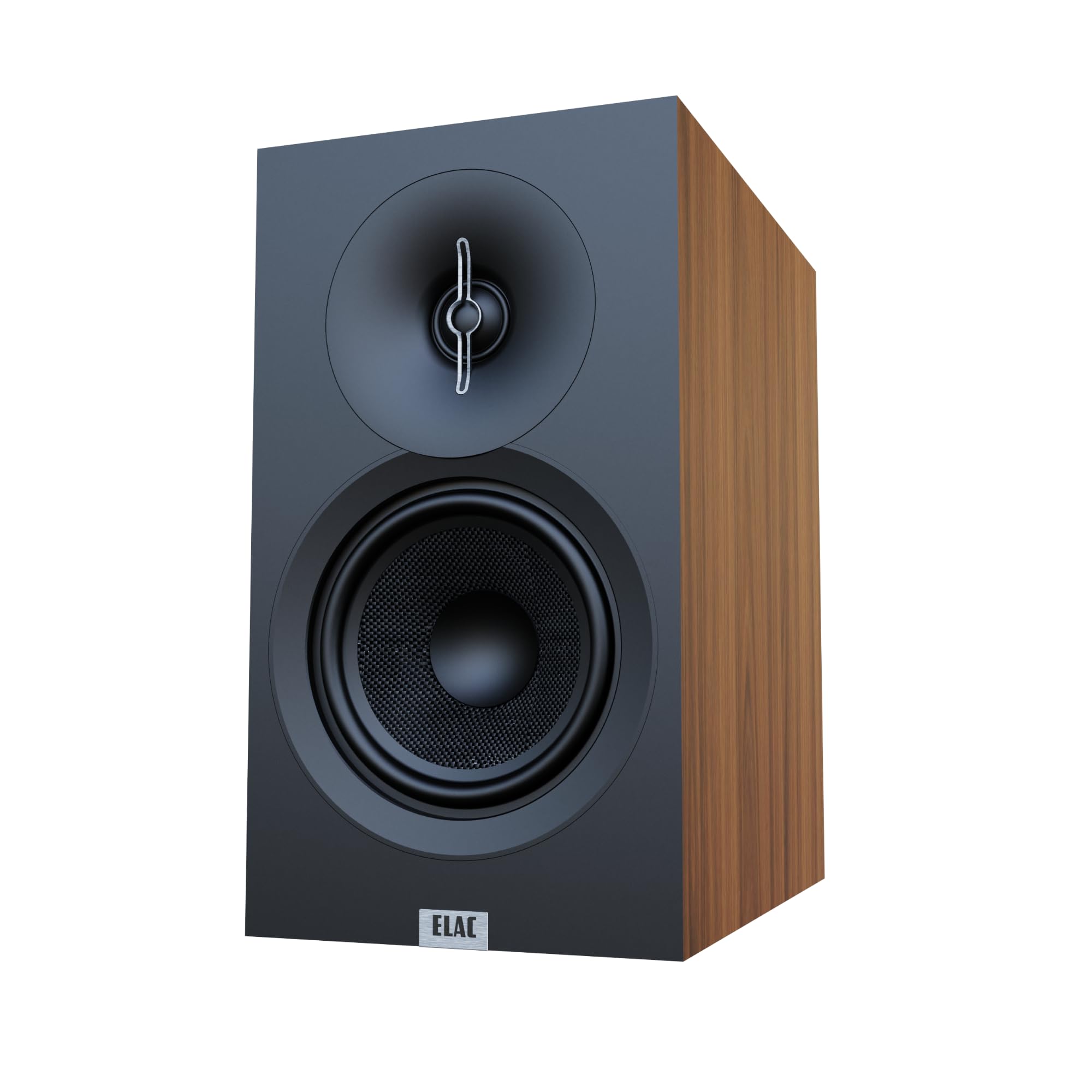
Internal bracing keeps the cabinet quiet, so the music comes from the drivers alone.
Most budget cabinets rattle a little when you push them. The DB53 is built with internal speaker bracing that reduces the vibrations which smear sound, so what reaches your ears comes from the drivers rather than the box. In daily use that reads as a cleaner, less muddy middle — vocals and strings stay separate instead of smearing together at volume.
You get consistent treble as you move around the room, thanks to a 1-inch aluminum dome tweeter paired with a newly designed waveguide and phase plug (a shaped piece that evens out how sound leaves the tweeter). For the low end, a 5.25-inch woven aramid fibre woofer handles bass, and the material’s stiffness and damping allow a smoother, extended low-frequency response.
Frequency response starts at 48Hz, so there is usable bass depth from a bookshelf cabinet. Magnetically attached grilles keep the front clean, and the walnut finish looks pricier than the cabinet’s position in the market. Customers note these can be cranked without breaking up, and that they hold up for both music and movies.
What The Bracing Buys You
- Internal bracing cuts cabinet vibration for cleaner detail
- Aluminum dome tweeter with waveguide for wider treble spread
- 48Hz low end from a bookshelf-sized box
- Magnetic grilles with no visible hardware
The Honest Limits
- Passive design needs an amplifier or AV receiver
- Aramid and aluminum detail reveals rough recordings rather than hiding them
A strong fit for: listeners who want detail and low cabinet colour for both music and film.
Look past it if: you want forgiving sound that softens rough streaming files — this one tells the truth.
8. KEF Q1 Meta Passive Compact Hi-Fi Bookshelf Speakers

One driver handles highs and mids together, so the sound stays even when you sit off-axis.
Voices stay clear whether you sit in the centre chair or off to the side of the sofa, because KEF’s Uni-Q design combines the tweeter and midrange into a single engineered unit. Instead of a narrow balance, sound spreads more evenly in a real room. That even spread is the main thing this cabinet buys you over a conventional two-way speaker.
Behind the natural tone is Metamaterial Absorption Technology, which KEF says reduces unwanted distortion so the speaker reproduces recordings more cleanly. The 5.25-inch bass/midrange driver delivers punchy bass and detailed vocals from an enclosure measuring 302mm high — compact enough for a bedroom, study, apartment, or small living room.
It is a passive speaker, so a separate stereo amplifier is required, and that is honestly the point: you choose the amp and keep the speakers as the fixed heart of the system. Reviewers point out this model outperforming the Q150 it replaces, which suggests the engineering update is audible rather than cosmetic. Add a KEF subwoofer or more Q Series speakers later if you want a full cinema setup.
Room-friendly sound: the Uni-Q driver spreads treble evenly, so off-centre seating still sounds right.
What you supply: a stereo amplifier — the Q1 Meta is passive and needs one.
Ideal for: a first serious stereo where you listen from all over the room, not just one chair.
Reconsider if: you want bass that shakes the floor — this compact box wants a subwoofer for that job.
9. DALI KUPID Compact Passive Hi-Fi Bookshelf Speakers
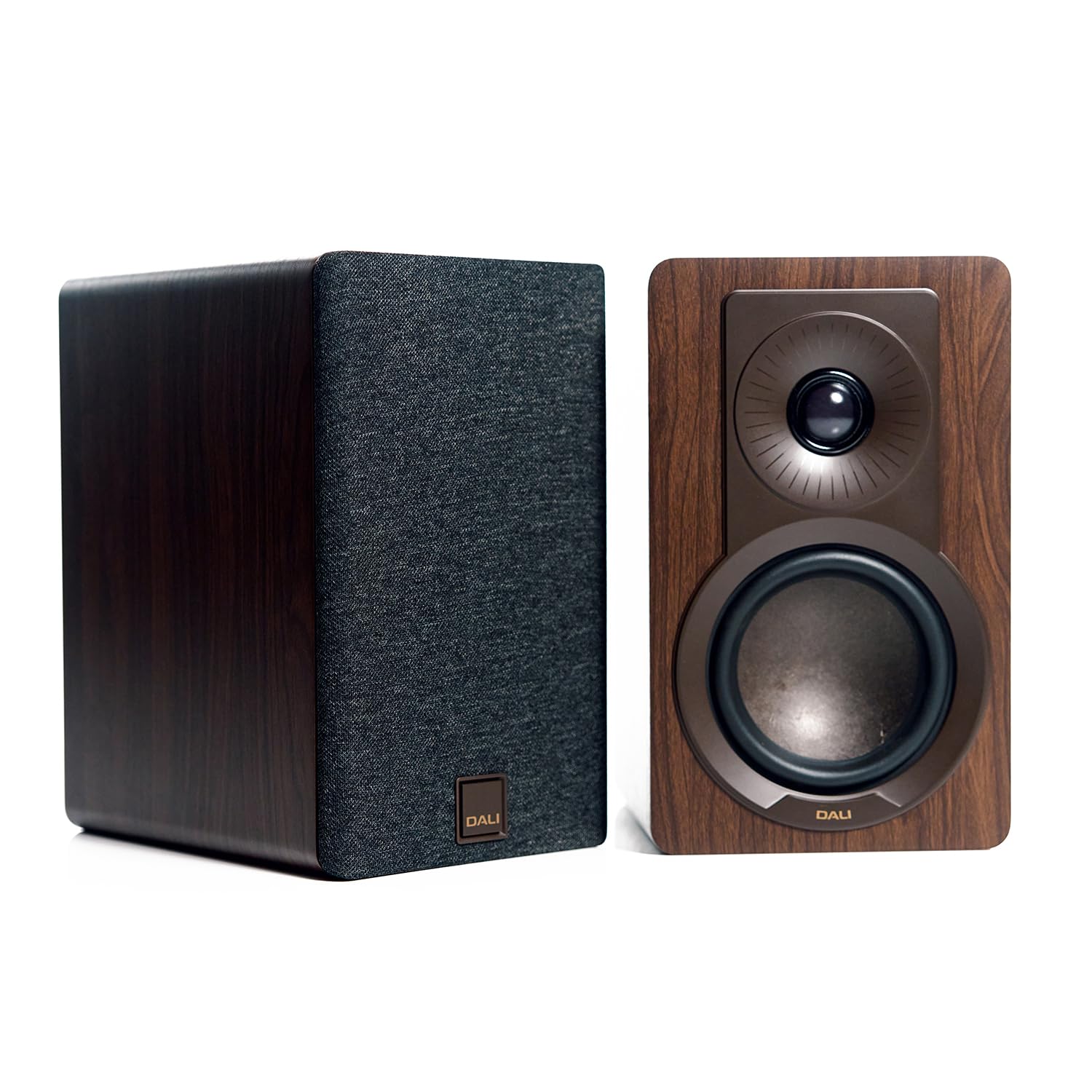
Brackets in the box means these go on the wall the day they arrive.
Wall-mounting is usually an afterthought you buy separately. DALI includes the wall brackets with the KUPID, so you can lift it off the shelf and mount it where it actually sounds best. Each cabinet holds a 4½-inch low-loss bass/midrange driver and a 26 mm soft dome tweeter, crossed over with a precision 2-way circuit across a 63–25,000Hz range.
The amplifier detail is the one to read twice: DALI rates this pair at 4 ohms and calls for amps from 40–120W. That is a lower electrical load than an 8-ohm speaker, so check your amplifier is rated for 4 ohms before you commit. Do that and the reward is refined, room-filling sound from a genuinely compact wood cabinet.
The enclosure is wood, the finish dark walnut, and it ships with two front grilles, eight rubber feet, and the mounting hardware — so stand or wall, you are covered. It is passive, so an amplifier still does the driving.
Go for it when: your amplifier is rated for 4 ohms and you want compact speakers up on the wall.
Check first if: your amp is 8-ohm only — this pair is not the match for it.
10. Klipsch Reference R-620F Floorstanding Speaker

Two 6.5-inch woofers on the floor, so you can skip the stands entirely.
This is the odd one out on the list because it stands on the floor instead of a shelf. Dual 6.5-inch spun-copper IMG woofers handle the low end, backed by rear-firing Tractrix ports for deeper bass. Power handling runs 100W continuous and 400W peak, and the frequency response covers 38Hz to 21kHz within +/- 3dB — a wide, honest spread that suits movies as easily as music.
The 1-inch aluminum LTS tweeter sits inside a 90×90 square Tractrix Horn, which is designed to control how the treble leaves the cabinet and keep distortion low. Shoppers say crisp treble and a wide listening area, which fits a horn-loaded design that throws sound outward rather than aiming it at one seat. Gold-plated binding posts keep the wire connection secure.
The finish is black textured wood grain vinyl rather than real veneer — worth knowing if genuine walnut is the whole reason you are shopping. Set against the bookshelf picks, it needs floor space and a room with room to breathe, and it is still passive, so your AV receiver does the driving.
Where it wins: dual 6.5-inch woofers and a 38Hz–21kHz range give it low-end reach a shelf speaker cannot match.
Finish honesty: the wood grain here is vinyl over the cabinet, not solid walnut.
Choose it for: a home cinema or larger room where floor space is available and deep bass matters.
Rule it out if: you have no floor space to spare or your heart is set on real wood veneer.
11. KEF Q3 Meta Passive Midsize Hi-Fi Bookshelf Speakers
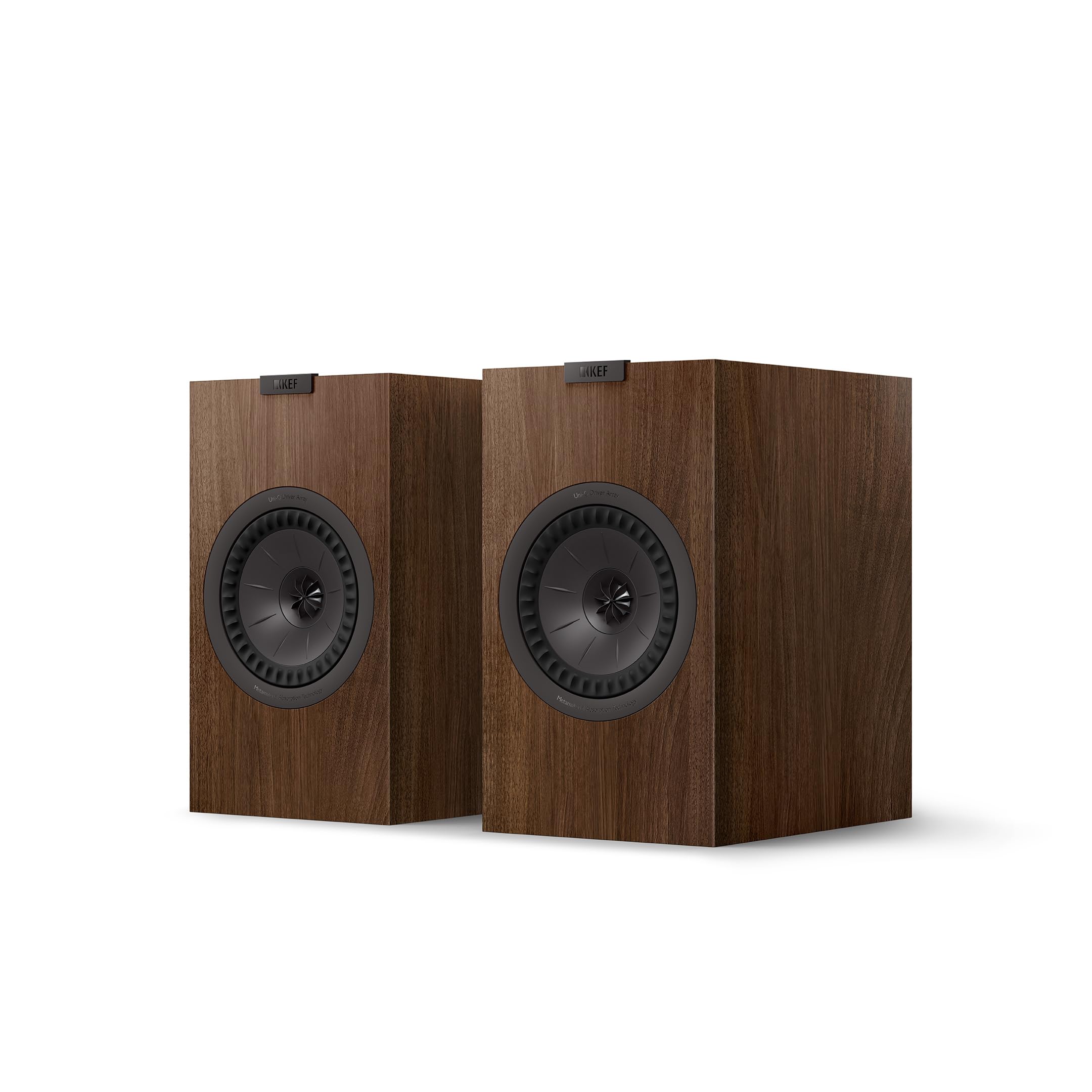
The midsize KEF with a 6.5-inch driver — bookshelf footprint, floorstander presence.
Where the compact Q1 Meta keeps things tidy, this one adds scale. The larger 6.5-inch driver pushes more air for deeper, punchier bass and a bigger sense of presence, while KEF’s Uni-Q layout keeps vocals clear and detail easy to follow. For medium-sized living rooms, it is the step between a small bookshelf and a large three-way floor model.
The Uni-Q driver places the tweeter at the centre of the main driver, so sound spreads evenly instead of narrowing to one seat — dialogue stays clear wherever you sit. Metamaterial Absorption Technology works behind the scenes to reduce unwanted distortion, so you hear the character of the recording rather than a coloured version of it.
It is a passive speaker, so a separate amplifier is required, and that keeps your options open as you upgrade. Use it for stereo music now, then add a KEF subwoofer or more Q Series speakers later for a cinema system. The walnut cabinet and wood enclosure look the part in a normal living room rather than shouting “studio”.
Best for: medium living rooms that want more weight than a compact bookshelf can give.
Not for you if: your amp budget is tight — this speaker deserves proper amplification to show what it can do.
Know the Specs
Power Handling and Sensitivity
Power handling is the wattage a speaker can take — often quoted as a maximum and an RMS figure — while sensitivity (in dB/W/m) measures how loud it gets from a given amount of amplifier power. A higher sensitivity figure, like the 89 dB/W/m on the Triangle BOREA BR02, means an easier drive and plenty of volume from a modest amp.
Impedance and Amplifier Matching
Impedance is the electrical load a speaker presents to your amplifier, measured in ohms. Many pairs here sit at 8 ohms, but some, like the DALI KUPID, are rated at 4 ohms — a heavier load that needs an amplifier rated for it. Always check your amp’s ohm rating before buying.
Driver Materials
The woofer cone material affects stiffness and damping. Fiberglass, woven glass fibre, and aramid fibre cones are built to resist flexing, which keeps bass clean at volume. Tweeter material matters too: a silk dome tends to smooth the treble, while an aluminum dome reaches higher and reveals more detail.
Cabinet, Ports, and Placement
Front-ported cabinets, like the NEUMI BS5, can sit close to a wall, while rear-ported designs need breathing room behind them. Internal bracing, as used in the ELAC Debut 3.0, cuts cabinet vibration for cleaner sound. Mounting options — keyhole slots, brackets, or wall inserts — decide where the speaker can actually go.
Common Questions
Can I use these wood passive speakers with my existing AV receiver?
What is the difference between passive and powered speakers?
How much amplifier power do these speakers need?
Will a 6.5-inch woofer give me enough bass without a subwoofer?
Can I use these passive speakers as surround channels in a home theater?
What is the difference between a silk dome and an aluminum dome tweeter?
Do wood cabinets really change how a speaker sounds?
Can I wall-mount wood bookshelf speakers?
What is impedance and why does 4 ohms versus 8 ohms matter?
Will I need speaker stands for bookshelf wood speakers?
The Bottom Line
Start with your amplifier, then choose thecabinet that suits your room. The Polk Signature Elite ES20 is the safest all-rounder in this batch — a 6.5-inch woofer, a 1-inch Terylene tweeter, and 4- and 8-ohm compatibility that lets most AV receivers drive it without fuss. What earns it the top spot is genuinely warm, room-filling sound, and the crowd agrees: 4.5+ stars across 800+ ratings from owners who rate the sound quality above everything else.
If wall space is tight and your shelf is shallow, the NEUMI BS5 solves the placement problem with its front port and still delivers a 5-inch woofer at a friendly price. Want a compact pair that stays even when you sit off to the side? The KEF Q1 Meta spreads its Uni-Q sound across the room instead of aiming it at one chair.
And if a bigger room deserves more weight, the KEF Q3 Meta adds a 6.5-inch driver and the scale to fill a living room. One last nudge: buy the amplifier first, then the speaker — that order will save you a return, and the ES20’s dual 4- and 8-ohm rating makes it the easiest of the lot to match.
How we choose
We do not accept paid placement. Every pick is matched to a real buyer and a real use-case; we do not hands-on test units.
Sources
Specifications: manufacturer listings and product documentation. Review insights: verified customer reviews, as of November 2026. Pricing: not shown on this page (it changes often); check the current price via the retailer link.
As an Amazon Associate, Tactical Gear Guy earns from qualifying purchases. This does not affect which products we feature.