Specs are compiled from manufacturer listings and verified buyer reviews and can change over time — please confirm the key details on the product page before buying.
Buying a wood lathe machine is really a question of what you plan to put on it. If you want to turn pens, bottle stoppers and small bowls at a bench in a garage or spare room, a midi or benchtop lathe will do everything you need. If you want to swing big out-of-round bowl blanks or spindle stock all afternoon, you need cast iron mass and a bigger motor instead. This guide splits benchtop midi lathes from cast-iron floor machines and matches each one to the swing and spindle work it handles.
This guide is built by comparing the manufacturers’ published specifications and the patterns across verified customer reviews, so you get each pick’s real strengths and trade-offs instead of marketing spin.
The two things that decide whether a lathe feels smooth or shaky are swing over the bed and spindle speed range. If you want the machine that balances both best for most home shops, the cast-iron JET takes it. Here is the honest breakdown of the wood lathe machine options worth a bench slot.
Top Picks


How To Choose The Best Wood Lathe Machine
Most first-time buyers walk in and ask about horsepower. That is the wrong first question. A 1/2 HP lathe with a cast iron bed cuts cleaner than a 2 HP machine on a flexing frame, and a 10-inch swing will not clear a 14-inch bowl blank no matter how good the motor is. Work through these four points in order and the shortlist narrows fast.
Swing over the bed and distance between centers
Swing is the largest diameter that clears the bed — a 12-inch swing means you can rough a bowl up to 12 inches wide. Distance between centers is the longest spindle you can mount between headstock and tailstock. A small machine with a 10-inch swing and 15-1/2 inches between centers is built for pens, stoppers and small bowls. A 12-inch swing with 18 or 20 inches between centers covers most home projects; anything longer needs a bed extension or a bigger frame.
Cast iron mass versus sheet metal
Chatter from a flexing bed is what leaves ridges a gouge cannot cut away. Cast iron is dense and absorbs the chatter a gouge sets up when it bites into an uneven blank, and every serious machine in this list uses it for the bed. Lighter frames can be bolted down to help, but mass is the honest fix. This is also why the heaviest lathes here are the steadiest at the highest speeds.
Speed range and how you change it
You want slow speeds for an out-of-round blank and high speeds for a thin spindle, so look at both ends of the range. Fixed-speed machines make you stop and move a belt to a different pulley step. Variable-speed machines let you dial within a belt range while the lathe runs, which is far friendlier for beginners finding their feet. Every lathe here changes belts for the big jumps — the difference is what you can adjust without stopping.
Headstock taper and spindle thread
Almost every accessory attaches through the headstock taper and spindle thread. An MT2 taper (a standard Morse taper size that seats chucks, spur centers and live centers) and a 1″ x 8 TPI spindle thread are the common pairing, so tooling is easy to find. Check the thread before you buy a chuck — a lathe with an odd thread leaves you hunting for adapters.
Side-by-Side Comparison
| Model | Best For | Swing / Between Centers | Speed Range | Motor / Power | Amazon |
|---|---|---|---|---|---|
| JET JWL-1015VS★ Best Overall | First lathe to advanced spindles | 10″ / 15-1/2″ | 200–3600 RPM (three ranges) | 1/2 HP, 4 A | Amazon |
| hightall MC1218Big Swing Value | Bigger bowls on a tight budget | 12″ / 18″ | 680–2770 RPM (five steps) | 550 W, 3/4 HP | Amazon |
| WEN LA3424Best Value | Value pick with the widest speed spread | 12″ / 18″ | 520–3400 RPM (five steps) | 4.5 A, 1/2 hp | Amazon |
| RIKON 70-105 | Pen and small-blank specialist | 10″ / 18″ | Five speed range | 1/2 hp, 375 W | Amazon |
| PSI KWL-1218VS | Variable speed on a 12″ swing | 12″ / 18″ | 500–3800 RPM (two ranges) | 1 HP | Amazon |
| WEN 34035 | Larger spindle capacity | 14″ / 20″ | 250–3550 RPM (variable) | 6 A | Amazon |
| Delta 46-460 | One-amp midi with full electronic control | 12-1/2″ / 16-1/2″ | 250–4000 RPM (three ranges) | 1 HP, 12 A | Amazon |
| JET JWL-1221VS | Serious home shop all-rounder | 12-1/2″ / 20-1/4″ | 60–3600 RPM (three ranges) | 1 HP, 6 A | Amazon |
| Powermatic 3520C | Large blanks and heavy production | 20″ / 35″ | 15–3200 RPM (variable) | 2 HP, 20 A | Amazon |
Detailed Reviews
1. JET JWL-1015VS Wood Lathe
Our pick — 4.5+★ from 100+ verified ratings; the strongest balance of quality and price.
The bench lathe that lets you dial speed mid-cut and skip the belt shuffle.
Start with the control, because that is what wins people over here. An electronic dial lets you fine-tune spindle speed inside three belt-selected ranges — 200–1050, 300–1750 and 600–3600 RPM — so you can slow down for an out-of-round bowl blank and speed up for a thin spindle without touching the belt. The crowd favorite in this group, it holds 4.5+ stars across 100+ owners, and the speed dial is the single thing that comes up most.
Rigidity is the other half of the story. The bed, headstock and tailstock are all solid cast iron, not stamped sheet metal, so the machine stays stiff and swallows vibration when a gouge bites in. That stiffness is what lets a roughing gouge take a deep pass without the bed ringing. Everything you need to start is in the box too — live center, spur center, 6″ tool support, 3″ faceplate and knockout rod — plus a 5-year JET warranty.
Here is the trade-off you should size up before ordering. The 10″ swing and 15-1/2″ between centers suit pens, bowls and spindle turning, not long stock; anything past 15-1/2″ needs the optional bed extension. And the durability picture is genuinely mixed in the reviews, so treat it as a machine to run within its limits rather than a production floor workhorse. One practical note: mount it to a solid bench, because a 72.6-pound lathe that slides will undo the cast-iron advantage.
What earns the bench slot
- Electronic speed dial across 200–3600 RPM lets you change speed without stopping
- Cast iron bed, headstock and tailstock damp vibration for cleaner cuts
- MT2 taper and 1″ x 8 TPI spindle fit standard chucks and faceplates
- Ships with live center, spur center, tool rest, faceplate and knockout rod
- 24 indexing positions lock the spindle for fluting and spaced drilling
Where it asks you to compromise
- 15-1/2″ between centers limits long spindle stock without the extension
- Durability reports are mixed — not a heavy-production machine
- Needs a sturdy bench to keep the cast-iron rigidity working for you
Made for: the home turner who wants one bench lathe for pens, bowls and spindles with true variable speed control.
Think twice if: you plan to turn stock longer than 15-1/2″ regularly — the bed extension becomes mandatory.
2. Wood Lathe Machine 12 x 18 inch
A 12-inch swing and 18 inches between centers, without the premium-lathe bill.
If your projects keep outgrowing a 10-inch machine, this is the shortcut. The swing over the bed is 12″ and the distance between centers is 18″, so a bowl or spindle that would crowd the smaller lathes fits comfortably here. Under the hood sits a 550-watt, 3/4 HP AC motor in an aluminum alloy housing — the maker’s spec points to that housing helping shed heat during a long session — and the bed itself is cast iron for stability at the higher speed steps.
Speed is set in five fixed steps — 680, 1000, 1420, 2000 and 2770 RPM — and each one is a clear gear position rather than a dial. That is a manual change, but the maker frames it as fewer complex parts and a lower failure rate, which is a fair trade for a workshop machine you want to keep running. The M33 x 3.5 spindle thread and MT2 spindle taper take common accessories, and the 5-year warranty covers the core components.
The thing to weigh is that this is a newer, leaner machine and buyers split on whether it delivers more than its price suggests — some call it good value, others call it only worth what you paid. One setup duty people miss: it mounts with M8 bolts that are not included, so plan a solid worktable and a hardware run before the first cut.
Why the swing matters: 12″ of clearance and 18″ between centers means your bowl and spindle options grow well past the pen-and-stopper tier, and cast iron keeps that larger frame steady.
Plan for the mount: M8 bolts are not in the box, so budget a worktable and hardware before unboxing day.
Reach for this if: you need 12-inch bowl capacity and 18-inch spindle length and want to spend entry-level money.
Look elsewhere if: you want variable speed you can dial while the lathe runs — this one is fixed steps only.
3. WEN LA3424 Benchtop Wood Lathe
A 12-inch benchtop lathe that spins to 3400 RPM and gets beginners turning fast.
For a first lathe, the LA3424 is the friendliest starting point here. It runs on a 4.5-amp motor and covers 12″ of swing with 18″ between centers, so you can rough a bowl up to 12 inches wide and mount a decent-length spindle. The five speeds — 520, 900, 1400, 2150 and 3400 RPM — give you a genuinely wide spread, and the 3400 RPM top end pushes well past the 2770 RPM ceiling of the hightall machine above, handy for fine finishing work on thin pieces.
The included kit is what makes it a clean start. You get a 3-1/8 inch faceplate for bowls, cups and other non-spindle work, plus an 8-inch tool rest, an on-board accessory holder and MT2 headstock and tailstock tapers so standard spur centers, live centers and chucks fit. Owners describe it as simple to use and set up — the kind of machine you can bolt down and be making shavings the same afternoon.
The honest catch is how you change speed. It is a belt-and-pulley step change, and adjusting it is the one part of ownership people routinely find fiddly, so budget a minute and a little patience at each range switch. Quality is what people praise most here, though, and a small minority hit durability trouble — at this price the strongest play is a light-to-moderate home shop rather than daily heavy stock removal.
The value read: a 12″ swing, 18″ between centers, five speeds and a faceplate included makes this the most complete first-lathe package in this group.
The honest limit: belt-step speed changes are the recurring fiddly bit — set the range before you mount the blank.
Go here for: a first benchtop lathe for pens, small bowls and vases at entry-level money, with the accessories already in the box.
Not quite your fit if: you want to vary speed with a dial mid-cut rather than move a belt.
4. RIKON Power Tools 70-105 10″ x 18″ 1/2 hp Mini Lathe

Built at the request of pen turners who wanted one dedicated, steady little machine.
This one has a clear job description. It was designed specifically for pen turners who wanted a sturdy, dedicated lathe rather than a compromise, and the 10″ swing with 18″ between centers is sized for exactly that — boring barrel holes, roughing out pen billets, turning to shape and finishing. The 1/2 hp motor and 375 watts are modest next to the 550 watts the hightall machine delivers, but for pen blanks and small bowls that is plenty, and the cast iron frame means vibration is basically a non-issue.
Practical touches show it was thought through. The tailstock self-ejects, so you are not fighting a stuck center, and speed changes are quick to reach — the five speed range is laid out for the four stages of a pen build. Included: a 6″ tool rest, live center, spur center, knockout bar and wrenches, plus a 5-year warranty. Owners call it a great starter machine with smooth operation and almost no vibration, which is the whole point of the cast iron frame.
Size this one honestly: 10 inches of swing caps your bowl diameter, so if big platters are on your list, look at the 12-inch machines instead. Reports on durability split between very sturdy and the occasional unit cracking, and power, alignment and noise each draw a mixed read — so treat this as a specialist that does its one job well rather than a do-everything lathe.
Where it wins
- Purpose-built for pen turning with a 10″ swing and 18″ between centers
- Cast iron construction keeps vibration nearly out of the cut
- Self-ejecting tailstock speeds up blank changes
- Comes with tool rest, live center, spur center, knockout bar and wrenches
What to keep in mind
- 10″ swing limits you to small and mid-size bowls
- 375 watts is the lowest power here — fine for pens, not for heavy stock removal
- Durability experiences vary from unit to unit
Best matched to: pen turners and small-blank hobbyists who want a steady, dedicated machine and quick tailstock work.
Wrong tool for: anyone chasing large bowl diameters — the 10-inch swing is the hard limit.
5. PSI Woodworking KWL-1218VS Midi Lathe

A full 1 HP in a 12-inch midi frame, with electronic variable speed on top.
Power is the headline. A 1 hp variable-speed induction motor paired with an SBC microprocessor controller gives this midi lathe real authority — double the 1/2 HP the JET JWL-1015VS carries, which matters when you are hogging material off a dense blank. Two belt positions split the range: 500–1800 RPM for low-end torque and 1950–3800 RPM for finishing speed. The 3800 RPM ceiling tops the 3600 RPM the JET JWL-1015VS reaches.
It is built to take that power. The base is cast iron, which is why the machine weighs 106 pounds — heavier than the 70.3-pound WEN LA3424 — and that mass is what keeps a 12-inch blank from walking the bench. You get 12″ of swing over the bed, 18″ between centers, 24 indexing positions with spindle locking, a 1″ x 8 TPI headstock thread and #2 MT tapers at both ends, plus built-in handles for moving it. ETL Listed and certified by Intertek, with a 3-year warranty.
The caution is durability, and it is the one blemish on an otherwise strong machine. Reports of pieces breaking on first use appear in the review history, so inspect it carefully on arrival and get it mounted solidly before you spin a big blank. Quality itself is what the machine is known for — treat the arrival check as part of the buy.
The power case: 1 hp and a 500–3800 RPM spread put this well ahead of the 1/2 hp JET on raw cutting authority, all in a 12-inch midi footprint.
Inspect on arrival: a handful of units have shown breakage from the start, so check the machine before your first spindle goes on.
Pick this when: you want genuine 1 hp cutting power and variable speed on a 12-inch midi lathe that stays put on the bench.
Pass if: you need a long spindle capacity — 18 inches between centers is the ceiling without an extension.
6. WEN 34035 Benchtop Wood Lathe

Fourteen inches of swing and twenty between centers — room to grow into bigger work.
Capacity is what separates this from the pack. A 14″ swing over the bed and 20″ between centers means you can turn wider bowls and longer spindles than the 12-inch machines here, and the 6-amp motor backs it with more grunt. Speed is genuinely variable, adjustable anywhere from 250 to 3550 rotations per minute, so you can creep down to the low end for a heavy blank and dial up for a finishing pass without moving a belt.
It is a well-equipped lathe from the start: a 4-inch faceplate for bowls and cups, MT2 tailstock and headstock tapers, a 1″- 8 spindle thread for common accessories, an MT2 spur center, MT2 live center, 8-inch tool rest and an onboard accessory holder. Owners come away praising the well-made construction and the easy speed-range adjustment — the belt change is straightforward when you do need to move it.
The one thing to watch is durability at the extreme end; a few units have been reported breaking quickly, so treat it as a solid home machine and run it within its limits. The extra swing and speed range are the whole reason to pick it over a 12-inch lathe, so if your projects are getting bigger, this is where you step up.
Standout strengths
- 14″ swing and 20″ between centers handle bigger bowls and longer spindles
- Variable speed from 250 to 3550 RPM without a belt change
- 4-inch faceplate, spur center, live center and 8-inch tool rest included
- Straightforward, quick belt adjustment when you do switch ranges
Trade-offs to know
- A handful of units have failed early — check yours on arrival
- Takes up more bench space than the 12-inch lathes
Ideal for: a growing home shop that needs 14-inch bowl capacity and 20-inch spindle capacity with variable speed control.
Keep looking if: your bench only has room for a compact 12-inch footprint.
7. Delta Industrial 46-460 Midi Lathe
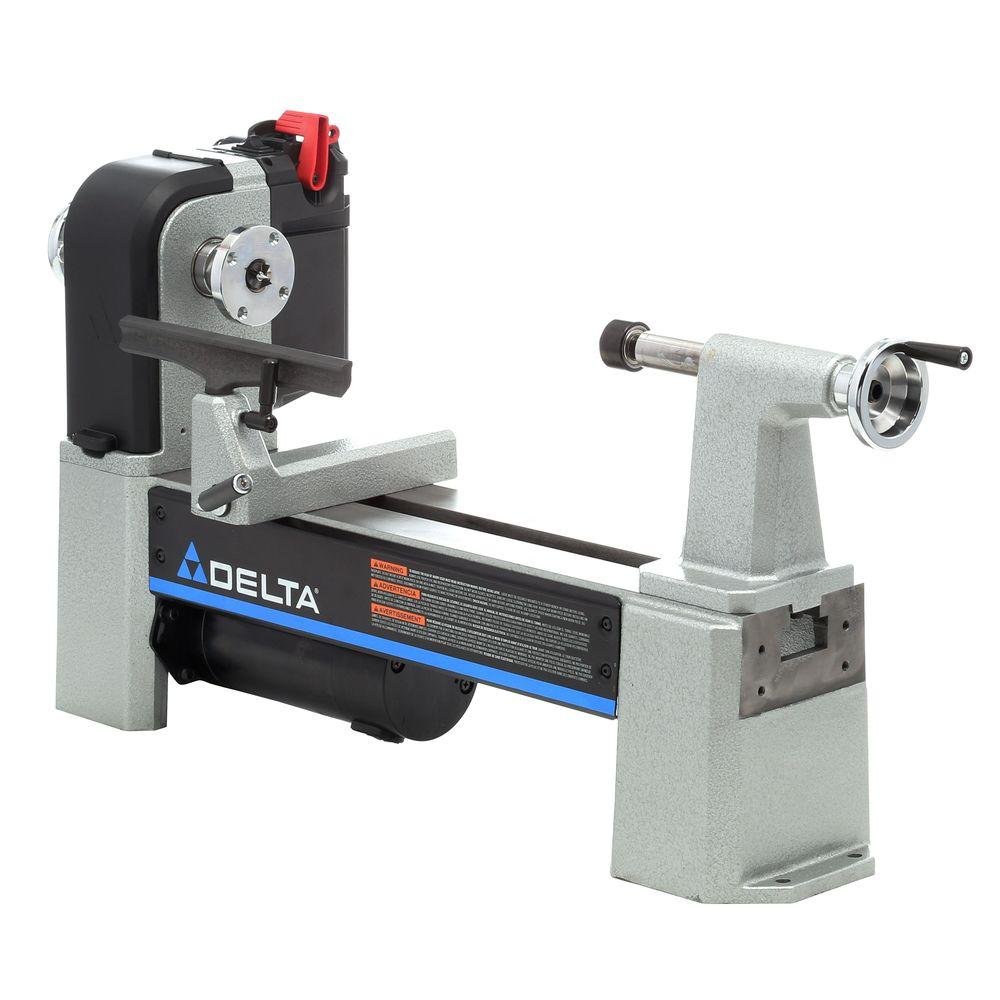
Full cast iron, a fast 4000 RPM top end, and belt tension that sets itself.
The speed range is the reason people graduate to this one. Three pulley ranges — 250–700, 600–1,800 and 1,350–4,000 RPM — let you hit the low end for a big rough blank and climb to a 4000 RPM ceiling for final passes on thin work. A patented belt tensioning system sets the belt at the correct tension every time you switch, which the maker ties to maximum power transfer and longer tool life, so you are not fiddling with a tensioner each change. All cast-iron construction, a 1 HP motor on 120V, and a 12-1/2-inch swing with 16-1/2 inches between centers (42 inches with the extension).
There is real craft in the details: a self-ejecting drive spindle with a 15/32-inch through hole, a 2-1/4-inch tailstock spindle travel, a heavy-duty steel knockout bar, and both a 6-inch and a 10-inch tool rest so short work and spindle work are each covered. A 5-year warranty backs it. Owners describe it as a mighty little machine that runs right from the start and does its job quietly and solidly, with the motor’s performance singled out repeatedly.
Two things to weigh before committing. Speed control, belt adjustment and durability each draw a mixed read — not a dealbreaker, but a nudge to set the belt correctly each time. And 16-1/2 inches between centers is shorter than the 18-inch machines above, so long spindle stock needs the bed extension.
The engineering edge: 4000 RPM top end plus a self-setting belt tensioner makes this the maddest-fastening midi lathe in the group, and the motor performance is what owners point to first.
Space to plan for: 16-1/2 inches between centers is the tightest here, so long stock means budgeting for the extension.
The right buy for: turners who want a fast-spinning, all-cast-iron midi with belt tension that handles itself.
Not for you when: regular long-spindle turning is on the schedule and 16-1/2 inches will not cover it.
8. JET JWL-1221VS Woodworking Lathe

It idles at 60 RPM so an out-of-round blank never lunges at your gouge.
Three belt ranges — 60–900, 110–1,800 and 220–3,600 RPM — cover every stage of a turn, and that 60 RPM floor is the standout figure. Start a badly out-of-round blank at walking pace, then climb to the top range for pens and small spindles. A digital readout shows your spindle speed so you always know where the dial sits. To move ranges you open the pulley doors, release the ratchet-style belt tensioner and shift the belt.
The build is the argument. Cast iron makes up the bed, tool support and tool support base, and the headstock and tailstock are cast iron and steel, on a 121-pound benchtop frame that soaks up vibration. The 1 HP DC motor runs on standard 115V household power at 6 amps, CSA certified to UL 987, with a removable safety key and no self-restart after a power outage. A forward/reverse switch you can flip while running speeds up sanding and finishing, and 24 indexing positions hold the spindle for fluting.
Capacity runs to 12-1/2 inches over the bed, 9.45 inches over the tool rest base, and 20-1/4 inches between spindle faces — 20-1/4 inches beats the 15-1/2 inches the JET JWL-1015VS offers, so longer spindles fit. The included kit is generous (6-inch and 10-inch tool supports, spur and live centers, 3-inch faceplate, knockout rod, two tool caddies), and the 5-year warranty applies. Expect to hear the word “heavy” about it more than once — the mass that steadies it also makes placement a two-person job.
What buyers respond to
- 60 RPM low end lets you true up lopsided blanks safely and slowly
- 1 HP DC motor with a digital spindle-speed readout
- Cast iron bed, tool support and base on a 121-pound steady frame
- Forward/reverse switch lets you sand and finish in both directions
- 20-1/4 inches between spindle faces fits longer spindles
Room for improvement
- At 121 pounds it is a two-person placement job
- Stability and durability draw mixed reports — mounting it solidly matters
- Requires opening the pulley doors to shift between belt ranges
Worth it for: turners who want 60 RPM control, 20-1/4 inches of spindle capacity and a densely cast frame at a bench.
Look past it if: a 121-pound machine is too much for your space or your back.
9. Powermatic 3520C Woodworking Lathe
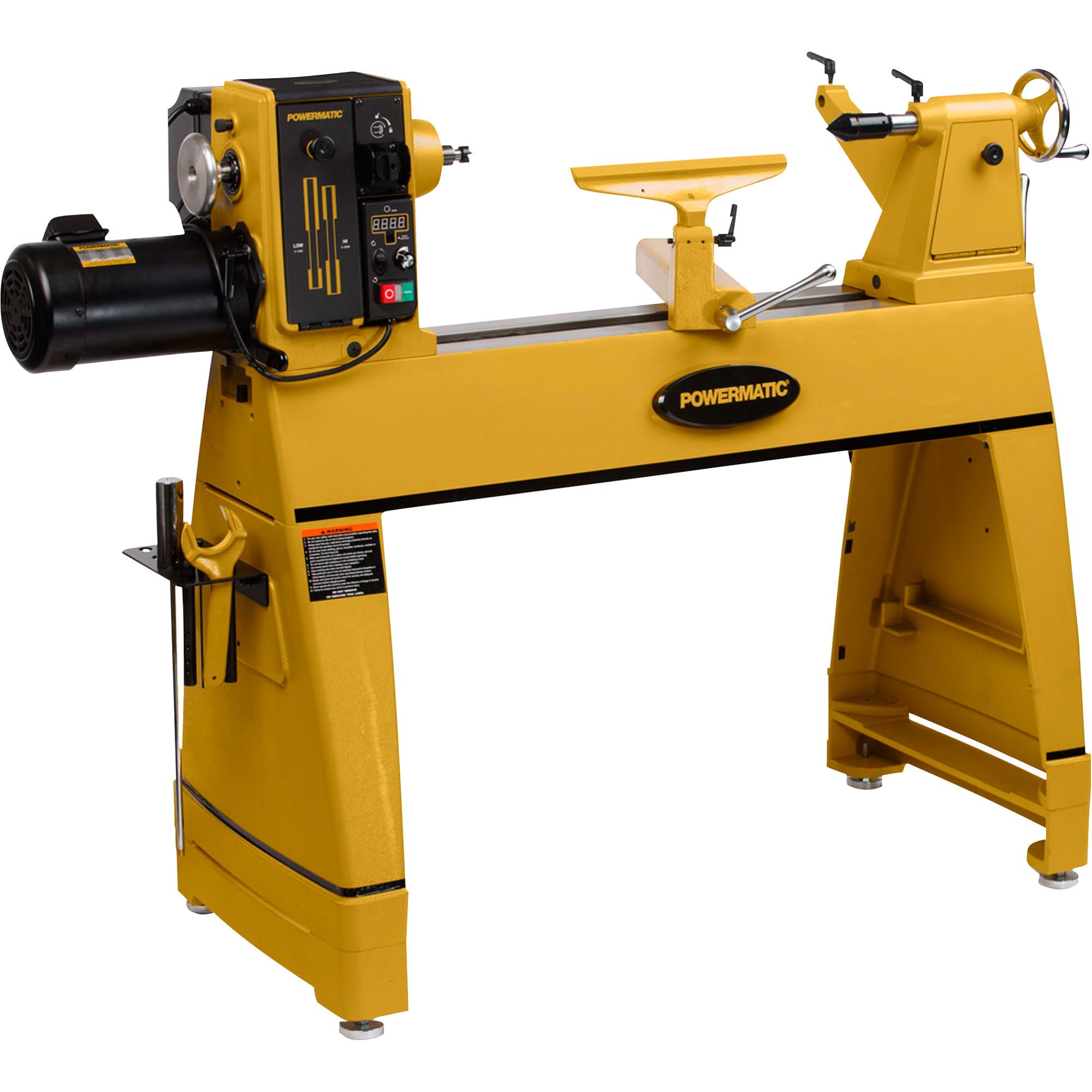
Twenty inches of swing and 2 hp of cast iron — a lathe for serious blanks.
This is the floor-standing tier, and the numbers say why. A 2 hp motor — double the 1 HP in the Delta and JET midis — drives a 20-inch swing and 35 inches between centers, so the bowls and spindle work that limit the bench lathes fit here with room to spare. Speed ranges from as low as 15 RPM up to 3,200 RPM, and the enclosed VFD (a variable-frequency drive, the controller that lets the motor hold a speed under load) is fully enclosed for added user protection.
The control layout suits a big turn. A magnetic-backed moveable control box lets you put the switches where you need them, a digital indexing readout simplifies indexing for precision, the upgraded banjo uses a non-marring pinch-style clamp for solid tool-rest placement, and an extended spindle nose gives you more access to the workpiece. Adjustable riser blocks add 4 inches of height so you can set it to a comfortable turning position. All cast-iron construction handles the loads a 20-inch blank throws at it.
The reality check is that all that mass — 726 pounds of it — is also the drawback. Placing and leveling a machine that heavy is a serious day’s work, and several buyers simply call it heavy. If you regularly rough large blanks or turn production quantities, that weight is what you are paying for; if your work lives under 12-inch bowls, the midi lathes are a far more sensible bench companion.
The scale of it: 2 hp, 20″ of swing and 35″ between centers put this in a different class from every bench lathe here, and it holds speeds down to 15 RPM for large blanks.
The weight reality: 726 pounds means you plan the install, not just the purchase — and it needs a 220V circuit at 20 amps.
Choose it if: you turn large bowl blanks or run production work and have the floor space and 220V power to feed a 2 hp machine.
Overkill if: your projects stay in pen-to-small-bowl territory — a midi lathe will serve you better.
Know the Specs
Swing over the bed
Swing is the largest diameter that clears the bed as it spins, so it sets your bowl and platter ceiling. A 10-inch swing keeps you in pen-and-small-bowl territory, 12-inch machines cover most home projects, and a 14- or 20-inch swing opens up large blanks — but only if the motor and the mass can handle what you mount. Match swing to the biggest project you realistically plan to turn.
Distance between centers
This is the longest spindle you can mount between headstock and tailstock. Short machines in the 15- to 16-inch range need a bed extension for long table legs or tool handles; 18- to 21-inch machines cover most home spindle work; a 35-inch machine is in floor-standing production class. If long spindles are on your list, check this number before anything else.
Variable speed versus belt steps
Belt-step machines make you stop and move the belt to a different pulley for each speed — reliable, simple, but fiddly mid-project. Variable-speed machines let you dial within a belt range while the lathe runs, and the widest ranges here run from 60 RPM up to 3,600 or even 4,000 RPM. For a beginner finding the right feel, the dial is worth the extra.
MT2 taper and spindle thread
Accessories seat through the headstock taper and thread onto the spindle. An MT2 taper (a standard Morse taper that chucks, spur centers and live centers slot into) and a 1″ x 8 TPI spindle thread are the common pairing, so tooling is easy to source. A lathe with an unusual thread means hunting adapters, so confirm the thread before you buy a chuck.
Common Questions
What size wood lathe machine do I need for bowls?
What is the difference between variable speed and five-speed wood lathes?
Will an MT2 chuck fit my wood lathe machine?
How much horsepower does a wood lathe machine really need?
Can I turn a large bowl on a 12-inch benchtop lathe?
Do I need to mount a wood lathe machine to a bench?
What does the RPM range mean for woodturning?
How long should a wood lathe machine last?
Can a wood lathe machine turn metal or plastic?
What comes included with a wood lathe machine?
The Bottom Line
For most home turners, the wood lathe machine winner is the JET JWL-1015VS because its electronic speed dial slides across 200–3600 RPM without stopping, and the full cast iron bed turns that control into clean cuts. If a wider 12-inch swing and 18 inches between centers matter more than a speed dial, reach for the WEN LA3424 — it beats the JET on swing and matches it on 18-inch spindle room at entry-level money. And when you want 1 hp of cutting authority with variable speed on a midi frame, the PSI KWL-1218VS is the one that steps up.
One last honest nudge: the JET earns its top spot on the strength of its speed control and build, and the size of its owner base tells you the design has been road-tested by a lot of benches before yours. Whichever you pick, bolt it to a solid bench and set the belt range before you mount a blank.
How we choose
We do not accept paid placement. Every pick is matched to a real buyer and a real use-case; we do not hands-on test units.
Sources
Specifications: manufacturer listings and product documentation. Review insights: verified customer reviews, as of November 2026. Pricing: not shown on this page (it changes often); check the current price via the retailer link.
As an Amazon Associate, Tactical Gear Guy earns from qualifying purchases. This does not affect which products we feature.