Specs are compiled from manufacturer listings and verified buyer reviews and can change over time — please confirm the key details on the product page before buying.
Your radiator, your graphics card, and your cable bundle all have to fit without a fight. Start with the Fractal Design North XL: it takes a 420 mm front radiator (the long cooling block that mounts at the front) and a 413 mm graphics card, and it ships with three 140 mm fans. It also looks like furniture rather than a server rack. Below are eleven full towers that earn the extra desk space, with the mid-range value picks first and the monster premium chassis after.
This guide is built by comparing the manufacturers’ published specifications and the patterns across verified customer reviews, so you get each pick’s real strengths and trade-offs instead of marketing spin.
Every pick here is a genuine full tower, so you can choose the right xl pc case without guessing at clearance.
Top Picks


How To Choose The Best XL PC Case
An extra-large chassis is a fixed commitment: you buy it once and live with the footprint, the weight, and the clearances for years. Get the radiator and graphics card numbers right first, and the rest of the decision gets simple. Get them wrong and you’re either returning a heavy box or shopping for a smaller cooler you didn’t want.
Radiator and graphics card clearance come first
Measure your graphics card and your AIO radiator before anything else. The Fractal Design Define 7 XL takes cards up to 530 mm, while the Antec Performance 1 FT tops out around 370 mm — a gap that rules out the longest flagship cards. Front radiator support runs from 420 mm on several picks up to three simultaneous 420 mm units on the Lian Li O11D EVO XL.
Fan counts and airflow design
Pre-installed fans save money and time, so count them. The Antec Flux Pro arrives with six PWM fans and supports up to 12 in total, while the be quiet! Light Base 900 DX ships with none but accepts up to 10. Mesh and open-grill front panels feed air more freely than solid doors, which matters most if you run a high-wattage graphics card.
Weight, footprint, and where it lives
A big chassis is heavy, and that changes how you build. The Fractal Design North XL weighs 5 kg, while the Antec Performance 1 FT comes in at 12.55 kg — one you can lift onto a desk alone, the other you plan around. Check desk depth too: the be quiet! Light Base 900 DX lists 25.98 inches of depth, which is a lot of desk real estate.
Storage bays and expansion room
If you’re building a media server or a workstation, drive capacity decides the pick. The Fractal Design Define 7 XL fits up to 18 HDDs alongside 5 SSD mounts, and the Antec Flux Pro includes 10 internal bays. A pure gaming build needs far less, so don’t pay for bays you won’t fill.
Side-by-Side Comparison
| Model | Best For | Case Type | Max Radiator Support | GPU Clearance | Amazon |
|---|---|---|---|---|---|
| Fractal Design North XL★ Best Overall | Wood-accented airflow builds | Full Tower | 420 mm front / 360 mm top | 413 mm | Amazon |
| Antec Performance 1 FTBest Display | Temperature-readout showcases | Full Tower | — | 370 mm | Amazon |
| Antec Flux ProTop Performer | Fan-heavy airflow setups | Full Tower | 420 mm + 360 mm together | — | Amazon |
| darkFlash DY470 | Angled-glass display builds | Full Tower | 2 x 360 mm | 410 mm | Amazon |
| be quiet! Light Base 900 DX | Inverted and horizontal layouts | Tower | 2 x 420 mm (plus 360 mm side) | — | Amazon |
| Fractal Design Define 7 XL | Massive storage builds | Full Tower | 480 mm | 530 mm | Amazon |
| Lian Li O11D EVO XL | Triple-radiator water loops | Full Tower | 3 x 420 mm | 460 mm | Amazon |
| ASUS ProArt PA602 | Quiet high-airflow workstations | Full Tower | 420 mm | 440 mm | Amazon |
| Cooler Master HAF 700 | Tool-less tinkering | Tower | 480 mm | — | Amazon |
| Corsair 9000D RGB Airflow | Fan-count extremes | Full Tower | 480 mm front and roof | — | Amazon |
| ASUS ROG Hyperion GR701 | Premium showcase builds | Full Tower | 2 x 420 mm | 460 mm | Amazon |
Detailed Reviews
1. Fractal Design North XL Chalk White Mesh
Our pick — 4.5+★ from 3,500+ verified ratings; the strongest balance of quality and price.
A full tower that fits big radiators and still looks like it belongs in a living room.
The wood-and-alloy front is the most-discussed feature here, with 236 buyers citing it — and it’s why a white chassis doesn’t have to look like a plastic gaming box. Underneath the styling sits real clearance: a 413 mm graphics card goes in straight, or 380 mm if you run a 420 mm front radiator at the same time. Three 140 mm Aspect PWM fans arrive pre-installed, so the build works on day one without a fan order.
At 5 kg, this is the one you can lift onto a desk on your own. Compare that to the Antec Performance 1 FT at 12.55 kg, and that gap is the whole reason this case gets picked for apartments and shared rooms. The top fits a 360 mm radiator, so a 360 mm AIO (an all-in-one liquid cooler with the pump and fans pre-fitted) mounts overhead while the front takes the 420 mm unit. It also holds 4.5+ stars across 3,000+ ratings, with owners calling assembly straightforward.
Buyers single out the cable management for praise, and the front I/O (the ports on the front panel) includes a real Type-C USB port. The honest limit is storage: this is an airflow case, not a drive vault, so a media server with a dozen hard disks needs the Define 7 XL instead. Want a big radiator, a flagship card and a clean look without a case that weighs as much as a small appliance? This is the balance.
What earns the top spot
- 420 mm front radiator plus a 413 mm graphics card, so big hardware fits together
- Three 140 mm Aspect PWM fans included — no extra fan spend on day one
- Just 5 kg, the lightest full tower here by a wide margin
- Type-C USB up front and cable routing that buyers describe as easy
Where it asks you to compromise
- Modest drive storage — not the pick for a multi-disk server
- Top radiator capped at 360 mm, so a 420 mm unit goes in the front only
Take this one: your build centers on one big front radiator, a long graphics card and a case you’d happily leave visible.
Think twice if: you need to stack six or more hard drives inside.
2. Antec Performance 1 FT Full Tower E-ATX
A glass box with a temperature readout built into the front panel.
Most full towers make you open software to see how hot things are running. This one puts the reading on the chassis itself — a temperature display paired with Antec’s iUnity software, which reports your PC specs at a glance. Dual 4 mm tempered glass panels wrap the side and back so the whole build stays visible, and two cable covers let you hide the ugly stretch of wiring behind the motherboard tray.
The number to watch is graphics card length: buyers describe it happily taking cards up to 370 mm, which covers most current models but not the very longest. Weighing 12.55 kg against the North XL’s 5 kg, it’s a case you set down and leave in place rather than shuffle around. Case quality dominates owner feedback, with 163 of the most-discussed comments landing on it, and the panels come off simply enough that building in it doesn’t turn into an afternoon project.
A Type-C 10Gbps port on the front handles fast external drives. Four internal bays cover a reasonable storage load without pretending to be a server chassis. If your build has a generous but not extreme graphics card and you like seeing temperatures without alt-tabbing, this is a clean mid-range answer.
The front-panel readout: seeing system temperature and specs without opening a monitoring app is a small thing that you end up using every day.
The clearance caveat: at 370 mm of graphics card room, the longest flagship cards are off the table — measure yours first.
Suits you when: you build a glass showcase and want status readouts on the case, not buried in software.
Pick something else if: your graphics card runs past 370 mm in length.
3. Antec Flux Pro Full-Tower E-ATX, 6 PWM Fans
Six fans from the start and room for twelve — airflow is the whole pitch.
Count the cooling before you compare this to anything else. Six PWM fans come pre-installed — three Tranquil 140 at the front, two P12R reverse fans on the power supply shroud, and one more in the rear — and the chassis supports up to 12 fans simultaneously. Then the radiator question resolves itself: it takes a 420 mm and a 360 mm unit at the same time. That’s the spec that separates it from the North XL above, where the top mount stops at 360 mm.
Ten internal bays is a real figure — compare the 4 in the Performance 1 FT and you can see which of the two was designed for storage on the side. The iShift PSU mount rotates the power supply 90 degrees, and the CPU/GPU dual temperature display gives you the same readout convenience Antec built into the Performance 1 FT, here with two sensors rather than one. Buyers describe it running quietly without loud fans, and airflow is a recurring point of praise.
The trade-off is weight and permanence. At 29 pounds this is not a case you move between rooms, and the walnut front panel commits you to a specific look. For a build that wants maximum cooling headroom with two radiators and a stack of drives, it’s genuinely hard to pass up.
The cooling math
- Six PWM fans included and support for up to 12 in total
- 420 mm and 360 mm radiators installed together
- Dual CPU/GPU temperature display on the chassis
- Ten internal bays for real storage capacity
The commitment
- 29 pounds — plan where it lives before you build
- Walnut front panel locks the build into one aesthetic
Reach for this if: cooling headroom and drive count both score high on your build sheet.
Look elsewhere if: you want something light enough to shift while you’re still tinkering with it.
4. darkFlash DY470 Full-Tower ATX, 4 PWM ARGB Fans

The glass tilts upward so your graphics card sits on display.
A top-angled glass panel is the defining feature, and it changes how you see the build — the hardware inside becomes the point, not the box around it. The dual-chamber layout pushes power supply and cabling into a rear section, which is why the front stays clear. Graphics cards up to 410 mm fit, and two 360 mm radiators will go in together. Four PWM ARGB fans arrive installed, though the RGB hub controller is sold separately.
Design is the most-discussed aspect here, with 39 pieces of feedback centered on it, and it holds up against bigger names in looks without the weight penalty. At 22 pounds it’s noticeably lighter than the Antec Flux Pro’s 29 pounds, so lifting it onto a desk is a one-person job. Back-plug motherboard support cleans up the visible side, and the snap-on panels make access quick.
Vertical GPU mounting is supported, which suits a display-first build. There’s a bottom dust filter and velcro straps for the cable runs. The caveat: you need to budget for a lighting controller separately if synchronized RGB matters to you. Otherwise this is the value pick for anyone who wants the glass to do the talking.
Why the glass wins: the angled top panel angles your components toward eye level, so a rack of ARGB fans actually reads well from where you sit.
The hidden add-on: the RGB hub controller isn’t included, so plan for it if you want the four ARGB fans synchronized.
Your case if: showing off the hardware matters as much as cooling it, and you want a lighter full tower.
Give it a miss if: you need an all-in-one lighting solution straight from the box.
5. be quiet! Light Base 900 DX Black

Flip it upside down or lay it flat — this case changes orientation in seconds.
Removable feet let you invert this chassis or set it horizontally without tools, which matters if your desk is on the left of the room and your build wants the glass facing a specific way. Window panels on both the front and side keep components visible in either orientation, and a large ARGB strip runs the visible edges — synchronizable with the motherboard through ARGB control.
Cooling support is the serious part. Two 420 mm radiators go in at once, plus a 360 mm on the side, using removable fan and radiator brackets in the lid and base. It ships without pre-installed fans and accepts up to 10, so you choose the airflow rather than inheriting it. Two ARGB and PWM hubs with 12 ports between them sit at the top and bottom for straightforward connections. Space is the aspect owners single out, and the extra-spacious interior takes an E-ATX board alongside a pair of big graphics cards.
The depth is the thing to check — 25.98 inches front to back is a lot of desk, and against the darkFlash DY470 at 18.66 inches it’s a substantially bigger footprint. If a standard layout has never quite fit your room, this is the one that adapts.
The orientation trick: inverted, horizontal or standard, all in seconds — the only case here that repositions without a rebuild.
The footprint warning: 25.98 inches deep is the largest here, so measure your desk before committing.
Fits you if: your room layout demands a case that can face a different direction or sit flat.
Not for you if: desk depth is tight — this is a deep chassis.
6. Fractal Design Define 7 XL Black Silent Modular
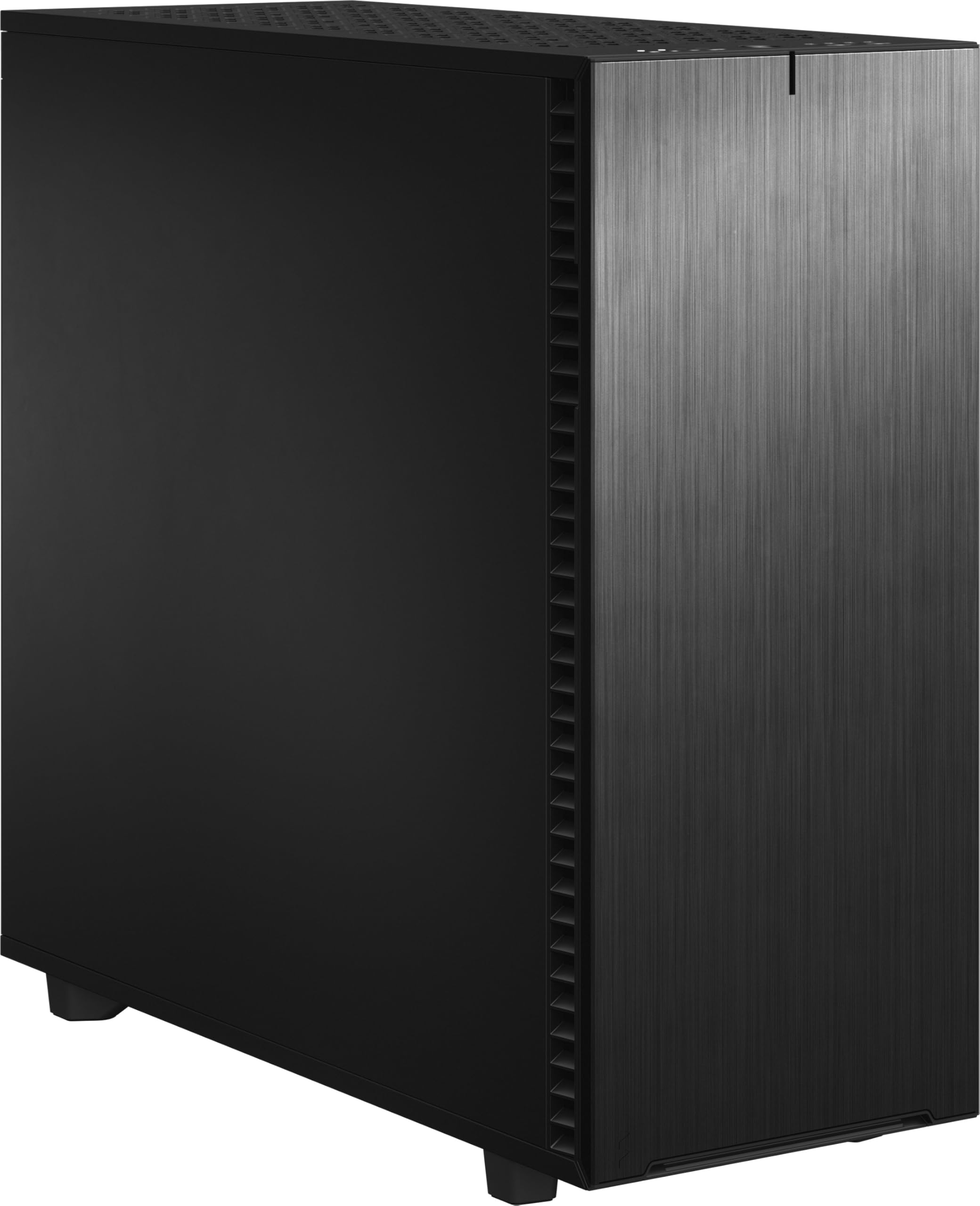
Eighteen hard drives and a 530 mm graphics card in one sound-damped box.
No other chassis here touches the storage figure: up to 18 HDDs alongside 5 SSD mounts in the default layout. That’s the reason a home server builder stops shopping.
Switch to the Open Layout and you get room for a custom water loop with reservoirs and radiators up to 480 mm. Multi-brackets convert any unused fan position into an HDD, SSD or pump mount, so the interior reshapes around what you actually need. Buyers describe it as built like a bank vault, and the brushed aluminum front door with reversible hinges and magnetic latching keeps the sound in. Design and storage capacity both feature heavily in what owners talk about.
Twelve-centimeter fans and a vented top keep things moving, and the tool-less design makes assembly quick. The counterweight is that this is a heavy, deliberate chassis aimed at data and silence rather than an RGB showcase. For a NAS-with-a-gaming-card hybrid build, nothing here matches it.
Why storage builds pick it
- Up to 18 HDDs plus 5 SSD mounts
- 530 mm graphics card clearance — the most generous here
- Radiators up to 480 mm in Open Layout
- Reversible magnetic front door keeps noise inside
What you trade away
- Heavy and bulky — this is floor furniture
- Silent-first design, not an ARGB display case
Built for you if: a dozen drives live inside your machine and you want quiet operation.
Wrong turn if: you’re building a glowing showpiece for the living room.
7. Lian Li O11D EVO XL Black E-ATX

Three 420 mm radiators in one chassis — the water-cooling build’s natural home.
Three 420 mm radiators at once is the figure that defines this case, and it’s a step beyond the dual-radiator setups on the be quiet! Light Base 900 DX and the Antec Flux Pro. Eleven fans are supported, graphics cards go up to 460 mm, and seven storage drives fit. Pull the front pillar out and the view through the glass goes completely unobstructed without weakening the structure.
The adjustable motherboard tray moves through three height levels, so different fan and radiator combinations line up properly rather than forcing one layout. A 14.5% larger top mesh opening and a 14% larger side mesh opening, plus a fully open bottom and three dust filters, feed the airflow. Case quality is the most-discussed point among buyers, and the flexibility for different fan and AIO sizes keeps coming up as the reason they chose it.
Storage capacity and removability show up as mixed points in owner feedback — worth knowing if you plan a dense drive array rather than a pure cooling build. Three dual-layer cable clips mount anywhere along the vertical grommets for routing. Weighing 19.37 kg, it’s a permanent fixture once built.
The radiator ceiling: three 420 mm units is the most radiator capacity on this list, which is what custom-loop builders need.
What to weigh up: storage loaders should check their drive count against the seven bays before committing.
Designed for: a triple-radiator loop where cooling capacity matters more than drive bays.
Not the one if: you plan to fill it with more drives than the seven bays hold.
8. ASUS ProArt PA602 E-ATX Full-Tower

Two oversized front fans push air quietly — the workstation builder’s pick.
A 15.5 mm front grill with 45% porosity feeds two extra-thick 200 x 38 mm front fans, while a 140 mm rear fan exhausts. That’s a lot of air moved with larger, slower-spinning fans, which is why the noise level holds up while you’re working. Two internal deflectors route the incoming air toward the motherboard and components, and a built-in fan hub handles management.
One 420 mm radiator fits for AIO or custom loops, and graphics cards up to 440 mm mount horizontally or vertically. Nine internal bays sit between the four-bay picks and the storage-focused Fractal, so it covers a workstation with several drives. Build quality is the most-discussed aspect among owners, and the velcro cable managers make the wiring side simple. The front panel IR dust indicator tells you when the filter needs cleaning rather than leaving you to guess.
There’s a power lock latch, two-section PWM control, and a USB Type-C 20Gbps port up front. At 35.5 pounds it’s one of the heavier picks here — you set it down and leave it. For a quiet, high-airflow workstation that doubles as a gaming machine, this is a considered choice.
What makes it a workstation case
- Two 200 x 38 mm front fans plus a 140 mm rear for airflow at low noise
- IR dust indicator tells you when to clean the filter
- USB Type-C 20Gbps on the front panel
- Graphics cards up to 440 mm, vertical or horizontal
The trade-off
- 35.5 pounds — heavy enough that once built, it stays put
- One 420 mm radiator only, unlike the dual-rad sets above
Best matched to: a workstation that runs long hours and needs to stay quiet while it does.
Not ideal if: you’re planning two large radiators in one loop.
9. Cooler Master HAF 700 E-ATX High Airflow

A mesh-front monster that takes 18 fans and 480 mm radiators.
The cooling ceiling is the point: from eighteen 120 mm fans to dual 360 mm or 480 mm radiators, this chassis has more fan positions than almost anything here. Two 200 mm Sickleflow ARGB fans come installed at the front behind a mesh panel, and ARGB Gen 2 lets each LED be controlled independently for a lighting scheme you set yourself.
The tool-less design is extensive, and that’s what buyers tend to notice — panels and brackets come apart with fewer screws than you’d expect. Appearance is the most-discussed positive aspect, with the black mesh front and multiple fan configurations drawing attention. Eight internal bays give it respectable storage for a gaming-first chassis.
Size and weight are the split points. It’s a genuinely huge case, and the honest note is that it takes up real space — one buyer found it too big to slide under their desk. At 19.6 kg it’s also heavy to move once built. Factor your room into the decision before choosing it. For a high-airflow build where fan count is the priority, it earns its keep.
Why airflow chasers pick it: eighteen 120 mm fan positions plus support for 480 mm radiators means you’ll never run out of mounting points.
The space reality: this is a very large chassis — measure under-desk height and floor space before ordering.
For you when: fan positions and radiator size decide your build and you have the room to house it.
Skip the idea if: your setup lives under a fixed-height desk.
10. Corsair 9000D RGB Airflow Super Full-Tower

The biggest fan count on the list, with a sliding rail as the answer.
Eighteen 120 mm fans, seven 140 mm or four 200 mm — those are the counts this super full tower will take, and the InfiniRail system is how it manages them. The aluminum rail slides in the front and roof so you can position 120 mm and 140 mm fans wherever you want rather than being stuck with fixed vertical slots. Radiators go up to 480 mm in front and roof, 360 mm in the side, and 240 mm at the rear for a custom loop.
An iCUE LINK System Hub comes included and controls the RGB front I/O, with room to manage up to 13 additional iCUE LINK devices — fans, coolers, or Hydro X Series parts. Design is what buyers discuss most, with the premium feel of the removable steel front panel standing out. The panel itself lifts off for cleaning, which keeps the intake clear over time.
Be realistic about the size and the wiring. This is a massive case by any measure, and cable management is a mixed experience depending on how you route. Mounting clips for the InfiniRail can run short for a full fan load, so plan the layout before you start. It’s a build-once chassis for someone chasing maximum fan real estate.
Where it leads the pack
- Up to 18 x 120 mm, 7 x 140 mm or 4 x 200 mm fans
- InfiniRail lets you slide 120 mm and 140 mm fans to any position
- iCUE LINK hub included and expandable to 13 more devices
- Removable steel front panel for easy filter cleaning
What to plan around
- Cable routing can get messy if you don’t route deliberately
- Mounting clips may run short for a maxed-out fan load
Best for: extreme fan counts and a full iCUE lighting ecosystem in one chassis.
Consider the alternative if: you want a straightforward build without planning fan clips and cable runs.
11. ASUS ROG Hyperion GR701 E-ATX Gaming Case

Carry handles rated for 80KG on a diecast aluminum frame.
The top bars double as carry handles rated to 80KG, backed by the diecast aluminum-alloy frame — so you can lift it by the frame instead of hugging it to your chest. The semi-open structure feeds up to two 420 mm radiators, and four 140 mm fans come installed with an ARGB fan hub to drive them.
Graphics cards go up to 460 mm, matching the Lian Li O11D EVO XL and clearing the ASUS ProArt PA602’s 440 mm. Two front panel Type-C ports support 60W fast charging, so phones and accessories top up from the case. A hinged tool-free side panel opens without screws, and a built-in storage drawer hides small parts. Seven internal bays cover a gaming build’s worth of drives.
Design is the most-discussed positive — the craftsmanship draws attention, and the tempered glass has a slight tint that darkens the interior look. Size runs both ways in owner feedback: spacious inside, but a big footprint in the room. If you want a premium showcase with handles and a solid frame, it’s the flagship pick here.
The frame story: an aluminum-alloy body with carry handles rated to 80KG turns moving a heavy build into a two-handlift job instead of a scramble.
What to accept: the tempered glass carries a slight tint, which dims the interior compared with clear panels.
Aimed at: a flagship showcase build where frame quality and front-panel fast charging count.
Second-guess it if: you want completely clear glass for maximum interior brightness.
Know the Specs
Radiator support in millimeters
Radiators come in fixed sizes, so the number that matters is the longest one your case accepts. The Fractal Design North XL front takes 420 mm, and the Define 7 XL takes up to 480 mm in Open Layout. If your radiator is bigger than the case’s limit, no amount of cable rerouting fixes it. Check the front and top mounts separately, because the top is often smaller than the front.
Graphics card clearance
Graphics cards have grown long, and the case sets a hard ceiling. Clearance runs from 370 mm on the Antec Performance 1 FT all the way to 530 mm on the Fractal Design Define 7 XL. If you run a front radiator, subtract its thickness from the published figure — that’s why the North XL lists 413 mm clear or 380 mm with a 420 mm radiator installed. Always measure the card itself before buying.
Fan counts and mounting systems
Pre-installed fans save money; mounting flexibility saves frustration later. Six fans come with the Antec Flux Pro, while the be quiet! Light Base 900 DX ships with none and accepts up to 10 — a deliberate choice for builders who want their own fan set. Sliding systems like Corsair’s InfiniRail let you move 120 mm and 140 mm fans to any position, rather than being locked to fixed slots.
Weight and footprint
Full towers are heavy, and that shapes where the case can live. Weights here run from 5 kg on the North XL to 19.6 kg on the Cooler Master HAF 700. Even if the footprint fits, a chassis this heavy is a two-person lift and a permanent spot. Check the depth figure against your desk or floor space too — depth ranges from 18.66 inches to 27.48 inches across these picks.
Storage bays
Bay counts separate gaming cases from server cases. The Fractal Design Define 7 XL reaches 18 HDDs plus 5 SSD mounts, while the Antec Performance 1 FT and darkFlash DY470 hold 4 internal bays each. Plan your drive count first; a pure gaming build with one or two drives doesn’t need to pay for a dozen trays, but a NAS or media server lives or dies on this figure.
Front I/O and connectivity
Front ports are what you reach for daily, and the standard has moved to USB Type-C. The Antec Performance 1 FT carries a Type-C 10Gbps port, the ASUS ProArt PA602 and ROG Hyperion push 20Gbps, and the ROG Hyperion adds two Type-C ports with 60W fast charge support. Higher speeds and wattage mean faster external drives and quicker phone charging from the case itself.
Common Questions
Will a 420 mm radiator fit in an XL PC case?
What graphics card length can a full tower hold?
Is a full tower too big to fit under a desk?
Do XL PC cases come with fans included?
Can an XL PC case hold a custom water cooling loop?
What does an E-ATX motherboard need from an XL case?
How many hard drives can an XL PC case hold?
Is a heavier full tower better built?
Can I mount a graphics card vertically in an XL case?
Do XL PC cases run quieter than mid towers?
What front panel ports should an XL case have?
The Bottom Line
For most builders, the winner is the Fractal Design North XL. It fits a 413 mm graphics card and a 420 mm front radiator in a body that weighs just 5 kg, and it still ships with three 140 mm Aspect PWM fans (pulse-width modulation fans whose speed the motherboard can control). If two large radiators and a stack of drives matter more than weight, the Antec Flux Pro gives you six included fans, ten internal bays, and a 420 mm plus 360 mm radiator combination. For a server-grade build with up to 18 HDDs and a 530 mm graphics card, reach for the Fractal Design Define 7 XL.
The North XL is the crowd favorite too: 4.5+ stars across 3,000+ ratings. The thing buyers discuss most is how that wood front panel looks on a desk.
How we choose
We do not accept paid placement. Every pick is matched to a real buyer and a real use-case; we do not hands-on test units.
Sources
Specifications: manufacturer listings and product documentation. Review insights: verified customer reviews, as of November 2026. Pricing: not shown on this page (it changes often); check the current price via the retailer link.
As an Amazon Associate, Tactical Gear Guy earns from qualifying purchases. This does not affect which products we feature.