Specs are compiled from manufacturer listings and verified buyer reviews and can change over time — please confirm the key details on the product page before buying.
Start with cuff fit: a wrist cuff that sits loose or rides up produces readings that look normal but are not. A wrist cuff that slips down your arm or pinches too tight distorts the squeeze and skews the result. This guide sorts nine wrist monitors by fit range, memory, and how easy each one is to live with daily.
This guide is built by comparing the manufacturers’ published specifications and the patterns across verified customer reviews, so you get each pick’s real strengths and trade-offs instead of marketing spin.
You will see which wristbands fit which wrist sizes, how many readings each one stores, and where the app side tends to fall down. Every pick here is judged on whether it earns a place on your bathroom shelf for the long haul, and the right wristband to monitor blood pressure starts with a cuff that fits you.
Top Picks


How To Choose The Best Wristband to Monitor Blood Pressure
The single biggest mistake buyers make in this category is picking a brand first and checking the cuff size last. A wrist cuff is a fixed loop with a stated range, and if your wrist sits outside that range the monitor cannot squeeze evenly. An uneven squeeze pushes the reading high or low with no way to tell which direction it went.
Measure your wrist before you read a single spec sheet
Wrap a soft tape measure around your wrist just below the bone, then check that number against the cuff range printed for each model. Ranges in this category run from as tight as 5.5 inches at the bottom to as wide as 10 inches at the top, so a large wrist can rule out several popular units outright. Write your number down and shop only inside it.
Decide early if you need two users or one
A dual-user memory splits the stored readings into two separate banks, which matters if a partner or family member will also be checking. Memory counts vary widely here, from 60 readings for 2 users up to 199 readings per user. If you track only yourself, a second user bank just sits empty.
Treat app syncing as a bonus, not a requirement
Bluetooth is the most consistently disappointing feature in this category. Across several models, buyers report pairing failures and readings that never reach the phone. If you want an app, buy a monitor that also shows your history clearly on the device screen so a failed sync never costs you your numbers.
Side-by-Side Comparison
| Model | Best For | Cuff Range | Stored Readings | Power | Amazon |
|---|---|---|---|---|---|
| HealthSmart Digital Standard Wrist★ Best Overall | Wide wrists and audible readings | 11.75″–16.5″ | 60 for 2 users | 4 AA (not included) | Amazon |
| HoMedics 700 Series Wrist CuffApp On A Budget | App tracking on a budget | — | 120 for 2 users | 2 AAA (included) | Amazon |
| Smartheart Adult Cuff WristTravel Kit | Travel with a storage case | 5.5″–7.6″ | 60 per user | Included | Amazon |
| iHealth Pulse Bluetooth Wrist | Long reading history | 5.5″–7.7″ | 199 per user | 2 AAA (included) | Amazon |
| Beurer BC57 Bluetooth Wrist | Colour-coded risk display | 5.3″–7.7″ | 60 for 2 users | 2 AAA (included) | Amazon |
| A&D Medical UB-525 Wrist | Larger wrists on a premium build | 5.3″–8.5″ | 60 readings | 2 AAA (included) | Amazon |
| Backlit Wrist Monitor with Carry Case | Dim rooms and weak eyesight | 5″–10″ | 198 for 2 users | 2 AAA (not included) | Amazon |
| DR. VALERE Voice Broadcast Wrist | Spoken results and fast checks | — | 240 for 2 users | 2 AAA (included) | Amazon |
| OMRON Gold Wireless Wrist | App history and morning averages | 5.3″–8.5″ | 200 per user | 2 AAA (included) | Amazon |
Detailed Reviews
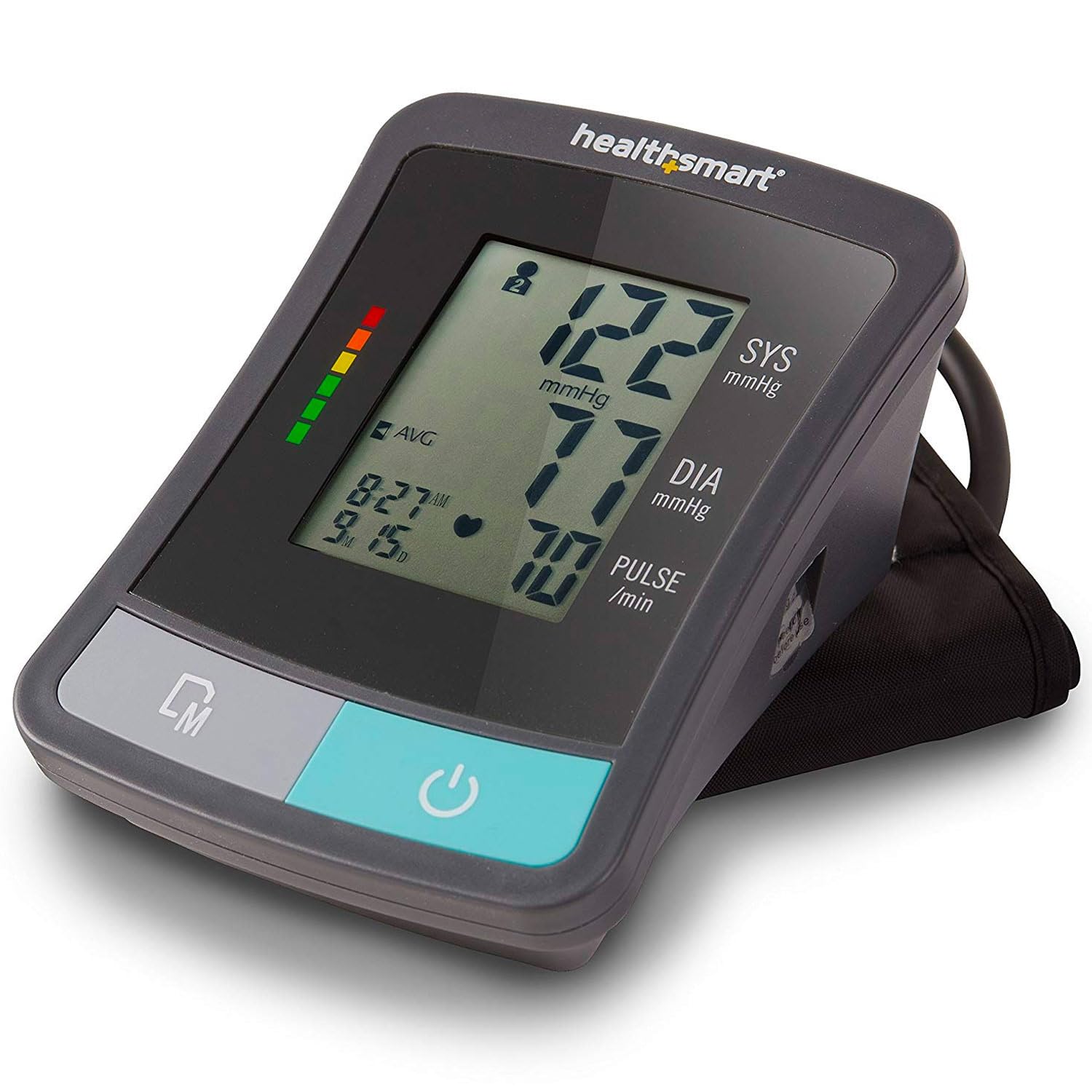
1. HealthSmart Digital Standard Wrist Blood Pressure Monitor
Our pick — 4.5+★ from 100+ verified ratings; the strongest balance of quality and price.
A wrist monitor that speaks your numbers out loud and takes a cuff most wrists cannot outgrow.
What makes this one worth starting with is the cuff. It measures 11.75 inches to 16.5 inches around, a range that swallows wrists the compact monitors above simply cannot close around. If you have ever squeezed a loaner cuff over a broad forearm and watched it slip, that number is the whole argument. The trade-off is bulk: at 13.4 ounces it is a different animal from the pocket-sized units further down this list.
The other reason to look here is that this monitor talks. It speaks your systolic and diastolic numbers aloud, which means you never have to stand in bad bathroom light squinting at a small panel. On top of that, the display stores up to 60 readings split across 2 users, each stamped with the date and time. An irregular heartbeat detector flags uneven rhythm during the reading, and a pulse rate readout sits alongside the pressure numbers. It runs on 4 AA batteries, which you supply yourself.
This is the crowd favourite of the group — 4.5+ stars across 110+ ratings — and the contentment is mostly about simplicity and that generous cuff. The honest catch is the battery habit: 4 AA cells are more to keep on hand than the 2 AAA most rivals ask for, so buy a pack up front. The other thing to know is that a monitor this size wants a permanent spot on a shelf rather than a corner of a travel bag.
Where it pulls ahead
- Takes wrists from 11.75″ to 16.5″ — genuinely wide coverage for larger arms
- Speaks the reading aloud so you are not chasing a small display
- Keeps 60 readings across 2 users with date and time stamps
- Flags an irregular heartbeat and shows pulse rate next to your numbers
What to plan around
- 13.4 ounces makes it the heaviest unit here — not a travel-first design
- Needs 4 AA batteries that arrive separately
- The spoken voice suits home use more than a shared office
Worth grabbing when: your wrist is on the larger side, or someone in the house needs to hear the number rather than read it.
Think twice if: you want something you can drop into a jacket pocket — the 13.4-ounce body and 5.3 x 3.9 x 1-inch frame want a drawer.
2. Homedics 700 Series Wrist Cuff Blood Pressure Monitor
The coach on the screen that tells you your cuff is wrapped wrong before the reading goes bad.
Most bad wrist readings trace back to a sloppy wrap, and this monitor is built to catch that. An on-screen cuff fitness icon tells you outright whether the cuff is too loose, too tight, or sitting correctly. That icon catches a bad wrap before it costs you a measurement. The Smart Measure inflation then adjusts the squeeze automatically for what the device reads off your arm.
Memory runs to 120 readings for 2 users, and the display averages your last 3 readings so one odd result does not send you spiralling. There is also a risk category index that places your result against the AHA 2017 blood pressure levels, plus irregular heartbeat detection. The Bluetooth link feeds the HoMedics Health+ app for history and reminders, and it ships with 2 AAA batteries included.
The blunt part: the Bluetooth is the weak link. Plenty of buyers struggle to get the phone and monitor talking, and the interface itself draws notes about feeling clunky. Buy this for the cuff-fit guidance and the on-device memory, and treat the app as a bonus that may or may not behave. At 6.74 ounces it still travels comfortably.
Best part of the design: that cuff fitness icon is a real teaching tool — it trains you to wrap properly instead of guessing, which lifts the quality of every reading you take afterwards.
The honest trade: syncing is inconsistent enough that you should not plan your record-keeping around the app. The 120-reading memory on the device is your reliable backup.
Reach for it if: you are new to wrist monitors and want the device to correct your technique as you go.
Look past it if: an app dashboard is the main reason you are buying — the pairing here frustrates more than it helps.
3. Smartheart Adult Cuff Wrist Digital Blood Pressure Monitor
A complete boxed kit that takes the reading while the cuff is still inflating, so your arm spends less time squeezed.
Advanced inflation technology is the headline trick here. This monitor reads your pressure during inflation rather than after, which shortens the time your arm sits under pressure. For anyone who finds the squeeze the worst part of checking, that is a meaningful difference. It runs on one button, inflates and deflates by itself, and lights the display so you can read it in a dim room.
The package is genuinely complete: monitor with the cuff attached, a storage case, batteries, English and Spanish instructions, a quick start guide, a results charting log, and a 3-year limited warranty. Memory holds 60 measurements for each of 2 people, with date and time stamps and a last-reading average. A Hypertension Indicator checks your result against World Health Organization standards, and an irregular heartbeat icon appears when rhythm looks uneven.
Know the boundary before you order. The cuff fits adult wrists from 5.5 inches to 7.6 inches, and the maker says plainly that outside that range you should move to an arm-style monitor. Meanwhile the mixed signals on quality and accuracy across owner feedback mean this is the pick for someone who wants a full kit and a long warranty, not the one chasing the best odds on every reading. At 4 ounces it is genuinely light in a bag.
What the box gives you: case, batteries, charting log and a 3-year limited warranty — the most complete starter kit in this group, with nothing else to buy on day one.
Go here if: you travel often and want the case, the log and the warranty bundled in one purchase.
Check first: your wrist tape reads between 5.5″ and 7.6″ — outside that window this cuff is the wrong tool and an arm monitor is the honest answer.
4. iHealth Pulse Bluetooth Wrist Blood Pressure Monitor
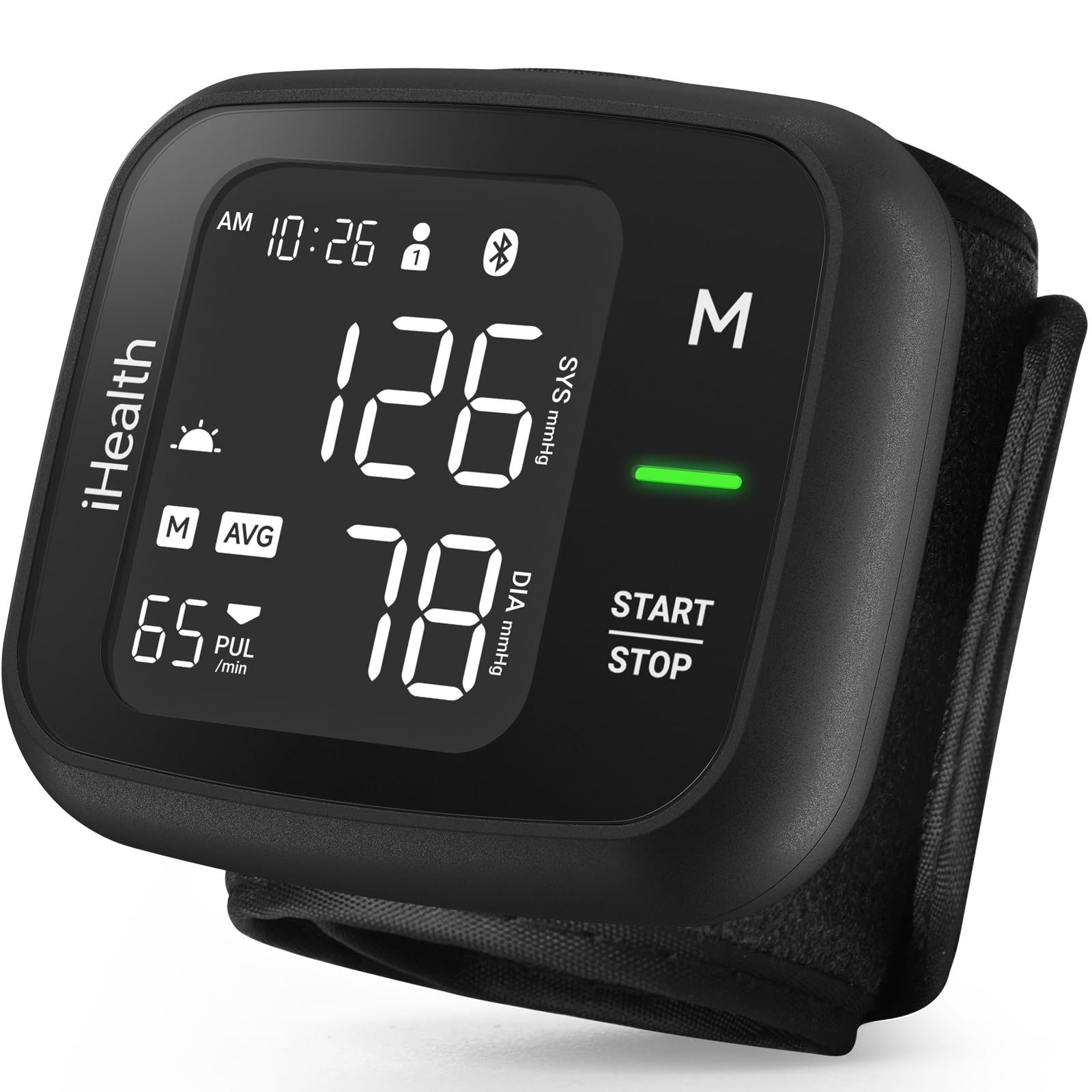
Months of history held on the device itself, so you can scroll back without ever opening an app.
Storage is the reason this one stands out. It holds 199 readings for each of 2 users — more than three times what the HealthSmart above keeps, and enough to carry months of twice-daily checks. Just as important, you can review that history right on the monitor, so a failed app sync never wipes your record. A colour-coded blood pressure indicator sorts each result at a glance, and a recent three-reading average plus a morning average make day-to-day comparison simple.
The MyVitals app adds trend tracking and sharing with Apple Health or Google Fit when it cooperates, and it ships with 2 AAA batteries, a carrying case, a manual and a 12-month limited warranty. The cuff fits 5.5 inches to 7.7 inches, so this is a compact-wrist design. A one-button automatic inflation takes systolic, diastolic and pulse in a single pass.
Here is the candid read. Quality and value are what buyers praise most, and the deep memory genuinely earns its place. But reliability and accuracy come back mixed, and the connectivity is the sore point — pairing failures show up often, and a few find the fit poorly sized. Owners mention, in the review pages’ own words, that it “doesn’t connect to the app” in some cases. Use the on-device memory as your real record and the app as a convenience.
Why it earns a slot
- 199 readings per user for 2 users — the deepest on-device history here
- Full history readable on the monitor with no app required
- Morning average and 3-reading average built in
- Cuff covers 5.5″ to 7.7″ with a soft-feel wrap
What you should know
- App pairing is unreliable for a fair share of buyers
- Accuracy and reliability draw mixed feedback
- Compact cuff means larger wrists need a different pick
Suits you when: you want a long paper-trail of readings on the device before you ever trust a phone.
Steer clear if: you have a wrist above 7.7 inches — the cuff simply will not close correctly.
5. Beurer BC57 Bluetooth Wrist Blood Pressure Monitor

A monitor that waits for you to settle before it lets you take the reading.
This one is built around a single idea: a calm body gives a cleaner number. A resting indicator lights up when you are in a suitably rested position, and you hold off until it appears. Most wrist monitors leave that rest check entirely up to you. Pair it with the maker’s guidance to measure with your wrist at heart level and to wait at least 5 minutes between repeat readings, and you are set up properly instead of guessing.
The large screen uses a colour-coded risk indicator so you can read the result at a glance, and a plastic storage case is included. Memory holds 60 readings for 2 users — 120 spaces in total — and the HealthCoach app takes the sync over Bluetooth. An irregular heartbeat alarm sounds when rhythm looks off, and heart rate is measured in the same pass. The cuff adjusts from 5.3 inches to 7.7 inches, and it ships with 2 AAA batteries.
Set your expectations on two fronts. Accuracy is the most discussed topic in owner feedback and it splits both ways, so this is not the pick for someone who wants uniform agreement on every reading. Bluetooth pairing is the second recurring theme, and app-related value draws its share of grumbles. What you are buying is the resting guidance, the clear colour scale and a genuinely compact body — 3.39 ounces, in a 2.9 x 2.3 x 0.9-inch shell that vanishes into a bag. That makes it far smaller than the 5.3 x 3.9 x 1-inch HealthSmart above.
Smartest detail: the resting indicator turns good technique into something the device enforces rather than something you have to remember.
Fair warning: readings and app syncing both draw divided feedback, so buy it for the guided routine and the compact size, not for flawless phone integration.
Made for you if: you want a wrist monitor that nudges you into the right posture every single time.
Pick something else if: your wrist runs past 7.7 inches, or you are counting on smooth Bluetooth from day one.
6. A&D Medical UB-525 Wrist Blood Pressure Monitor
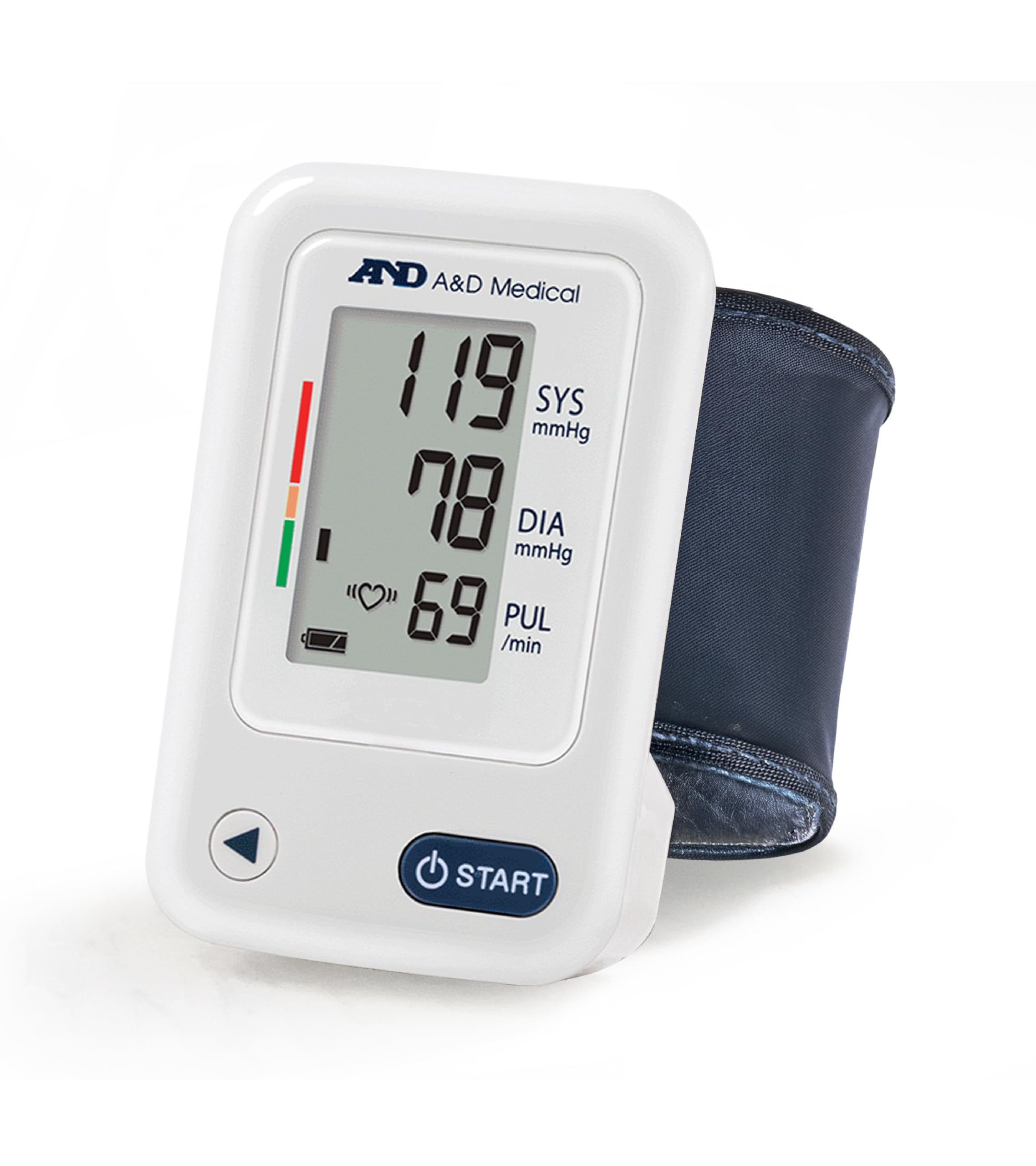
The cuff that reaches 8.5 inches, wrapped in a body light enough to forget you packed it.
Most compact wrist monitors stop at 7.7 inches, and that ceiling shuts out a lot of forearms. This cuff runs from 5.3 inches to 8.5 inches, so a heavier build still gets an even squeeze. The maker calls out gentle inflation as part of the design, which matters when you are taking a reading every morning. It weighs 3.2 ounces and measures 3.66 x 0.78 x 2.44 inches, so it slips into a bag without a second thought.
Operation is a single button, and the large digital LCD shows oversized numbers for systolic, diastolic and pulse rate. Memory holds up to 60 readings you can recall and compare over time. The A&D Heart Track App is where unlimited logging lives, and it needs iOS 12.0 or later or Android 5.0 and above. In the box you get the monitor, a manual, a quick start guide and 2 AAA batteries.
Quality is the thing that wins people over here, and it is the most-praised trait in this monitor’s feedback. Accuracy and reliability, on the other hand, split both directions — some find their readings track well and some do not. The practical answer is to compare against a known figure at a clinic once, then trust your own trend. A&D sells this as a premium build, and it feels like one in the hand.
what separates it
- Widest cuff range in this group at 5.3″ to 8.5″
- Only 3.2 ounces — easy to carry for travel checks
- Oversized LCD numbers for quick reading
- One-button operation with gentle inflation
Where it asks patience
- App logging is manual rather than automatic
- Accuracy feedback runs mixed across owners
- 60-reading memory is modest next to the deep-storage picks
Best matched to: a wrist between 7.7 and 8.5 inches that other compact cuffs cannot handle.
Not the one for: anyone who wants app readings to file themselves away without tapping anything.
7. Backlit Wrist Blood Pressure Monitor with Carrying Case
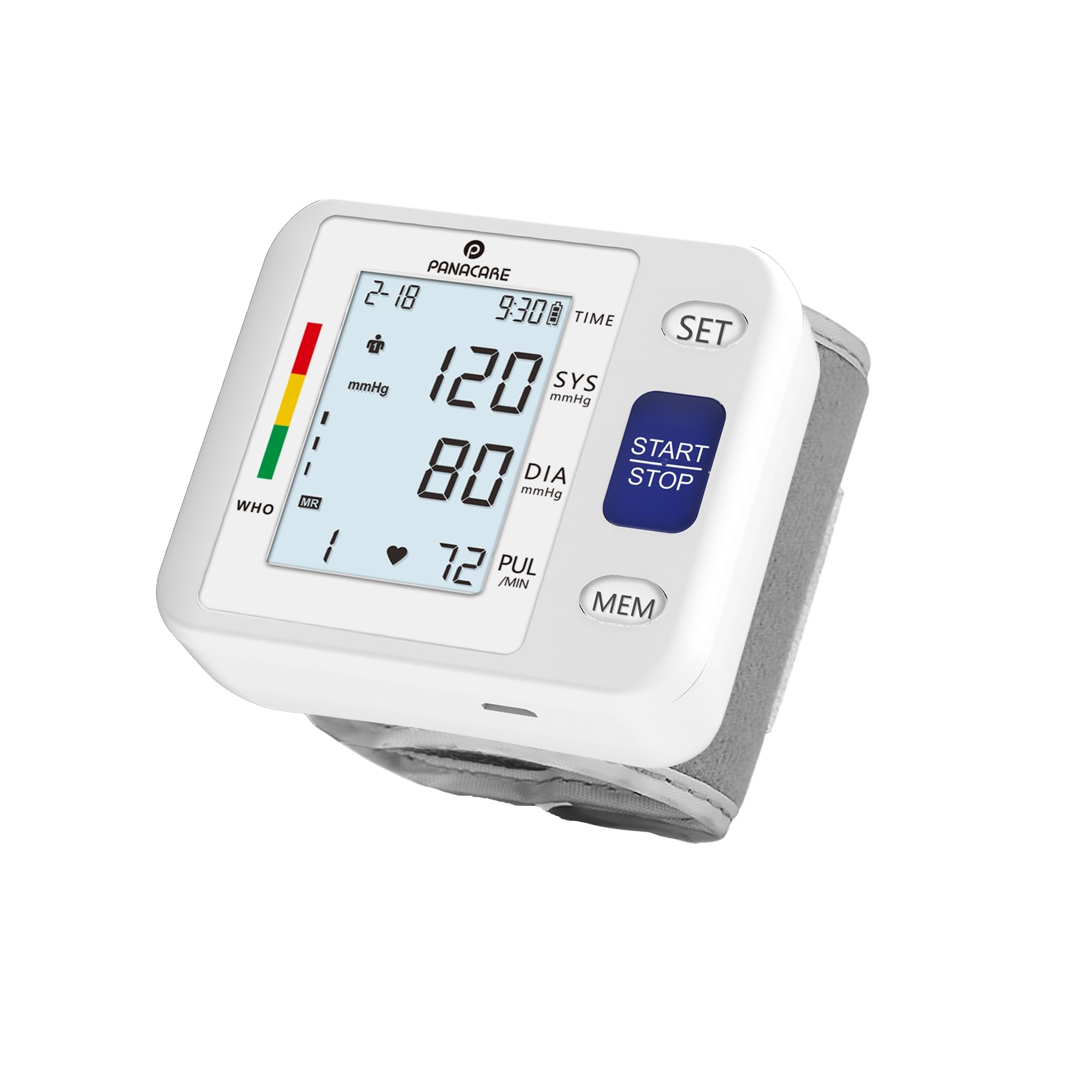
A screen built for 3 a.m. checks and a cuff that opens up to 10 inches.
Readability drives this design. The backlit LCD lights up in green, yellow or red to sort your result instantly, and it stays legible in a dark bedroom or with less-than-sharp eyesight. Readings arrive in about 30 seconds using improved signal processing, and the monitor takes both blood pressure and heart rate in that window. One touch on the start button handles inflation and deflation, so there is no pumping a bulb or rolling up a sleeve.
The cuff ranges from 5 inches to 10 inches, the widest adjustable span here, and the soft breathable material is meant to stay comfortable for daily tracking. Memory holds 198 readings for 2 users and a carrying case comes in the box. An auto power-off protects battery life and a low-battery indicator warns you before a check fails. It takes 2 AAA batteries, which are not included.
What to weigh honestly: the app is not part of this package at all, so all your history lives on the device. That is a plus if you dislike Bluetooth fuss and a limitation if you want to email charts to a clinic. The wide 5-to-10-inch cuff does mean the fit is looser at the small end, so take care to seat it snugly on a narrow wrist. For a bright, easy-to-read screen at this tier, it is a strong match.
Why the display matters: The backlight lets you read your numbers in a dark bedroom without glasses, and the green-yellow-red scale sorts the result for you.
Choose this one if: you check your pressure at night, or you want the widest cuff range without paying a premium for it.
Pass if: phone syncing is non-negotiable — there is no Bluetooth here at all.
8. DR. VALERE Wrist Blood Pressure Monitor with Voice Broadcast

Spoken results and a 25-second reading, in a body light enough to live in a coat pocket.
Speed and sound are the two reasons to look at this one. The reading lands in about 25 seconds, which is quicker than the roughly 30-second cycle of the backlit model above. Results come through a high-contrast LED screen and a voice broadcast, so you can hear your numbers even when the display is hard to see. That pairing works well for anyone whose eyesight makes small fonts a chore.
Memory reaches 240 readings through dual-user tracking, giving each person 120 historical records to scroll through. An irregular heartbeat detector is built in for home use, and the skin-friendly design keeps the cuff comfortable during checks. At 3.6 ounces and 3.15 x 2.56 x 1.18 inches, it is one of the easier units here to drop into a bag. It runs on 2 AAA batteries, included.
Accuracy is where this one has made its name — owners describe readings lining up closely with a separate upper-arm device, though the unit is new enough that the track record is still short. Read that as encouraging rather than conclusive, and confirm against a clinic reading at least once. If you want a quick spoken check with no app to fight, this fits neatly. It is the pick for someone who values speed and simplicity over connected features.
The standout pairing: a 25-second cycle plus spoken results means you can take a reading and know your numbers without ever reading a screen.
The honest caveat: this is a newly listed model with a short feedback history, so treat early praise as promising rather than proven.
Reach for it when: you want a fast, spoken check and dislike fiddling with a smartphone app.
Consider the OMRON instead if: you want a long, deep track record behind your purchase.
9. OMRON Gold Wireless Wrist Blood Pressure Monitor
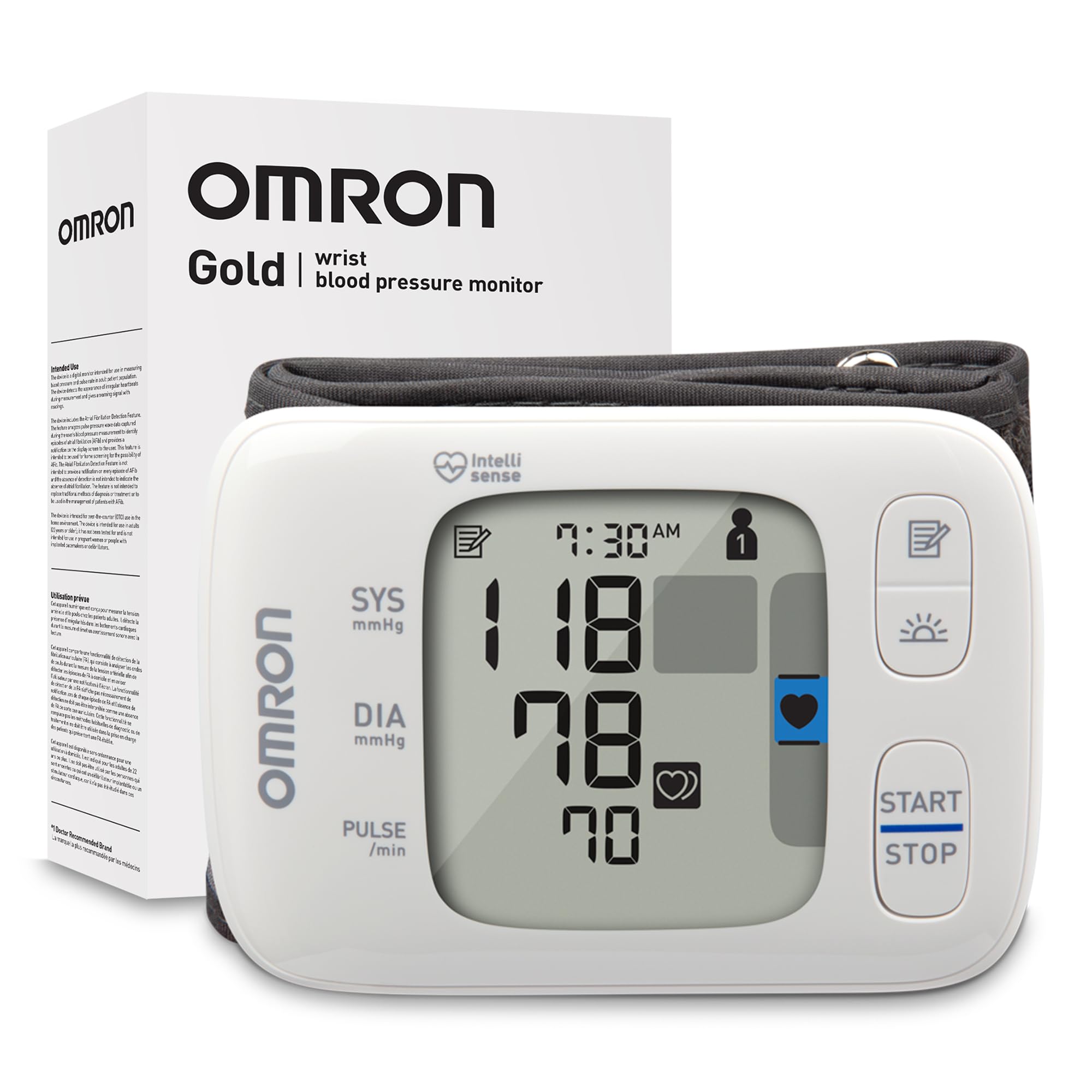
The one that watches your morning numbers, when pressure tends to shift.
Morning pressure spikes are a known pattern worth watching, and this device tracks that average for you instead of leaving it to your memory. Dual-user support stores up to 200 readings for you and a partner, so two people can share the unit without mixing their history. The OMRON connect app takes unlimited readings over Bluetooth and shares reports with a doctor, and it works with Apple Health and Google Fit.
Setup is complete in the box: the monitor with its attached wrist cuff, a storage case, instruction manual, quick start guide and 2 AAA batteries. The cuff fits wrists from 5.3 inches to 8.5 inches. An Irregular Heart Beat Indicator flags uneven rhythm during routine readings. It weighs 3.17 ounces and measures 3.58 x 0.52 x 2.49 inches, making it the slimmest body in this lineup at just 0.52 inches thick.
You deserve the plain version. This unit has the most reviews here, with 13,000+ owners, and that huge pile of feedback is exactly why it lands last instead of first. Many customers note it is easy to use and reliable, but a clear group say readings miss the mark or throw errors on repeat. That split is real. Buy it for the morning average, the 200-per-user memory (it stores 200 past readings for each person) and the connected app. Check its readings against a clinic figure early on, so you know where you stand.
The case for the OMRON
- High Morning Average Indicator tracks morning spikes automatically
- 200 readings each for 2 users with unlimited app storage
- Slimmest body here at 0.52 inches thick, 3.17 ounces
- Shares reports with a doctor via Apple Health and Google Fit
The case against rushing in
- Accuracy and reliability feedback splits both ways
- Repeat errors are a reported pattern for some units
- App features assume a stable Bluetooth connection
Fits the buyer who: wants morning-average tracking and the ability to hand reports to a doctor.
Check the fit first: a wrist inside 5.3″ to 8.5″ is required, and pairing with a clinic reading early is the smart move.
Know the Specs
Cuff Range (Wrist Circumference)
This is the number that decides whether a monitor works for you at all. The cuff is a fixed loop, and its stated range — say 5.3 to 8.5 inches — tells you the smallest and largest wrist it will close evenly around. A cuff that gaps on a small wrist or pinches on a large one distorts the squeeze, and a distorted squeeze means a reading you cannot rely on. Measure your wrist with a soft tape below the wrist bone before you shop, then rule out every model whose range does not contain your number. Note that the ranges are not all created equal: the largest here reaches 10 inches, while the smallest caps at 7.6 inches.
On-Device Memory (Readings Stored)
The memory counts how many past measurements the monitor holds so you can compare trends over time. A single-user figure like 60 readings means the device keeps 60 before it overwrites the oldest; a dual-user figure like 199 per user means each of two people keeps their own separate bank. More memory matters if you want to hand a doctor a longer history, but the far more important question is whether you can read that history on the screen. A monitor that displays its stored readings lets a failed app sync cost you nothing. Also check the battery type and count — models here run on 2 AAA or 4 AA, and only some include them.
Common Questions
How do I know if a wrist cuff will fit my wrist?
Why does my wrist monitor give a different reading than my arm cuff?
Can two people share one wrist blood pressure monitor?
Is a wrist monitor as accurate as an upper-arm one?
Why does Bluetooth syncing fail on so many wrist monitors?
How long should I wait between repeat readings?
What does the irregular heartbeat icon actually mean?
Do these monitors come with batteries?
What does the colour-coded risk indicator tell me?
The Bottom Line
For most people the right pick is the HealthSmart Digital Standard Wrist, because its 11.75-to-16.5-inch cuff fits the widest range of arms and it reads your numbers aloud — the strongest start for the money. If deep on-device history matters more, the iHealth Pulse holds 199 readings per user for two people. And for a wrist between 7.7 and 8.5 inches, the A&D Medical UB-525 is the one that will close around you properly. Measure your wrist first, then buy the monitor whose stated cuff range contains that number.
How we choose
We do not accept paid placement. Every pick is matched to a real buyer and a real use-case; we do not hands-on test units.
Sources
Specifications: manufacturer listings and product documentation. Review insights: verified customer reviews, as of November 2026. Pricing: not shown on this page (it changes often); check the current price via the retailer link.
As an Amazon Associate, Tactical Gear Guy earns from qualifying purchases. This does not affect which products we feature.