Specs are compiled from manufacturer listings and verified buyer reviews and can change over time — please confirm the key details on the product page before buying.
A wrap around monitor only earns its keep when the curve fits your desk, your eyes and your workload. Pick one that is too flat and you get wide-screen neck strain. Pick one that curves too hard and spreadsheets look bowed at the edges. This guide sorts the nine curved ultrawides that actually earn their place on a real desk. It also flags the one spec most shoppers ignore until the box is already open: curvature in R (the radius of the curve).
This guide is built by comparing the manufacturers’ published specifications and the patterns across verified customer reviews, so you get each pick’s real strengths and trade-offs instead of marketing spin.
Fair warning up front: this list uses flexible, human-like matching, so not every pick is the exact number you searched. The nearest same-type curved size serves the same purpose. Every screen here is genuinely curved, never flat. For most desks, the right pick is a 34-inch WQHD curved panel (WQHD means 3440 x 1440 pixels across the curve). That size is the balance behind this shortlist of the best wrap around monitor.
Top Picks

How To Choose The Best Wrap Around Monitor
Curved ultrawides look alike on a product page, but three things separate a good buy from a regret: the curve radius, the aspect ratio, and how far back you sit. Get those three right and everything else — refresh rate, panel type, ports — is a preference. Get them wrong and no amount of 240Hz saves you.
Match the curvature to your viewing distance
Curvature is a radius, written as R1500 or 1800R. The smaller the number, the tighter the wrap. An R1500 screen pulls the edges in more aggressively, which feels dramatic up close but can distort straight lines at the far corners. An 1800R curve is gentler and tends to suit mixed work-and-play setups where you sit back a little further. Sit closer than about arm’s length and a tighter curve wraps around you more naturally.
Decide 21:9 versus 32:9 before anything else
A 21:9 screen at 3440 x 1440 gives you two full windows side by side with room to spare. A 32:9 panel stretches to 5120 x 1440, which is effectively two monitors fused together with no bezel in the middle. The trade-off is desk depth and the sheer width — a 49-inch or 57-inch 32:9 screen dominates a room.
Know what refresh rate and response time buy you
Refresh rate in Hz is how many times per second the screen redraws. Higher means smoother motion when the picture moves fast. Response time in ms is how quickly a pixel changes color, and lower means less smearing behind moving objects. For office work, 100Hz feels plenty fluid; for fast games, higher is noticeable.
Side-by-Side Comparison
| Model | Best For | Curvature | Resolution | Refresh Rate | Amazon |
|---|---|---|---|---|---|
| Alienware AW3425DWM★ Best Overall | Balanced gaming and work | 1500R | 3440 x 1440 | 180Hz | Amazon |
| Sceptre C345B-QUT168Budget Stunner | Big screen on a tighter budget | R1500 | 3440 x 1440 | Up to 180Hz | Amazon |
| LG 34G600A-BEveryday All-Rounder | Everyday gaming and multitasking | 1800R | 3440 x 1440 | 160Hz | Amazon |
| msi MAG 346CQDF E20 | Fastest motion on a budget | 1500R | 3440 x 1440 | 200Hz | Amazon |
| LG 34WR55QK-B | Single-cable laptop docking | Curved | 3440 x 1440 | 100Hz | Amazon |
| INNOCN 45C1R | Huge 49-class canvas for work | R1500 | 5120 x 1440 | 120Hz | Amazon |
| Alienware AW3425DW | Elite gaming contrast | 1800R | 3440 x 1440 | 240Hz | Amazon |
| Samsung Odyssey OLED G9 | Wraparound OLED immersion | Curved | 5120 x 1440 | 144Hz | Amazon |
| Samsung Odyssey Neo G9 57″ | Maximum canvas and brightness | 1000R | 7680 x 2160 | 240Hz | Amazon |
Detailed Reviews
1. Alienware 34 Curved Gaming Monitor – AW3425DWM
Our pick — 4.5+★ from 750+ verified ratings; the strongest balance of quality and price.
A 1500R curve that pulls the corners in without bending your spreadsheets out of shape.
Pixels first, because resolution drives everything else. This panel runs 3440 x 1440 across a 21:9 ultrawide layout — that is WQHD, meaning sharp text and detail on a screen roughly the length of two standard monitors with the seam missing. A 1500R curve (a fairly tight wrap that curls the edges toward your eyes) keeps both far corners within comfortable sweeps of your gaze instead of at the edge of your vision.
Motion is where this one earns the spreadsheet-and-shooter double duty. A 180Hz refresh rate redraws the picture 180 times a second, paired with a 1ms gray-to-gray response time (how fast a pixel shifts shade) to keep fast action from smearing. AMD FreeSync Premium and VESA Adaptive Sync both work to stop screen tearing. For color, DCI-P3 95% coverage means a broad slice of the cinema color range is reproduced, backed by VESA DisplayHDR 400 certification for a modest brightness boost on highlights.
Owners keep landing on the same theme: the picture beats what the price suggests, with deep blacks and confident color on both games and spreadsheets. A dedicated console mode and a hardware-based low blue light filter round out the long-session comfort. The honest limit is brightness — 400 candela per square meter, the number behind that HDR400 badge, is enough for a normally lit room but not a sun-blasted one.
What earns it the top slot
- 1500R curve wraps a 34-inch ultrawide around your view without corner distortion
- 180Hz with 1ms gray-to-gray and FreeSync Premium for tear-free fast motion
- DCI-P3 95% color with DisplayHDR 400 for punchy, accurate-looking visuals
- Height and tilt adjustment plus anti-glare coating for long desk sessions
Where it asks you to compromise
- 400 candela brightness is not designed for a very bright room
- A 21:9 panel takes more desk depth than a standard flat screen
Grab this one: if you want one curved screen that holds up for both editing work and fast games, without stepping into OLED territory.
Think twice: if your desk faces a wall of afternoon sun — the 400-nit ceiling will feel dim at midday.
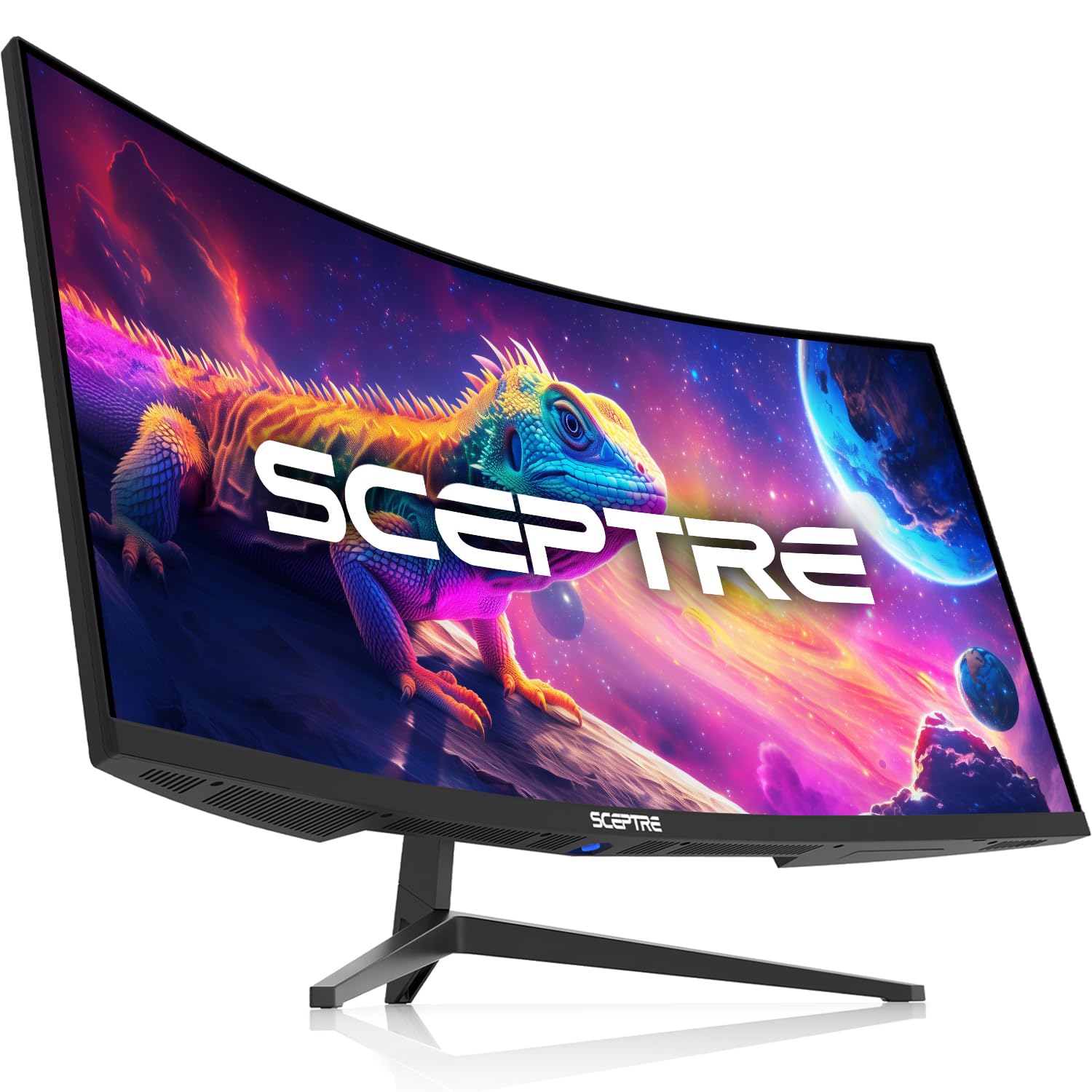
2. Sceptre C345B-QUT168 Curved Monitor
The cheapest way to get a genuinely wide 21:9 curve with a fast panel behind it.
If budget is the deciding factor, this screen gets you a curved ultrawide without a premium label tax. It carries a 3440 x 1440 resolution on a 21:9 panel (a 21:9 panel is wider than a standard 16:9 screen). Sceptre claims that 21:9 width yields 30% more screen space than a 16:9 monitor. In practice, two documents sit open side by side with room to breathe. The R1500 curve (a tighter wrap) curls that width toward you.
The spec sheet is stronger than the tier suggests. A 1ms MPRT response time (motion picture response time, a measure of how fast the panel clears an image) targets ghosting on fast scenes, with up to 180Hz/165Hz refresh and FreeSync Premium smoothing out frame pacing. Brightness lands higher than the premium LG 34G600A-B below, so a brighter room does not wash this panel out the same way.
What wins people over is the sheer size of the thing — it reads as a much more expensive monitor at first glance, and image quality holds up for general work and play. The trade-off is real, though: reliability is genuinely mixed, with some units arriving dead or failing early, and the built-in speakers are widely panned as tinny. Buy it with the expectation of a bare-bones sound setup and a screen-first mindset.
Where the money went: A 3440 x 1440 R1500 curved panel with 1ms MPRT and 100% sRGB coverage — the value is real on the display itself.
Where it did not: The built-in speakers are a fallback at best, and reliability varies enough that buying from a retailer with an easy return path is the smart move.
Worth your cash: if a big curved canvas matters more than a trusted badge and you have a headset or external speakers ready.
Look elsewhere: if you need a sound built into a monitor or want the safest long-term reliability record in the list.
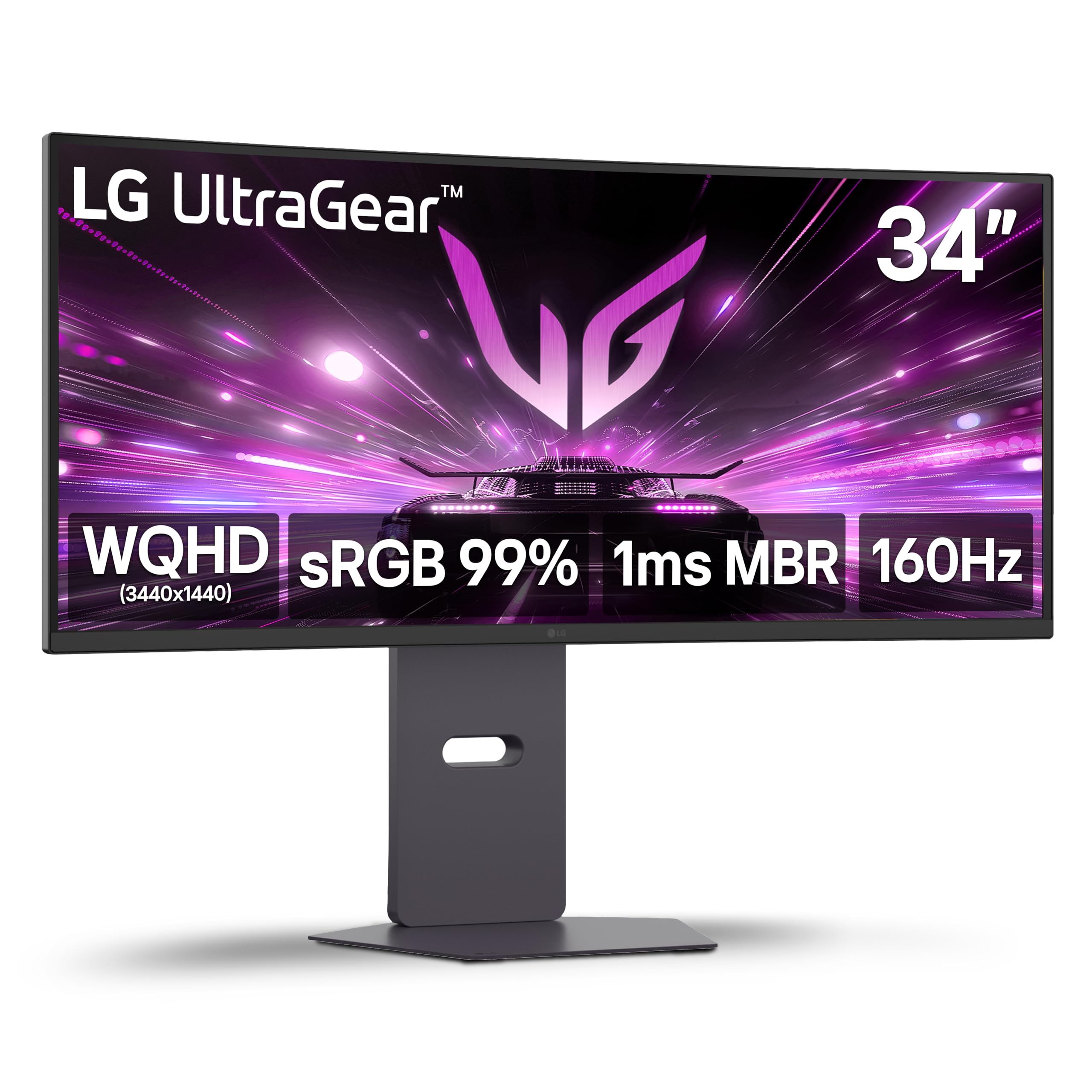
3. LG 34G600A-B 34-inch Ultragear WQHD Curved Gaming Monitor
A gentler 1800R wrap that works as convincingly for office days as for late-night games.
This is the screen for the person who spends the day in documents and the evening in a game, and does not want to buy two monitors. The 34-inch 3440 x 1440 panel sits on an 1800R curve (a looser radius than the Alienware above). That gentler bend pulls you into the picture without making the outer edges feel like they are curving away from you. The wider field of view is what a wrap-around panel is for.
Against the Alienware, the numbers split neatly: where the AW3425DWM runs at 4000:1 contrast, this LG panel matches that 4000:1 figure, and its DCI-P3 coverage is 99% sRGB. Refresh runs at 160Hz with 1ms MBR (motion blur reduction, which strobes the backlight to keep moving edges crisp) and AMD FreeSync Premium. HDR10 support brightens highlights, and Dynamic Action Sync trims input lag for shooters.
The recurring praise here is build and picture quality — it feels solid, sets up quickly, and the 1800R curve is described as wrapping into your field of view without warping the image. Audio is the fair caveat: the built-in stereo speakers with Waves MaxxAudio are serviceable for a video call, not a substitute for a headset. And at 300 candela per square meter, this is a normal-room display, not one for a bright office window.
Why it fits a mixed desk: 1800R is the friendliest curve for someone switching between spreadsheets and games, and the 160Hz panel with FreeSync Premium keeps the fast stuff smooth.
The honest catch: Brightness comes in at 300 candela per square meter, the lowest-friendly of the group, so glare-prone rooms will want blinds drawn.
The smart default: for anyone who wants one curved 34-inch screen for both work and play and cares more about a comfortable curve than peak brightness.
Not your pick: if your desk sits beside a bright window or you need loud built-in sound.
4. msi MAG 346CQDF E20 34-inch UWQHD Gaming Monitor

The speed leader of the list: 200Hz and 0.5ms on a 1500R ultrawide panel.
If the number that matters to you is frame-to-frame clarity, this is the one. The 200Hz refresh rate outruns the LG 34WR55QK-B at 100Hz — twice the refresh — and the 0.5ms response time undercuts that same LG’s 5ms, a full order of magnitude faster on paper. On a 1500R curved VA panel at 3440 x 1440, that pairing is built for tracking a target across a scene without trailing smear.
The feature list is packed for the tier. HDR Ready (a format that shows brighter highlights and deeper shadows) is on board, along with FreeSync Premium (a screen-sync feature that reduces stutter and tearing in games). A dual-mode option switches between refresh rates, and there are FPS and RPG picture modes, a crosshair overlay, plus picture-in-picture and picture-by-picture for splitting two inputs across the curve. The 1500R bend wraps the width around you, and the panel covers 1.07 billion colors.
What you are buying here is motion, not a long track record. This is the newest entry in the list, so it has the fewest owner experiences to lean on — the spec sheet is loud, but you are an early adopter relative to the LG and Alienware panels above. If a sharp, fast ultrawide at a keen tier is the goal, though, the raw numbers are compelling.
Reach for this if: refresh rate and response time are your top two specs and you want a 1500R curve to match the speed.
Hold off if: you want a deep pool of owner experience behind your purchase — this panel is newer and thinner on long-term feedback.
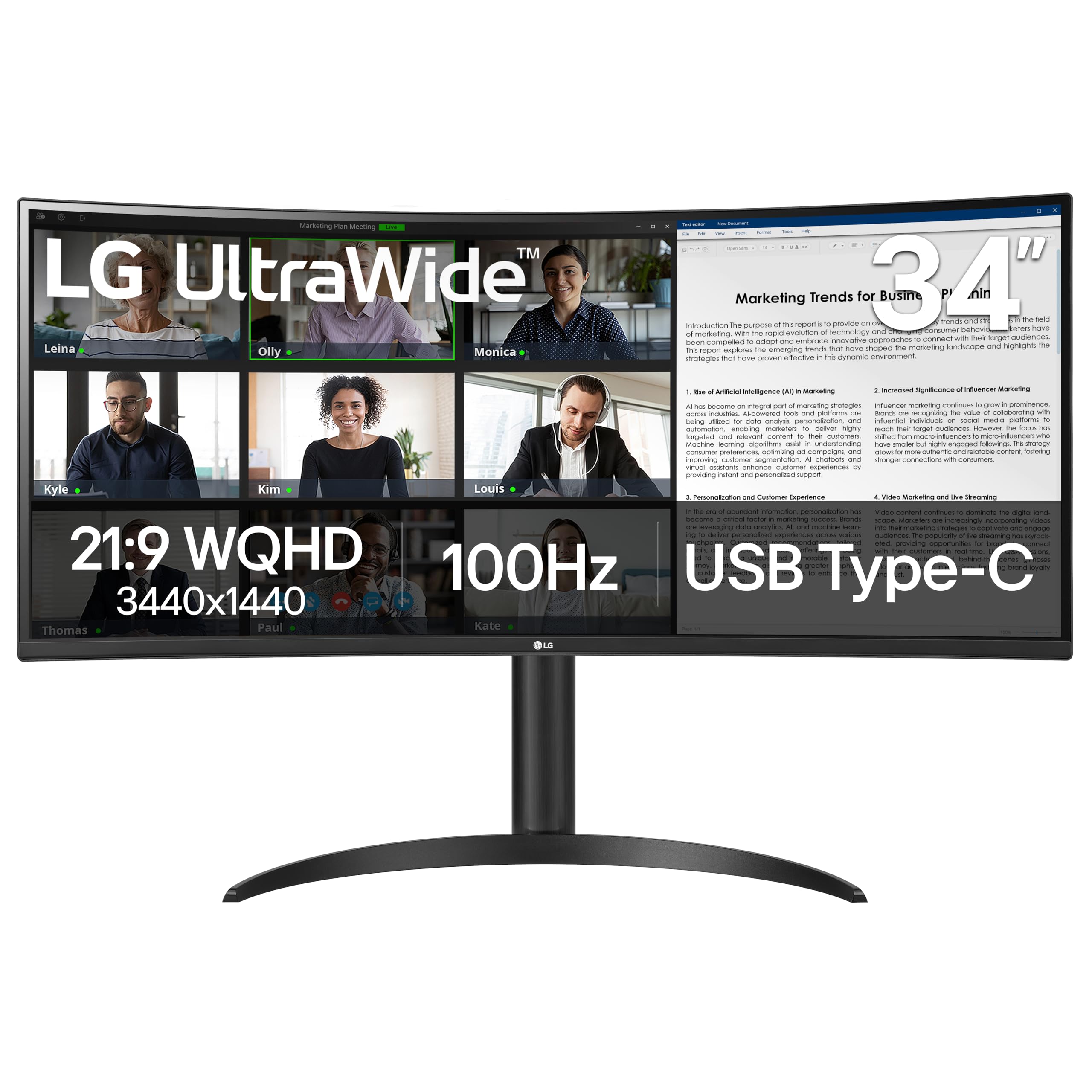
5. LG 34WR55QK-B 34-inch UltraWide WQHD Curved Monitor
One cable to a laptop, a 34-inch curve for windows, and a brightness that behaves like a desk slab.
The story here is the USB Type-C port with up to 65W power delivery. That single cable runs your display and charges your laptop at the same time, so the curved panel becomes the hub of a clean, cable-tidy desk rather than a second screen you have to feed. Around it: two HDMI ports, two USB ports, a DisplayPort and a headphone jack.
The 3440 x 1440 21:9 panel is built for windows, not fragging. OnScreen Control lets you split the display into zones with a few clicks, and Picture-by-Picture shows two separate input sources on one curved screen. Reader Mode cuts blue light for long document sessions. Refresh sits at 100Hz and response at 5ms, and 99% sRGB coverage means the color is trustworthy for content work.
What earns the most praise is display quality for text and spreadsheets — sharp WQHD resolution across the full width, and an easy setup. The caveat worth knowing is that 100Hz and 5ms are not gaming-first figures; a dedicated shooter player should look at the msi or the OLEDs instead. For a work-from-home desk that occasionally games, the balance is excellent.
The drawing card: USB-C with 65W delivery turns this into a one-cable dock-and-display setup, and the OnScreen Control window splitting is genuinely useful on a 21:9 curve.
Read this before buying: 100Hz refresh is fluid for work but not the panel a competitive gamer wants — the higher-Hz picks in this list suit that job better.
Made for: the desk worker who wants a tidy USB-C single-cable setup and a big curved canvas for windows.
Not the one: if fast-motion gaming is the primary job — you will want a higher refresh rate and lower response time.
6. INNOCN 45C1R 45″ 5K2K Ultrawide Curved Gaming Monitor

A 49-class 32:9 spread that trades desk width for the ability to see everything at once.
This is the step up in scale: a 45-inch VA panel at 5120 x 1440 on a 32:9 aspect ratio, twice as wide as a conventional 16:9 screen in feel. The practical result is that four windows can sit side by side without a single overlap, with PIP/PBP letting you split two input sources across the span. The R1500 curve keeps that enormous width within your peripheral reach.
The connectivity is unusually rich for the tier: a USB-C port with 65W power delivery, 1 x DP 1.4, 2 x HDMI 2.1, 2 x USB-A, a USB-B, an RJ45 Ethernet jack and a 3.5mm audio jack. That means laptops, a gaming console and a wired network all plug into the screen itself. It hits HDR400 with 3000:1 contrast and 99% sRGB coverage, and the panel is G-Sync Compatible on top of Adaptive-Sync support.
Owners lean positive on both raw monitor quality and value, with the wide spread landing as the standout for productivity. The fair trade-off is that 32:9 at this size is a serious desk commitment, and reliability and color consistency read mixed across the field — most owners are happy, but a handful of units misbehave. You buy this for four side-by-side windows on one unbroken 5120 x 1440 span.
The real-estate win
- 5120 x 1440 across a 32:9 span for four windows with no overlap
- USB-C with 65W delivery plus DP 1.4, dual HDMI 2.1 and an RJ45 network port
- R1500 curve keeps the huge width comfortable, HDR400 with 3000:1 contrast
What a 32:9 screen demands
- A 45-inch 32:9 panel needs a desk at least as wide as the screen plus sitting distance behind it
- Reliability is mixed across the field, so buy from a retailer with easy returns
Best suited to: multi-window workers who want a monitor-wide replacement for a dual-display setup with one tidy USB-C cable.
Skip the upgrade: if your desk is tight — a 45-inch 32:9 screen needs the space to match.
7. Alienware 34 240Hz QD-OLED Curved Gaming Monitor – AW3425DW

A 0.03ms QD-OLED panel that turns every dark scene into true black, at 240Hz.
QD-OLED is a different kind of panel: each pixel lights itself instead of sitting behind a backlight, so black means genuinely off — no glowing gray behind your letterboxed movie. That is why this 34.2-inch 3440 x 1440 screen runs an infinite contrast ratio, with DisplayHDR TrueBlack 400 and a quoted 1000-nit peak HDR brightness. Color is the headline gap versus the AW3425DWM above: this one hits DCI-P3 99.3% coverage with Delta E<2 accuracy, a measurable step up from the 95% of the sibling panel.
Speed follows the panel tech. The 0.03ms response time is near-instant, and 240Hz refresh with AMD FreeSync Premium Pro, NVIDIA G-SYNC Compatible and VESA AdaptiveSync covers whichever graphics card you run. The 1800R curve wraps the width around your view, and height, tilt and swivel adjustment let you dial in the angle.
The thing that wins people over is picture quality — deep, pure blacks and color that makes games look a tier better than a standard LED panel. The trade-off here is the one that follows OLED everywhere: brightness moderation. Peak HDR brightness and sustained full-screen brightness are not the same, and a bright room blunts the contrast advantage. Its 240Hz QD-OLED tuning favors games over all-day static spreadsheets.
The upgrade it open up: 99.3% DCI-P3 with Delta E<2 accuracy and infinite contrast puts the AW3425DWM’s 4000:1 ratio in the shade on black-level performance and color range.
The compromise to accept: OLED brightness limits mean a dim room gets the best out of it — and 240Hz is the number that should drive this purchase, since the panel is tuned for games over documents.
The gamer’s pick: if you want a curved panel where dark scenes actually go black and 240Hz matches a fast card.
Not for documents: if your day is spreadsheets and static toolbars, an OLED’s brightness behavior and burn-in care are added overhead you do not need.
8. Samsung Odyssey OLED G9 G91SD Monitor

A 49-inch Dual QHD OLED that wraps the whole desk and lights each pixel itself.
At 49 inches across a 32:9 aspect ratio, this is the definition of a screen that surrounds you. Dual QHD at 5120 x 1440 spreads across that width at 110 pixels per inch, so the image stays sharp even as the panel grows. The self-lit QD-OLED panel delivers blacks with no pixel light bleed behind them, and the 0.03ms response time plus 144Hz refresh keeps fast motion clean.
Samsung builds in the OLED caretaking this kind of panel needs. A thermal modulation system predicts surface temperature and adjusts brightness to keep heat down. Logo and taskbar detection dims static images to guard against burn-in, and a screen saver dims after 10 minutes of inactivity. Picture-in-Picture lets you park a chat window or a tips feed on the big canvas without a second monitor, and the stand tilts for a comfortable angle.
Owners prize this one as a gaming display. Buyers report that colors and picture are the standout, with the sheer size doing half the work. Opinions split on reliability, with a minority of units arriving non-functional, and on value, since the OLED premium (OLED is a panel type that lights each pixel itself for deep blacks) is real. It is a superb rich screen if you will run its burn-in safeguards and keep static images moving.
Why the immersion sells itself
- Dual QHD 5120 x 1440 across 49 inches at 110 pixels per inch keeps detail sharp
- QD-OLED pixels deliver true black with no light bleed, and 0.03ms keeps motion clean
- Thermal modulation, logo/taskbar detection and a screen saver handle burn-in care
What to weigh honestly
- Reliability reads mixed — a minority of units arrive faulty, so easy returns matter
- A 49-inch 32:9 screen eats most of a desk’s width and pushes your chair back
Suits the immersion seeker: if you want one enormous self-lit screen that fills your view on racing, flight and open-world games.
Worth pausing: if a fixed taskbar and long static documents are your norm — OLED caretaking is real daily work.
9. Samsung Odyssey Neo G9 G95NC Monitor

The widest, brightest, most pixel-dense curve here — Dual 4K at 7680 x 2160 on a 1000R bend.
This is the ceiling of the category. A 57-inch MINI-LED panel (MINI-LED means many tiny LEDs behind the screen for finer brightness control) at 7680 x 2160 — Dual 4K UHD — makes it as wide as two 4K displays fused together. It has 2,392 local dimming zones working with Quantum Matrix Technology to control brightness zone by zone. A 1000R curve is the tightest radius in this entire list, pulling the enormous width around you the way a cockpit wraps a pilot. Refresh runs at 240Hz (240 screen updates per second) with 1ms gray-to-gray (how fast a pixel changes shade), and DisplayPort 2.1 carries that full resolution at variable refresh rates.
Brightness is the standout number. VESA DisplayHDR 1000 certification pairs a 1,000-nit peak with a 1,000,000:1 contrast ratio, so dark corners stay dark and highlights punch hard. AMD FreeSync Premium Pro smooths motion, and CoreSync projects the on-screen colors into the room via Core Lighting plus. The connectivity is deep: DisplayPort 2.1, HDMI 2.1, a USB hub, and picture-by-picture so two full sources run side by side at native resolution.
Owners mention that the praise splits between sheer scale and the productivity it enables, and the curve is what makes that scale liveable. The honest caveats come thickest too. It is the widest screen here by far, it wants a substantial desk, and it leans on the newest DisplayPort standard to hit its best numbers, so check your graphics card leads with DP 2.1. Buy it only if a 57-inch 7680 x 2160 curve is the whole point and your desk can take it.
The scale story: 7680 x 2160 in a single 57-inch curve is two 4K displays with the bezel removed, and the 1000-nit peak with 2,392 dimming zones makes bright and dark scenes read properly.
What to plan for: a 1000R 57-inch screen is the tightest curve and widest span on the list — measure the desk and confirm DP 2.1 on your PC before committing.
For the size-first buyer: you want the largest, brightest curved canvas on the market and have the desk and the graphics card to drive it.
Choose another: if your desk is any less than generous — this panel is the most space-hungry pick here.
Know the Specs
Curvature (R1500 vs 1800R vs 1000R)
Curvature is the radius of the curve, written as an R number. A smaller number means a tighter wrap: 1000R curls hard around you, while 1800R is a gentler bend. Tight curves feel more rich up close but can distort straight edges at the far corners. Looser curves behave better for mixed document work.
Refresh Rate (Hz) and Response Time (ms)
Refresh rate in Hz is how many times a second the panel redraws, so higher smooths fast motion. Response time in ms is how fast a pixel changes shade, so lower reduces trailing smear. Office work feels fine at 100Hz; fast games benefit from higher refresh and 1ms or lower response.
Aspect Ratio (21:9 vs 32:9)
21:9 is the common ultrawide, wide enough for two windows and quick to adapt to. 32:9 is double-wide — effectively two screens fused — which is superb for multitasking but demands much more desk width and viewing distance.
Panel Type (VA, LED, QD-OLED)
VA panels are the workhorse for curved ultrawides, with good contrast at accessible tiers. QD-OLED lights each pixel individually for true black and near-instant response, but it asks for brightness moderation and burn-in care with static images.
Common Questions
What does the R number on a curved monitor actually mean?
Is a 21:9 monitor better than a 32:9 for work?
Will my laptop run a 34-inch ultrawide over USB-C?
How much desk space does a 49-inch or 57-inch curve need?
Do I need a DisplayPort 2.1 graphics card for these monitors?
Does a curved monitor distort spreadsheets and straight lines?
Is QD-OLED worth it over a standard VA panel?
Do these ultrawides include speakers?
Can I split one curved screen between two devices?
Which curved monitor is best for a bright room?
The Bottom Line
For most desks, the wrap around monitor that makes the fewest compromises is the Alienware AW3425DWM. Its 1500R curve, 180Hz refresh, 1ms response and DCI-P3 95% color hold up for both work and fast games, and the crowd is clearly behind it — a 4.5+ star average across 700+ ratings. If you want a gentler 1800R curve and a USB-C single-cable desk, the LG 34WR55QK-B is the workhorse. And if immersion is the whole point, the Alienware AW3425DW OLED delivers true black at 240Hz, while the Samsung 57″ Odyssey Neo G9 is for the buyer chasing the largest curved canvas available.
How we choose
We do not accept paid placement. Every pick is matched to a real buyer and a real use-case; we do not hands-on test units.
Sources
Specifications: manufacturer listings and product documentation. Review insights: verified customer reviews, as of November 2026. Pricing: not shown on this page (it changes often); check the current price via the retailer link.
As an Amazon Associate, Tactical Gear Guy earns from qualifying purchases. This does not affect which products we feature.