Specs are compiled from manufacturer listings and verified buyer reviews and can change over time — please confirm the key details on the product page before buying.
Reaching the nut that holds your faucet to the sink is a knuckle-scraping, flashlight-in-your-teeth job — and the wrong tool turns a fifteen-minute swap into an afternoon on your back. The right basin wrench grabs that nut from a standing position, holds it at any angle, and lets you turn it one-handed. This guide separates the nine tools that actually do that from the ones that just look like they might.
This guide is built by comparing the manufacturers’ published specifications and the patterns across verified customer reviews, so you get each pick’s real strengths and trade-offs instead of marketing spin.
The picks below are ordered by what actually matters under a cabinet — jaw size, reach, and whether the head stays where you put it. Whether you are a plumber or a first-timer, here is the honest breakdown of a wrench for sink duty.
Top Picks


How To Choose The Best Wrench for Sink
Under-sink work is a reach problem before it is a turning problem. You are lying on your back, the shutoff valves are in the way, and the nut you need lives in the worst-lit corner of the house. A basin wrench solves that by letting you work from below with a long handle and a head that pivots to meet the nut where it sits. Before you buy, get three things straight: what size nut you are chasing, how much reach you need, and whether the head will hold its angle once you have it set.
Jaw capacity: the number that decides if it fits
Jaw capacity is the widest nut the wrench can grab, measured in inches across the flats. Most faucet and supply-line nuts fall between 3/8 inch and 1-1/4 inches, which is why so many basin wrenches are rated to that range. Bigger nuts exist on drain bodies and tub drains, and those want a tool rated to 2-1/2 inches like the DURATECH. Buy for the nut in front of you, not the nut you might meet someday.
Reach and head hold: the two things that save your knuckles
A telescoping shaft that runs from 10 inches to 17 inches lets you stay outside the cabinet while the wrench goes deep. Just as important is the head: a pivoting head that holds its position at any angle (RIDGID calls it a tension plug, others use a spring-loaded clasp) means you are not fighting the tool to keep it on the nut. If the head flops, you will re-seat it after every quarter turn.
Side-by-Side Comparison
| Model | Best For | Jaw Capacity | Length | Head Pivot | Amazon |
|---|---|---|---|---|---|
| RIDGID 31175 Model 1017★ Best Overall | Overall under-sink work | 3/8″ to 1-1/4″ | 10″ to 17″ | Up to 90° | Amazon |
| HAUTMEC PL0025Best Value | Reach on a budget | 3/8″ to 1-1/4″ | 10″ to 17″ | Up to 180° | Amazon |
| Klein Tools 68098Most Versatile | Full-kit swaps | 5/8″ to 15/16″ hex | Up to 14-1/2″ | Fixed square drive | Amazon |
| Superior Tool 03811 | Cheapest entry point | Up to 1″ hex/square | 11″ | Infinitely adjustable | Amazon |
| ARES 33004 | One-handed ratcheting | 3/8″ to 1-1/4″ | 11″ | Up to 180° | Amazon |
| Superior Tool 03825 Basin Buddy | Faucet locknuts | 1/2″ shank + locknut slots | — | Fixed square | Amazon |
| DURATECH DTBWS-3 | Large drain nuts | 1-3/8″ to 2-1/2″ | 10″ to 17″ | 180° | Amazon |
| Klein Tools 68232 | Hex-nut torque | Up to 1-1/4″ | 10″ to 17″ | Spring-action jaw | Amazon |
| RIDGID 46753 Model 2017 | Dark, deep cabinets | 3/8″ to 1-1/4″ | 10″ to 17″ | Adjustable | Amazon |
Detailed Reviews
1. RIDGID 1017 Basin Wrench
Our pick — 4.5+★ from 550+ verified ratings; the strongest balance of quality and price.
The forged-steel workhorse that holds its angle and shrugs off a 25-year-old faucet nut.
The RIDGID 1017 is the wrench most people should stop researching after. Its spring-loaded jaws are forged from alloy steel, so they bite a nut and keep biting through a full ratcheting turn. The jaw opens from 3/8 inch to 1-1/4 inch, which covers the standard faucet and supply-line nuts in nearly every home. And the telescoping shank stretches from 10 inches to 17 inches, so you can stand back while the head goes deep into the cabinet.
Its spring-loaded jaws grab standard faucet and supply-line nuts from 3/8 inch to 1-1/4 inch and hold through a full ratcheting turn. The forged body feels heavy and tank-like in the hand, and that heft is the point: this is a tool you buy once and hand down. A tension plug locks the head at any position up to 90 degrees, so it stays where you set it instead of flopping off the nut every quarter turn. As buyers put it, it made short work of a 25-year-old connection that had clearly settled in for good.
Here is the trade-off you should know about. It is a fixed 11-inch class of tool in the other competitors’ ranks, but this one extends to 17 inches — a full 6 inches more reach than the Superior Tool 03811’s 11-inch length. It is also heavier in the hand than a stripped-down socket tool, so a long session under a tight cabinet will tax your wrist. The 150 ft-lb torque rating means it will take whatever a hand can deliver.
What earns the top spot
- Forged alloy steel jaws spring back and grab through a full ratcheting turn without re-seating
- Telescoping shank runs from 10 inches to 17 inches — 17 inches versus the Superior’s 11 inches
- Tension plug holds the head at any position up to 90 degrees, so it stays put on the nut
Where it asks for a little patience
- Heavier in the hand than a stripped socket-style tool during long under-sink sessions
- Premium build commands a higher entry than the budget basin wrenches
Right call for: the one-wrench homeowner who wants a tool that handles standard faucet nuts and stays in the box for the next twenty years.
Think twice if: you are chasing a 2-inch drain-body nut — this one tops out at 1-1/4 inch jaw capacity.
2. HAUTMEC Telescoping Basin Wrench
Seventeen inches of reach and a head that spins 180 degrees, for a fraction of what the premium names ask.
If your main worry is the nut tucked near the back wall of the cabinet, the HAUTMEC PL0025 answers it directly. The chrome-plated shaft extends from 10 inches to 17 inches in four locked positions, matching the RIDGID 1017’s reach at a more forgiving point of entry. The jaw opens from 3/8 inch to 1-1/4 inch, and the spring loading auto-adjusts so the jaws stay engaged with the nut through continuous ratcheting — you do not re-fit after every turn.
Heads up on the pivot: HAUTMEC’s head rotates up to 180 degrees, double the 90-degree limit on the RIDGID 1017 above. That is a real advantage when a supply line or shutoff valve sits in the swing path. The removable 8-inch handle and sliding T-bar let you take the tool down to fit a crowded toolbox drawer, and a rear hanging hole keeps it on the board. Reasonable buyers will also like that the manufacturer publishes it as a fit for professionals, plumbers, and beginners alike.
Buyers report the chrome-plated shaft and spring-loaded head feel sturdier than the price suggests, and the 180-degree pivot clears shutoff valves and supply lines in the swing path. The main honest caveat is the sliding T-bar: on a very long, very tight pull it can shift position if you do not seat it firmly first. A small habit to learn, not a flaw to fight.
Straight reading: 17 inches of reach, a 180-degree pivoting head, and a 1-1/4 inch jaw — the same headline numbers as the top pick, at a friendlier starting point.
The small catch: the sliding T-bar rewards a firm first seat; let it wander and it will shift mid-turn.
Reach for this if: you want the full 17-inch reach and the wider 180-degree head without stepping up to the premium tier.
Look elsewhere if: you need a fixed-hook locking clasp that clicks into one angle and refuses to budge.
3. Klein Tools 68098 12-in-1 Faucet Wrench, Plumbing Multi Tool
One tool that swaps the whole faucet, not just the nut holding it on.
This is the pick for a full faucet replacement rather than a single-nut rescue. The Klein 68098 packs twelve jobs into one tool: the handle end fits 2-, 3-, 4-, and 6-tab faucet and toilet supply mounts, while open hex jaws take 5/8-inch, 3/4-inch, 7/8-inch, and 15/16-inch nuts. There is a valve wrench for most angle stops, plus a detachable metal piece carrying a four-slot strainer wrench and an aerator wrench. The wrench extends up to 14-1/2 inches to reach into the cabinet, and a 3/8-inch square drive connection with screwdriver passthrough adds leverage when a nut is stubborn.
Owners value leaving the tab, hex, valve, strainer, and aerator tools in the box, since the 68098 covers all five jobs in one 14-1/2-inch frame. The body is built from nylon and feels stiff when you load it, with no flex under torque. The short extension budget on a full aerator or angle-stop job keeps it a good fit for a bathroom vanity swap or a kitchen faucet upgrade.
The honest limit: this is not a deep-reach basin wrench in the way the RIDGID 1017 is. At 14-1/2 inches extended it falls short of the 17-inch reach of both RIDGID picks and the HAUTMEC. It is also built around specific nut sizes, so a non-standard faucet brand outside the listed hex sizes is not its job. Its real home is a plumber’s quick-grab kit that covers the common installs, not the single deepest nut.
One tool, many jobs: 12 functions in one frame, from tab mounts to hex nuts to angle-stop valves to strainer and aerator wrenches.
Reach reality check: 14-1/2 inches extended versus 17 inches on the RIDGID pair — a bathroom-vanity tool, not a back-corner tool.
Fits best when: you are replacing a whole faucet and want the tab, hex, valve, strainer, and aerator jobs handled by one piece in your bag.
Does less well when: a Faucet brand uses a non-standard nut size outside 5/8-inch to 15/16-inch, or the nut sits more than 14-1/2 inches deep.
4. Klein Tools 68232 10 to 17-Inch Telescoping Basin Wrench
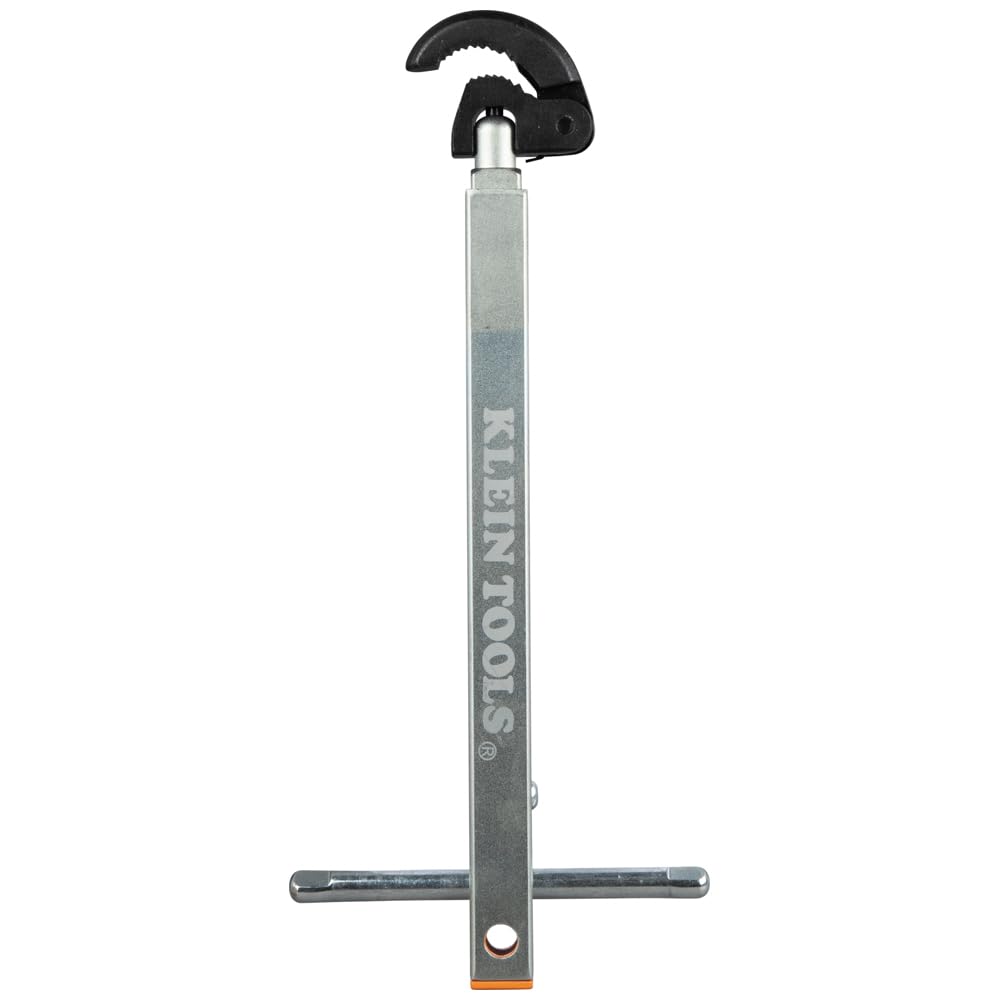
A push-button reach adjuster that clicks into three set lengths and a jaw built for hex-nut torque.
Klein’s 68232 strips the basin wrench down to the job. The shaft adjusts with a push-button to three set lengths — 10 inches, 13-1/2 inches, and 17 inches — so you are not guessing at a length, you are locking one in. The spring-action jaw is shaped to grab hex nuts up to 1-1/4 inch and hold them under high-torque loads. A dual-leverage T-handle gives you a solid two-handed grip, and the bottom opening fits a 3/8-inch socket wrench for extra turning force.
What makes this one stand apart from the multi-tool above is focus. It is a single-purpose hex-nut grabber rather than a twelve-function kit, and the spring action seats the jaw the same way on every turn. The three locking lengths also mean the tool does not slip in length mid-turn the way a continuously sliding shaft can. At 1.8 pounds it is light enough to work overhead without a cramp, and the T-handle’s shape gives your off-hand a clear place to brace against the cabinet floor.
The honest limit: 1-1/4 inch is the top of its jaw range, so drain-body nuts and tub-drain spouts are outside its scope. It is also a fixed length in three steps, not a free slide — which is a strength for repeatable grip but a slight loss if the perfect reach sits between two of its stops.
Where it shines: a spring-action jaw that holds 1-1/4 inch hex nuts under real torque, with a push-button shaft at 10 inches, 13-1/2 inches, and 17 inches.
The trade: three set lengths rather than a free slide, so the exact middle reach is not available.
Worth it for: the hex-nut specialist who wants a predictable, repeatable grab on faucet nuts up to 1-1/4 inch.
Not the one for: oversized drain nuts and tub drains — that calls for the DURATECH below.
5. RIDGID 2017 Telescoping Basin Wrench

When the nut is in a cabinet with no light, this one carries its own.
The 2017 solves the problem the other picks leave you to solve with a flashlight. A built-in LED at the head lights up the workspace right where the jaw meets the nut — one owner’s description of it completely lighting up the nut you want to tighten is the whole pitch. The body telescopes from 10 inches to 17 inches with a redesigned easier slide, and the contoured grip is shaped to keep leverage in a cramped space. Like the 1017 above, it carries a 150 ft-lb torque rating.
What owners consistently report is that the LED is the difference-maker on old faucets where the nut is caked in mineral buildup and hard to see. The build is solid and the reach connects with the impossible-to-reach corners of a deep cabinet. It shares the RIDGID family’s forged, heavy-duty feel, and the telescoping action gets you the full 17 inches without a second hand on the shaft.
The catch is weight and cost for the added light. At 1.16 kg it is noticeably heavier in the hand than a bare basin wrench, and the light adds a premium over RIDGID’s own non-LED 1017. If your cabinet is already wired with a work light or your work is in a bright, open vanity, the extra bulk and cost are harder to justify. For a dark, deep, back-of-cabinet nut, they buy you a much easier job.
The differentiator: a built-in LED that lights the nut, plus the same 10-inch to 17-inch telescoping reach and 150 ft-lb torque as RIDGID’s standard 1017.
The honest weight: 1.16 kg and a higher point of entry make the light a real investment, not an automatic add.
Ideal if: the nut is buried behind mineral buildup and your cabinet has no work light — this is the tool that ends the flashlight-in-teeth routine.
Not needed if: you are already working in a bright vanity, where the added weight and cost buy you less.
6. DURATECH 10″-17″ Telescoping Basin Wrench

A 2-1/2-inch swivel jaw built for the oversized nuts the faucet wrenches cannot reach.
Most basin wrenches top out at 1-1/4 inch. The DURATECH opens to 2-1/2 inches, which puts sliding nuts on sink drains and tub-drain hardware in reach. The pivoting carbon-steel head turns 180 degrees, and the telescoping square rod stretches from 10 inches to 17 inches. It also ships with a separate tub drain remover wrench, and both ends of that piece fit most bathtub drains and spuds.
The head is forged and milled with phosphated blackening for corrosion resistance, and the outer tube is sandblasted chrome-plated steel. The aluminum alloy drain-removal tool is intentionally lighter than zinc alloy, so it can install or remove a tub drain without scratching a delicate surface. Buyers point to the forged, phosphated carbon-steel head and sandblasted chrome-plated tube as the reason it should hold up over repeated drain jobs. It can handle lug nuts up to 2-1/2 inches, which hints at how much grab the large jaw provides.
Here is the critical fit rule: DURATECH publishes a direct warning that this is not suitable for small nuts or limited space. The oversized head is the reason it grips large drain nuts so well, and the same size is why it cannot chase a 3/4-inch faucet nut. Buy it as a companion to a standard basin wrench, not as a replacement. At 1.28 kg it is the heaviest of the mid-range picks, though the heft goes with the size.
The standout number: a 1-3/8 inch to 2-1/2 inch jaw range — roughly double the 1-1/4 inch ceiling of the RIDGID 1017 and HAUTMEC.
The fit rule: the maker explicitly flags it as unsuitable for small nuts and tight spaces — pair it with a standard wrench, do not swap it in.
Grab this when: the nut on your list is a large sink-drain sliding nut or a tub-drain spout that a standard jaw slips right past.
Keep shopping when: the nut is a small faucet or supply-line nut — its 1-3/8-inch minimum jaw start is too wide for the job.
7. Superior Tool 03825 Basin Buddy Faucet Nut Wrench

The cutaway socket that slips around the supply line and grabs the locknut wings whole.
This one is a different animal from a jaw wrench entirely. The Basin Buddy uses a cutaway socket design that slides over an existing supply line, then grabs the wings of the faucet locknut without snapping them off. It fits most metal locknuts, most coupling nuts, most PVC locknuts, and most metal and plastic toilet supply nuts. Once the coupling nut is off, the cutaway wraps around the faucet shank (1/2 inch) to remove metal and plastic nuts. It drives on a 1/4-or-3/8-inch ratchet, and an adapter is included.
The cutaway socket slides over the supply line and grips the locknut wings directly, so you turn the nut instead of fighting the space around it. Under a crowded kitchen cabinet, a jaw wrench can only fight the space it has; the Basin Buddy reaches around the supply line like a socket, which is why it handles this specific nut so cleanly. It carries a lifetime guarantee from Superior Tool. Long-time DIYers keep it on hand for locknut and coupling-nut work, where the socket design beats a jaw wrench.
The honest limit is compatibility. This is built for locknuts and shank nuts, not for a general faucet nut that a jaw wrench would grab. A nut that does not have an open supply line to slide past, or one with no locknut wings, is outside its reach. Reaching for it as your only under-sink wrench will leave you short on the standard jaw-wrench jobs the RIDGID 1017 covers.
Where it wins: a cutaway socket that slides around the supply line and grips locknut wings in one of the tightest spaces under a sink.
Where it stops: it is a locknut and shank-nut tool — standard faucet nuts without wings want a jaw wrench instead.
Pair it with a jaw wrench if: your kitchen cabinet is packed and the locknut is the exact nut you keep failing to reach.
Do not expect it to: replace a standard basin wrench for the full faucet job — it handles one nut style extremely well.
8. ARES 33004 11-In Basin Wrench, Adjustable 3/8″ to 1-1/4″ Jaw

A forged steel head on a slim 11-inch shaft, with a one-handed ratchet that earns its way.
The ARES 33004 is a solid, honest basin wrench at a budget point. The jaw is spring-loaded and auto-adjusts from 3/8 inch to 1-1/4 inch, and the head pivots up to 180 degrees to hold its position in tight spots. The shaft is Chrome Vanadium Steel with a forged steel jaw, and the sliding T-handle gives you leverage for one-handed use where two hands do not fit. It is designed to remove nuts on faucets, supply lines, drains, and valves.
On a real faucet swap, the 180-degree pivoting head angles the jaw around shutoff valves and supply lines that a fixed hook cannot clear. The continuous ratcheting action means the jaw engages with the nut and stays engaged, so you are not re-fitting the wrench after each turn. The head’s 180-degree range covers the awkward angles a fixed-head tool would fight. There is also a limited lifetime warranty backing it.
Two honest caveats, sized to the job. First, the grip is the main recurring note — on a heavily seized nut the jaws can lose their hold and need to be re-seated, which is common on a spring-loaded jaw and rewards patience over brute force. Second, at 11 inches it is a shorter tool than the telescoping picks above: it is a compact cabinet wrench, not a deep-back-of-the-sink wrench. For a standard bathroom vanity swap it is the right size.
Good honest buy: a forged jaw and 180-degree pivoting head at the entry price, backed by a limited lifetime warranty.
Where it asks more: 11 inches of reach is well short of the 17-inch telescoping picks, and the jaws can slip on a badly seized nut.
Best fit: a bathroom vanity or kitchen faucet swap where the nut is within an arm’s length of the cabinet opening.
Skip it for: a nut buried deep or heavily rusted — that job wants the longer reach and firmer hold of the RIDGID 1017.
9. Superior Tool 03811 Basin Wrench

The compact 11-inch starter that handles a simple faucet swap for the least commitment.
This is the tool to grab for a straightforward vanity swap. At 11 inches it is compact, and its infinitely adjustable head angle lets you dial in the exact position a crowded cabinet demands. The spring-loaded head is rated to accommodate hex and square nuts up to 1 inch. The alloy steel body and powder-coated chrome finish feel solid for the price, and Superior Tool backs it with a lifetime warranty.
At 11 inches with an infinitely adjustable head, it fits the narrow gap in a crowded vanity where a 17-inch telescoping shaft will not go. The 1-inch jaw capacity is the smallest of this group, which is a design choice for close-quarters nuts rather than a deep-reach all-rounder. For a simple, single-nut faucet job it gets the work done without fuss.
Here is where it loses to the leaders: the 11-inch length is 6 inches short of the 17-inch reach of the RIDGID 1017 and HAUTMEC, and the 1-inch jaw is 1/4 inch narrower than the 1-1/4 inch jaw on the RIDGID and HAUTMEC picks. The clasp mechanism also can feel loose at the angle you set — it does not lock as firmly as a tension plug. If your job is a deep cabinet or a bigger nut, this is not your tool.
For the simple job: a compact 11-inch frame with infinitely adjustable head angle and 1-inch hex-and-square jaw capacity, at the lowest point of entry here.
Where it runs out: 11 inches of length and a 1-inch jaw mean deep, oversized faucet nuts need a bigger tool.
Smart first buy: a first faucet swap in an open vanity where a short, compact wrench will reach the nut without an extension.
Step up instead when: the nut is bigger than 1 inch or sits past 11 inches from the cabinet edge — go to the HAUTMEC or RIDGID 1017.
Know the Specs
Jaw Capacity, In Plain Words
Jaw capacity is the widest nut a wrench can grab, measured across the flats and written in inches. A 1-1/4-inch jaw covers the faucet and supply-line nuts on most homes, while a 2-1/2-inch jaw is built for larger drain and tub hardware. Choose the jaw capacity that matches your nut first — a jaw that is too narrow cannot grip it, and a jaw that starts too wide cannot close on it.
Telescoping Reach and Head Hold
Reach is how far the shaft extends — 10 inches to 17 inches on the telescoping models — so you can work from outside the cabinet. Head hold is whether the pivoting head stays at the angle you set. A tension plug or locking clasp keeps the head on the nut through a ratcheting turn; a looser clasp makes you re-seat it after every quarter turn.
Common Questions
How do I know what size basin wrench I need for my faucet nut?
Can a basin wrench reach the nut on an old rusted faucet?
Is the Basin Buddy better than a regular basin wrench?
What is the difference between a fixed and a pivoting basin wrench head?
Will a telescoping basin wrench fit in a tight cabinet?
Can I use a basin wrench to remove a tub drain?
Does the Klein 68098 work on Moen faucets?
How much torque can a basin wrench handle without slipping?
Is a compact 11-inch basin wrench enough for a kitchen sink?
The Bottom Line
The wrench for sink duty really breaks into two jobs: gripping the standard faucet nut and reaching the deep, dark corner it lives in. The RIDGID 31175 Model 1017 is the pick that does both, with forged spring-loaded jaws, a 10-inch to 17-inch telescoping shank, and a head that holds its angle up to 90 degrees. If reach is your priority and you want a wider 180-degree head, the HAUTMEC PL0025 gives you the same 17 inches for a more forgiving start. And if your kitchen cabinet has no light, the RIDGID 46753 Model 2017 carries its own, so you can stop juggling a flashlight alongside the wrench.
How we choose
We do not accept paid placement. Every pick is matched to a real buyer and a real use-case; we do not hands-on test units.
Sources
Specifications: manufacturer listings and product documentation. Review insights: verified customer reviews, as of November 2026. Pricing: not shown on this page (it changes often); check the current price via the retailer link.
As an Amazon Associate, Tactical Gear Guy earns from qualifying purchases. This does not affect which products we feature.