Specs are compiled from manufacturer listings and verified buyer reviews and can change over time — please confirm the key details on the product page before buying.
If you want the short answer: buy the bin that lets you harvest castings without dumping the whole thing out, and make sure it has real drainage under the bedding. Everything else — tray count, color, whether worms come included — is secondary. The biggest mistake first-time worm keepers make is buying a bin with nowhere for the liquid to go, then wondering why the bedding turns into a swamp and the worms climb the walls.
This guide is built by comparing the manufacturers’ published specifications and the patterns across verified customer reviews, so you get each pick’s real strengths and trade-offs instead of marketing spin.
Each one has a drainage path, a harvest method and a footprint you should know about before you commit counter space to it. Here is the honest breakdown of the worm farm bin market and which one fits your kitchen, balcony or garage.
Top Picks

How To Choose The Best Worm Farm Bin
Worm bins fail for boring, predictable reasons: no drainage, no airflow, or a harvest method that makes you dig through the whole colony every few months. Get drainage, airflow and harvest method right and the colony handles the rest. Get them wrong and you will be scooping out wet, sour bedding at 11 p.m.
Drainage and the spigot are the whole ballgame
Worm bedding should feel like a wrung-out sponge — damp to the touch, with no standing water in the tray. A collection tray or reservoir under the working trays catches the liquid that drains down — the “worm tea” — and keeps it away from the worms. A spigot on that base lets you draw the tea off without lifting anything. Skip the drain and moisture builds up, oxygen disappears, and the smell starts.
How you harvest decides how much you’ll enjoy this
Stacked-tray bins let worms migrate upward into fresh food, so the bottom tray finishes first and pulls out as a block of castings. Continuous-flow designs work differently — you feed the top and pull finished material out of the bottom, never separating worms from anything. Both work. The tray route suits someone who wants to see the process; the flow route suits someone who wants to touch it as little as possible.
Airflow keeps the colony healthy and the room livable
Ventilation slits, molded aeration points and breathable fabric all do the same job: move air through the bedding so the aerobic process continues and odors stay down. That is why most of these bins can live indoors year-round in a kitchen or utility room. Match the bin’s airflow to where it will actually sit — a sealed corner with no air movement makes any bin work harder.
Size it to your scraps, not to your enthusiasm
Worms eat roughly their own body weight, and a colony needs volume to absorb a week of vegetable peelings without going anaerobic. Small bins suit one or two people; bigger trays or a fabric bag suit a family. Measure the counter or balcony spot first — a tall five-tray stack and a squat two-tray box occupy very different floor space.
Side-by-Side Comparison
| Model | Best For | Capacity | Trays / Layers | Harvest Method | Amazon |
|---|---|---|---|---|---|
| VermiHut Classic 5-Tray★ Best Overall | High-volume indoor/outdoor recycling | 50 liters | 5 | Stacked trays, continuous flow | Amazon |
| Blütezeit 3-Tray Worm ComposterStarter Kit Pick | First-timers who want the whole kit | 7.93 gallons | 3 | Stacked trays plus spigot | Amazon |
| VIVOSUN 3-Layer Worm Compost Bin | Tight spaces and small kitchens | 30 liters | 3 | Stacked trays plus spigot | Amazon |
| FCMP Essential Living Composter | Year-round indoor composting | 8 gallons | 2 | Stacked trays plus worm tea reservoir | Amazon |
| Maze Worm Farm | Portable, lift-and-go setups | — | 2 | Rotating trays plus worm-saver tray | Amazon |
| Urban Worm Bag Version 2 | Big batches with minimal handling | 150.75 liters | — | Continuous flow, zipper-free bottom | Amazon |
Detailed Reviews
1. VermiHut Classic Model 5-Tray Worm Composter
Our pick — 4.5+★ from 800+ verified ratings; the strongest balance of quality and price.
Five stacked trays and 50 liters of room — the bin that keeps feeding a hungry colony for months.
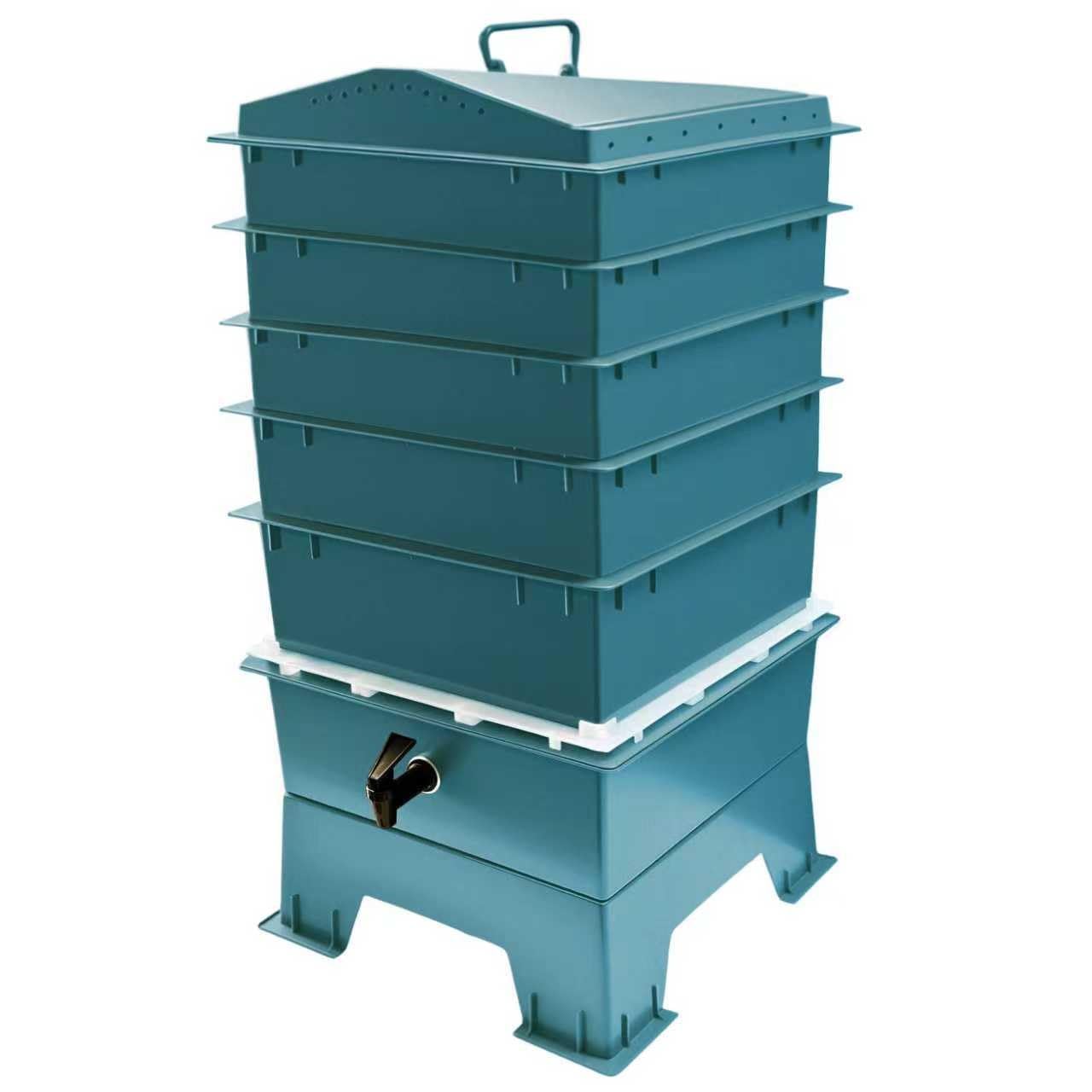
Fifty liters is the number that decides this one. That is the largest tray-stack capacity in this lineup, and it means a family’s weekly vegetable peelings land in fresh bedding instead of piling onto a colony that has already eaten its fill. The five-tray stack works as a continuous flow system: worms finish the bottom tray, migrate up through the next, and you pull the finished tray out as solid castings. At 27.5 inches tall it is also the tallest bin here — the Maze Worm Farm stands just 11 inches — so clear a full-height corner before it arrives.
Owners consistently report the colony settling in fast and feeding steadily. Castings come out dark and crumbly enough to go straight into the garden. Assembly is quick enough that most people have it stacked and running the same afternoon, and the footprint stays tight for a bin holding this much — 16 inches long and 16 inches wide in high density polyethylene (HDPE, a rigid plastic that shrugs off moisture and won’t go brittle in a damp utility room). The dark green shell reads more like a planter than a waste bin, which matters if it lives where guests can see it.
The honest trade-off is the instructions, which some buyers find less clear than the bin deserves, and the height — this is a stack you look at, not a box you tuck under a counter. Odor has not been an issue for the overwhelming majority of owners, and the worm tea collection keeps the liquid off the bedding. As the ledger reads, 4.5+ stars across 800+ ratings puts it at the top of this list on score, though the FCMP pick actually carries more feedback — the VermiHut holds the higher mark. Think twice if your only free space is under a low shelf.
Where it earns its keep
- 50 liters across five trays — the biggest stacked capacity here
- Continuous flow means worms migrate up while you pull finished castings from the bottom
- Worm tea collection keeps excess liquid out of the bedding
- HDPE shell handles damp indoor and outdoor placement
What to plan around
- 27.5 inches tall — needs real vertical clearance
- Instructions are the weakest link; the bin itself is simple
- Five trays is more assembly than a two-tray box
Reach for this if: you generate steady kitchen scraps and want a bin that scales with the colony instead of maxing out in a month.
Pass if: your only spot is a low shelf or a cabinet — the height will not fit.
2. Blütezeit 3-Tray Worm Composter 32QT
Everything but the worms — a turning fork, coco-coir bedding and a soil meter in one box.
Most bins arrive as an empty plastic shell and leave you buying bedding and tools separately. This one does not. The kit includes a turning fork, a shovel, a coco-coir brick for bedding, non-woven fabric, four anti-slip feet, a 250ml collection cup and a spigot for drawing off worm tea. The soil meter is the piece that earns its place — it reads moisture, pH and light levels, so you can tell whether the bedding is drifting wet or dry before the colony tells you the hard way.
The tray geometry is where it wins people over: three trays with air holes in each one keep the colony breathing, and the modular stack lets you add trays later rather than replacing the bin. Buyers report the colony settles in and feeds steadily through all three trays. Capacity lands at 7.93 gallons (30 liters), and the footprint is 16.14 inches long by 12.6 inches wide — noticeably longer than the VIVOSUN bin’s 12.3 inches, so it needs a slightly wider counter run. Polypropylene construction handles the damp without complaint.
Here is the catch. The size gets mixed reactions — plenty of buyers find it right for a balcony or an apartment kitchen, while others expected more volume than 7.93 gallons delivers. Nobody is wrong; it depends on how many people’s scraps you are processing. Worms are not included, so budget for a starter colony separately.
What lands well: the worm-friendly bedding environment and the genuine beginner on-ramp — the manual walks you through stacking, bedding and feeding in order, which is exactly what you want on your first bin.
Worth knowing: the soil meter and coco-coir brick save you a second shopping trip, and the spigot means the tea comes out clean rather than through the bedding.
First bin, zero parts run: buy this if you want to open one box and start composting the same weekend.
Check the volume first: 7.93 gallons suits a small household — a big family will fill three trays fast.
3. VIVOSUN 3-Layer Worm Compost Bin, 30L

Thirty liters in a footprint small enough to disappear into a kitchen corner.
If counter space is the constraint, start here. The VIVOSUN holds 30 liters across three layers in a body just 12.3 inches long and 13.18 inches wide, and it comes in at 2.61 kg — against 4.4 kg for the FCMP bin, which is the lightest way to get a real stacked system into a small apartment. The PP plastic shell is sturdy where it counts, and setup is genuinely quick: stack the layers, add bedding, done.
The design detail worth calling out is the spigot on the base tray. Worm tea collects down there and you draw it off without disturbing a single worm. Ventilation slits are placed around the layers to keep air moving, which handles odor and supports the moisture and temperature balance a colony needs. The kit is more complete than the price tier suggests too — four anti-slip foot pads, a 250ml measuring cup, a soil meter, a rack, a rubber scraper, non-woven fabric and a pair of gloves all ship in the box.
Two things to weigh honestly. Fruit flies are a recurring gripe — bury food scraps properly and keep the lid seated and it settles down, but it is the trade-off of an actively fed bin. And the size divides opinion: fine for a small household, tighter than expected for anyone picturing a family-sized system. Harvesting is the easy part, since the layered design lets you lift finished castings out tray by tray.
Best at: fitting a real vermicomposting setup into a space where a five-tray stack simply would not go.
The honest limit: 30 liters fills faster than you think with a hungry colony — this is a one-or-two-person bin.
Small-space match: the pick for apartment kitchens and balconies where every inch is spoken for.
Not for big scrap volume: if you cook for four or more, step up to the VermiHut’s 50 liters.
4. FCMP Outdoor The Essential Living Composter, 2-Tray
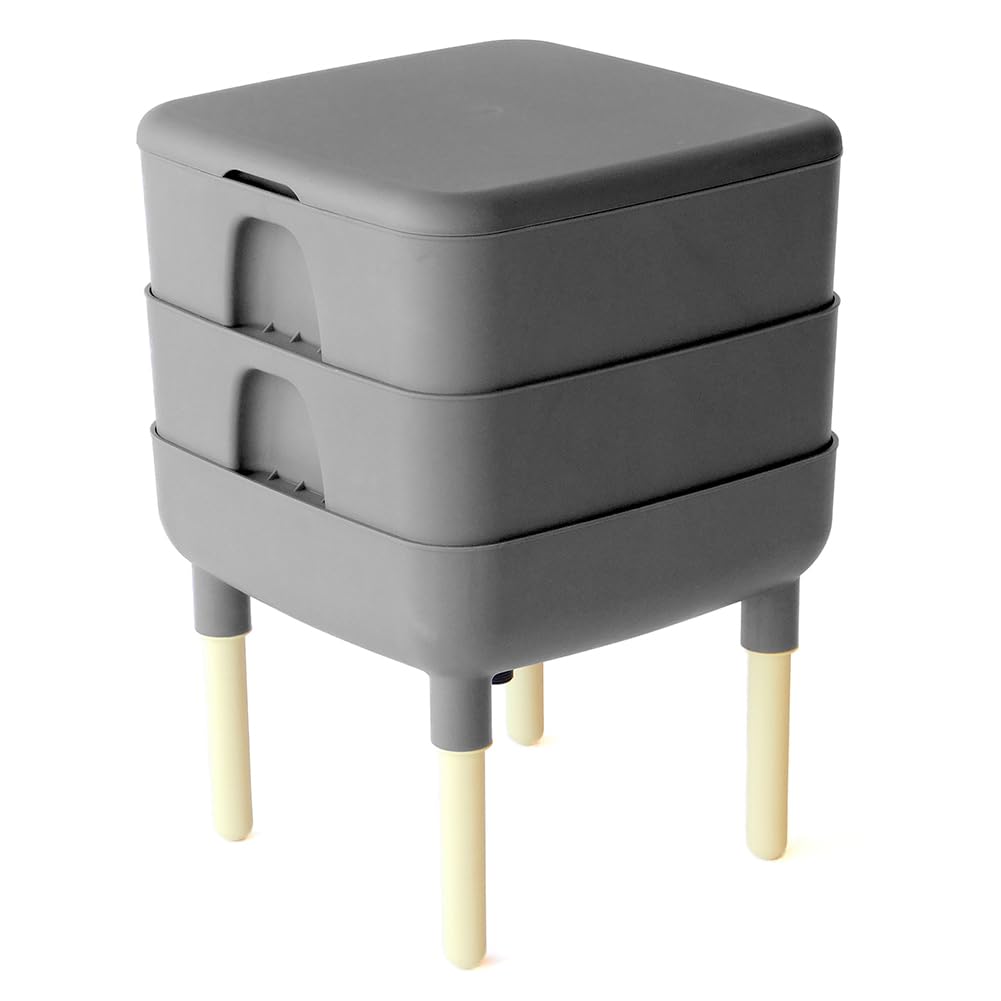
Fifty-two migration tunnels and a moisture channel — engineered so worms move freely and bedding never dries at the edges.
The engineering here is quietly serious. Each tray carries a moisture control water retention channel running around its outside edge, which stops the bedding along the walls from drying out and driving worms away from the perimeter. Fifty-two angled migration tunnels drop from the base of each tray, giving the colony ample routes between levels. Aeration support points molded into the tray sides push airflow through 360 degrees. It is the most deliberately designed tray system in this lineup, and the result is a bin that can live indoors year-round without turning the room.
Two trays, 8 gallons, and a body 15 inches long by 15 inches wide by 22 inches tall — shorter than the VermiHut’s 27.5 inches but taller than the Maze’s 11 inches, so it slots into a utility room or mudroom without dominating it. The material is BPA-free, UV-inhibited recycled polypropylene, made in Canada, and the 4.4 kg weight keeps it stable when you lift a loaded tray. Worm tea collects in the reservoir base; mix one part tea with one part water for a plant fertilizer, and the one-year limited replacement warranty covers manufacturing defects.
Assembly is straightforward and the bin looks tidy enough to leave out. The catch is capacity and tray count together: 8 gallons over two trays suits a steady but modest scrap flow, and there is less headroom to expand than a five-tray stack gives you. Worm composters of this type do not include worms, and that is true here as well.
Why it holds up: the moisture channel, migration tunnels and 360-degree aeration are real functional differences — not decoration — and they translate into a colony that stays put and bedding that stays right.
The trade-off: two trays and 8 gallons cap how much you can process at once, so a large household will outgrow it.
Bring it indoors: the right call for a utility room or mudroom setup where the bin has to be unobtrusive and odor-free.
Skip if: you want room to add trays later — this one is fixed at two.
5. Maze Worm Farm

Two working trays, a sliding worm-saver and a lid light enough to lift one-handed.
Liftability is the design brief here. At 9 pounds and 11 inches tall, the Maze is the most portable bin in this lineup by a wide margin — the VermiHut Classic stands at 27.5 inches, which is a stack you site once and leave, while this one you can pick up by the lid and move. Two working trays rotate when one fills, so you always have a fresh feeding layer while the other finishes. The square 15-by-15-inch footprint sits neatly in a corner.
The parts list is thoughtful: a worm-saver tray that slides out, a liquid collection tray under everything, coconut peat for bedding, and a base and lid that mean the whole system arrives ready to populate. Airflow is well handled, and the recycled material construction diverts waste from landfill — a nice bit of consistency for a product whose whole job is recycling food waste. Made in Australia, with a one-year limited warranty.
Owners confirm the worm-saver tray keeps the colony out of the liquid collection tray below. The limitation is tray count and expandability — two working trays cover a modest household, and this is not a system that grows the way the VermiHut’s five-tray stack does. It is also the priciest per tray of the group, so you are paying for portability and build quality rather than raw volume.
Strong points
- 9 pounds and 11 inches tall — genuinely lift-and-move portable
- Sliding worm-saver tray keeps the colony out of the collection tray
- Liquid collection tray handles drainage cleanly
- Made from recycled material, made in Australia
Limits to know
- Two working trays only — a smaller household system
- No expandable stack like the five-tray VermiHut
- Liquid collection tray needs draining before it gets heavy
Best for balconies and renters: you can walk this bin to a new spot without dismantling it.
Skip if: you need to absorb a whole family’s scraps — two trays will not keep pace.
6. Urban Worm Bag Worm Composting Bin Version 2

A 150-liter fabric bag that you feed from the top and harvest from the bottom — no trays to separate.
Nothing else here holds this much. At 150.75 liters, the Urban Worm Bag dwarfs the VIVOSUN’s 30 liters and the Blütezeit’s 7.93 gallons, and it does it without a single tray to lift. The continuous flow design means you feed through the top and collect finished castings out the bottom, so you never separate worms from their work. Version 2 removes the bottom zipper entirely — the patent-pending design means one less thing to seize up or tear.
The fabric does real work. 900D oxford is a tightly woven, heavy-duty cloth, and here it functions as the bin’s breathing surface — you keep the detachable flap open or closed to dial moisture up or down. That is a different approach from ventilation slits in rigid plastic: the whole wall breathes. Setup takes under five minutes with no tools, glue or confusing instructions. Sized 26.75 inches long by 26.75 inches wide by 31.75 inches tall, it needs real floor space in a garage, basement or shed.
Where it falls short is the frame. The structure itself draws mixed feedback — plenty of owners find it solid and long-lived, but a wobblier frame and units failing early do come up, and that is the one thing to watch with a bag this big holding wet material. Weigh the 150-liter capacity against a frame that is not in the same league as the molded plastic bins before you commit.
The capacity argument: you can process a genuine volume of scraps without ever touching a tray, and the no-zipper bottom removes the usual failure point on harvest day.
The honest caution: the frame is the weak link — set it somewhere it will not get knocked, and do not overfill it.
For the serious scrap producer: a large household, a community garden, or anyone with a garage floor to spare.
Think twice if: it will live on a carpet or in a tight corner — 26.75 inches square and 31.75 inches tall needs room and a stable floor.
Know the Specs
Capacity in liters and gallons
Capacity tells you how much bedding, food and colony the bin holds at once — not how much waste it processes in a day. A 30-liter bin and a 150.75-liter bag are different tools for different households. Large capacity buys you tolerance: more bedding buffers a wet feeding, more volume lets a colony spread out. Small capacity suits a compact kitchen but fills fast, so weigh the number against how many people are generating scraps.
Tray design and harvest method
Stacked-tray bins let worms migrate upward into fresh food, so the bottom tray finishes first and slides out as a block of castings. Continuous-flow designs skip the trays — you feed the top, pull finished material from the bottom, and never sort worms out. Stacked trays give you more control and visible progress; flow designs ask less of you at harvest. Both keep the colony undisturbed if you work them properly.
Drainage, spigots and worm tea
Worm bedding should be damp like a wrung-out sponge, never soaked. A collection tray or reservoir under the working layers catches the liquid that drains through, and a spigot lets you draw it off without lifting anything. That liquid — worm tea — gets diluted with water and used on plants. Bins without a clear drainage path let moisture pool, which drives worms out and turns the bedding sour.
Airflow and odor control
Ventilation slits, molded aeration points and breathable fabric all do the same job: keep oxygen moving through the bedding so the aerobic process continues and odors stay down. Rigid plastic bins use slits and channels; fabric bags use the wall itself. Either way, the bin needs some air movement around it — a sealed cabinet or a stuffy corner makes any of these systems work harder than it should.
Common Questions
Do worm farm bins come with worms included?
How do I know which bin capacity is right for my kitchen?
What is worm tea and how do I collect it?
Can a worm farm bin be kept indoors year-round?
How long does it take before I get usable castings?
Why does my worm bin attract fruit flies?
Is a tray bin or a fabric flow bag better for a beginner?
Where should I put a worm farm bin in an apartment?
Does a worm bin actually smell?
What material should the bin be made from?
The Bottom Line
The VermiHut Classic is the pick that fits the most people best. Fifty liters across five trays gives a growing colony room to work, the continuous-flow stack means harvest is a tray pull rather than a sorting session, and the worm tea collection keeps moisture where it belongs. If budget is the constraint and space is tight, the VIVOSUN delivers a compact 30-liter setup with a spigot and a genuinely complete accessory kit — it is the value play in this lineup. And if you want the whole start-up experience in one box, worms aside, the Blütezeit’s included bedding, tools and soil meter get you composting without a trip to the garden store.
Where the VermiHut’s height is a real constraint, measure first. The Maze at 11 inches and 9 pounds is the portable option, and the Urban Worm Bag is the one to reach for if you have garage floor space and a lot of scraps to process. Measure your counter, balcony or garage floor first, then pick the bin that fits it.
How we choose
We do not accept paid placement. Every pick is matched to a real buyer and a real use-case; we do not hands-on test units.
Sources
Specifications: manufacturer listings and product documentation. Review insights: verified customer reviews, as of November 2026. Pricing: not shown on this page (it changes often); check the current price via the retailer link.
As an Amazon Associate, Tactical Gear Guy earns from qualifying purchases. This does not affect which products we feature.