Specs are compiled from manufacturer listings and verified buyer reviews and can change over time — please confirm the key details on the product page before buying.
A wobbly stand ruins a good light. A cheap tripod shakes at full height, tips when a softbox catches a draft, and makes you lift a heavy fixture every time you move it. The seven stands below solve this in different ways: one rolls on casters (small wheels), one reaches 10 ft, and one packs into a gear bag. So the right pick depends on one question: do you roll your lights, lift them, or carry them?
This guide is built by comparing the manufacturers’ published specifications and the patterns across verified customer reviews, so you get each pick’s real strengths and trade-offs instead of marketing spin.
Load rating, top height, and pack-down length are the three numbers that decide whether a stand survives your workflow, and every spec below is quoted exactly as the maker publishes it. Here is the honest read on the best work light stand for studios, gigs, and garage setups alike.
Top Picks

How To Choose The Best Work Light Stand
Start with the fixture you own, not the stand. A small COB light or LED panel needs a few pounds of support; a strobe with a softbox on a boom needs a base that will not tip the moment a door opens. Everything else — height, wheels, folded length — follows from that one number.
Match the load rating to your heaviest setup
The load capacity is how many pounds the stand holds with your modifier attached, and it is quoted for the whole stand, not per leg. A ring light and a reflector sit comfortably on the lighter ratings. A softbox catching wind outdoors is a different story, and that is the case where an 11 lb rating with a sandbag at the base beats a higher rating with an empty base.
Decide between a tripod base and a rolling base
A tripod base spreads three legs and folds into a tube you carry over your shoulder. A rolling base adds casters so you glide a heavy fixture across a smooth studio floor instead of dragging it. Casters with step-on brakes lock the stand in place while you shoot, then release so you can reposition between setups.
Check the mount before you buy
Most consumer stands end in a 1/4″-20 screw — the small camera-style thread. Studio stands use a universal spigot that takes strobes, monolights, and ring lights. If your lights use one thread and your stand uses the other, you are buying an adapter, so check this first.
Think about where it will live
A stand that folds small enough for a suitcase suits gig work; a stand that folds flat for a closet corner suits a home studio. Height matters just as much in reverse: a stand that stops at 6 ft cannot put a hair light above a standing subject, and a stand that reaches 10 ft needs more room than a low ceiling allows.
Side-by-Side Comparison
| Model | Best For | Load Capacity | Max Height | Weight | Amazon |
|---|---|---|---|---|---|
| NEEWER Heavy Duty with Casters★ Best Overall | Rolling a full studio rig | 66 lb | 10 ft | 17 lb | Amazon |
| Ulanzi TT43Best for Travel | Sliding into a video bag | 6.6 lb | 6.32 ft | 840 g | Amazon |
| K&F CONCEPT TL06 | Height on a tight budget | 11 lb | 9.3 ft | 1742 g | Amazon |
| SMALLRIG 5475 | Folding flat for travel | 8.8 lb | 6.23 ft | 2.2 lb | Amazon |
| Altson 2 Pack | Two lights on one order | 11 lb | 83 in | 2.2 lb | Amazon |
| Bloazzup DJ Light Stand | Stage and party lighting | 66 lb | 95 in | 6.6 lb | Amazon |
| NEEWER Pro C Stand | Boom-mounted studio work | — | 10.8 ft | 25 lb | Amazon |
Detailed Reviews
1. NEEWER Heavy Duty Light Stand with Casters
Our pick — 4.5+★ from 550+ verified ratings; the strongest balance of quality and price.
The rolling heavyweight that holds a full studio rig and moves it without a lift.
If you shoot in one room and rearrange it a dozen times a session, this is the stand that stops the lifting. It supports up to 66 lb (30 kg) of gear — enough for a strobe, a softbox and the arms around them — on a stainless steel frame that shrugs off moisture, heat and knocks. That is ten times the 6.6 lb rating of the Ulanzi TT43.
What wins people over is the build. Owners praise the stainless steel frame first and the 360° swivel casters second — they roll the whole rig across a floor instead of forcing a drag. Step-on brakes lock all the wheels so the stand stays put mid-shoot, and the rubber wheels keep a finished floor free of scratches. Height runs 4.3 ft to 10 ft (130 to 305 cm) across three telescopic sections, so you can drop it low for a product shot and raise it over a standing subject.
The honest catch is weight. At 17 pounds it is nearly eight times the 2.2 lb Altson stand, and you will feel every ounce on stairs or a loading ramp. It also folds to 3.9 ft (120 cm), which is long for a car boot. This is a studio fixture, not a bag stand, and the spring-loaded mechanism under the legs is there to cushion a sudden drop rather than to make the stand light.
Where It Earns Its Floor Space
- 66 lb load rating carries a strobe and softbox together
- 360° casters with step-on brakes lock and release in one motion
- Stainless steel resists moisture, heat and shocks
- Extends 4.3 ft to 10 ft across three sections
What You Give Up
- 17 pounds — a two-hand carry, not a shoulder carry
- Folds to 3.9 ft, so it needs real storage length
- Overkill for a single small LED panel
Buy it if: your lights live in one studio and you want to move them without lifting.
Think twice if: the stand has to travel in a car boot or up stairs every week.
2. Ulanzi TT43 Extendable Photography Light Stand
Folds to 43 cm and disappears into a video bag, then climbs to 6.32 ft when you need it.
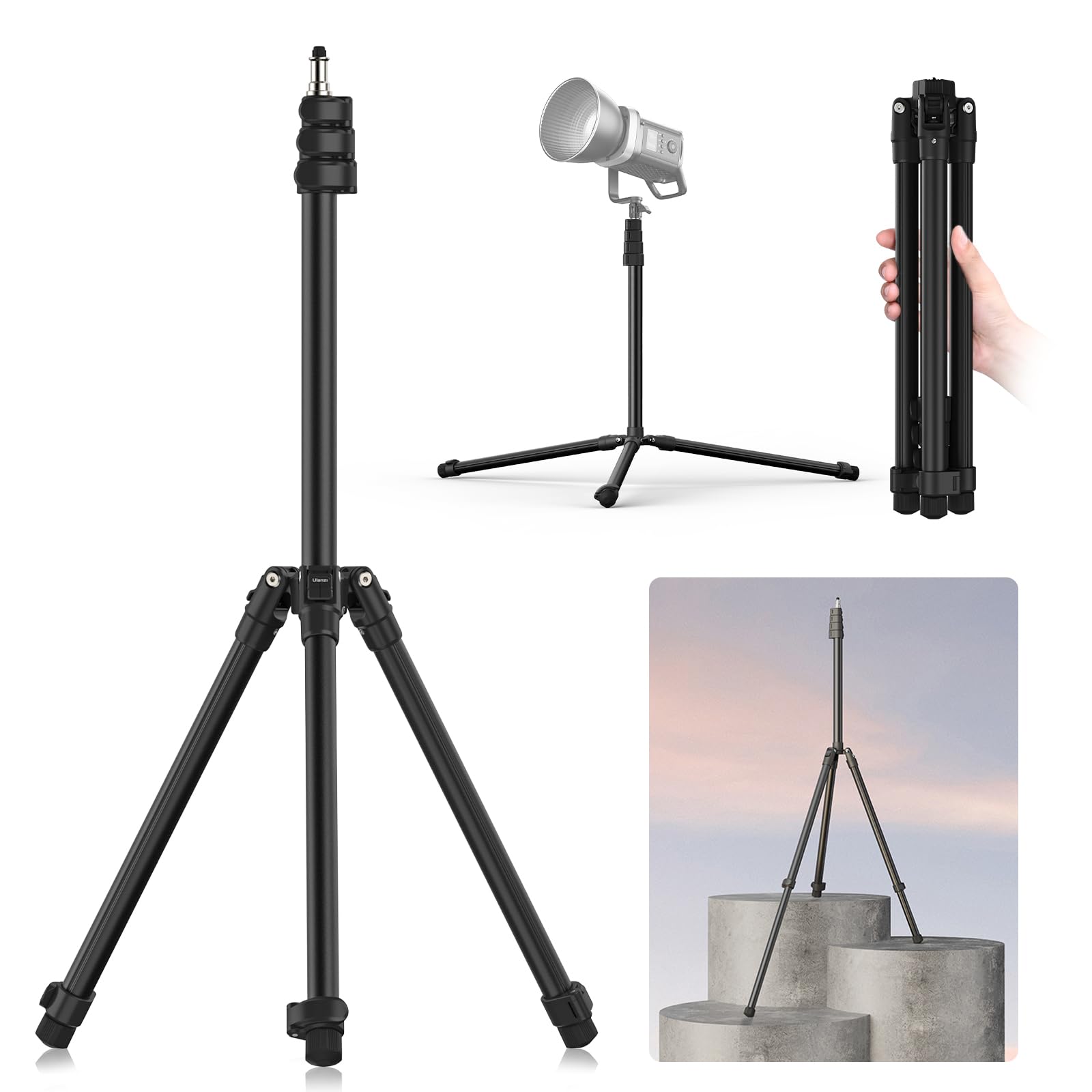
For run-and-gun shooters, the fold size is the whole argument. This stand collapses to 43 centimeters, so it slides into the same bag as your camera and never rides loose in the boot. The anodized aluminum alloy frame has thickened tubes in all three sections and takes up to 6.6 lb (3 kg) — a ring light, an LED panel, a small strobe. The top carries a standard 1/4″ screw, so most consumer lights mount straight on.
The adjustable range is wider than the fold size suggests. Height runs from 2.49 ft (76 cm) to 6.32 ft (190 cm), and a snap design lets the tripod base splay for a 45 cm low-angle setup — useful for product shots on a table. A spread lever locks the legs where you splay them. Owners praise the 43 cm fold first and the build quality second.
The trade-off is stiffness, and the reviews say so plainly. Stability comes up often and splits both ways — the stand holds steady for a light fixture but is not as planted as a heavier base when you push it to full height with a big modifier. A sandbag (not included) on the tripod base is the fix, and if you plan to hang a softbox off the top at 6 ft, budget for one.
The carry-first pick: nothing else here folds this small while still reaching above eye level, and the 1/4″ screw means most LED lights mount without an adapter.
Know its limit: at 6.6 lb it is built for a single light, so a strobe plus a large softbox belongs on a heavier stand.
Made for: the shooter who packs a bag and moves location weekly.
Better served elsewhere: a studio rig that never leaves the room needs more base weight.
3. Altson 7 Feet Aluminum Light Photography Tripod Stand

Two key-and-fill stands in one box, light enough to carry both at once.
A two-light setup usually means buying twice, and this pack skips that step. You get two aluminum stands and a carry case, each stand rated to 11 lb and reaching 7 feet (83 inches). Each one weighs 2.2 pounds, so carrying the pair still beats hoisting the 17-pound NEEWER on its own. For a fill light and a key light in a small space, the math works in this pack’s favor.
The base is built to stay put. A triangular structure with soft rubber feet keeps the stand planted on uneven ground outdoors, which matters when you are setting up on grass or gravel rather than a studio floor. The top uses a 1/4″ screw for strobes, umbrellas, softboxes, panel lights and phones. The legs come apart for storage, which is how the whole set drops into the included case.
Height runs 2.5 to 7 feet, and that range is the reason to stop here. It handles a seated portrait and a standing subject, but it will not get a hair light over a tall model the way the K&F CONCEPT at 9.3 ft will. If your work is headshots and product shots rather than full-length studio lighting, the ceiling is not a problem.
The pairing play: two stands rated at 11 lb each for roughly the same outlay as one heavier stand, with a case to keep them together.
Height ceiling: 7 feet is a headshot and product height, not a full-length studio height.
Suits you when: you are building a two-light setup from scratch and want the case included.
Not for you when: you need a single stand that reaches over a standing subject.
4. SMALLRIG 74.8″ Light Stand Photography

A 180° flip-up design that folds to 16.5 in and still carries 8.8 lb.
The 180° flip-up folding is the spec to note. When folded, this stand measures 42 cm (16.5 in) — short enough to drop into a suitcase or a backpack, not just a gear bag. It weighs 2.14 lb and carries up to 4 kg (8.8 lb), so a 25W LED light mounts without strain. The top takes a stainless steel 1/4″-20 screw, which fits SmallRig’s own COB and video lights plus ring lights and softboxes from other makers.
Height runs 42 to 190 cm (1.38 to 6.23 ft), adjusted by a lever clamp that locks with a quick throw instead of a twist. The two-section leg tubes offer three angle options, and wider angles add stability when you need it. Enlarged anti-slip foot pads sit under the base to keep it from creeping. The anodized aluminum alloy frame resists rust, with ABS plastic at the joints and non-flip feet.
Where this one asks patience is stiffness and reach. Sturdiness and height both draw mixed feedback — a few owners find it less solid than hoped at full extension, and some want more height than 6.23 ft gives. Neither is a defect, just a ceiling: mount a light panel and it holds, mount a heavy strobe with a large softbox and you have asked more than 8.8 lb of equipment really covers.
Pack-it-and-go build: 16.5 in folded and 2.14 lb on the arm, with three leg angles to widen the stance on uneven ground.
Set your expectation: 8.8 lb and 6.23 ft define a light-panel stand, not a studio strobe stand.
Grab this one for: travel lighting with a small LED or COB light and a suitcase to pack it in.
Handle with care if: you plan to hang a large softbox at full height on a windy set.
5. K&F CONCEPT 9.1ft Light Stand

Nine and a third feet of reach on a stand built like a tank, without the tank’s weight.
Height is the headline here, and it is close to the rolling NEEWER. This stand climbs to 9.3 ft (283 cm) against the NEEWER’s 10 ft — near enough that a ceiling-height hair light stops being a problem. The metal construction with a tripod base and extension bar keeps the reach steady, and the built-in collapsible long legs with non-slip feet widen the base where the floor allows. Load capacity tops out at 11 lb (5 kg).
Owners describe the metal frame as tank-like and single out its sturdiness. The buckle-style locking lets you set the angle, and the top has a 1/4″-20 threaded stud that swivels 180° front to back so a light panel can be tilted without moving the base. It folds to 39.4 in (100 cm), which fits a car trunk or a large gear bag — longer than the SMALLRIG’s 16.5 in, so plan storage for it.
The one caution: 11 lb is the limit, and a heavy modifier at 9.3 ft pushes right against it. The maker’s own advice is to pair heavy modifiers at full height with a sandbag (not included). Height runs 3.7 to 9.3 ft, so it drops low for a product shot too.
Reach over weight: 9.3 ft of height at a weight the arm can manage, with a swiveling 1/4″-20 stud on top.
Sandbag territory: full height plus a heavy modifier means adding ballast at the base.
Reach for this if: you need over-subject height and a stand that still travels in the trunk.
Look elsewhere if: you hang a heavy softbox at 9 ft with no way to weight the base.
6. Bloazzup DJ Lights Stand 41-95 Inch, Heavy Duty T Bar Tripod

A T-bar that hangs four par cans and still breaks down for the car after the gig.
Stage lighting is a different job from studio lighting, and this stand is built for it. The heavy-duty tubular steel tripod takes up to 66 lb while weighing 6.6 lb itself, so it can carry the weight of four stage lights over a full night. Height runs 41 to 95 inches, adjusted by a mechanical design that lets you set it wherever you want and leave it there.
The T-bar does the heavy lifting. Eight hanging point bolts let you mount fixtures quickly, or the FS-Adapter mounts one light at a time at the top. Run two stage lights and put one on each side so the bar stays balanced. Remove the crossbar entirely and the stand converts to a speaker stand — a useful second job for a one-man DJ rig.
Set-up speed wins people over. Owners praise the build quality and sturdiness, and the stand holds steady without the wobble that ruins a light show. It breaks down and collapses for transport, which is what makes it work for outdoor performances and parties. The one number to watch: the bracing legs spread wide — the base footprint is a matter of feet, so measure the floor before you plan the layout.
Built for the Gig
- 66 lb load capacity carries four stage lights
- Eight hanging bolts plus FS-Adapter for single fixtures
- Converts to a speaker stand when the crossbar comes off
- Collapses for transport between venues
Odd Man Out in a Studio
- Wide leg spread needs floor room
- T-bar format is not built for a softbox or reflector
On your shortlist if: you run stage wash lights or par cans for gigs and parties.
Keep looking if: your setup is a studio softbox on a single top mount.
7. NEEWER Pro 100% Metal C Stand with Wheels and Boom Arm

The boom arm reaches where three legs cannot, and the wheels follow it there.
Sometimes the light has to hang out over the subject, not stand beside it. That is the problem the 4 ft (120 cm) boom arm solves: it swings a light or reflector out past the tripod base, and two metal grip heads with four channels let you set that angle precisely. Remove the crossbar and it works as a plain light stand — a flexible choice for a studio that shoots both.
Height and stability run high. This stand tops out at 10.8 ft (330 cm) and drops to a 4.8 ft (146 cm) minimum, on a three-leg structure that keeps equipment planted. The frame is pure metal, built to resist corrosion from air pollution and salt exposure, with rubber pads on the sliding points to keep it from skating. The step-lock system on the wheels locks and releases with a foot, and the rubber base adds a non-slip grip.
The trade-off: at 25 pounds it is the heaviest stand on this list, and its load rating (how much weight it can hold) is not published. So plan around what the boom (the arm that holds a light out from the stand) and grip heads will physically hold, not a printed number. The base is wide and the legs are long, so it needs a room with floor to spare. What you get back is a stand that will not tip, even through a long shoot day.
Boom-first design: a 4 ft arm and two grip heads reach over a subject where a straight stand cannot.
Space and muscle required: 25 lb and a wide leg base mean a permanent studio corner, not a closet shelf.
Worth it for: the studio that needs a boom-mounted light or reflector and wants zero tip risk.
Too much stand for: a bag-and-go shooter or a room with no floor to spare.
Know the Specs
Load capacity and why it is measured in pounds
A load capacity tells you how much gear the stand will hold, quoted in pounds or kilograms. It is the number that decides whether a stand survives a heavy modifier. A small LED panel on an 8.8 lb stand is comfortable; a strobe with a large softbox needs more headroom. As a rough rule, match the rating to the fixture you own, then add margin if the light hangs out on a boom or catches outdoor wind.
Max height versus folded length
Max height is how high the stand reaches with every section extended; folded length is how short it packs. These two fight each other. A stand that folds to 16.5 in rarely tops 6.23 ft, and a stand that reaches 10 ft usually folds to 3.9 ft or more. Decide which matters more — reaching over a standing subject or fitting in a suitcase — and pick the stand that trades in your favor.
What a 1/4″-20 screw versus a spigot means for your gear
A 1/4″-20 screw is the small camera-style thread found on most consumer lights and panels. A universal spigot is the wider studio mount that takes strobes, monolights and ring lights. Check the thread on the bottom of your light before ordering. If the two do not match, you need an adapter — a small, cheap part, but worth knowing before the stand arrives.
Casters, brakes, and boom arms
Casters let you roll a heavy fixture rather than lift it, and step-on brakes lock them so the stand stays put while you shoot. A boom arm swings a light out past the tripod base, which is how you get a hair light directly over a subject. Both add weight and floor space, so they pay off in a studio that stays put and get in the way for a stand that travels.
Common Questions
How much weight can a work light stand safely hold?
Will a 1/4″ screw stand fit my strobe light?
Do I need casters or a plain tripod for a home studio?
How tall a stand do I need for full-length portraits?
Will a light stand fit in a car trunk?
Is a heavier stand really more stable?
Can I use a DJ light stand for photography softboxes?
What is a boom arm for on a light stand?
Can a work light stand go outdoors?
Do I need a sandbag with my light stand?
The Bottom Line
For most studios, the work light stand that earns the spot is the NEEWER Heavy Duty with Casters. It holds 66 lb on stainless steel and rolls on 360° casters (wheels that spin all the way around), so you stop lifting your rig and start rolling it. If height on a budget matters most, the K&F CONCEPT reaches 9.3 ft with an 11 lb rating and folds into a trunk. And for a shoot that travels by bag, the Ulanzi TT43 folds to 43 cm and still climbs to 6.32 ft.
Before you buy, measure the folded length against your boot or closet, check the top thread against the bottom of your light, and match the load rating to the heaviest fixture you own.
How we choose
We do not accept paid placement. Every pick is matched to a real buyer and a real use-case; we do not hands-on test units.
Sources
Specifications: manufacturer listings and product documentation. Review insights: verified customer reviews, as of November 2026. Pricing: not shown on this page (it changes often); check the current price via the retailer link.
As an Amazon Associate, Tactical Gear Guy earns from qualifying purchases. This does not affect which products we feature.