Specs are compiled from manufacturer listings and verified buyer reviews and can change over time — please confirm the key details on the product page before buying.
You want to see what your oxygen level does while you sleep — without clamping a hard plastic finger clip on and waking up with a numb hand. A wrist pulse ox does exactly that: a small unit straps to your wrist, a soft sensor sits on your finger, and it logs blood oxygen and pulse rate all night on its own. The picks below split into two jobs: dedicated overnight recorders built for sleep data, and fitness bands that read blood oxygen as one metric among many. For sleep logs, stay with the recorders. For a general activity watch with oxygen as one extra number, the band belongs on your list.
This guide is built by comparing the manufacturers’ published specifications and the patterns across verified customer reviews, so you get each pick’s real strengths and trade-offs instead of marketing spin.
One thing to settle before you scroll: these are sports and aviation tools, not medical devices, so treat every reading as a training and trend number rather than a diagnosis. Here is how to read the fine print in the wrist pulse ox listings so you end up with the right recorder.
Top Picks


How To Choose The Best Wrist Pulse Ox
The mistake most first-time buyers make is shopping by brand name or by how the strap looks. The number that decides whether a wrist unit is useful to you is how it handles a full night away from your phone.
Recording time versus charge time
A recorder that runs eight hours but takes six to charge is a unit you have to think about every day. Look at the continuous-recording figure, in hours, and the charge time beside it — that pair tells you whether you can strap it on nightly without a charging ritual. A 100-hour continuous rating with a two-hour charge is a very different ownership experience than a 12-hour rating on the same charge cycle.
Where the data lives when the phone is off
Your phone does not sleep beside you, and Bluetooth drops when it walks out of range. That is why built-in memory matters more here than in almost any other wearable. A unit that stores several nights on the device keeps recording even with nothing paired, then syncs when you open the app. Check how many sets it holds and whether old sets overwrite new ones.
Finger probe comfort and fit
The probe is what actually touches your skin for eight hours, so silicone and a soft cable beat a rigid clip. Look for an adjustable finger loop and a cable long enough to let your hand rest naturally. A tight or chafing probe is the reason people give up on overnight tracking after two nights.
The oxygen alert threshold
Some units buzz or beep when your oxygen drops under a level you set in the app. That feature earns its keep if you want the device to flag a dip instead of hunting through charts the next morning. Check whether the threshold is adjustable from the unit itself or only from the app.
Side-by-Side Comparison
| Model | Best For | Continuous Battery | Form | On-Device Storage | Amazon |
|---|---|---|---|---|---|
| EMAY SleepO2★ Best Overall | Reliable nightly sleep recording | 12 hours | Wrist unit + soft finger probe | Built-in, records without a phone | Amazon |
| Amzhero Fitness TrackerEveryday Wear | Everyday activity plus oxygen readings | 15 days standby | Wrist band, rear optical sensor | — | Amazon |
| OxyU Wrist Pulse Oximeter | Light, small continuous tracking | 12–16 hours | Wrist unit + silicone ring sensor | 4 groups of 10-hour data | Amazon |
| OxyU with Threshold Alerts | Waking you when oxygen dips | 12–16 hours | Wrist unit + finger sensor | 4 groups of 10-hour data | Amazon |
| Wellue Checkme O2 Ultra | Longest recording stretch per charge | 100 hours | Wrist unit + finger probe | 4 sets of 12-hour data | Amazon |
Detailed Reviews
1. EMAY SleepO2 Wrist Pulse Oximeter with Recording Capability
Our pick — 4.0+★ from 550+ verified ratings; the strongest balance of quality and price.
The overnight recorder that stores the whole night itself, phone or no phone.
This is the pick for someone who wants a clean record of one thing: what their oxygen and pulse did across eight hours of sleep. The unit carries its own data storage, so it logs your SpO2 (blood oxygen saturation, the percentage of oxygen your red blood cells are carrying) and pulse rate straight to the device all night. You do not need a smartphone in the room to make that happen. The app is there when you want to look at the night, not when the device needs it to function.
Battery is rated at 12 hours of continuous recording once fully charged. That covers a normal night with a little headroom, and the maker’s own material notes 10 hours in one place and 12 in the spec sheet — plan on the shorter end if you sleep long. Charge time is quoted as two hours, so a nightly routine of charging while you are at your desk keeps it ready.
The physical build is what makes it wearable rather than tolerated. It weighs 20 g, and the finger probe is a soft silicone design — that is the soft sleeve that slips over your fingertip instead of a stiff clip. Buyers report the silicone probe stays comfortable through a full night, and that its readings track closely with dedicated equipment. Sleep data comes back broken down minute by minute, which is the level of detail that makes a chart useful instead of decorative. The catch: this is a sleep recorder, not a general watch — there is no step counting, no notifications, no workout modes.
What Earns It Top Spot
- Built-in memory records SpO2 and pulse all night with no phone connected
- 20 g total weight with a soft silicone finger probe that stays on
- Minute-by-minute sleep data that is actually readable the next morning
- Simplest possible nightly loop: strap on, sleep, sync in the app
What to Know Before You Buy
- Battery is rated 12 hours continuous — a full night, not a weekend
- No steps, workouts, or smart notifications; it does one job
- Sold for sports and aviation use, not as a medical device
Buy it for: anyone whose real question is “what is my oxygen doing overnight” and who wants that answer stored on the device, not streamed to a phone.
Look past it if: you want one wrist gadget that also counts steps and buzzes for texts.
2. Amzhero Health Fitness Tracker
A full activity watch first — oxygen is one reading in a much bigger toolkit.
Start here if you were never really shopping for a sleep recorder. This is a 1.47″ HD color screen fitness band that reads heart rate, blood oxygen, blood pressure and stress, then scores your sleep on top of that. It carries 14 sports modes spanning walking, running, swimming, cycling and yoga, and it tracks steps, distance and calories all day. Text, call and social alerts buzz through to your wrist. That makes it a different product from the dedicated recorders here — the right buy only if you want oxygen as one number among many.
The daily-wear specs are the reason it holds up. It is rated 5ATM waterproof — that is a water-pressure rating meaning it is built to handle washing your hands, rain and swimming — and it tops out at 15 days of standby on the 300mAh lithium-ion battery, with a quoted 2-hour charge. Both an S and an L silicone band come in the box alongside a zinc alloy case.
Now the honest part. This is the most-used device here by a wide margin, and the feedback splits in a way you need to hear before buying. Setup and app navigation are the friendliest things about it. Accuracy is the weakest: blood pressure readings in particular draw the most friction, and step counts and reliability land mixed rather than praised. If a precise overnight oxygen trend is the whole reason you are shopping, this is not the tool — a wrist band reading oxygen every so often is not the same as a dedicated recorder logging continuously. Buy it as an activity watch that reports oxygen, and it makes sense.
The trade you are making: you get a 1.47″ screen, 14 sports modes, 5ATM water resistance and 15-day standby in one band — a genuinely broad daily tracker — but you give up the continuous overnight oxygen logging that the recorders here are built around.
Where it stumbles: blood pressure accuracy is the sore spot, and step tracking and reliability read as mixed rather than settled. Treat the oxygen figure as a rough daily checkpoint, not a trend line.
Right call when: you want a wrist band for steps, swims and notifications and simply like having an oxygen number on the display.
Keep scrolling if: the words “continuous overnight recording” are the reason you opened this page.
3. OxyU Wrist Pulse Oximeter with Bluetooth and Finger Sensor

The ring-style sensor you barely notice — until you want the numbers out of it.
If probe bulk is what put you off overnight tracking, this is the design answer. The sensor is described as the lightest, smallest silicone ring, which means it wraps the fingertip in a soft band rather than clamping it. That build is the whole pitch for continuous wear. The wrist unit measures oxygen saturation, heart rate and body motion, and runs 12 to 16 hours after a full charge — enough for a night with room to spare.
Data handling is where it goes further than a plain recorder. It samples every four seconds and builds an O2 score, and you can export records free as PDF, CSV or Binary for a proper PC report. That export is the difference between a chart on your phone and something you can hand to whoever wants to see the trend. The device stores 4 groups of 10-hour data internally, then pushes each set to the app over Bluetooth — with one caveat: the first set gets overwritten by the fifth, so a habit of syncing keeps your history intact.
Setup is genuinely hands-off. The monitor starts running the moment you put it on, and turning your wrist wakes the screen. Fit runs to an adjustable 16–23cm perimeter, so it sizes across a wide range of wrists. The honest note is on function: the feedback runs mixed, with some units working exactly as intended and some not working at all. That makes the first-week check essential — confirm the sensor is picking up a trace before you rely on it overnight.
The standout detail: four-second sampling plus free PDF, CSV and Binary export, which is a level of data portability the simpler recorders here do not offer.
What to verify early: once it is running, it runs well for most owners — but the mixed feedback means you should test a full night in the first week rather than assume.
Fits you if: you want the least intrusive probe and you plan to pull the data into a report.
Think twice if: you would rather have a proven simple recorder than a feature-rich one you must test first.
4. OxyU Wrist Blood Oxygen Monitor with Real-Time Notification
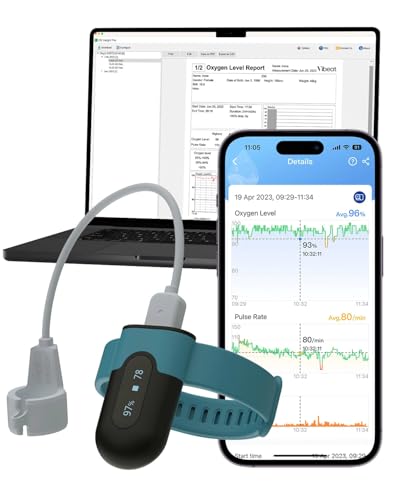
Built to tell you when oxygen dips, instead of letting you read about it later.
The feature that sets this OxyU apart is the alert. Set a threshold anywhere between 80% and 95% in the app, and if your oxygen falls under it, the wrist unit vibrates and the app beeps. That turns a passive logger into something that taps you on the wrist during the night. The measuring range is 70% to 100% SpO2, and the sensor uses infrared technology to track oxygen saturation, heart rate and body motion continuously.
Everything else follows the same blueprint as the smaller-sensor OxyU: 12 to 16 hours of use on a full charge, a data point every four seconds, and free export in PDF, CSV or Binary with PC-side report management. Storage holds 4 groups on the device at 10 hours each and syncs to the ViHealth app over Bluetooth, with unlimited app storage but the same overwrite warning once you pass the fourth set. Monitoring starts automatically when you put it on, and a wrist turn wakes the screen.
The gap worth knowing is the data feedback. This variant has the thinnest track record of the group, and that is a fair signal — the alert function is a real advantage, but you are buying a newer listing with less history than the EMAY. Run it side by side with your expectations in the first week. It is rated 3.0+ stars, low for this list, so go in with clear eyes about the odds.
Why people pick this one: the customizable 80–95% threshold with vibration and sound is the most practical safety-net feature on the page if you want to be woken by a dip.
The fair caveat: it is a young listing with limited feedback history, so the built-in alert is compelling but lighter-proven than the older recorders here.
Choose it when: being alerted mid-night to a low reading is worth more to you than a long track record.
Pick differently if: you want a recorder with years of owner data behind it — the EMAY is the safer bet.
5. Wellue Checkme O2 Ultra Wrist Pulse Oximeter
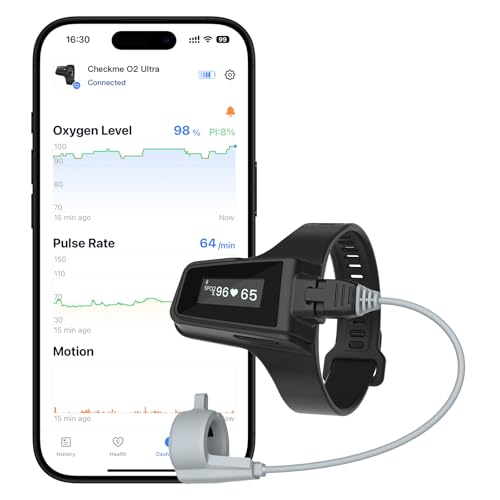
The marathon recorder: a full charge covers night after night after night.
If you have ever cut a recording short because the battery gave out, the number to look at is 100 hours. That is how long the Checkme O2 Ultra runs continuously on a full charge, and it needs only 2 hours plugged into its magnetic charging cable to get there. Compare that with the EMAY SleepO2’s 12-hour continuous rating and 2-hour charge — the gap is enormous if you track over multiple nights or loan the unit out without a nightly charging habit. It is the clear winner on stamina, and it is the reason the price tag sits at the top of this list.
The rest of the package is built for unsupervised nights. It stores 4 sets of 12-hour data internally, so it keeps logging second by second even without a constant app connection, then syncs over Bluetooth to the ViHealth app for graphic trends. The reminder function is adjustable both on the unit itself and in the app, firing an audible or vibrating alert when oxygen or pulse rate drops below your set thresholds. The sensor is an advanced optical design that measures oxygen level and pulse rate continuously, and the whole thing is shaped to fit wrist and finger without intruding during daily wear.
What owners keep coming back to is the battery — it is the standout by a clear margin, and the device syncs easily to phones. The recurring trade-off is that the reading is only as good as the probe placement, so a loose finger sensor or a cold hand shows up in the data. It is rated 3.5+ stars, which is solid but not stellar, so treat it as the long-haul recorder rather than a faultless one. Magnetic charging is a nice touch for a nightly routine, though it means keeping the proprietary cable track of.
Where It Wins Big
- 100 hours continuous recording on a 2-hour charge — far beyond the 12-hour recorders here
- 4 sets of 12-hour on-device storage for nights without a phone nearby
- Audible and vibration alerts adjustable on the unit itself, not only in the app
What to Weigh
- Top-tier pricing for the category
- Probe placement is critical — a loose sensor or cold fingers shows up in the data
- Charging uses a proprietary magnetic cable you will need to keep track of
Go for this: if you want to record many nights between charges and never think about the battery mid-streak.
Hold off if: you only ever need one overnight reading, where a 12-hour recorder does the same job for less outlay.
Know the Specs
Continuous hours versus standby days
The most misleading comparison on this page is between “12 hours” and “15 days.” They measure different things. A 12-hour rating means the device runs its sensor nonstop for that long while recording every second — that is a full night. A 15-day figure on a fitness band means standby time with normal wear and intermittent readings, not continuous oxygen logging. When you compare the Checkme’s 100 hours against the SleepO2’s 12 hours, that is apples to apples — both are continuous recording on a full charge.
On-device memory in sets
A “set” is one recording session the unit holds internally before it syncs or overwrites. The OxyU units store 4 groups of 10-hour data; the Checkme stores 4 sets of 12 hours. That matters because the first set gets overwritten by the fifth on the OxyU designs — so a habit of syncing keeps your history, and skipping it for a week costs you the earliest night. The EMAY stores on the device and works without a phone, which is why it suits the no-phone-in-the-bedroom crowd.
SpO2 percentage and alert thresholds
SpO2 is the percentage of your red blood cells carrying oxygen, and these units read it in the 70% to 100% range. The alert thresholds on the OxyU and Checkme work by letting you set a floor — typically between 80% and 95% — and firing a buzz there. This is a signal to look at your trend, not a medical reading; all of these are labeled sports and aviation tools.
Common Questions
Will a wrist pulse ox record my oxygen all night without my phone nearby?
How long does the battery actually last during continuous recording?
Is a fitness tracker with blood oxygen the same as a dedicated pulse oximeter?
Are these wrist oximeters medical devices?
What is the difference between the two OxyU units?
How often should I sync the data to the app?
Does the finger sensor fit different hand sizes?
Can I export the oxygen data to a computer?
What does the alert threshold do on the Checkme O2 Ultra?
Does wearing a wrist pulse ox make sleeping uncomfortable?
The Bottom Line
For most buyers, the wrist pulse ox that earns the top spot is the EMAY SleepO2, because it records continuous overnight SpO2 and pulse with its own built-in memory and needs no phone in the room. If battery endurance is your priority and you track many nights in a row, reach for the Wellue Checkme O2 Ultra with its 100-hour run time and adjustable alerts. And if you wanted an everyday activity watch that happens to show oxygen, the Amzhero Fitness Tracker is the band-shaped answer. One nudge: the EMAY is the crowd-trusted pick here — 4.0+ stars across 500+ owners — so if sleep data is the goal, that is the safe start.
How we choose
We do not accept paid placement. Every pick is matched to a real buyer and a real use-case; we do not hands-on test units.
Sources
Specifications: manufacturer listings and product documentation. Review insights: verified customer reviews, as of November 2026. Pricing: not shown on this page (it changes often); check the current price via the retailer link.
As an Amazon Associate, Tactical Gear Guy earns from qualifying purchases. This does not affect which products we feature.