Specs are compiled from manufacturer listings and verified buyer reviews and can change over time — please confirm the key details on the product page before buying.
If your headlight has dimmed and a shop has quoted you a full housing replacement, here is the short answer: you probably only need the bulb. These four picks are genuine xenon HID (high-intensity discharge) bulbs, the same arc-lamp technology that came in your car from the factory. The winner is the Philips X-TremeVision Gen2: the only pick here that is E-mark road legal and made in Germany, and the one owners praise most for brightness.
This guide is built by comparing the manufacturers’ published specifications and the patterns across verified customer reviews, so you get each pick’s real strengths and trade-offs instead of marketing spin.
Below you will find how base types like D1S, D3S and D5S differ, why Kelvin ratings confuse so many buyers, and which of these bulbs actually delivers usable light instead of a marketed color. Every pick here is a real xenon arc lamp, and each one is compared on exactly what matters — this is the honest baseline for the xenon arc lamp search before you order a single bulb.
Top Picks

How To Choose The Best Xenon Arc Lamp
Most people buying a xenon bulb are not shopping for an upgrade. They are reacting to a headlight that has gone yellow, dim, or dead, usually on one side only. That changes what you should care about: fitment first, usable light second, color last.
Match the base code before anything else
A D1S bulb will not drop into a D3S socket, and neither one fits a D5S housing. The base code is the mechanical plug on the back of the bulb — the PK32d-2 on the Osram D1S, for example, is a different shape from the PK32d-5 on the Philips D3S. Check the marking on the bulb you are pulling out, not the listing on a parts website that says your car is “compatible.”
Stop chasing big Kelvin numbers
Kelvin measures color, not brightness. A 4800K bulb burns just slightly whiter than the 4300K bulb your car left the factory with. An 8000K bulb looks blue-white, and blue light is harder for your eyes to use at distance. If you want to see further, you want a lower Kelvin figure and a higher lumen figure — the Osram and Sylvania bulbs here both land at 3200 lumens.
Understand your ballast before buying
Xenon bulbs need a ballast — the small box that fires the arc and keeps it running. Some bulbs, including the D5S pick here, are sold with an integrated ballast built into the base, while others expect your car’s existing ballast to do the work. Buying the wrong configuration means a bulb that fits the hole but never lights.
Plan to replace both sides
HID bulbs dim gradually, so the old working bulb is already dimmer than the new one. Running a fresh bulb next to a worn one gives you two different colors across the front of the car. Sylvania’s own guidance is blunt about it: replace the pair.
Side-by-Side Comparison
| Model | Best For | Base Type | Color Temperature | Light Output | Amazon |
|---|---|---|---|---|---|
| Philips Xenon X-TremeVision Gen2 D3S★ Best Overall | Most buyers | D3S / PK32d-5 | 4800K | — | Amazon |
| Osram Xenarc D1S Cool Blue | D1S housings | D1S / PK32d-2 | 5500K | 3200 lm | Amazon |
| Sylvania D3S Basic HID | Simple stock swap | D3S | White | 3200 lm | Amazon |
| TechWizHub D5S HID | D5S with ballast | D5S | 8000K | 4000 lm | Amazon |
Detailed Reviews
1. Philips Xenon X-TremeVision Gen2 D3S HID Bulbs Set Of Two
Our pick — 4.5+★ from 150+ verified ratings; the strongest balance of quality and price.
The only D3S bulb here claiming 150% more road light while carrying E-mark road-legal approval.
If your car already runs D3S bulbs and you want to see further without blinding the car in front, this is the pick. Philips claims up to 150% more light on the road than a standard D3S bulb, and the E-mark approval means it is legal for public-road use, not a show-only part. Both bulbs in the set are made in Germany, and the PK32d-5 base is a direct D3S replacement at 35W.
Where the Philips separates itself is arc-blending technology, which shapes the arc inside the bulb so the light lands on the road ahead instead of scattering into oncoming eyes. The 4800K color temperature is deliberately restrained: it reads as white with the faintest hint of cool, not the blue-white you see on modified cars. Comparing it to the Osram D1S below, the Philips runs 4800 Kelvin against 5500 Kelvin — so it is the calmer, more factory-looking choice of the two. Both are genuine 35W xenon arc lamps, so the difference you feel at night is beam discipline, not raw wattage.
What wins people over, above everything else, is the brightness — it is far and away the most-discussed thing about this bulb, followed by build quality. The recurring honest note is cost: this is the priciest bulb on this list, and a share of buyers feel the extra spend over a basic replacement is hard to justify. The other thing to know is that a few owners have had issues with the bulb not behaving as expected after install, which usually traces back to a tired ballast rather than the bulb itself. Pair it with a healthy ballast and the experience lands where the reviews say it does.
What stands out
- Up to 150% more road light than a standard D3S xenon bulb
- E-mark road legal, so it is approved for street use
- Arc-blending keeps the beam out of oncoming drivers’ eyes
- 4800K reads as clean white — close to factory, not blue
- UV-quartz glass construction, made in Germany, set of two
Where it asks more of you
- The most expensive pick on this list
- Value is the one point owners split on, not brightness
- Needs a healthy ballast to deliver the light it promises
Buy this one if: your car takes D3S bulbs and you want the most usable light while staying road legal.
Think twice if: you are chasing a blue-tinted look — this bulb is deliberately white at 4800K.
2. Osram Xenarc D1S Cool Blue HID Xenon Bulbs 66140CB

A D1S-only bulb that pushes 5500K — and tells you upfront it is not really blue.
Here is the detail that saves you a return: “Cool Blue” is only the model name. Osram states plainly that the bulb runs up to 5500K, and it is not blue light. The base is D1S with a PK32d-2 socket, and it is explicitly not compatible with D3S or D8S. So if your car takes D3S, this is not your bulb no matter how good the specs read — check the marking on your old bulb first.
The numbers are a genuine 35W xenon arc lamp at 3200 lumens ±15%, running 85V, made in Germany and sold as a pair. That lumen figure is identical to the Sylvania D3S below at 3200 lumens, so on raw output the two are matched — the difference is in what the light looks like. Osram also explains something most listings skip: xenon color drifts as the bulb ages. A bulb gets whiter with use and eventually turns bluish right before it dies, while losing brightness the whole time. That is why a used factory bulb can look whiter than a brand-new Cool Blue while actually throwing less light.
The thing owners talk about most is how much further down the road they can see after the swap, and fitment is close behind — it drops into the housing as expected. Color is where opinions split: some find the tint noticeable, others say they cannot perceive it at all. Treat that as a preference question rather than a flaw. Given the bulb’s own explanation of color drift, the honest read is that the tint you get depends partly on how fresh the bulb is.
The practical case: a real German-made 35W D1S pair at 3200 lumens, with a manufacturer that tells you outright what the color will and will not do — rare in this category and genuinely useful.
The honest catch: verify your socket says D1S before ordering. It is the single most common way buyers end up with a bulb that will not fit.
Match made here: D1S housings that want brighter, whiter light with a proper factory-style beam.
Wrong turn: D3S or D8S cars — Osram states this bulb does not fit those.
3. SYLVANIA D3S Basic HID Headlight Bulb

One bulb, direct-fit D3S, for when a single side has gone dark.
This listing is a single bulb, not a pair — which makes it the practical choice when one headlight dies and you want to get back on the road now. It is a direct-fit factory replacement for D3S HID housings, rated at 3200 lumens, and it ships with a 12-month customer satisfaction guarantee from Sylvania. The bulb itself weighs 2.4 ounces, so there is nothing bulky to wrestle into the housing.
Sylvania’s own position on lifespan is worth reading before you buy: HID bulbs use roughly a third less energy than halogen and last longer, but they do dim over time. The maker’s guidance is to replace in pairs, because the two bulbs in your car always run together and the second one is never far behind the first. Against the Philips D3S above, this one is the plain replacement — no road-legal claim, no arc-blending, no 150% light figure. It is the honest stock swap, and at 3200 lumens it matches the Osram D1S on output while fitting a different socket entirely.
Fit is what owners praise most — it goes in like the part it replaced. Lifespan is the honest sore point, with several long-term users reporting a bulb giving out around the one-year mark, and installation and brightness opinions split down the middle. That pattern tells you this is a serviceable basic bulb rather than a long-haul one. If you plan to keep the car for years, budget for replacements.
Straight talk: a genuine Sylvania D3S at 3200 lumens that fits first time and costs less than the Philips — the right call for a quick single-side repair.
Set expectations: it is a basic bulb. Lifespan reports are the weak spot, so buy a spare or plan to swap both sides together.
Reach for it when: one D3S bulb just failed and you want the simplest, most affordable way back to working lights.
Look past it if: you want maximum road light or the longest service life — that is the Philips or Osram territory.
4. D5S HID Bulbs 35W
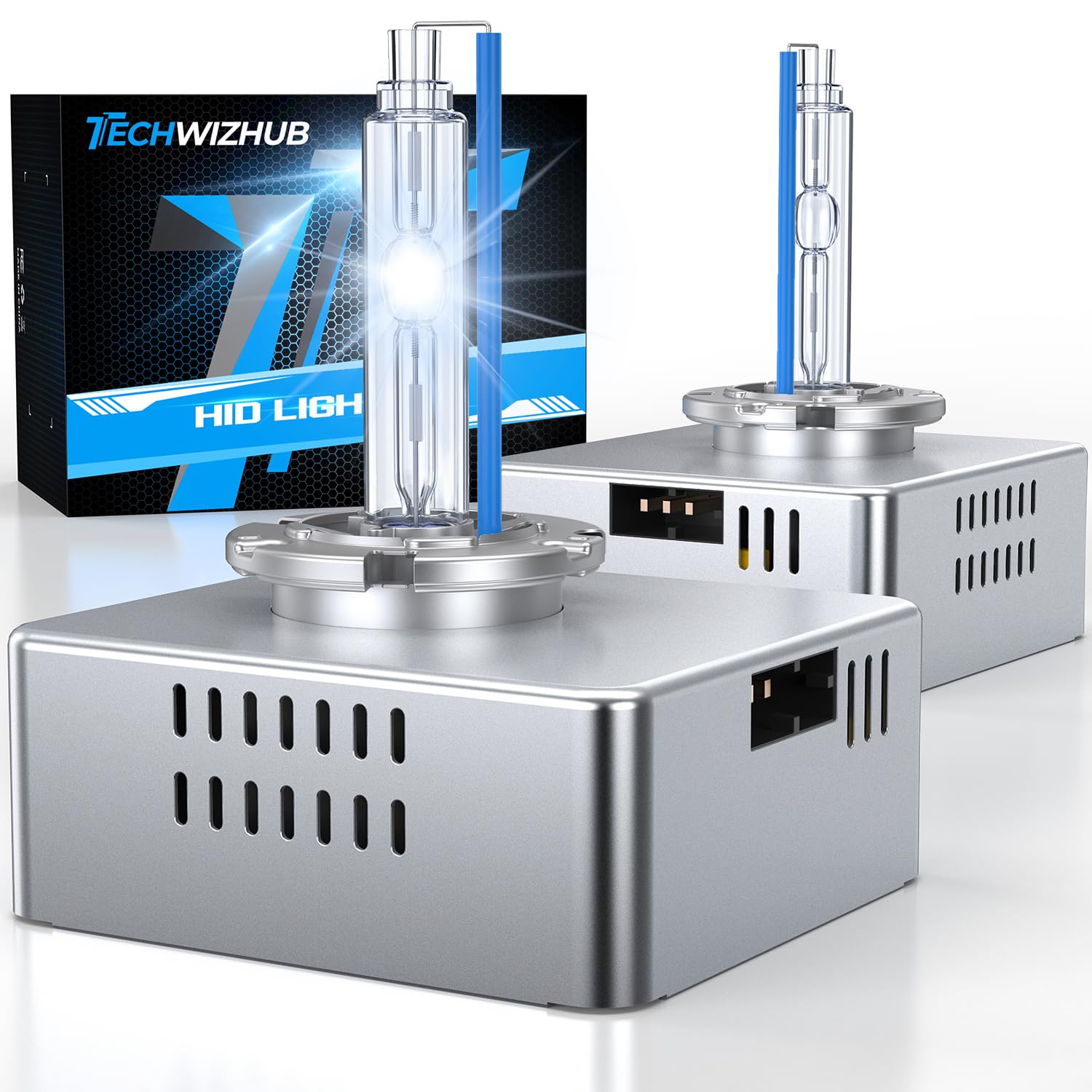
The highest lumen figure here, with the ballast built into the base.
It is a D5S-only replacement with an integrated ballast — that means the electronics that fire the arc are built into the bulb base, so you are not relying on a separate factory ballast to make it work. Its 8000K color temperature sits at the blue end of the spectrum, and the maker claims up to 300% more brightness than halogen plus roughly 4.5 seconds faster brake response.
Build details matter when a bulb sits inches from engine heat. The glass is 100% quartz with anti-UV treatment, the electrode is a sealed tungsten filament winding that keeps the xenon gas from leaking, and the aluminum base shell is folded and assembled to be shock-proof and rain-resistant. TechWizHub lists a 3,600-hour operating life and backs the D5S with a 2-year warranty. That 8000K figure is the number to think hard about — the Philips above runs 4800K for a reason, and blue light is what your eyes struggle with at distance, so the highest lumen count does not automatically mean the most usable light.
Fitment is the make-or-break detail. The maker is unusually direct that this only replaces stock D5S HID bulbs, and will not work in a halogen or LED housing even if a compatibility tool says it will. If you are not sure what is in your car, check whether the stock bulb is HID before ordering. These are the newest bulbs on this list with the lightest review history, so treat the marketing figures as the maker’s claims and the fit check as your real decision.
Why it earns a look
- 4000 lumens — the highest output figure of the four
- Integrated ballast simplifies the D5S install
- 3,600-hour listed operating life and a 2-year warranty
- Quartz anti-UV glass and a sealed electrode against gas leaks
Read before you order
- D5S only — will not work in halogen or LED housings
- 8000K is deep into blue, which is harder to see with at distance
- The thinnest track record on this list so far
Right for you if: your car runs D5S bulbs and you want a self-contained replacement with the biggest lumen number here.
Hold off if: you want neutral white light — go for a lower Kelvin bulb instead.
Know the Specs
Kelvin And Color Temperature
Kelvin is a measure of how white or blue the light looks, not how bright it is. Factory xenon runs around 4300K. The Philips here sits at 4800K for a slightly whiter look, the Osram at up to 5500K, and the TechWizHub at 8000K for a distinctly blue tone. Blue light scatters more easily in the eye, so a higher Kelvin figure often feels dimmer on the road even when the lumen rating is higher.
Lumens And Usable Beam
Lumens count the total light a bulb puts out. Both the Osram D1S and the Sylvania D3S are rated at 3200 lumens; the TechWizHub D5S is listed at 4000 lumens. What matters more is where that light lands — hence arc-blending on the Philips and quartz anti-UV glass on the TechWizHub, both aimed at keeping the beam focused and away from oncoming drivers.
Base Codes And Fitment
The base is the plug on the back of the bulb. D1S uses a PK32d-2 socket, D3S uses PK32d-5, and D5S is its own shape. None of these cross over. Look at the marking on the bulb you remove, not a website’s compatibility tool — the TechWizHub listing specifically warns that its bulb will not work in a halogen or LED housing even if a tool says it fits.
Ballasts And Integrated Electronics
A ballast supplies the voltage that starts and sustains the arc; xenon bulbs need it to light at all. Some bulbs, like the Philips and Osram, run on your car’s existing ballast. The TechWizHub D5S carries its own integrated ballast in the base. Match the configuration to what your vehicle already has, or the bulb can fit perfectly and still never light.
Common Questions
How do I know if my car takes a D1S, D3S or D5S bulb?
Is a higher Kelvin number brighter?
Can I replace just one xenon bulb instead of both?
Why does my new xenon bulb look different from the old one?
Do I need a new ballast when I replace the bulb?
Is an 8000K xenon bulb legal on the road?
How long do xenon arc bulbs actually last?
Will these bulbs work if my car came with halogen lights?
Do I need gloves to install a xenon bulb?
What is arc-blending and does it matter?
The Bottom Line
The strongest overall pick is the Philips X-TremeVision Gen2 D3S, because it is the only bulb here that pairs up to 150% more road light with an E-mark road-legal claim and a factory-calmed 4800K beam. If your car takes D1S, the Osram Xenarc D1S is the match, with 3200 lumens and a maker honest enough to explain how xenon color drifts with age. For a quick single-side fix, the Sylvania D3S is the simplest way back on the road. And if you run D5S and want the highest output figure on the page, the TechWizHub D5S brings 4000 lumens with its own integrated ballast. Whatever you pick, confirm the base code on your old bulb first — that one check prevents nearly every wrong order in this category.
How we choose
We do not accept paid placement. Every pick is matched to a real buyer and a real use-case; we do not hands-on test units.
Sources
Specifications: manufacturer listings and product documentation. Review insights: verified customer reviews, as of November 2026. Pricing: not shown on this page (it changes often); check the current price via the retailer link.
As an Amazon Associate, Tactical Gear Guy earns from qualifying purchases. This does not affect which products we feature.