Specs are compiled from manufacturer listings and verified buyer reviews and can change over time — please confirm the key details on the product page before buying.
You want a drone small enough to launch from your palm and steady enough that a first-timer doesn’t wreck it on the first flight. The picks below are all nano quadcopters — tiny four-rotor flyers you can hold in one hand. The one that gets the most out of that tiny frame is the SIMREX X300C, the crowd favorite at 4.0+ stars across 600+ ratings, pairing optical flow positioning with two batteries. It pairs optical flow positioning (a downward sensor that watches the floor to hold its spot in the air) with two batteries. That means beginners get steadiness and flight time without paying premium money.
This guide is built by comparing the manufacturers’ published specifications and the patterns across verified customer reviews, so you get each pick’s real strengths and trade-offs instead of marketing spin.
Nano drones look like toys, but a steady hover versus a wall-bound wobble depends on a few small specs. Here is what actually separates the flyable from the frustrating in the world’s smallest drone class.
Top Picks


How To Choose A Palm-Sized Drone
The mistake most first-time buyers make is assuming smaller means simpler. A nano drone weighs almost nothing, so any wobble in its stabilization shows up instantly as a drift across the room. What you want is a tiny flyer that holds its own position in the air while you learn the sticks.
Stabilization is the make-or-break feature
Look for altitude hold, which locks the drone at a fixed height so you are not fighting the throttle every second. Optical flow positioning goes a step further — a downward-facing sensor reads the floor texture to keep the drone from sliding sideways. That is the single biggest difference between a beginner drone that feels planted and one that feels twitchy.
Count the batteries, not just the milliamp-hours
These drones use small lithium cells measured in milliamp-hours (mAh — a measure of how much charge the battery holds). A single 180 mAh pack buys you only a short hop. Two or three batteries in the box is often more useful than one larger cell, because charging a nano battery takes longer than flying it.
Guards and safety buttons matter for kids
Full propeller guards enclose the spinning blades so a bump against a wall or a hand does not turn into a scuffed finger. Emergency stop and one-key landing let you bring the drone down fast when it drifts out of control. For a gift aimed at younger pilots, those two features are worth prioritizing over camera specs.
Side-by-Side Comparison
| Model | Best For | Battery | Weight | Flight Range | Amazon |
|---|---|---|---|---|---|
| SIMREX X300C★ Best Overall | First-time pilots | 1 Ah, 2 included | 1.6 oz | — | Amazon |
| Cheerwing Syma X20Budget Stunter | Budget stunt flying | 180 mAh | 6.4 oz | 50 meters | Amazon |
| Spider Mini DroneLight Show Pick | Light-show novelty | 2 included | — | — | Amazon |
| Holy Stone HS190 | Pocket portability | 220 mAh | 35 g | 96 feet | Amazon |
| Sharper Image Glow Up | Rechargeable stunts | 350 mAh | 1.6 oz | 150 feet | Amazon |
| SYMA X100 | Indoor safety | 700 mAh, 2 included | 58 g | — | Amazon |
| Holy Stone HS210 | Longest battery bundle | 250 mAh, 3 included | 50 g | 160 feet | Amazon |
| Veeniix V995 | Smallest footprint | 180 mAh, 3 included | 22.3 g | — | Amazon |
Detailed Reviews
1. SIMREX Mini Drone X300C
Our pick — 4.0+★ from 600+ verified ratings; the strongest balance of quality and price.
The nano that actually holds its spot in the air instead of wandering into the sofa.
This is the pick to start with if you have never flown anything. Optical Flow Positioning uses a downward sensor to read the floor and keep the drone hovering in place, which is why it feels planted rather than skittish for a total beginner. One-Key Takeoff/Landing and Headless Mode strip out the usual first-flight panic — headless mode means forward on the stick is always forward from where you stand, no matter which way the nose points.
At 1.6 ounces it is genuinely palm-sized, and it folds into a pocket or backpack with a carrying case in the box. Compare that with the Cheerwing Syma X20 at 6.4 ounces — a 4.0x gap in item weight per the manufacturer listings. The SIMREX is the one you can slip into a jacket and forget about until you pull it out. The box includes two modular batteries for up to 20 minutes of total flight time, so you can swap packs instead of waiting on the charger.
The camera is 720P with Wi-Fi FPV (first-person view — a live feed on your phone screen), and the app adds gravity-sensor steering and drawn flight paths for kids. What wins people over is the sheer ease of use; the flight experience is the most-praised trait by a wide margin in the feedback on this model. The recurring gripe is battery life — the extra pack helps, but individual runs are short, so plan a charging rotation.
Why it earns the top spot
- Optical flow plus altitude hold keeps it steady for total beginners
- Two included batteries stretch total flight time to 20 minutes
- 1.6 ounces and a foldable frame mean true pocket portability
- 720P Wi-Fi camera with live FPV feed to your phone
Where it asks for patience
- Individual battery runs are short; you’ll be rotating packs
- Camera resolution is modest, fine for fun clips not crisp footage
- Kid-rated build means it wants indoor or calm-air flying
Best matched to: a first-time pilot or a kid who needs a drone that holds still while they learn the sticks.
Look elsewhere if: you want long unbroken flights — the two-pack softens it, but each pack is a short hop.
2. Cheerwing Syma X20 Mini Drone
The one-key, one-touch lander that forgives clumsy stick work and lights up the night sky.
The feature that carries this drone is the One Touch Down function. When the drone drifts out of control or the battery runs low, it descends slowly and lands itself before the motors stop. For a nervous beginner that safety net is what makes the whole thing feel manageable. Add altitude hold for a fixed hover height and headless mode for direction confusion, and you have a tiny flyer built around not losing control.
Its 180 mAh lithium polymer cell drives a compact 4.13 by 4.13 by 0.98 inch frame at 6.4 ounces — noticeably denser than the SIMREX’s 1.6-ounce body. Flight range reaches 50 meters, and the built-in LED lights open up evening flying. One key 360° roll and continuous roll give you stunt moves once you have the basics down.
Fun is what owners keep coming back to — the joy of flying is the trait mentioned most in the feedback, comfortably ahead of value and size. The honest trade-off is endurance: battery life draws the most negative sentiment by a clear margin, so treat this as a short-session flyer. Stability and control draw a mixed read, meaning calm indoor air suits it far better than wind.
The value read: For the money, this is a stunt-capable nano with a self-landing safety feature that most budget drones skip entirely.
Set expectations on: Flight time is the weak link here more than on almost any other pick on this list — plan for quick sessions and a charging rotation.
Reach for this if: you want stunt rolls and a self-landing button on a tight entry-level budget.
Better to skip if: long hover sessions are the whole point for you.
3. Spider Mini Drone
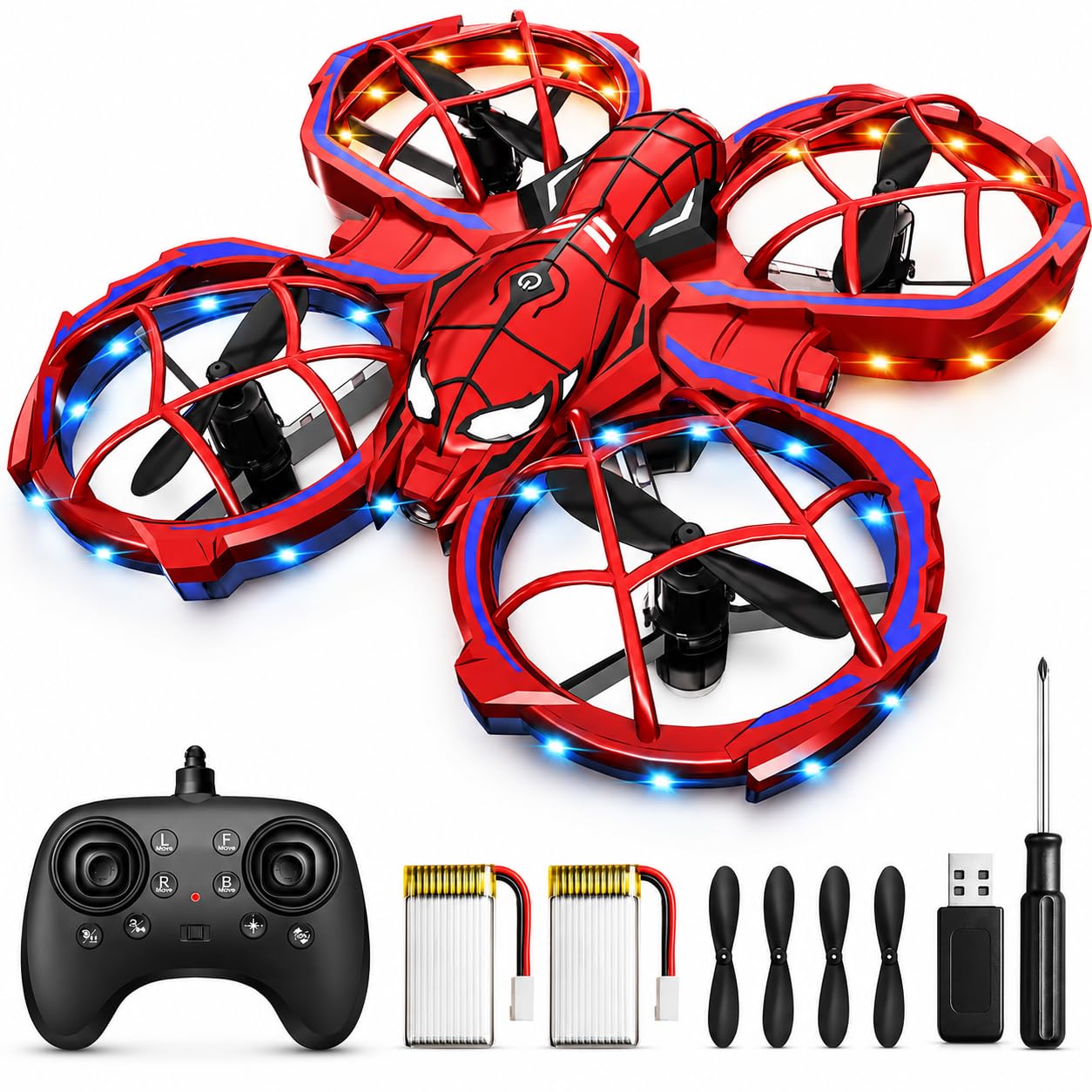
Red and blue LEDs turn a dark room into a tiny airshow for the youngest pilots.
This one is built for the kid who wants a spectacle. Brilliant red and blue lights throw a colorful glow across a dark room, and 360-degree flips, three speed gears, and automatic obstacle avoidance keep the flying varied. It ships with two batteries, four spare propellers, and clear instructions, so a young pilot has a full kit to learn on.
The safety story is what parents ask about first: a hard propeller cover shields fingers from the spinning blades, and the ABS plastic body is made to shrug off collisions and falls. A group can fly together without interference. Charged up, each of the two included packs flies for 8 minutes.
The build quality earns the most praise by a wide margin in the feedback, and the “super cute” look draws plenty of gift-driven buyers. The honest caveat sits with durability over time — multiple owners describe it breaking during first use, so this is a toy to fly gently and supervise. Mixed value feedback reflects that; some find it good for the money, others less so.
Parent-friendly angle: The enclosed propeller cover and ABS shell make it a low-anxiety first drone for younger kids ages 3 and up.
The fair caution: This is a gentle-use toy, not a stunt machine to slam into walls — treat it kindly and it delivers the light show it promises.
Made for: a young child who will love the glowing red-and-blue show more than precise flying.
Honest limit: Rough handling wears on it — gentle indoor play is where it shines.
4. Holy Stone HS190
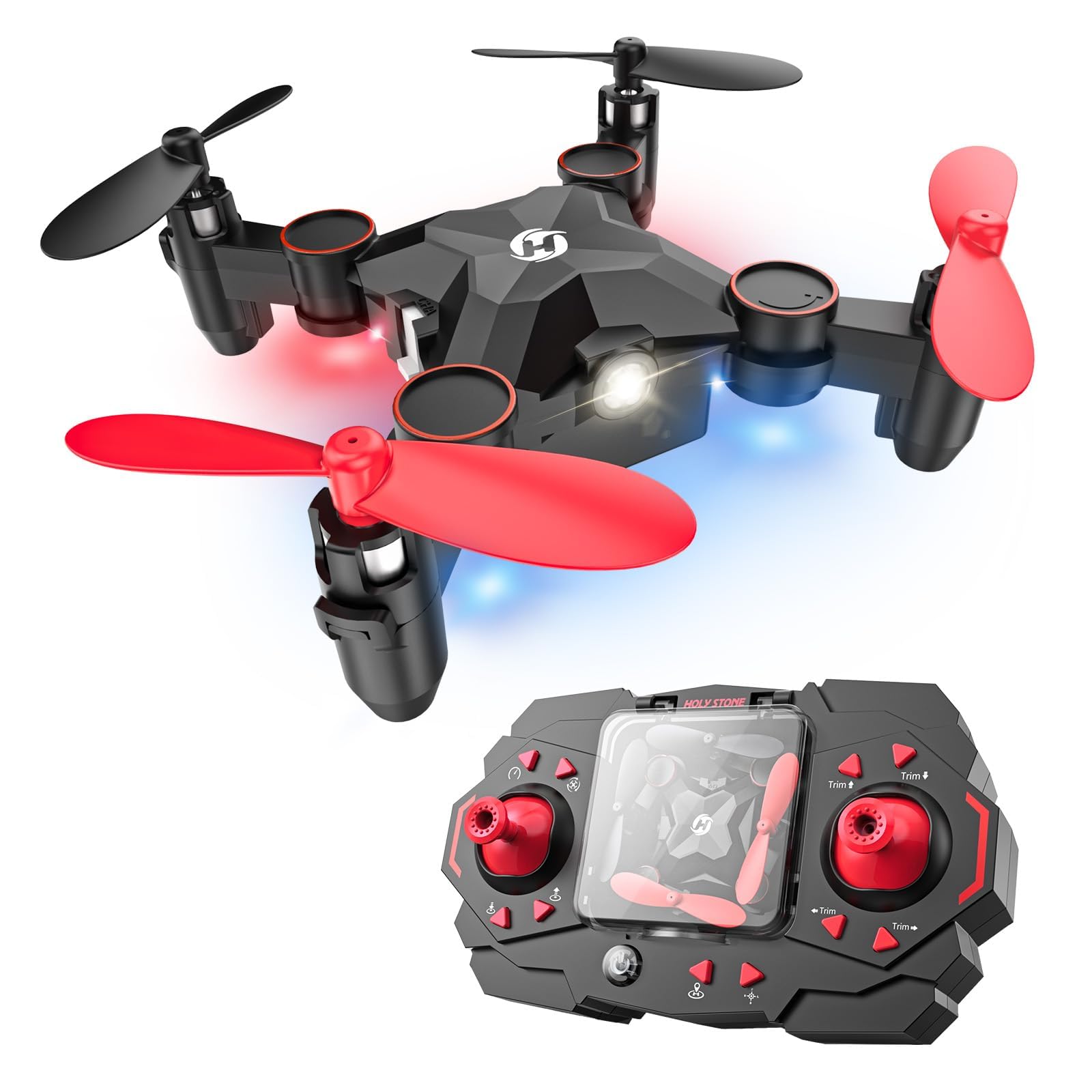
The nano that tucks into its own remote, so the whole kit rides in your pocket.
For hiking, fishing trips, or a quick fly at the park, the HS190 is the pick that travels lightest. Folded into the controller, it takes almost no space in a bag — that stow-away design is what makes it genuinely grab-and-go. It weighs 35 grams, and a 220 mAh lithium polymer cell gives it enough power to loop around the yard.
Altitude hold locks the drone at a fixed height, headless mode keeps directions relative to where you face, and three speed modes let a child start on low before moving up. The four propellers sit inside a protection guard, and an emergency stop lands it immediately if things get wild. Range reaches 96 feet, enough for a backyard.
What sets this one apart in its own feedback is sheer learnability — ease of use is the trait mentioned most by a wide margin, well ahead of fun and value. Owners describe first-day trick flying within hours, and it is widely recommended as a first drone. The honest trade-off: maneuverability comes with a light frame, so a steady hand on the throttle helps on quick descents, and durability is a mixed undercurrent once crashes mount.
The crowd signal: With more owner feedback behind it than almost any other pick here, this is a proven first flyer rather than an unknown gamble.
Where the seams show: Repeated crashes take a toll over time, so fly it over grass and keep the guard on.
Best for: travelers and backyard beginners who value a self-contained pocket kit above all else.
Trade-off to know: Hover steadiness asks for gentle input more than the pricier options do.
5. Sharper Image Glow Up Stunt Drone

A 350 mAh rechargeable cell and gyro stabilization packed into a glowing mini flyer.
The spec worth leading with is the 350 mAh rechargeable lithium battery — the largest capacity on this list, and it recharges rather than burning through disposables. Gyro stabilization and auto orientation keep the frame steady as you zip, dive, and climb, and LED lights glow in the dark for evening flying. You get 360-degree flips and stunts with an assisted landing to soften the finish.
Range reaches 150 feet with the joystick remote, and at 1.6 ounces it is a true mini. Setup is minimal, which is why it lands as a beginner-friendly pick for kids and adults alike. Just note the included caveat: after a hard landing it may show instability or a stalled propeller, and the fix is to power off and re-pair following the manual.
Performance is what owners praise most, with the fun factor close behind. The picture gets murkier on reliability and durability — some units work great while others show trouble sooner. Value opinions split too, so this is the pick to grab when the larger 350 mAh cell and glow factor matter to you specifically.
Leading spec: That 350 mAh battery is the biggest single pack among all nine picks, and it recharges instead of needing disposables.
Real caveat: Hard landings can knock the calibration loose — the manual’s re-pair process fixes it, but it is extra homework most won’t expect.
Grab it when: the larger rechargeable pack and the glow-in-the-dark look are the two things you care about most.
Pause if: you want the most predictable long-term reliability.
6. SYMA X100 Indoor Drone

Four infrared sensors stop it from smacking into your living-room walls.
If your flying space is a living room full of furniture, the X100 is built for exactly that. Its 4-way infrared sensors detect obstacles within about 12 inches and help auto-avoid, so fewer bumps into walls and lamps. You can even guide it with your hand to make an “air-pass” game — that gesture control makes it more fun for kids and more relaxing for parents.
Safety is baked in: a fully enclosed propeller guard blocks contact with the fast-spinning blades, the ABS body takes everyday bumps, and a 180° flip-to-stop design lets it shut down on impact. One-key takeoff and landing get kids flying on the first try, altitude hold keeps it steady, and headless mode cuts direction confusion. Two speed modes let beginners start slow, and two batteries give up to 20 minutes of total play.
Obstacle avoidance is the standout — it draws a strong positive response in the feedback, alongside broad praise for the build quality of the whole unit. The honest wrinkle is battery life, which draws mixed reaction; the second battery is a welcome buffer, but per-pack runs stay modest. This is a bigger-bodied pick at 58 grams and a 5.16 by 5.16 by 1.77 inch frame, so it is small but not the tiniest here.
Standout feature: The 4-way infrared avoidance system actively steers around furniture — a rare safety layer in the nano class.
The trade: It is the heftier body on this list, so “palm-sized” is a looser fit than the Veeniix or HS190.
Ideal for: indoor play in a furnished room where bumps and wall strikes are the real worry.
Consider another if: pocket-sized is your top priority.
7. Holy Stone HS210 (Blue)
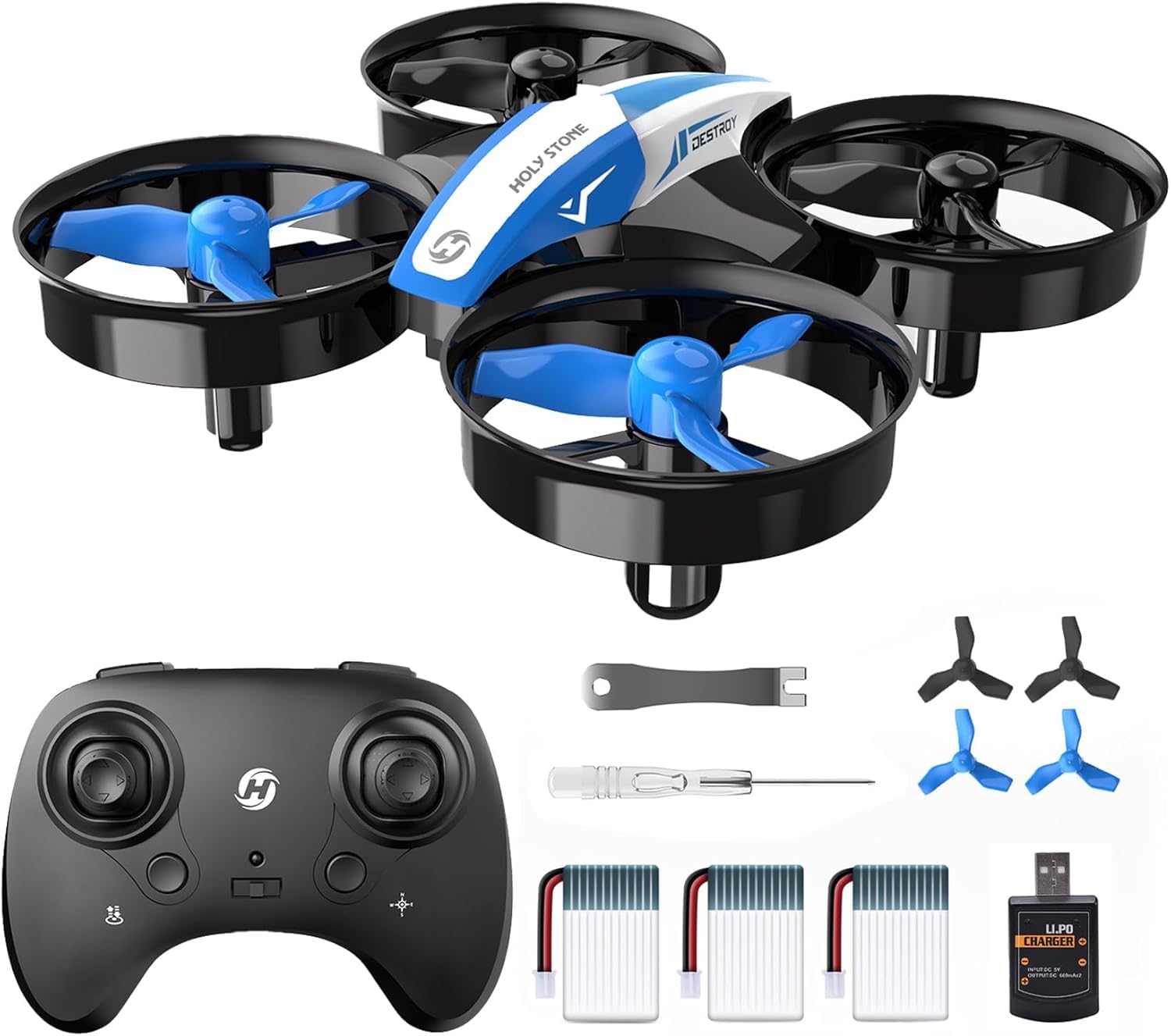
Three batteries in the box mean up to 21 minutes of flight without a charging break.
For the family that does not want to stop for a recharge, the HS210 solves the problem outright. Three 250 mAh battery packs push total flight time to 21 minutes, and a low-battery alarm warns you before the pack dies. It even launches from a toss of the hand — throw it up and it starts flying. Circle fly, 3D flips, and auto rotation keep the stunt menu full, and the speed is adjustable to the pilot’s comfort.
Altitude hold and headless mode make it forgiving for kids and newbies. The propellers sit inside a protection guard that shields little fingers and the drone itself, and range reaches 160 feet. At 50 grams on a 3.15 by 3.15 by 1.18 inch frame, it balances small size with a bit of presence. Like its sibling, it wants each drone paired to its own remote separately when multiple units fly together.
Functionality is the trait owners praise most here by a huge margin, with ease of use right behind — this is a battle-tested, popular flyer on a scale the other picks do not match. Durability is a mixed undercurrent: some owners say it survives multiple high-speed crashes, others report odd self-launches. The battery bundle is the clincher for most.
The bundle advantage: Three 250 mAh packs add up to 21 minutes total — the longest bundled flight time here.
Honest thread: Durability reads mixed, so keep the full guard on and start on low speed.
Best fit: families who want continuous play with a charger rotation built into the box.
Weigh against it: the self-launch quirk some owners note — pair carefully and check the compass before takeoff.
8. Veeniix V995 Mini Drone

At 22.3 grams, this is the lightest body on the list and the truest pocket nano.
If “world’s smallest” is the target, the Veeniix V995 gets closest on weight: 22.3 grams, on a 3.6 by 3.15 by 1.25 inch frame, and it hauls the same trick menu as the heavier options. 3D flips, 360° rotations, and easy circle fly come with one-key takeoff and landing plus altitude hold for stable hovering. Adjustable speed settings — low, medium, or high — let a beginner ramp up in steps.
Three rechargeable batteries deliver up to 21 minutes of total flight, so you can charge one while you fly another. Headless mode clears up direction confusion, and low-battery plus distance warnings keep flights on the safe side. Protective guards shield little fingers from spinning propellers, and the compact frame stays sturdy through indoor and outdoor use.
Size is what owners praise most here by a wide margin, with the fun of flying a clear second — this is the pick for the buyer who wants the genuinely tiniest body. The honest caveat: batteries draw mixed reaction, and some accounts mention packs dying after only a handful of charges, so the three-battery bundle matters as much for backup as for playtime.
Tiny-body edge: At 22.3 grams it undercuts every other pick here on weight without losing stunt features.
Watch the packs: Battery longevity reads mixed — keep all three in rotation so a single failing cell does not ground you.
Choose it for: the smallest, lightest flyer you can still pull off a 360° flip with.
Hold off if: you want proven long-term battery reliability above all.
Know the Specs
Battery Capacity (mAh)
A milliamp-hour is a measure of how much charge a battery holds — think of it as the size of the fuel tank. A 180 mAh nano cell typically flies for only a few minutes; a 350 mAh cell buys more air time. But because nano packs charge slowly, the number of batteries in the box often matters more than the individual capacity. Two or three packs let you rotate while one charges.
Optical Flow & Altitude Hold
Altitude hold locks the drone at a fixed height so you are not constantly adjusting the throttle — the drone hovers on its own. Optical flow positioning adds a downward sensor that reads the floor to stop the drone sliding sideways. Together they turn a twitchy micro-quad into a steady flyer a beginner can actually control indoors.
Headless Mode
Normally “forward” on the stick means forward relative to the drone’s nose, which flips as it turns and confuses new pilots. Headless mode makes every direction relative to where you stand — push forward and the drone flies away from you no matter which way it is facing. For kids and first-timers, it removes the single most common source of panic.
Propeller Guards
Full guards enclose the spinning blades in a cage so a bump against a wall or a hand does not catch a finger — or snap a propeller. In a nano drone flown indoors, they are the difference between a gentle bounce and a broken toy. Many picks pair the guards with an emergency-stop button that cuts the motors instantly.
Common Questions
How small is a nano drone compared with a palm-sized quadcopter?
Why does my nano drone keep drifting sideways indoors?
How long can a tiny drone actually fly on one battery charge?
Is headless mode necessary for a first-time kid pilot?
What is the difference between altitude hold and optical flow positioning?
Can multiple mini drones fly at the same time without interference?
Do propeller guards slow the drone down or shorten flight time?
What should I do if a nano drone lands hard and stops responding correctly?
Are these mini drones suitable for a five-year-old?
Does a larger battery always mean longer flight time on a nano drone?
The Bottom Line
For most buyers chasing the world’s smallest drone, the SIMREX X300C is the pick that balances tiny size with genuinely flyable stability — optical flow positioning plus two batteries for beginners who want to learn without wrecking anything. If you want the lightest body on the list, the Veeniix V995 undercuts everything at 22.3 grams. And for the longest bundled flight time, the Holy Stone HS210 and its three batteries deliver 21 minutes of play. Start on whichever bundle matches your patience for charging, and keep the guards on for the first week.
How we choose
We do not accept paid placement. Every pick is matched to a real buyer and a real use-case; we do not hands-on test units.
Sources
Specifications: manufacturer listings and product documentation. Review insights: verified customer reviews, as of November 2026. Pricing: not shown on this page (it changes often); check the current price via the retailer link.
As an Amazon Associate, Tactical Gear Guy earns from qualifying purchases. This does not affect which products we feature.