Specs are compiled from manufacturer listings and verified buyer reviews and can change over time — please confirm the key details on the product page before buying.
A 4-inch doorway lip stops a wheelchair, walker or rollator dead — and someone has to lift it over the sill. A wooden handicap ramp fixes that with a gradual sloped board you set down in front of the door: no bolts, no contractor, no concrete pour. Both picks below are solid pine ramps with a 4-inch rise, so your real choice depends on load rating, width, and how you handle the slippery part.
This guide is built by comparing the manufacturers’ published specifications and the patterns across verified customer reviews, so you get each pick’s real strengths and trade-offs instead of marketing spin.
You will see where each board fits and where it strains, how the surface grip is actually applied, and what to check on your own sill before ordering. Here is the honest breakdown of the wooden handicap ramp market and which board earns a place by your door.
Quick Picks
- yeezoo 4″ Rise Wooden Door Threshold Ramp — Best Overall
- THOOUM 4″ Rise Solid Wooden Threshold Ramp — Best Finish
How To Choose The Best Wooden Handicap Ramp
The thing that decides whether a threshold ramp works or fights you is the ratio between how tall the step is and how long the board is. Both ramps here clear a 4-inch rise, but one runs longer front to back than the other, and that extra length is what softens the climb. Measure your sill first: a door threshold plus a small lip may be less than you think, and a board bought too short will feel like a wall.
Check the load rating against your real total
Load capacity is the weight the board is built to carry across its span, not just the person. A power chair, a heavier occupant, or a caregiver leaning on the rail all add up. One pick here is rated to 800 pounds and the other to 600 pounds, and that difference is the single most useful number when a bariatric chair or a heavy scooter is in the picture. A support bar underneath is what keeps the board from sagging in the middle over years of daily rolls.
Understand the grip surface before you buy
Traction on a wooden ramp comes in two flavors. Some boards ship with separate non-slip strips or pads you stick on yourself, which means placement is on you and the adhesive has to survive rain and grit. Others cut grooves straight into the surface so the texture is part of the wood. Either can work, but if the ramp sits outdoors, ask which one you are getting before it arrives.
Measure width and doorway swing
A ramp that is narrower than the chair’s wheelbase is useless no matter how strong it is. Check the width figure and compare it to your chair’s outside wheel-to-wheel measurement, then check that the board does not block the door as it swings. If your opening is unusually wide, look for a board with pre-drilled holes so two units can be joined into one continuous surface.
Side-by-Side Comparison
| Model | Best For | Load Capacity | Rise | Surface Grip | Amazon |
|---|---|---|---|---|---|
| yeezoo 4″ Rise Wooden Door Threshold Ramp, 2 Pack | Heavier chairs and wide openings | 800 lbs | 4″ | Adhesive non-slip strips | Amazon |
| THOOUM 4″ Rise Solid Wooden Threshold Ramp with Grooves | Finished look at a single doorway | 600 lbs | 4″ | Cut-in non-slip grooves | Amazon |
Detailed Reviews
1. yeezoo 4″ Rise Wooden Door Threshold Ramp 2 Pack

Two solid pine boards rated to 800 pounds each — the heavy-chair answer to a stubborn doorway lip.
The yeezoo ramp carries a load capacity of 800 pounds on a 25mm-thick pine board, and that is the number to start with if a power chair or a heavier scooter is what you push. Against the THOOUM below it holds 800 pounds versus 600 pounds, so it keeps a wider margin under a heavy occupant plus gear. A support bar runs underneath, which is what stops the middle of the board bowing over daily use. Across 180+ ratings it holds 4.0+ stars, with buyers reporting simple setup and reliable rolling for wheels and walkers.
Width is the other reason this one sits in front. It measures 35.4″W x 27.9″L x 4.0″H, so the board is wider than it is long and swallows a broad threshold without leaving a gap at the edges. Two ramps come in the order, and the boards are pre-drilled with connecting screws so you can link them into one continuous surface if your opening is very wide. That makes this the better fit for a double doorway, a wide patio slider, or a porch where you want the whole sill covered.
The trade-off is physical: 4 inches of rise over roughly 28 inches of length makes for a brisk climb. Reviewers repeatedly call the slope steep, which is simple geometry at this rise and run, not a defect. It also arrives with the non-slip strips loose, so you have to peel and stick them yourself — worth doing carefully and on a clean, dry board. Its 4.0+ rating reflects a solid-working ramp that some buyers find steep on the climb.
Where this board pulls ahead
- 800 lb load capacity on 25mm solid pine, the higher rating of the two picks here.
- 35.4″ width covers a broad door threshold in a single piece.
- Two ramps per order, joinable with pre-drilled holes for wider openings.
- Support bar underneath resists sagging in the middle span.
What to plan around
- Non-slip strips are applied by you, not factory-fitted.
- 4″ rise over about 28″ of run is a steep push for an unassisted wheelchair user.
Reach for this if: a heavy chair, a wide doorway, or a porch sill needs a board that carries real weight across a broad span.
Look elsewhere if: you need the gentlest possible climb — a shorter board over 4 inches simply asks more of whoever is pushing.
2. THOOUM 4″ Rise Solid Wooden Threshold Ramp
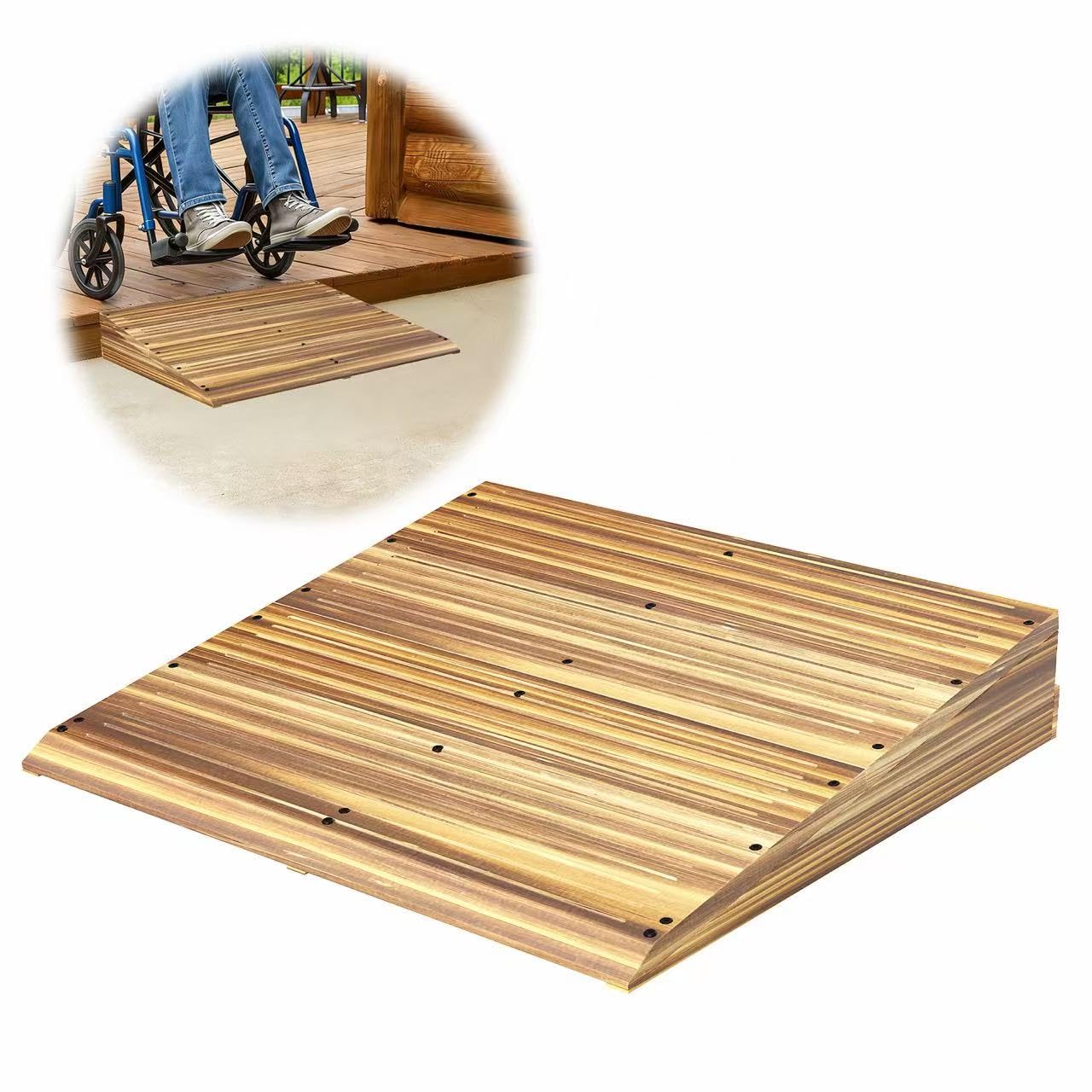
The one that looks like furniture instead of a utility board — and grips without stick-on strips.
The THOOUM is the ramp for a front entrance you actually look at every day. Its pine is sanded smooth and finished in a burnt color under a sprayed coating, so it reads as a stained wooden sill rather than a raw plank. That finish also gives basic water resistance for daily outdoor use. Where the yeezoo above makes you stick on traction strips, this board has non-slip grooves cut directly into the surface, so the texture is permanent and nothing peels off in the rain.
Length is where this board earns its keep. It measures 29″L x 31.4″W x 5″H against the yeezoo’s 27.9″L x 35.4″W x 4″H — a slightly longer run under the same 4-inch rise, which spreads the slope a touch more gently for anyone pushing by hand. It is also the narrower of the two, so it suits a standard single doorway better than a wide double opening. A support bar underneath keeps the deck from deforming under rolls, and the one-piece design needs no assembly; expansion screws come in the box to anchor it if you want it fixed.
Load capacity is 600 pounds on the same 25mm pine — less headroom than the yeezoo’s 800 pounds — so a heavy power chair plus a caregiver’s weight should be counted carefully. Reviews are mixed on doorway-edge stability, with some owners finding it shifts unless screwed down. Its 3.5+ rating reflects buyers who like the look and function but find it needs anchoring to stay put.
What wins people over: the finished burnt-wood surface and the molded-in grooves — no loose strips to align, and the board reads as part of the house.
The number to weigh: 600 pounds of load capacity is enough for most manual chairs and walkers, but it sits below the 800-pound pick above. Anchor it with the included expansion screws and it behaves.
Confident verdict: a good-looking, permanently grippy board for a single standard doorway where appearance matters as much as access.
Think twice if: your chair is heavy or your doorway is wide — the narrower span and lower load rating push you toward the yeezoo instead.
Know the Specs
Rise Versus Run
Rise is how tall the step is; run is how long the board is front to back. A 4-inch rise over a longer board gives a shallower slope, which is easier to push. Both ramps here clear a 4-inch step, but the board lengths differ, and that is what separates a comfortable roll from a steep one. Always measure your total sill height, not just the visible lip.
Load Capacity
The rating in pounds covers the whole load crossing the board, not just the occupant. It tells you how much weight the pine span is built to carry without bowing. A higher number leaves margin for a power chair, a heavier rider, or a caregiver leaning in. A support bar underneath is what keeps the deck flat over years of use.
Surface Grip
Traction comes either as stick-on non-slip strips you apply yourself, or as grooves cut into the wood. Strips can be positioned where wheels actually land but need care to stick; grooves are permanent and need no maintenance. For an outdoor ramp, ask which style you are getting before it ships.
Width And Joining
The board has to be wider than the chair’s outside wheel measurement. Pre-drilled holes let you join two ramps into a wider surface for a broad doorway or porch. A narrower board suits a standard single door but leaves a gap on a wide opening.
Common Questions
Will a 4-inch wooden ramp work for my wheelchair over a door threshold?
How much weight can a solid pine threshold ramp hold?
Can I use a wooden handicap ramp outdoors in the rain?
Do these ramps need to be screwed down or secured?
What is the difference between stick-on strips and cut-in grooves for grip?
How wide does my doorway ramp need to be for a wheelchair?
Is a longer wooden ramp easier to push a wheelchair up?
Can I join two wooden threshold ramps to cover a wider step?
Does a wooden threshold ramp arrive assembled?
Will a wooden ramp sit flat on a slightly uneven porch?
The Bottom Line
For the majority of shoppers, the wooden handicap ramp winner is the yeezoo 4″ Rise Wooden Door Threshold Ramp. It holds up to 800 pounds and spans 35.4 inches wide, so a heavy power chair rolls across a broad sill without wobble. Two ramps come in the order, letting you widen the surface when you need to. Want a finished burnt-wood look with grooves cut straight into the surface so nothing peels? Grab the THOOUM 4″ Rise Solid Wooden Threshold Ramp. For a standard single doorway where the board should read as part of the house, the THOOUM is the one to reach for.
How we choose
We do not accept paid placement. Every pick is matched to a real buyer and a real use-case; we do not hands-on test units.
Sources
Specifications: manufacturer listings and product documentation. Review insights: verified customer reviews. Pricing: not shown on this page (it changes often); check the current price via the retailer link.
As an Amazon Associate, Tactical Gear Guy earns from qualifying purchases. This does not affect which products we feature.