Specs are compiled from manufacturer listings and verified buyer reviews and can change over time — please confirm the key details on the product page before buying.
You want a vise that holds a board dead still while a chisel drives into it — and that is exactly the thing to shop for first. Everything else (how wide the jaws are, how fast the release moves, how deep the throat reaches) exists to serve that one job. The nine vises below all do it, and they split cleanly into two groups: quick-action bench vises with a release lever, and traditional screw vises built around a rolled thread and twin guide rods. The first group is what most home woodworkers want, because a lever lets you slide the jaws from closed to wide open in one motion instead of cranking. The second group is for people building or outfitting a dedicated workbench where the vise is part of the bench rather than a bolt-on.
This guide is built by comparing the manufacturers’ published specifications and the patterns across verified customer reviews, so you get each pick’s real strengths and trade-offs instead of marketing spin.
You want a vise that holds a board dead still while a chisel drives into it, then stays out of your way. Below you’ll see jaw width and opening side by side, plus the honest gaps — the vises that need two people to hang, and the ones that need custom wooden jaw faces before they will hold anything. Check these details first and you avoid a vise you fight with on every project. That is why this shortlist of the best wood working vise options keeps every spec and every caveat in plain sight.
Top Picks


How To Choose The Best Wood Working Vise
Start with the boards you actually clamp. A vise is a second set of hands that has to stay rigid while you push a plane across a board or strike a chisel. That requirement narrows the field fast, because a vise that flexes or shifts under load is worse than no vise at all. Work through the four points below in order and you’ll land on the right vise without reading every listing.
Jaw width versus jaw opening
Jaw width is how wide the clamping faces are — the flat plates that touch your wood. Jaw opening is how far apart those faces can travel. Confusing the two is the most common buying mistake in this category. A vise with 7-inch jaws and an 8-inch opening can hold a board up to 8 inches thick but only grips it across 7 inches of face. Wider jaws spread the pressure so a board is less likely to twist, while more opening lets you swallow thicker stock. Decide which of the two you run out of first on your own work.
Quick release versus a plain screw
A quick-release vise has a lever or trigger that disengages the main screw, letting the sliding jaw move freely. You pull the lever, slide the jaw to the board, let go, and then a turn or two of the handle tightens it. Without that mechanism you crank the handle every time the opening changes, which gets old fast when you switch between stock sizes. The trade-off is one more mechanism that has to be built well — a sloppy release is the single most common complaint in this category, and a clean one is the thing people praise most.
Throat depth and what it lets you do
Throat depth is the measurement from the top of the jaws straight down to the body of the vise. It tells you how far a board can hang below the jaw faces, which matters when you stand a piece on end to saw or chisel it. A shallow throat means the board bottoms out early and you end up clamping it at an angle. A deeper throat holds tall pieces square, and that is why the bigger vises in this list carry a deeper throat alongside their wider jaws.
Bench-mount versus build-in front vise
Most of the vises here bolt or clamp to the top or edge of a bench and are ready in minutes. A front vise is different — it is hardware you mount under the bench apron with your own wooden jaw faces added to it. That gives you a flush, custom fit and jaw faces you can replace when they wear, but it takes real bench-building work. If your bench already exists and you just want clamping, stay with the bolt-on style. If you are building the bench, the front-vise hardware is the cleaner answer.
Side-by-Side Comparison
| Model | Best For | Jaw Width | Jaw Opening | Mount Style | Amazon |
|---|---|---|---|---|---|
| Yost Vises M9WW★ Best Overall | Wide boards and deep throat work | 9 in | 10.25 in | Bench bolt-down | Amazon |
| Groz 6-Inch PortableBest Portable Pick | Clamping to whatever bench you have | 6 in | — | Clamp or bolt-down | Amazon |
| Woodriver 6″ Quick ViseBest for Round Stock | Round stock and finished surfaces | 6 in | 6 in capacity | Clamp or screw to base | Amazon |
| Yost Vises M7WW | Everyday bench work in a compact footprint | 7 in | 8 in | Bench bolt-down | Amazon |
| Groz Front Vise 39020 | Building a bench from scratch | 7-1/8 in | 8-1/4 in | Under-bench front vise | Amazon |
| Eclipse EWWQR7 | Vise and tail vise in one tool | 7 in | — | Bench bolt-down | Amazon |
| Jorgensen 10″ | Long stock and thick benchtops | 10 in | 13 in | Bench bolt-down | Amazon |
| Rockler Quick Release Front Vise | Racking-free custom benches | 9 in | — | Under-bench front vise | Amazon |
| Wilton 78A | Irregular and tapered parts | 4 in | 10 in | Bench bolt-down | Amazon |
Detailed Reviews
1. Yost Vises M9WW Rapid Action Woodworking Vise
Our pick — 4.5+★ from 550+ verified ratings; the strongest balance of quality and price.
Nine inches of jaw face and a throat deep enough to swallow a standing board.
The number that decides it is the throat: 4 inches of depth, measured straight down from the jaw faces to the body. That is a third more depth than the Yost M7WW below gives you, and it is the difference between holding a board vertically to chisel its end grain and having to lay the piece flat and work sideways. The jaw faces themselves run 9 inches across — half again the width of the Groz 6-inch portable — so pressure spreads over a long face and a wide panel resists twisting. Jaw opening reaches 10.25 inches, which is 28 percent more travel than the M7WW’s 8 inches, and that extra reach keeps up with the throat.
What wins people over is the build: it is poured from 30,000 PSI cast iron (a rating of how much pressure the casting takes before it gives) with a chrome-plated steel T-bar handle and steel guide rails. Quality is the theme across the whole product, and the rapid action lever earns its own following because it disengages the screw so the jaw slides free instead of cranking. The word “smooth” shows up again and again around that release. Value matters here too — this is a heavy, long-throat vise that undercuts the premium tier by a wide margin.
The honest catch is the weight at 63 pounds and change once it is from the start — roughly three times what the Groz portable carries. It is also 21 pounds heavier than the same-brand M7WW, which means you want a bench that is already anchored or a helper on install day. And the T-bar handle sits in a horizontal orientation that some hands find awkward at first. Neither is a defect; both are things to plan around before the box arrives.
What earns it the top slot
- 4-inch throat depth — the deepest in the shortlist alongside nothing at this jaw size, letting you clamp boards standing upright
- 9-inch jaw width with 10.25-inch opening handles wide panels and thick stock in the same vise
- Rapid action lever slides the jaw free in one motion instead of cranking the screw
- 30,000 PSI cast iron body with chrome-plated steel T-bar handle and steel guide rails
- 1-year limited warranty with a 90-day return window and lifetime tech support from the maker
Plan around these
- Heavy enough that mounting is a two-person job on an unanchored bench
- T-bar handle sits horizontal, which some hands find awkward on the first few uses
Buy this one when: your work runs to wide panels, tall standing pieces, and mixed stock sizes you want to reposition in a heartbeat.
Think twice if: you work at a small bench you move around, where a 63-pound casting is more vise than you want to bolt down.
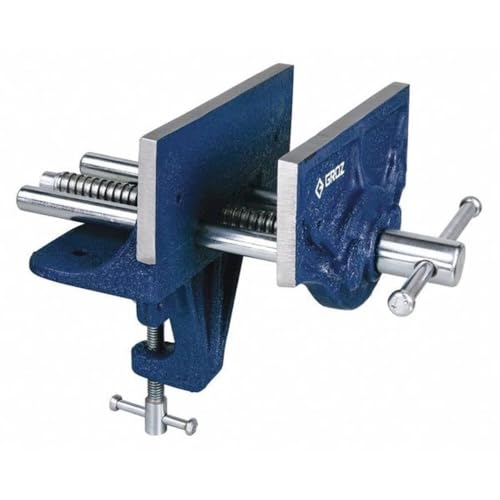
2. Groz 6-Inch Portable Woodworking Vise
Seven pounds of cast iron that clamps to nearly any surface you already own.
No bench to drill into? This vise solves that: it mounts two ways, either clamped to a table edge or bolted down permanently. It weighs 7 pounds, the lightest tool in this group by a wide margin — against 21 pounds for the Yost M7WW, that is a 3.0x gap. That gap is why you can carry it to a friend’s garage or a jobsite in one hand.
The jaws are machined with a toe-in profile, meaning they meet at the top first when closed and then spread pressure evenly down the full depth of the board. In practice that means a piece of stock stays put through planing and chiseling without you re-tightening halfway through the cut. The main screw, twin guide rods, and tommy-bar handle are all chrome plated, so the action stays smooth and resists rust in a garage or damp shop.
Here is where it earns its keep honestly: the alignment and clamp tightness draw divided feedback, with some owners finding the jaws perfectly parallel and others saying they can be fiddly to bring tight. That is a fit note rather than a flaw — this vise rewards a careful hand and steady tightening. It also holds less board than the 9-inch Yost above, so think of it as your second vise or your only vise on a small bench.
Where it shines: portability and rigidity in the same casting — close-grained iron damps vibration so planing and chiseling stay clean, and the dual mount means you are never stuck without a way to attach it. The build quality is the most-praised part of the tool, followed by the value it delivers.
The trade to accept: jaw alignment can vary unit to unit, so check yours on arrival and return it inside the window if the faces are not square to each other.
The right call for: renters, apartment woodworkers, and anyone whose bench is a folding table.
Look past it if: you are clamping long panels that need more than 6 inches of jaw face.
3. Woodriver 6″ Quick Vise
Rubber jaws with V-notches — built for dowels and finished parts that must not scar.
Round stock is the thing most vises handle badly. A dowel or a turned leg rolls between flat metal jaws and pops loose the moment you put a tool to it. This vise sidesteps that with large non-marring rubber jaws cut with V-notches, which cradle round work instead of pinching it on two flat faces. The rubber also means a sanded or finished surface comes out without jaw marks — useful when the piece is already past the point where re-sanding is easy.
Clamping force is listed at 300 pounds and capacity is 6 inches, so it covers drawer parts, small panels, and turned pieces comfortably but not long boards. The quick action handle and release lever do the same job as the rapid-action levers on the Yost vises: the jaw slides free, then a turn of the handle locks it. Mounting is flexible — clamp it to a bench or screw it to a wooden base you can move around the shop.
One thing to weigh before you commit: this is a newer listing with a small pool of ratings, so the long-term track record is thinner than the Yost or Eclipse vises here. It is made by Woodcraft under the WoodRiver name, which is a real woodworking supplier rather than a generic brand, and the V-notch design is genuinely uncommon in this price band.
Its whole reason to exist: the V-notched rubber jaws, which no other vise in this shortlist offers. Add a lever release and 300 pounds of clamping force and you have a specialty tool that also handles flat stock fine.
Know before you buy: 6 inches of capacity is the ceiling, and the rubber jaws will not survive the same abuse a bare cast-iron face will.
Reach for this if: you turn legs, drill dowels, or clamp already-finished parts that cannot take a jaw mark.
Pass on it if: your work is all flat panels and you want maximum jaw face for the money.
4. Yost Vises M7WW Rapid Action Woodworking Vise

The one most home shops should buy — 7-inch jaws, 8-inch opening, and a build that outlasts the bench.
Durability is what this vise is known for, and it is earned the old-fashioned way: a 30,000 PSI cast iron body (a pressure rating for the casting itself), a chrome-plated steel sliding T-bar handle, and steel guide rails. Owners describe a tool that will last a lifetime, and the quick release gets called flawless — it disengages the screw so the jaw slides to the board, then locks solid with a turn. Jaw width is 7 inches, jaw opening 8 inches, throat depth 3 inches.
Against the 9-inch M9WW above, this is the compact sibling: 2 inches less jaw width, 2.25 inches less opening, and 1 inch less throat. What you get in exchange is a 42-pound-lighter package that a single person can hang without drama — the M9WW runs 21 pounds heavier and the difference shows up on install day. That 3-inch throat still handles most flat bench work; it just will not hold a tall board standing on end as comfortably.
Installation is the one divided point. Some owners mount it solo without trouble, others say it takes two people to line up and bolt down — which is fair for a casting this heavy with no bench clamp option. Buy it expecting to drill your bench. Once it is on, the rapid action lever and the sheer rigidity make it the vise you stop thinking about, which is the highest compliment a shop tool can get.
Why it holds this spot
- 30,000 PSI cast iron build with steel guide rails and a chrome-plated T-bar
- 7-inch jaws and 8-inch opening cover the vast majority of home bench work
- Rapid action release lever slides the jaw freely for fast repositioning
- 1-year limited warranty, 90-day return, and lifetime tech support from Yost
- Noticeably easier to mount solo than the larger 9-inch M9WW
The honest caveats
- Bolt-down only — no clamp mount option, so it needs a bench you can drill
- 3-inch throat is shallower than the M9WW, limiting tall standing pieces
Best for: the woodworker with a real bench who wants one vise to cover flat panels, joinery, and general clamping for years.
Skip if: you regularly clamp boards standing upright — the deeper throat on the M9WW is worth the extra weight there.
5. Groz Woodworking Front Vise, 7-1/8″ Jaw Width

Hardware for the bench you are building, not a vise you bolt on afterward.
This is a different animal from the bolt-on vises above: it is a front vise kit that mounts under your bench apron, and you make the wooden jaw faces yourself. It gives you 7-1/8 inches of jaw width and 8-1/4 inches of opening. For a bench build, the spec that matters is the twin guide rods (two metal rods that keep the jaw tracking straight) paired with precision rolled threads (screw threads formed to a tight tolerance). Together they keep the jaw square under load, so stock stays aligned through planing, sawing, and glue-ups. A turned wooden handle ships with it.
You are asking a front vise to resist the sideways force of a hand plane pushing across a board, and the cast iron body and cast iron handle socket are built to take that heavy clamping load. It weighs 9.4 pounds, lighter than the bolt-on Yosts, because the mass in a front vise comes from the bench and jaw faces around it rather than the hardware alone.
The caveat is real and worth stating plainly: construction feedback here splits, with some owners finding it well made and others noting sloppy machining, and casting holes that were not aligned properly. That is a build-consistency point rather than a design flaw — check the parts fit before you cut your bench opening, because a misaligned hole is far easier to sort out before the bench is assembled. For a builder who expects to fit and fettle, this is a solid foundation.
What makes it a bench-build pick: twin guide rods and precision rolled threads keep the jaw square, and the wooden handle plus optional custom jaw faces let you finish the vise to match your bench.
Fit note: machining quality varies, so dry-fit the hardware and confirm the holes line up before committing to your bench layout.
Choose it if: you are building a workbench and want proven front-vise hardware to mount into it with your own wooden faces.
Not for you if: your bench is already finished and you want something to bolt on in an afternoon.
6. Eclipse EWWQR7 7″ Vise

A vise and a tail vise in the same casting, thanks to one adjustable front stop.
Most vises do one job. This one carries an adjustable front stop — a dog that works with a bench stop to give you a second clamping point — so the same tool acts as a normal vise and a tail vise. If your bench has dog holes, that single feature doubles what the tool can do and is why it stands out in a crowded field. Jaw width is 7 inches, matching the Yost M7WW, but the extra front-stop function is something no other vise here offers.
The body and sliding jaw are grey cast iron, chosen because it damps shock (absorbs vibration) well, with steel slide rods and a single-start main screw (one spiral thread, so it moves slowly and holds firmly). The quick release trigger opens and closes the vise without touching the main screw. Two pre-drilled holes make mounting to a bench a straightforward drill-and-bolt. One honest safety detail: the tommy bar (the handle you turn) is designed to bend before the vise itself gets over-stressed. If you ever see it flex, that is the tool telling you to back off, not a failure.
What holds it back from a higher spot is simple arithmetic: buyers report the release and the value as the two things they like most, while size and weight draw divided opinions — some find it heavier and bulkier than expected at 20.7 pounds. It is a solid bench vise first and a tail vise second. Mount it where you can reach around to swap roles and the dual function pays off.
The standout: that adjustable front stop makes it two tools in one, and the quick release trigger does the lever work without cranking the screw. The tommy bar is built to give before the casting does, which is a sensible safety margin.
What to expect: it is a 20.7-pound bench vise, so plan the mount for a fixed location and leave room to work both roles.
Worth it for: bench-dog users who want tail-vise capability without buying a second tool.
Not the one if: you only ever clamp flat stock and would rather not pay for a function you will not use.
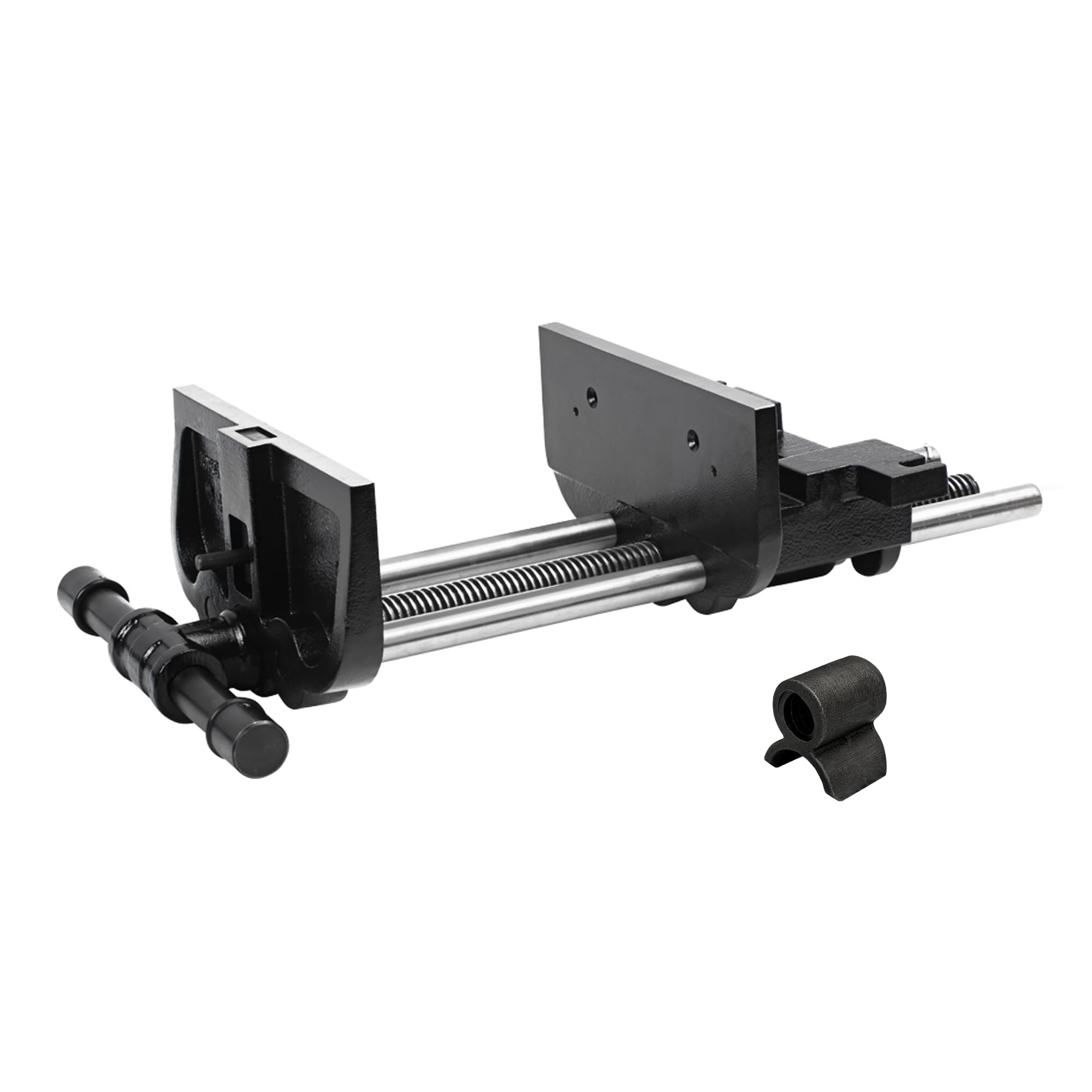
7. Jorgensen 10″ Woodworking Vise, Quick Release
Ten-inch jaws that spread to 13 inches — the widest reach in this whole group.
When a project calls for clamping something genuinely large, the number to chase is opening, and this vise offers 13 inches of it. Pair that with 10-inch jaws — the widest faces on this list — and you can swallow a thick glued-up panel or a wide board without reaching for a second clamp. The main body is ductile iron, a tougher grade than plain cast iron, with all-steel hardware carrying the load.
The jaws are machined with a toed-in profile, so they bite at the top first and hold the workpiece firmly under pressure rather than letting it slip as you cut or drill. That bite is the reason a vise this size still feels controlled. Quick release lets you slide the jaw to position in seconds instead of cranking through 13 inches of travel, which matters at this scale.
Two practical details if you plan to bolt one on: it is designed for workbenches up to 3 inches thick, and the front and back jaws carry countersunk holes (recessed holes that sit the bolt head flush) so you can add your own wooden facings to protect finished work. For a big-bench shop, the reach is hard to argue with.
Why the size wins: 10-inch jaws and a 13-inch opening give you clamping capacity the rest of the field cannot match, with toed-in jaws that grip firm under pressure.
Check your bench first: it fits tops up to 3 inches thick and bolts down, so confirm your bench dimensions before ordering.
The pick for: shops that routinely clamp wide panels and thick glue-ups and want the reach in one tool.
Overkill if: your work stays under 8 inches wide, where a smaller vise does the same job for less bulk.
8. Rockler Quick Release Front Vise 9″ Dual Guide Rod

Dual guide rods fight the one failure every wide vise risks: racking.
Racking is what happens when you clamp a board at one end of a wide jaw and the sliding jaw twists instead of pressing evenly — the wider the jaw, the worse it gets. This vise attacks that head-on with two guide rods on a 9-inch bar, which resist twisting so the jaw stays square to whatever you clamp. The body is iron and steel, the handle is solid hardwood, and a wide 9-inch handle plate adds stability under load.
You get a 1/4 turn quick release: pull up on the handle and hold, the nut disengages, you slide the wooden jaws to the opening you want, then release and a turn of the main handle re-engages the screw and tightens. That is a cleaner motion than cranking through a long thread, and it is built for a custom bench where you make your own jaw faces. Mounting takes 1/4-inch lag bolts, which are not included — note so you have them on hand.
The divide worth knowing: the release draws mixed feedback, praised by some and disliked by others. Given the anti-racking design is the whole point, this is a vise for someone who wants stable wide clamping on a built bench and will take the time to fit it properly. It rewards careful installation over quick bolting.
The design argument: two guide rods plus a 9-inch handle plate make this the most racking-resistant front vise in the shortlist, and the 1/4-turn release swaps the jaw position fast.
Dependencies to plan: you need 1/4-inch lag bolts and a bench built to accept a front vise — this is not a clamp-on tool.
Built for: custom workbench builders who clamp wide stock and cannot tolerate a jaw that twists.
Not your tool if: you want to unbox and clamp without building a bench around it.
9. Wilton Woodworking Vise, 4″ x 7″ Jaw, 10″ Max Jaw Opening

The jaw tilts 10 degrees, so tapered and irregular parts finally sit flat.
Every other vise here assumes your workpiece has two parallel faces. This one does not. Its front jaw pivots 10 degrees, so a tapered leg, a wedge, or a rough-sawn piece with an uneven side can be gripped squarely instead of rocking. For anyone who works with reclaimed stock or shaped parts, that single feature changes what is possible at the bench, and it is the reason this vise rounds out the list.
The jaw is 4 inches tall and 7 inches wide with a maximum opening of 10 inches — plenty of travel for thicker stock. A set of magnetic maple jaw inserts comes with it, so you get a wood-on-wood grip from the start rather than marking work with bare iron. And if you ever need more room, the pivoting jaw removes entirely for wider clamping. Cast iron body, backed by Wilton’s lifetime warranty against manufacturing defects.
The honest trade: this is the heaviest tool in the group at 30 pounds, and the pivoting jaw draws mixed feedback — the adjustment takes some getting used to, and a jaw that moves is not what everyone wants on an ordinary flat board. It is a specialist. If your work is square stock and nothing else, a fixed jaw gives you a simpler tool. If odd shapes cross your bench regularly, this solves a problem nothing else here touches.
The specialty win: a 10-degree pivoting front jaw grips tapered and irregular parts, magnetic maple inserts protect finished surfaces, and the jaw lifts out for wider work — backed by a lifetime warranty.
Who should look elsewhere: square-stock-only work does not need a moving jaw, and 30 pounds wants a fixed bench location.
Made for: reclaimed-stock, chair-making, and shaped-part work where parallel faces are a luxury.
Simpler alternative if: every board you clamp is already square and flat.
Know the Specs
Jaw Width and Jaw Opening
Jaw width is the length of the clamping faces — how much of your board gets gripped. Jaw opening is how far those faces travel apart — how thick a board you can fit between them. A vise with 9-inch jaws and a 10.25-inch opening grips 9 inches of face but accepts a piece up to 10.25 inches through it. Match the width to the boards you clamp flat, and the opening to the thickest stock you plan to hold.
Throat Depth
Throat depth is the drop from the top of the jaws down to the body. It sets how far a board can hang below the jaw faces when you stand it on end — a common move for sawing or chiseling end grain. More depth holds taller pieces steady; less depth forces you to lay the board flat or clamp it at a lean. If you do joinery on upright boards, this is the spec to check before anything else.
Quick Release Mechanism
A quick release disengages the main screw so the sliding jaw moves without cranking. On a lever or trigger model you slide the jaw to the board in one motion, then a turn of the handle locks it. On a wide vise the payoff is large, because otherwise every adjustment means spinning the handle through the full travel. Look for a release that engages cleanly and returns firmly — a loose one is the recurring complaint in this category.
Guide Rods and Racking
Guide rods are the steel bars that keep the sliding jaw travelling straight. Two rods resist racking — the twist that lets a wide jaw clamp harder on one end than the other. On narrow vises one guide is often enough, but on a 9-inch or wider front vise, twin rods are what keep the jaw square. If you clamp wide panels, this is the difference between even pressure and a board that creeps.
Common Questions
Will a quick-release vise hold as tightly as a plain screw vise?
Can I clamp a wood working vise to a table without drilling holes?
How thick a benchtop does a front vise fit?
What is the difference between a front vise and a bench vise?
Why does throat depth matter more than jaw width for some work?
Can a vise grip round stock like dowels without it spinning?
Do I need two people to install a heavy cast-iron vise?
Will wooden jaw faces wear out and need replacing?
Can a vise hold a tapered or irregularly shaped part?
How much clamping force is enough for hand-plane work?
The Bottom Line
For most home shops, the wood working vise that covers the widest range of jobs is the Yost Vises M9WW. Its 4-inch throat and 9-inch jaws handle both wide flat panels and tall boards you stand on end, and a rapid action lever slides the jaw into place instead of cranking. If you want the same rapid-action build in a lighter, easier-to-mount package, the Yost Vises M7WW is the smarter fit at 21 pounds with 7-inch jaws and an 8-inch opening. And if your bench is not yet built, the Groz 39020 front vise gives you twin guide rods and precision rolled threads to build into it.
One nudge worth making: this category rewards buying the vise that matches your bench rather than the biggest one on the page. The M9WW is the crowd favorite at 4.5+ stars across 500+ owners, but a 63-pound casting bolted to a folding table is a worse tool than a 7-pound Groz portable clamped to a solid edge. Measure your bench, decide whether you clamp flat stock or stand boards on end, and pick from there — every vise above will hold a board still once it is mounted to something that does not move.
How we choose
We do not accept paid placement. Every pick is matched to a real buyer and a real use-case; we do not hands-on test units.
Sources
Specifications: manufacturer listings and product documentation. Review insights: verified customer reviews, as of November 2026. Pricing: not shown on this page (it changes often); check the current price via the retailer link.
As an Amazon Associate, Tactical Gear Guy earns from qualifying purchases. This does not affect which products we feature.