Specs are compiled from manufacturer listings and verified buyer reviews and can change over time — please confirm the key details on the product page before buying.
You can sand all afternoon and still see a grey haze hanging in the shop light. That haze is fine dust a shop vac’s filter lets through, and it is why a real wood shop needs a dedicated dust collector instead of a vacuum. This guide walks through nine collectors that move serious air volume — some wall-mounted for tight shops, some rolling, some built around a cyclone that keeps the filter clearer — so you can match the machine to your tools, your space, and the dust you actually make.
This guide is built by comparing the manufacturers’ published specifications and the patterns across verified customer reviews, so you get each pick’s real strengths and trade-offs instead of marketing spin.
Airflow, filtration, and how the dust gets separated all decide whether your shop stays clear. Below you’ll find the right wood shop collection setup for your tools and your floor space.
Top Picks

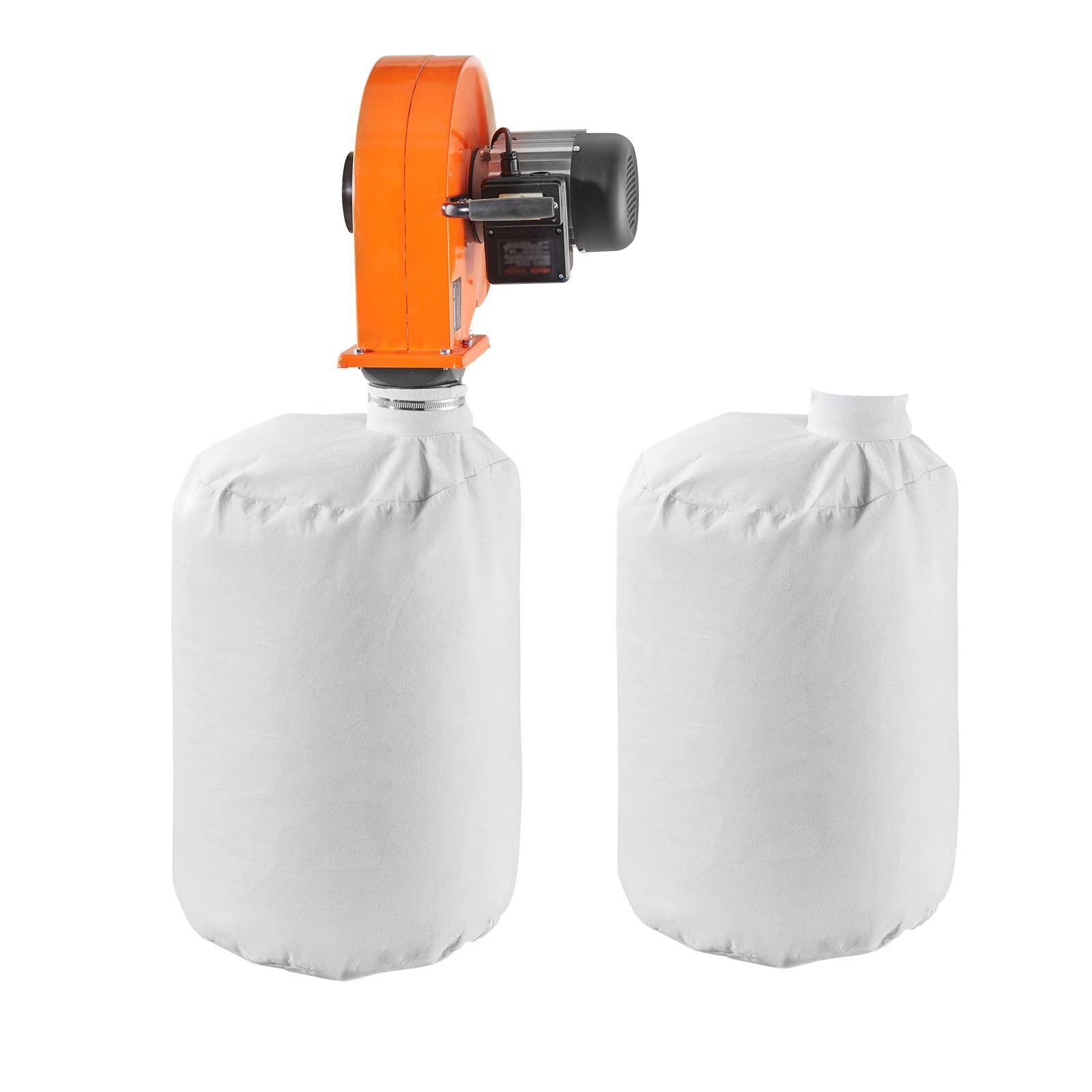

How To Choose The Best Wood Shop Dust Collection System
The first thing to get straight is that a shop vac and a dust collector do two different jobs. A shop vac pulls a small, hard column of air — great for cleaning up after the job. A dust collector moves a big, wide volume of air, which is what you need at the moment a blade or sander throws fine dust into the room. Buy for the tool, not for the cleanup.
Match the airflow to your biggest machine
Airflow is measured in CFM, or cubic feet of air moved per minute. A planer or wide drum sander throws far more dust per second than a scroll saw. If your collector’s CFM rating can’t keep up, the dust leaks out at the tool instead of getting caught. Look at the biggest machine on your floor and pick a collector rated to cover it.
Understand filtration in microns
Filter bags and canisters are rated in microns — one millionth of a meter. A 1-micron filter catches finer dust than a 5-micron bag. Coarse sawdust drops out of the air quickly, but the dangerous stuff is the invisible fine dust that hangs around. A 1- or 2-micron filter is what keeps that fine dust out of your shop air.
Single-stage or cyclone separation
A single-stage collector pulls everything straight into the bag or canister. A two-stage or cyclone design spins the heavy chips out first, so mainly fine dust reaches the filter. That keeps the filter from clogging and holds airflow steadier between cleanings. Cyclones cost more, but they can mean less filter maintenance over a long shop life.
Where the unit will live
Wall-mount collectors save floor space in a tight shop and keep the hose reachable at the bench. Rolling units with casters let you park the collector next to the machine you’re using. Think through your shop layout before you buy, because a great collector in the wrong spot gets used less.
Side-by-Side Comparison
| Model | Best For | Airflow (CFM) | Filtration | Capacity | Amazon |
|---|---|---|---|---|---|
| WEN DC1300★ Best Overall | High-volume shop centerpiece | 1,300 CFM | 5 micron | 50 gallons | Amazon |
| VEVOR Wall MountBest for Tight Shops | Tight shops, wall mounting | 560 CFM | 2.5 micron | 21 gallons | Amazon |
| WEN DC3474Best Rolling Value | Rolling flexibility, one tool at a time | 600 CFM | 5 micron | 15 gallons | Amazon |
| POWERTEC DC5371 | Wall-mount fine filtration | 560 CFM | 1 micron | — | Amazon |
| SHOP FOX W1727 | Portable single-stage workhorse | 800 CFM | 2.5 micron | — | Amazon |
| JET Vortex Cone 708659K | Serious home shops, low maintenance | 1,100 CFM | 2 micron canister | 39.6 gallons | Amazon |
| Shop Fox W1687 | Big-volume shops, multiple machines | 2,800 CFM | — | 10.8 cubic feet | Amazon |
| Powermatic PM1300TX-CK | Two-machine collection, remote control | — | 2 micron canister | 10 cubic feet | Amazon |
| JET JCDC-2 Cyclone | Full-shop cyclone separation | — | 2 micron canister | 30 gallons | Amazon |
Detailed Reviews
1. WEN DC1300 Dust Collector
Our pick — 4.5+★ from 200+ verified ratings; the strongest balance of quality and price.
The highest-CFM collector here, built to feed two machines at once in a garage-sized shop.
Most collectors on this list move 560 to 800 CFM, and then there is this one. The WEN DC1300 circulates up to 1,300 cubic feet of air per minute — the highest on the list, and more than double the 560 CFM of the VEVOR wall unit. In plain terms, you can run it as the centerpiece of the shop and feed more than one machine off it. That width of airflow is what keeps fine dust from escaping at the blade of a planer or router.
Two 4-inch air inlets mean you can attach up to two tools at once, so you are not crawling behind the bench to swap a hose every time you change stations. The 14-amp motor spins a 10-inch steel impeller up to 3450 RPM, which is where that airflow comes from. A vertical bag holds up to 50 gallons of dust, enough that the bag change is a rare chore rather than a weekly one. And the mobile base runs on four swivel casters, so the heaviest-hitting unit here still rolls wherever the work is.
The honest catch is the collection side: the 5-micron bag is looser than the 1-micron POWERTEC or the 2-micron mesh of the JET, so the finest dust is not as tightly contained. Quality is what wins people over here, followed by how quiet it runs for a machine this size, though a build-detail gripe and some thin instructions turn up now and then. Put it in a shop with good ventilation or near a door, and that 5-micron bag is a fair trade for the raw airflow.
Where this collector wins
- 1,300 CFM tops the list and beats the VEVOR’s 560 CFM
- Two 4-inch inlets let you run a pair of tools at once
- 50-gallon bag means far fewer emptyings
- Four swivel casters roll the whole unit around the shop
The honest trade-off
- 5-micron bag is looser than 1- or 2-micron filter setups
- Build durability gets a split verdict from owners
- Instructions are on the thin side
Grab this one: if you run more than one machine and want maximum airflow with minimal floor-clearing.
Think twice: if ultra-fine filtration is the priority and you have no way to vent the shop.
2. VEVOR Wall Mount Dust Collector
Saved floor space in a one-car garage shop is the whole point, and this unit hangs it on the wall.
If your shop is a corner of the garage, floor space is the real currency. This VEVOR mounts on the wall, so the machine sits at head height and out of your way — a boon when the table saw has to live against the same wall. It still pulls 560 CFM of airflow, enough for coarse sawdust and fine sanding dust on medium and small projects. The 21-gallon (80L) non-woven collection bag holds a lot between emptyings, and a bottom zipper lets you dump it without unclipping the whole bag.
The 1 HP induction motor runs at ≤ 90dB, which is quiet enough to talk over while you work, and the bag filters down to 2.5 microns — a step tighter than the 5-micron bags on the WEN units. At 24 pounds it is by far the lightest unit on this list, which matters because a wall mount needs to be easy to lift into place. One thing to know: the 24-pound figure is the unit only, not the wheels-and-base heft of the rolling collectors.
The trade-off is airflow headroom. At 560 CFM it matches the POWERTEC and far trails the 1,300 CFM WEN, so it is happiest running one moderate tool at a time rather than feeding a whole shop off a duct run. The zipper-empty bag is convenient but it is fabric, so give it a shake-out rather than expecting a rigid canister. For a compact bench setup it is a tidy, quiet answer.
Space-saving math: mounting high frees the floor for machines and stock, and 24 pounds is light enough to hang without a helper.
Know before you hang it: the 90dB ceiling and 2.5-micron bag are good, not top-tier, so treat it as a small-shop unit.
Reach for this: when the shop is small and every square foot is precious.
Look elsewhere: if you need to run long duct runs or multiple machines at once.
3. WEN DC3474 Dust Collector
One unit that can roll up to the bench or bolt to the wall, whichever your shop decides.
The DC3474 gives you a choice the WEN DC1300 does not: roll it or hang it. The 7.4-amp induction motor and 9-inch impeller push up to 600 cubic feet of air per minute through a single 4-inch dust port, which connects straight to your favorite tool. A carrying handle and swivel casters let you walk it from the table saw to the planer, then park it out of the way. If floor space gets tight, you can mount it to the wall instead.
Effectiveness is what people talk about most with this collector — it has the power to keep a planer running without choking. A 15-gallon 5-micron zippered bag collects the chips, and a two-year warranty covers the motor. Compare the airflow to the VEVOR’s 560 CFM and it’s a touch higher at 600; compare it to the DC1300’s 1,300 and it’s roughly half, which tells you this is a one-tool-at-a-time machine rather than a shop-wide ducted system.
Suction gets a mixed verdict in reviews, and durability is the other split-prone topic, though most owners find it plenty capable for weekend work. The 5-micron bag is loose compared to the fine canisters, so plan to vent the shop. For a hobbyist who works one machine at a time and wants both mount options in one purchase, this is the flexible middle ground.
What you get for the money
- Rolls on casters or mounts to the wall — buyer’s choice
- 600 CFM through a single 4-inch port
- Onboard handle makes it genuinely portable
- Two-year warranty backs the motor
The fine print
- 5-micron bag catches less fine dust than 1- or 2-micron setups
- One port means one tool at a time
- 15-gallon bag fills quicker than the 50-gallon DC1300
Pick it for: the hobbyist who wants one machine that rolls and can also wall-mount.
Step up if: you need shop-wide airflow or a tighter filter bag.
4. POWERTEC DC5371 Wall Mount Dust Collector

The tightest bag filter on the list, and the reason this one is worth a look before any 5-micron unit.
If the invisible dust is your worry, start here. The POWERTEC DC5371 comes with a 1-micron dust collector filter bag — five times finer than the 5-micron bag on the WEN DC1300, and tighter than the VEVOR’s 2.5-micron. A micron is one millionth of a meter, so a 1-micron bag traps the fine dust a 5-micron bag passes back into the shop. A built-in window lets you see when the bag is filling, and a zipper makes dumping it quick without a cloud of dust.
Performance is what gets praised most — it holds up on table saws, sanders, and routers, and the Vortex Base design guides airflow to reduce turbulence, which POWERTEC says gives up to 10% better efficiency over a comparative model. The 1 HP induction motor runs at 3450 RPM and moves 560 CFM through a 4-inch inlet, and it is dual-voltage: 12 amp at 120V or 6 amp at 240V. At 80dB it is quietly rated. Assembly and install are straightforward, and it hangs on a mounting bracket to clear the floor.
There is a maintenance quirk worth knowing. The 4-inch side port has a built-in grate to stop big debris from hitting the impeller, and that grate can collect material over time. Pull the hose now and then and check the port. Suction and size get mixed notes, so it is not the loudest-sucking unit per dollar — but for the finest dust capture in a wall-mounted package, nothing on this page touches that 1-micron bag.
The filtration lead: a 1-micron bag captures markedly finer dust than the 5-micron bags on the WEN units, which is the whole ballgame for shop air quality.
The upkeep note: that built-in port grate needs periodic unclogging or efficiency drops — a small habit to build.
Best for: the woodworker whose priority is the finest possible filtration in a wall-mount unit.
Not for: anyone wanting the maximum CFM — the 560 rating trails the big single-stage machines.
5. SHOP FOX Portable W1727 1 HP Dust Collector

A rolling 800 CFM single-stage collector that punches above its 1 HP label without eating a whole wall.
Here is a spec that stands out: this 1 HP machine pulls 800 CFM, more airflow than the 600 CFM WEN DC3474 and the 560 CFM VEVOR, despite the smaller-sounding motor. It runs on 120V/240V single-phase, prewired for 110V, drawing 9A at 120V or 4.5A at 240V. Standard bag filtration is 2.5 microns, which sits between the loose 5-micron bags and the tight 1-micron POWERTEC. The portable base is sized to roll from station to station.
It is a genuinely heavy unit at 55 pounds — the VEVOR wall mount tips the scale at 24 pounds by comparison — so this is a roll-it-where-you-need-it machine, not a hang-it-up one. Owners consistently describe it as easy to assemble and quiet in use, suited to a small shop where one collector serves a handful of tools. The 2.5-micron bag is a reasonable middle of the road for a rolling single-stage.
Where it falls short of the finest units is filtration — it will not match the 1-micron POWERTEC or the 2-micron canister of the JET. But if you want real airflow from a 1 HP rolling machine and don’t need cyclone separation, the 800 CFM figure makes a strong case. Just clear a path wide enough for the base and keep the bag zipped tight.
Why it earns its spot
- 800 CFM beats the 600 CFM WEN and 560 CFM VEVOR on airflow
- Dual-voltage motor: 9A at 120V, 4.5A at 240V
- Rolls on a portable base, so it travels to the machine
- Owners describe it as easy to assemble and quiet
The trade-offs
- 55 pounds is heavy to move up or down stairs
- 2.5-micron bag won’t match 1- or 2-micron filtration
- Single-stage, no cyclone separation
Good match when: you want maximum airflow out of a rolling 1 HP single-stage.
Keep shopping if: filtration fineness is your top priority.
6. Jet 708659K Dust Collector
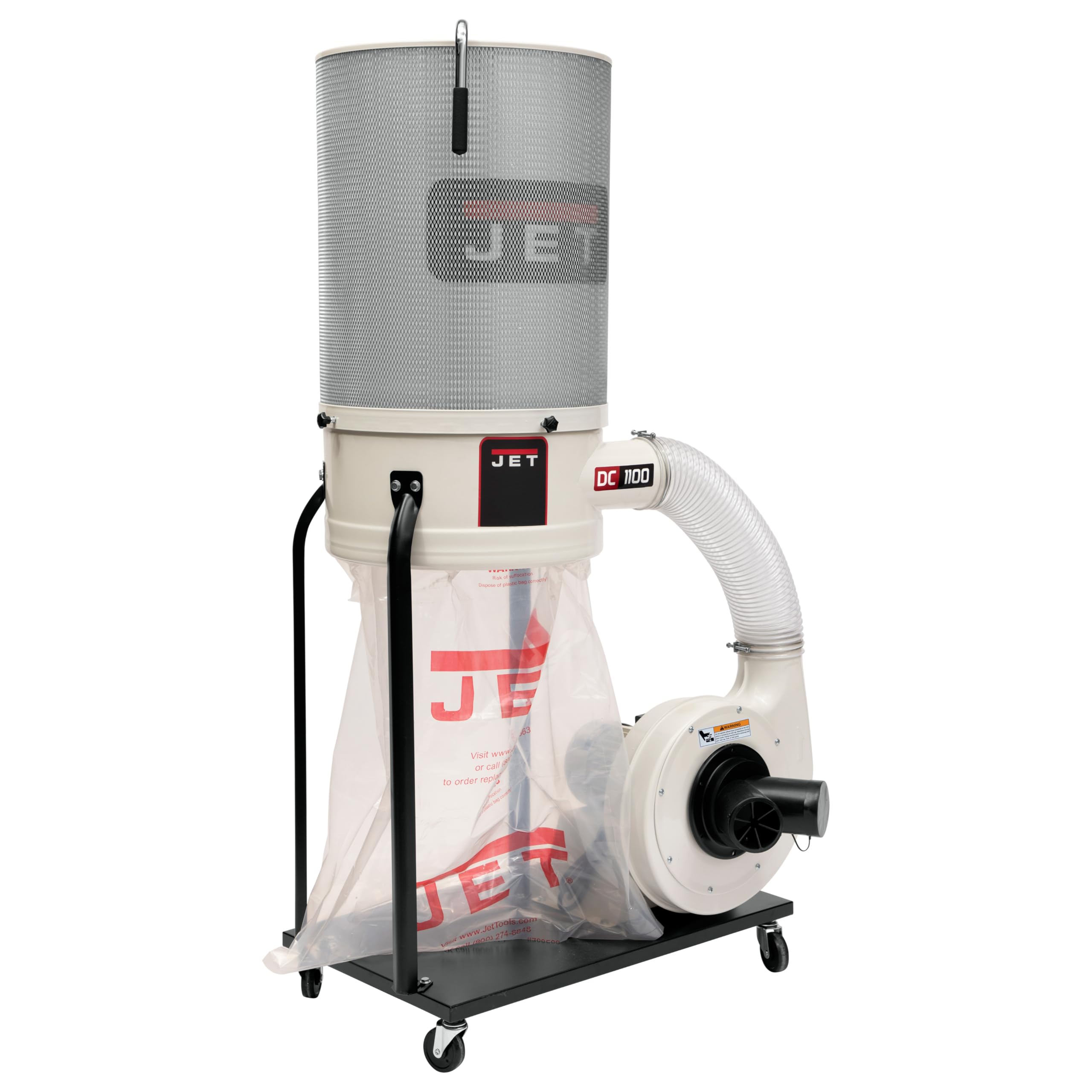
The one that takes most of the chips out of the airstream before they ever reach the filter.
What earns this JET its keep is the Vortex Cone tucked below the filter chamber. It knocks 98% of wood chips down into the collection bag before they can clog the pleated canister, so mainly the fine dust reaches the filter. That keeps airflow steadier between cleanings and packs the bag more densely, which means fewer bag changes. The 2-micron canister itself captures 98% of 2-micron and 86% of 1-micron particles, and you clean it by turning the top handle a couple of rotations — internal scrapers knock the dust off the pleats with no filter removal.
The airflow is substantial: 1,100 CFM with 10-1/2 inch static pressure, driven by an 11-inch steel impeller and a continuous-duty 1-1/2 HP motor. It is prewired 115V but wants a 20A circuit, and it runs at 70-80 dB — noticeably quieter than a shop vac at the same job. One 6-inch inlet or two 4-inch inlets let you plumb it to table saws, planers, and jointers. A 39.6-gallon bag with clear walls shows when it needs emptying, and the whole unit rolls on four swivel casters.
This is a wood-dust-only machine — no metal shavings, liquids, glass, or rock. The canister design means less filter fuss than a bag unit, but it is a bigger footprint than a wall mount, so plan real floor space. For a home or small shop that wants strong airflow with low filter maintenance, the Vortex Cone does the work for you.
The cyclone-lite trick: 98% chip separation before the filter is the spec that saves you cleaning time, and the turn-handle canister cleaning is genuinely hands-off.
Space and power note: it wants a 20A circuit and a real patch of floor — this is not a hang-it-on-the-wall unit.
Choose this if: you want 1,100 CFM and low-maintenance canister cleaning in a home shop.
Skip if: you’re short on floor space — it lives on casters, not a bracket.
7. Shop Fox 3 HP Dust Collector W1687

When one collector has to serve the whole shop at once, 2,800 CFM is the reason this exists.
This is the largest airflow figure on the page by a wide margin. The W1687 pulls approximately 2,800 CFM — more than double the 1,300 CFM WEN DC1300 and roughly five times the 560 CFM wall units. A 3 HP, 220V single-phase motor turning at 3,450 RPM drives it, drawing 18A at 220V. Static pressure is rated at 14.4 inches, which is the number that tells you it can push air down a real duct run rather than just at the port. A 10.8 cubic-foot bag volume holds a large amount between emptyings.
This collector is built for a serious shop: a multi-machine layout with hard duct, where you want one big unit pulling from several stations. It is powder-coated and heavy-built. A 3 HP, 220V motor also means you need a 220V circuit ready for it — this is not a plug-into-the-garage-outlet machine, and the amperage draw confirms it.
The honest picture: quality and functionality get solid marks, and it has been praised for keeping CNC machines clean. Noise is the mixed topic — some find it comparable to other big collectors, some find it loud, which is the reality of moving this much air. For a full shop with the power and space to host it, the airflow is the headline.
The case for the big unit
- 2,800 CFM dwarfs every other collector here
- 14.4-inch static pressure pushes air down duct runs
- 10.8 cubic-foot bag holds a lot between changes
- Praised for keeping CNC machines clean
What it demands
- 3 HP, 220V motor draws 18A — needs a 220V circuit
- Noise gets a split verdict from owners
- Built for a fixed shop, not a bench corner
Made for: a full shop with a 220V circuit and ducted multi-machine collection.
Wrong pick if: you’re wiring a standard 120V bench setup.
8. Powermatic PM1300TX-CK Dust Collector
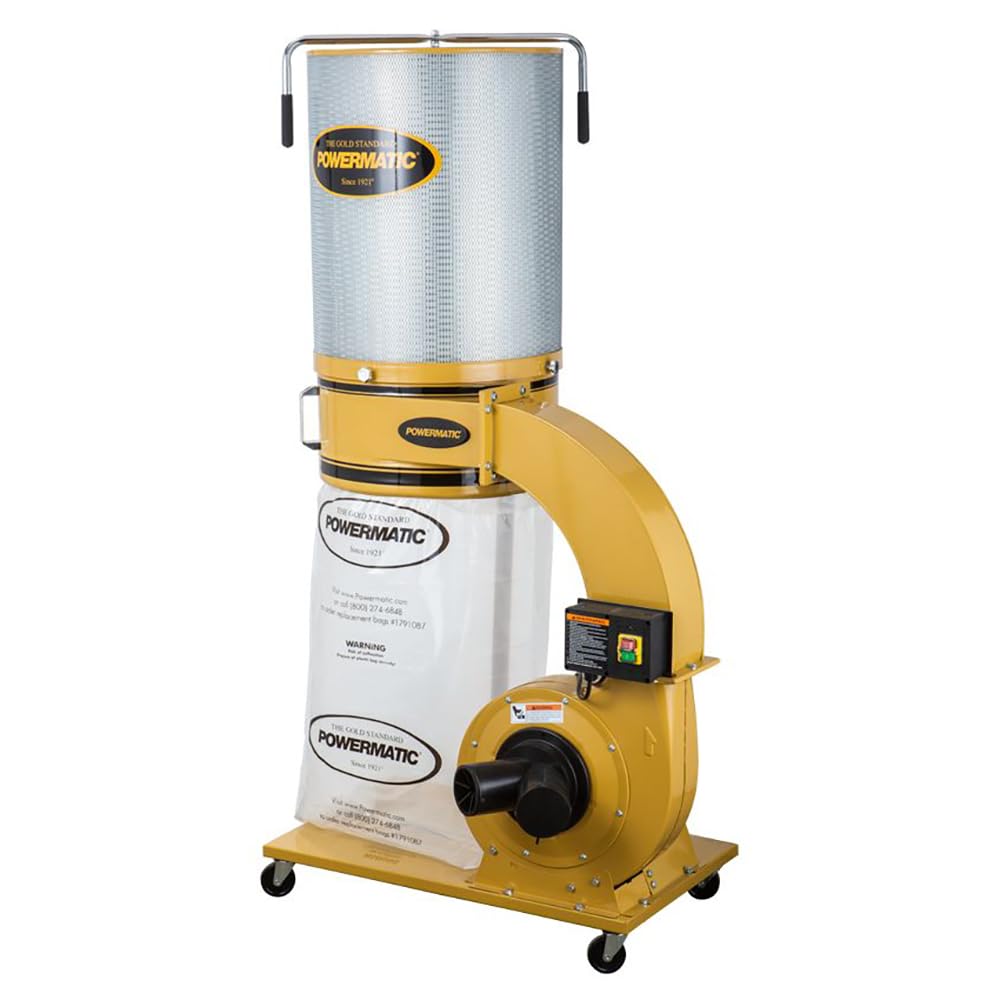
A canister collector with a remote timer that starts the airflow before you even reach the tool.
The feature that changes the routine here is the IR remote-controlled digital timer. You can program it for up to 99 minutes, so the collector can run on after you finish and clear the last of the dust from the air. The TurboCone design improves chip separation and packs the collection bag more densely, so the filter stays cleaner and you change bags less often. Dual 4-inch dust ports let you collect from two machines at the same time without moving a hose. A 1-3/4 HP motor drives a large steel impeller, and the 10 cubic-foot collection bag cuts down on bag-change frequency.
All-metal duct construction keeps the airflow path rigid, and four swivel casters let you turn the unit around the shop. The 2-micron canister filter handles the fine dust, and a 5-year warranty backs the machine. Owners find it effective on a range of machines, especially at the lathe where dust capture matters, and assembly is on the quick side.
The remote control and the noise level are the two topics that split opinion — treat the remote as a nice extra rather than the main reason, and know that 90dB is the loudest on this page. It is also the tallest footprint of the canister units, so measure your ceiling clearance before it arrives. If running two tools at once is your normal day, the dual ports are the deciding spec.
Automation that pays off: the 99-minute programmable timer and dual 4-inch ports are the practical wins here.
The loud truth: 90dB is a real number — hearing protection is part of the deal with this one.
Best fit: a shop that regularly runs two machines and wants remote-timed airflow.
Consider the JET instead: if quieter operation and a tighter cyclone matter more than the remote.
9. JET JCDC-2 Cyclone Dust Collector

The two-stage separator that keeps working airflow up by keeping the filter out of the heavy chips’ path.
This is a true cyclone. The two-stage separation spins the heavy debris into a 30-gallon drum with quick-release levers and independent casters, so fine dust never loads the pleated filter. That design is why JET says it provides more working CFM than a comparable-horsepower single-stage unit — the filter stays clear while a 2 HP, 230V motor keeps the air moving. Fine particles still get captured through the pleated material, which filters down to 1 micron. Emptying the drum is easier than hauling a full bag.
A radio-frequency remote works from up to 50 feet away, and a timer lets you run the system for 2, 4, 6, or 8 hours before it shuts off automatically — handy when you want the shop air cycled after you step away. The double-paddle manual cleaning system cleans the pleated filter with a few turns, and eight casters make a heavy machine surprisingly movable.
Suction, value, assembly, and ease of use all get a split verdict, so this is a machine you buy for the two-stage design rather than for raw simplicity. The 230V, 15A draw means a dedicated circuit. For a shop that makes steady dust and wants the cyclone to separate chips from fines, the 30-gallon drum and 1-micron pleated capture are the reasons to reach for it.
Where the cyclone shines
- Two-stage separation keeps the filter freer and airflow steadier
- 30-gallon drum with quick-release levers is easy to empty
- RF remote works up to 50 feet, with a 2/4/6/8-hour timer
- Pleated filter captures down to 1 micron
What to plan around
- 2 HP, 230V motor draws 15A — needs a dedicated circuit
- Assembly and ease-of-use get mixed notes
- Big footprint that wants real floor space
Step up to this: if you want two-stage separation, a 1-micron pleated filter, and remote control in one machine.
Pause if: you’re not set up for 230V or you need a compact wall-mount footprint.
Know the Specs
Airflow and CFM
CFM stands for cubic feet per minute — the volume of air the collector can move. The higher the number, the more dust it can pull away from a given tool before the dust escapes at the blade. A 2,800 CFM machine like the Shop Fox W1687 can feed a whole ducted shop, while a 560 CFM wall mount suits one moderate tool. Match CFM to your biggest dust-maker, not your smallest.
Micron Filtration
A micron is one millionth of a meter, and the micron rating tells you how fine a filter catches. Coarse sawdust drops out fast, but sub-5-micron dust stays airborne long enough to reach your lungs. A 1-micron bag catches more of that than a 5-micron one. Tight filters trade some airflow for cleaner air, which is why the finest-bag units and the highest-CFM units are rarely the same machine.
Static Pressure
Static pressure is measured in inches of water and describes how hard the collector can push air against resistance — the resistance of long hose or hard duct. A unit with high static pressure keeps pulling at the far end of a duct run. It is why a big machine can serve several stations while a small one is best kept close to the tool.
Single-Stage vs Cyclone
A single-stage collector sends all the dust straight to the bag or canister. A cyclone separates the heavy chips out first with a spinning action, sending only fine dust to the filter. That keeps the filter cleaner and airflow higher for longer. Cyclones cost more and take more floor space, but they cut filter maintenance over the years.
Common Questions
Will a dust collector keep up with my planer or table saw?
What micron rating do I need for fine sanding dust?
Do I need a 220V circuit for a big dust collector?
Can a dust collector run two tools at once?
How often do I empty the collection bag?
Can I use a dust collector for metal shavings or liquids?
Is a cyclone worth it over a single-stage collector?
How loud is a dust collector compared to a shop vac?
What is the difference between a wall-mount and a rolling collector?
Do dust collectors come with a remote control?
The Bottom Line
For most woodworkers building out a shop, the wood shop dust collection system that pulls the most air and still rolls where you need it is the WEN DC1300 —1,300 CFM, dual 4-inch inlets, and a 50-gallon bag make it the airflow leader on this page. If fine-dust filtration is your priority instead, the POWERTEC DC5371 brings the tightest 1-micron bag here in a wall-mount package. And if you want cyclonic chip separation with low filter fuss, the JET Vortex Cone earns its keep at 1,100 CFM. The WEN DC1300 holds 4.5+ stars across 200+ ratings — a strong following for the machine that simply moves the most air.
How we choose
We do not accept paid placement. Every pick is matched to a real buyer and a real use-case; we do not hands-on test units.
Sources
Specifications: manufacturer listings and product documentation. Review insights: verified customer reviews, as of November 2026. Pricing: not shown on this page (it changes often); check the current price via the retailer link.
As an Amazon Associate, Tactical Gear Guy earns from qualifying purchases. This does not affect which products we feature.