Specs are compiled from manufacturer listings and verified buyer reviews and can change over time — please confirm the key details on the product page before buying.
Buying wooden handles for knives is really a question of one thing: will the block survive the grinder, the drill, and the first hard season of use? Most beginners assume any pretty hardwood will do, then watch a cheap blank split along the grain halfway through shaping. The picks below are the blanks that consistently hold together, plus the ones with the figure that makes a finished handle worth showing off.
This guide is built by comparing the manufacturers’ published specifications and the patterns across verified customer reviews, so you get each pick’s real strengths and trade-offs instead of marketing spin.
You will learn which measurements actually matter when you shape a handle, and how hardness changes the way a blank cuts. Read on for the honest shortlist of wooden handles for knives.
Top Picks


How To Choose The Best Wooden Handles for Knives
The first thing to get straight is that you are buying raw material, not a finished handle. Every blank here arrives square and oversize, and you cut, drill, epoxy, and sand it into shape yourself. That changes what “good” means — the block has to be thick enough to work down, dry and stable enough not to move after gluing, and pretty enough that the grain still looks right once you have carved into it.
Thickness decides your shaping room
A 1/2-inch blank gives you room to taper, contour, and round the edges without running out of material. A 3/8-inch blank saves weight and sanding time, but leaves less to remove before you hit your liner or tang. If you plan an ambitious sculpted handle, go thicker.
Hardness changes your sanding day
Harder exotics hold a crisp edge and polish up glassy, but they eat sandpaper and throw more dust. Softer woods shape quickly but can fuzz or tear out if your tools are dull. Match hardness to your sandpaper budget and tooling, not just the photo.
Bookmatched versus single blanks
A bookmatched pair is two slices cut from the same block and opened like a book, so the grain mirrors across the handle. If you are building a full-tang knife where both sides show, that symmetry is the difference between “handmade” and “store-bought.”
Side-by-Side Comparison
| Model | Best For | Piece Count | Blank Size | Wood | Amazon |
|---|---|---|---|---|---|
| Payne Bros Variety Pack (VP18)★ Best Overall | Sampling several species | 5 Count | 5.5 x 1.5 x 0.38 in | Assorted hardwood | Amazon |
| TEAMWILL Octagonal HandleRehandle Pick | Rehandling a Japanese knife | 1 | 1.3 in, 70 mm tang slot | Olive wood + sandalwood | Amazon |
| Doc of All Trades PurpleheartBold Color | A dense, bold-colored handle | 1 | 5 x 1.5 x 0.38 in | Purpleheart | Amazon |
| Maragos Zebrawood Scales | Stripe-figure bookmatched look | 1 pair | 5 in length | Zebrawood | Amazon |
| Wislist Walnut Lumber | Versatile all-round blanks | 4 | 5.1 x 2.3 x 0.5 in | Walnut | Amazon |
| TANEMUDO Ironwood Scales | Bulk kit for learning | 5 | 5.11 x 1.77 x 0.51 in | Ironwood | Amazon |
| Riakrum Ironwood Scales | Dense blanks, larger stock | 4 | 5.12 x 1.77 x 0.51 in | Ironwood | Amazon |
| IECAP Desert Ironwood Pair | High-end full-tang builds | 2 (matched pair) | 5.12 x 1.75 x 0.5 in | Desert ironwood | Amazon |
| Doc of All Trades Leopardwood | A patterned, easy-shaping block | 1 | 5 x 1.5 x 0.25 in | Leopardwood (lace wood) | Amazon |
Detailed Reviews
1. Payne Bros Variety Pack of 5 Wood Scales
Our pick — 4.5+★ from 200+ verified ratings; the strongest balance of quality and price.
Five different hardwoods in one box — the fastest way to find the grain your hand actually likes.
Five species, 5.5 inches long, 1.5 inches wide, 0.38 inches thick, and 1.8 pounds for the set. That weight tells you something useful before you ever touch a saw: these are solid, substantial blocks, not paper-thin veneer slices. The 1.8 pounds actually runs heavier than the TANEMUDO ironwood five-pack at 1.17 pounds, so you are getting more physical stock per piece. The 5.5-inch length also edges past the 5-inch norm most other blanks here use, which gives you a little spare material at each end of a full-tang layout.
What wins people over is the quality of the cut — the grain is clean and the blanks arrive flat, so you spend your afternoon shaping rather than flattening a warped face. The five-species format is the real trick here. You can build one knife in a wood you already trust, then try a second handle in an exotic you have never sanded before without committing to a full set of it.
The honest catch is that a variety pack means you do not control the exact figure in each piece. You get five good species, but not five matched halves for a single knife. Treat it as a workshop sampler rather than a bookmatched build set, and it makes far more sense.
What earns the top spot
- Five separate hardwoods, so you can test a species before buying a full set of it
- 5.5-inch length gives spare material on a full-tang handle
- 1.8 pounds of stock for the set means genuinely solid blanks per piece
Where it asks for patience
- Grain varies piece to piece, so it will not give you a matched pair
- Finished handle shape is entirely on your own shaping work
Best for: The first-time handle maker who wants to feel five different hardwoods under the sander before picking a favorite.
Know before you buy: It is a sampler, not a matched pair — plan a pair of single-handle builds rather than one symmetrical knife.
2. TEAMWILL Octagonal Wooden Handle for Japanese Kitchen Knives
An already-shaped octagon for a Japanese blade that lost its handle, at 1.76 ounces.
Most blanks here are cubes you carve down. This one is different: it arrives as a finished octagonal handle, not a block. The sold piece is 1.3 inches across and weighs 1.76 ounces — that figure is roughly a tenth of the Payne Bros five-pack’s 1.8 pounds, because you are buying one small, pre-shaped handle instead of a pile of stock. It carries a tang slot about 70 mm deep.
The shape itself is the reason to buy it. An octagonal handle settles into a pinch grip with clear flat faces under your fingers, which is exactly the feel a lot of Japanese kitchen knives are built around. The olive wood body is paired with black sandalwood at the collar for a two-tone look, and that combination shows nicely when you are holding it over a cutting board.
Now the part the listing is upfront about: it is not a drop-in fit. The maker expects you to sand and polish the handle yourself after the tang goes in, so budget for sandpaper and a bit of finishing time. It is also a single piece — no backup if you drill the wrong angle. For the cook restoring one special gyuto, that is a fair trade for skipping the hardest part of handle making.
Pre-shaped advantage: You skip the whole rough-shaping stage — the octagon is already cut, so your work is fitting the tang and finishing the surface.
One-piece reality check: With a single handle in the box, measure your tang width carefully before you drill, because there is no spare.
Reach for this if: You are rehandling a Japanese chef knife and want the octagonal profile without carving it yourself.
Look elsewhere if: You want a blank to sculpt a totally custom handle shape from scratch.
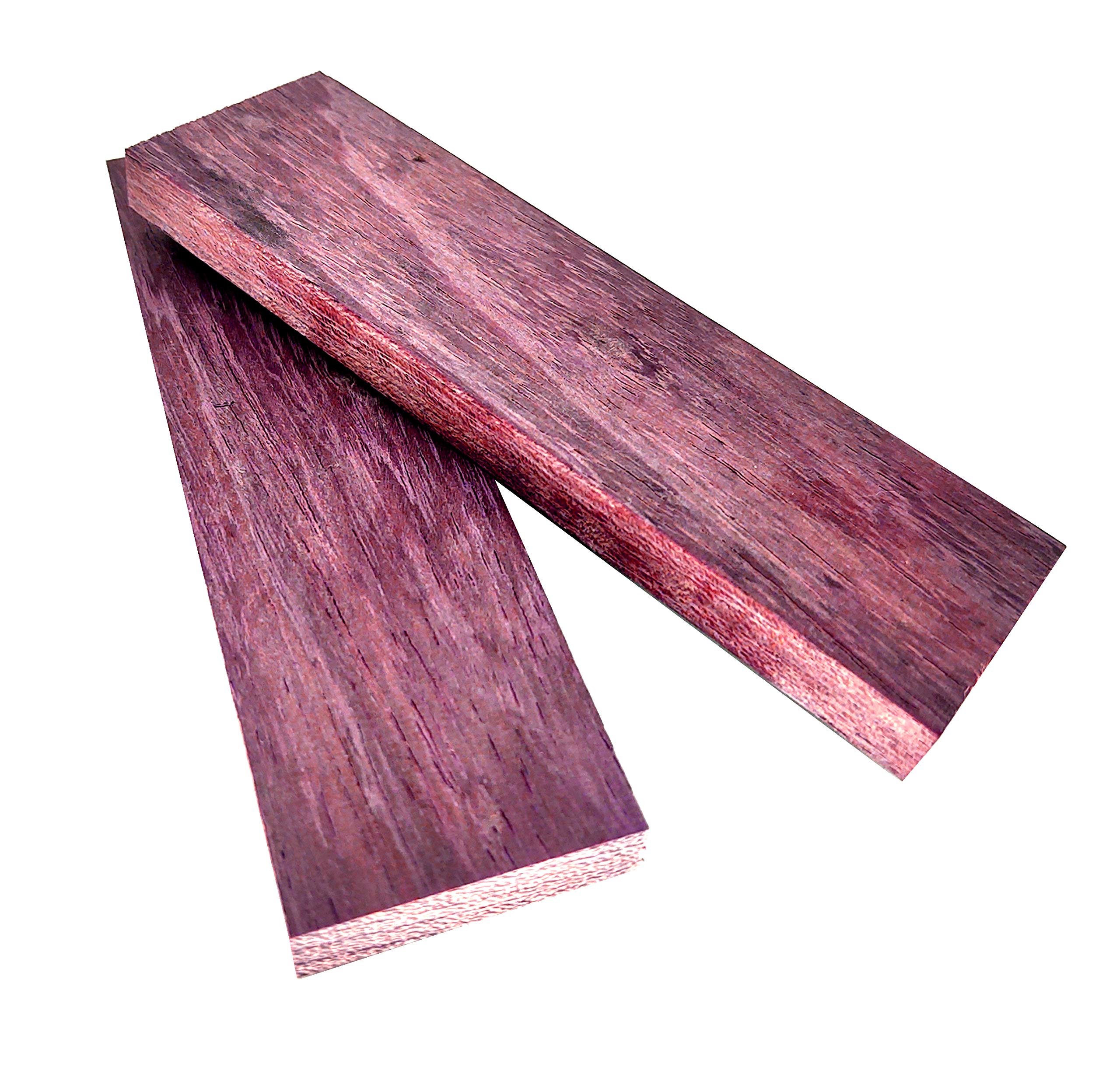
3. Doc of All Trades Purpleheart Knife Scales
A 2900-hardness block that deepens toward purple instead of fading away from it.
Purpleheart is the wood that gives a handle a color nobody else at the workbench has. This block measures 5 x 1.5 x 3/8 inch and carries a stated hardness around 2900, the densest spec quoted on this shortlist. For you that means slow sanding and a finish that closes up tight. It also means the tool has to be sharp, because a block this hard will burn a dull belt rather than cut cleanly.
The color is the reason to pick it: graded 4 out of 4 for colorfastness, it deepens toward purple with light exposure instead of going grey. The maker grades colorfastness a 4 out of 4 and notes that the wood gains color over time — the purple deepens with light exposure rather than going grey the way some exotics do. So the handle you glue today is not the final shade. The figuring is listed as consistent, which matters when you are cutting two sides and want them to look like siblings.
A word on the work rating: this is listed 7 out of 10 on the easy-hard scale, so it is genuinely on the demanding side. Expect more time at the sander and more dust than walnut. The heavier 2.82-ounce weight for a single blank tells you the density is real, not marketing copy. Finish the surface with a good oil and the effort shows.
Why pick purpleheart: You get a color that shifts deeper over time instead of washing out, on a block listed at hardness ~2900.
Be ready to sweat: A 7-out-of-10 work rating means slower shaping and more sandpaper — not a project for a dull belt.
Pick it for: A personal carry knife where a deep purple handle is the whole point of the build.
Think twice if: You want fast, forgiving sanding on your first-ever handle blank.
4. Maragos Wood Bookmatched Zebrawood Knife Scales

Stripe-figure zebrawood, mirrored left to right, so the two sides of your handle talk to each other.
Zebrawood’s whole appeal is the striping, and it only looks deliberate when the two halves mirror each other. These are bookmatched, 5 inches long, and shaped as rectangles — so the bold stripes on one scale continue across the tang into the other. The figure is the reason people reach for it, and the wood is genuinely dense, which helps a handle feel planted in the hand.
The density cuts both ways, though. Because this is a hard, dense exotic, it wants a sharp drill and a light touch at the grinder. It is also a single pair, so measure and mark carefully before any cut that cannot be undone.
The recurring gripe on these scales is brittleness — some units arrive with the wood already split right off, and the wood can crack under heavy clamping. Treat this as a fit note, not a red flag: work it gently, back the pair with a liner, and use a clamping caul so pressure spreads evenly instead of biting one spot. Back it with a liner and clamp with a caul, and the mirrored stripes hold.
Reasons to reach for zebrawood
- Bookmatched, so the stripe pattern mirrors across a full-tang handle
- Dense and dimensionally stable, which helps the finished handle feel solid
- 5-inch length suits standard full-tang and hidden-tang layouts
The trade-off to plan around
- Brittle under hard clamping — back it with a liner and spread the pressure
- A single pair, so there is no backup if one scale splits
Right choice when: You want the striped figure to be the star of a full-tang build and you work with a light hand.
Not for you when: You want a wood that shrugs off rough handling and heavy clamps.
5. Wislist Walnut Wooden Log Lumber Board Knife Handle Material
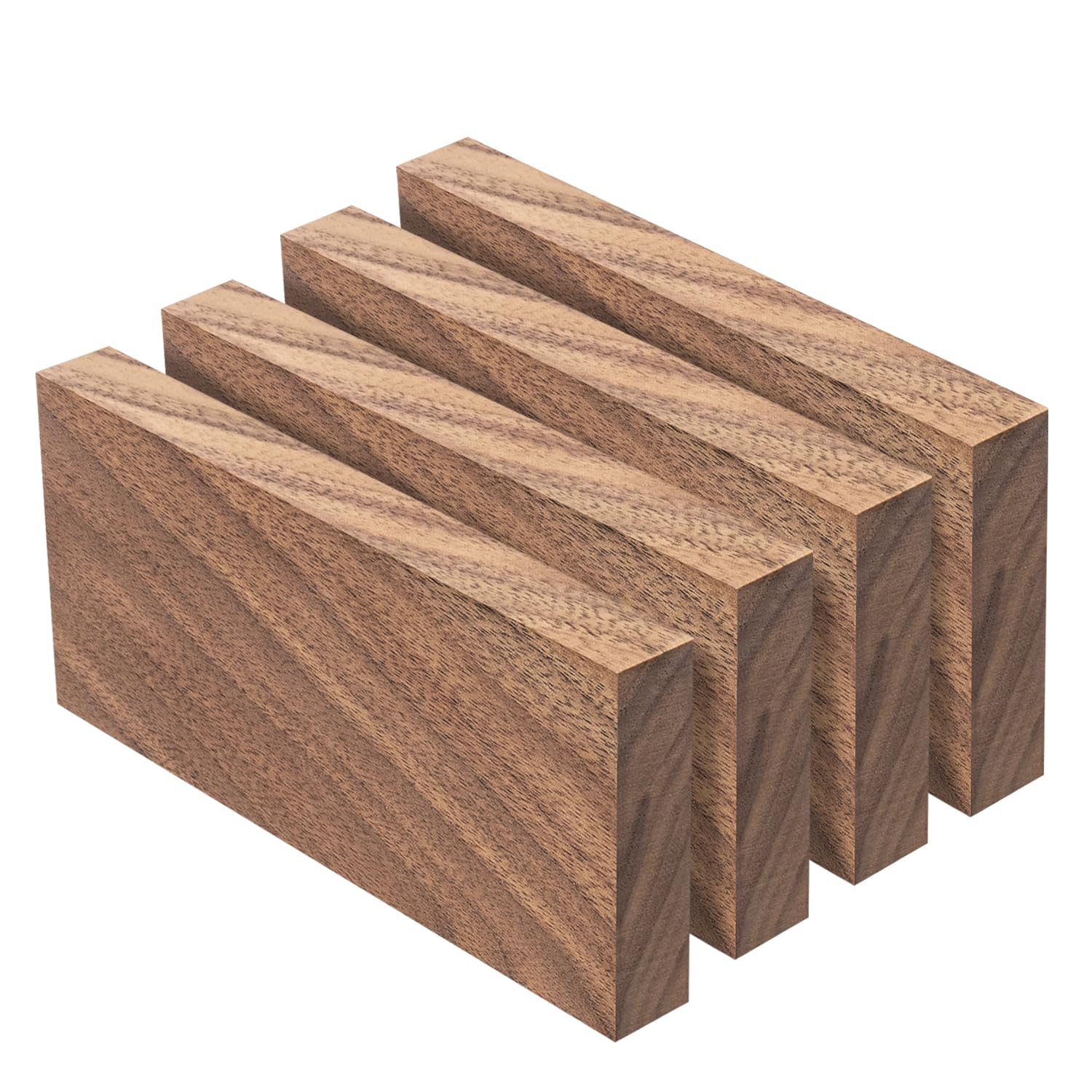
Four walnut blocks at a full half-inch thick — the most forgiving room to reshape of the whole shortlist.
At 5.1 x 2.3 x 0.5 inches, these walnut slabs are the thickest and widest blanks here. The 2.3-inch width beats the zebrawood pair’s 1.5-inch face by a wide margin, and the 0.5-inch thickness beats the zebrawood’s 0.38-inch cut, so you have real room to taper and contour without running out. Four blocks means a ruined first attempt does not end your day.
Walnut is the easy wood — softer than purpleheart or ironwood, quicker under sandpaper, and far less likely to burn. The listing describes it as cut from the entire log and finished to a smooth face, which is what you want from a starter block. It is also genuinely multipurpose: the maker lists beads, pens, desk ornaments, and tool grips alongside knife handles, so leftover offcuts do not go to waste.
One thing to set expectations on: the description notes that because it is natural wood, texture and color vary slightly piece to piece. That is normal for cut lumber, not a defect. If you need a perfectly matched pair for a showpiece handle, this is not the set for that — if you need four chances to learn on, it is exactly the set.
Best beginner geometry: A 0.5-inch thickness and 2.3-inch width give you the largest shaping window of the group.
Natural variance: Texture and color differ slightly between the four pieces, so pick your two most similar blocks for a paired build.
Choose walnut if: You want quick, forgiving shaping and four blocks to learn on.
Pass it by if: You need a matched pair for a symmetrical showpiece handle.
6. TANEMUDO 5 Pcs Ironwood Knife Handle Scales
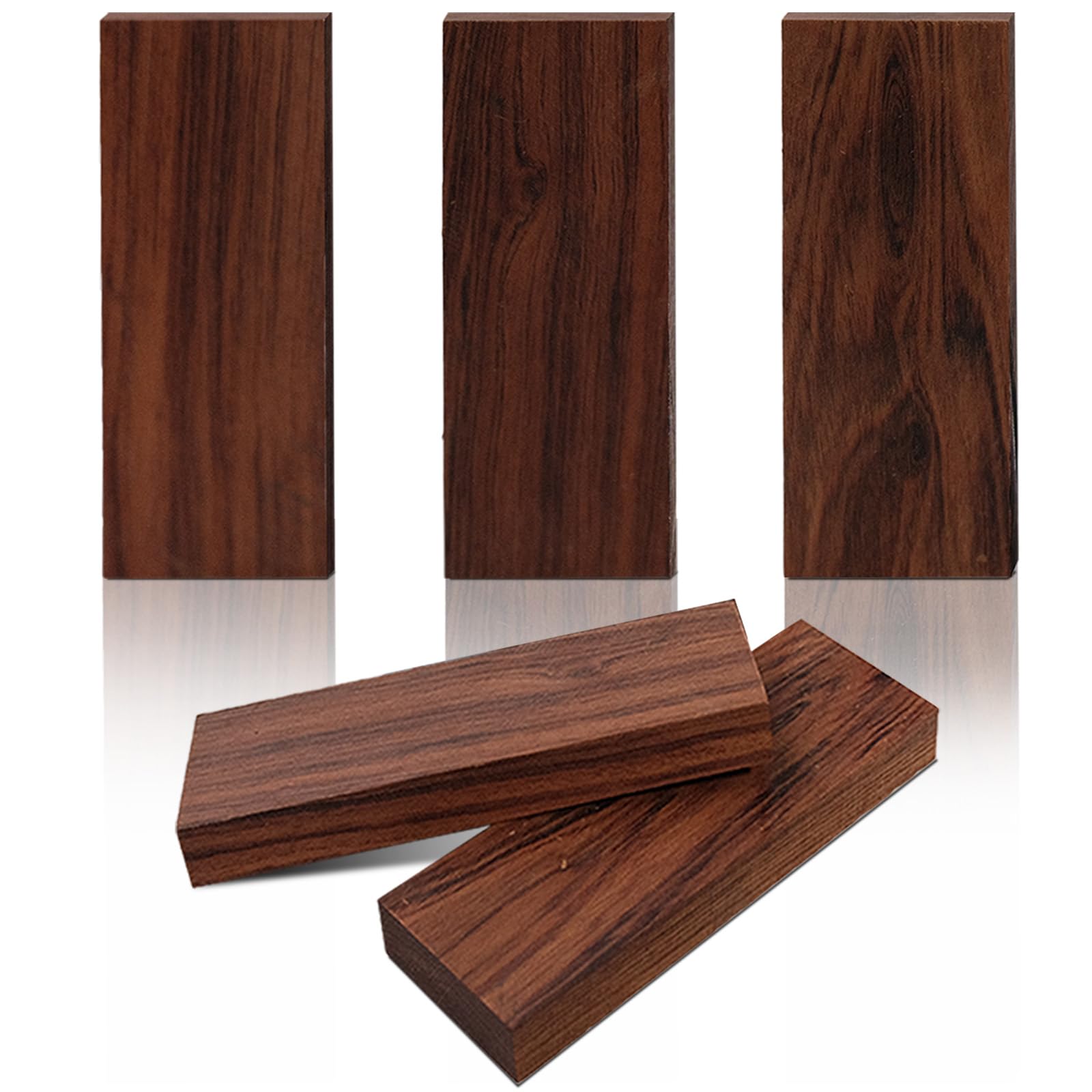
Five ironwood scales for one committed afternoon of practice — the cheapest way to buy repetition.
Five pieces, each about 5.11 x 1.77 x 0.51 inches, packed at 1.17 pounds total. Because that weight covers five blocks rather than one, these are moderately sized pieces, not thick slabs. The 0.51-inch thickness is still generous for shaping, and the 1.77-inch width suits a standard full-tang pattern. Ironwood itself is a natural hardwood with genuinely varied grain, so no two of your five will match — the maker says outright that different textures are normal.
This is the pick for someone who wants to build four or five simple handles and get the muscle memory down. Five blanks means you can afford to mess one up, which is a real comfort when you are learning where the tang sits under epoxy. Because each piece is a different grain, you also get a built-in reason to make each knife a little different.
The clear limit is that you are not buying a matched pair. If symmetry is your goal, five randomly grained scales will frustrate you. If the goal is practice and volume, the five-count at this weight is a sensible starting point — and the extra pieces mean you can experiment with stain or a satin finish on one before committing to your best block.
What the pack delivers: Five roughly 5.11 x 1.77 inch ironwood scales at 0.51 inch thick, enough for repeated practice builds.
What it will not do: Matched grain across sides is not on the menu — each of the five is its own pattern.
Good fit for: A new maker who wants five practice handles and does not need them to mirror each other.
Wrong tool for: Anyone building one knife with symmetrical sides — you would burn through blanks finding a match.
7. Riakrum 4 Pcs Ironwood Knife Handle Scales

Four ironwood blocks at 14.9 ounces total — the same size as the five-pack, but with more meat in each piece.
Here is the number that separates this set from the TANEMUDO five-pack: 14.9 ounces for four pieces versus 1.17 pounds for five. Same 5.12 x 1.77 x 0.51-inch dimensions per scale, but fewer pieces carrying comparable total weight means each block is a heavier, denser cut. If you like a handle that sits dead still in the hand, that density is exactly what delivers it.
Ironwood is also the material to pick when you want a fine, tight grain that polishes to a deep shine without much pore filling. The maker notes that each piece has a different pattern, so expect variation across your four — that is inherent to natural ironwood, not a defect. Four blanks still leaves one spare beyond a pair of builds.
The honest note concerns the wood itself. The customers-say summary flags that durability feedback is mixed, with hairline cracks running the length of one unit called out in that summary. This is a wood known for being stiff and dense, and stiff wood can check if it dries fast or takes a hard knock. Inspect each block on arrival, store them flat and dry, and the other three have a fair chance of being fine. Buy accordingly.
The density draw: 14.9 ounces across four pieces buys you heavier, more substantial blocks per scale.
Inspect and store well: Hairline checking has been reported, so check each block and keep them flat and dry before working them.
Suits you if: You want denser-than-average ironwood for a heavy-feeling, fine-grained handle and can use all four.
Hesitate if: You want each blank to come from the start perfect — inspect these before you commit a good blade to one.
8. IECAP Desert Ironwood Knife Handle Scales
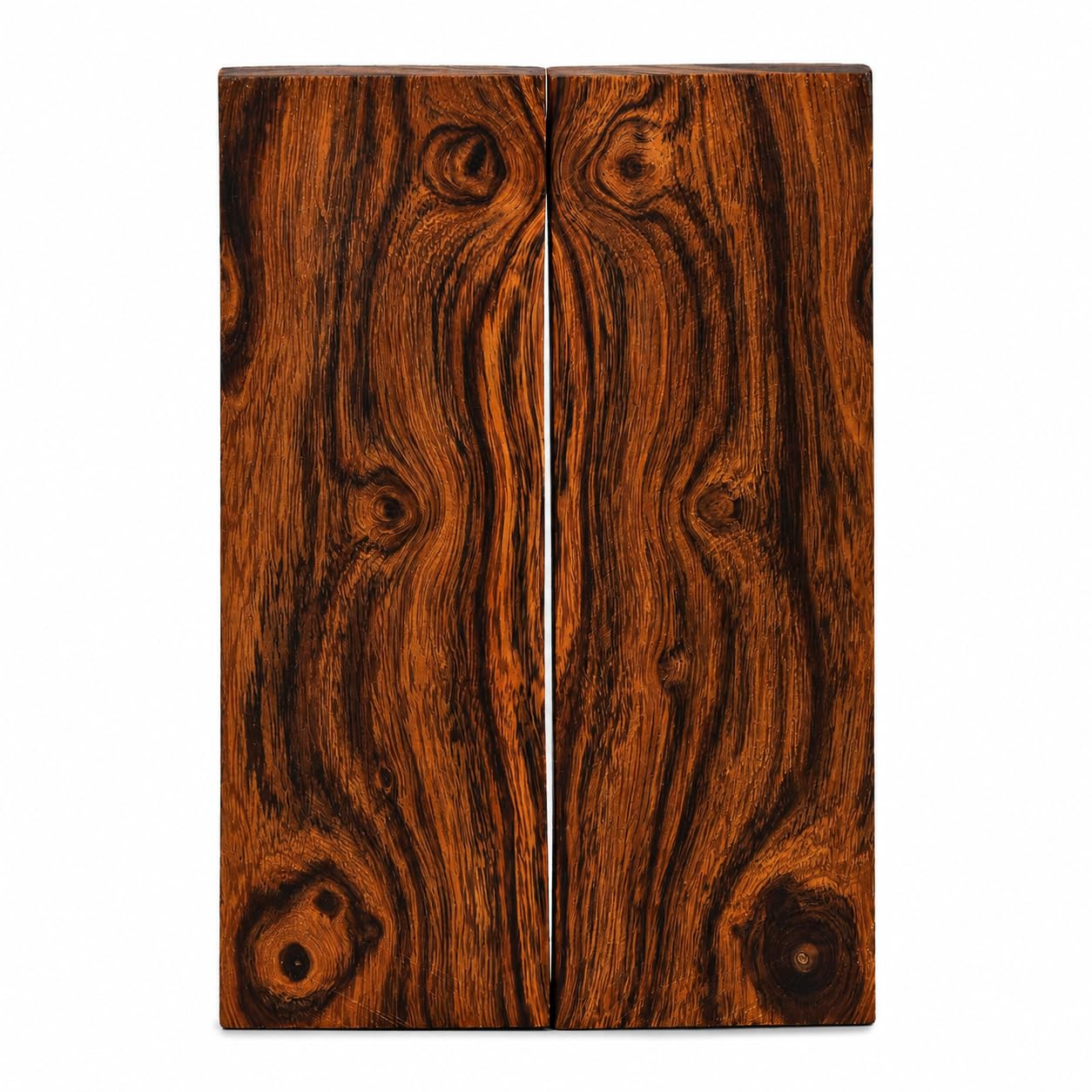
A bookmatched desert ironwood pair cut at a full half-inch, built for a knife you plan to keep.
Two matched halves, 5.12 x 1.75 x 0.5 inches each. The 0.5-inch thickness is deliberate — the maker points out it leaves room to taper, contour, and shape a handle to your hand without running out of material, and calls out that it is more stock than a typical 3/8-inch scale. On a full-tang build, that half inch is the difference between a slab-sided handle and a properly sculpted one.
Desert ironwood is the material choice when you want a natural alternative to synthetic scales. The listing pitches it against micarta and G10 on the strength of its hardness and stability, and the solid 7.4-ounce weight for the pair backs up that it is genuinely dense stock. These are bookmatched, so the natural grain mirrors across the two sides, which is what sells a custom handle as a custom handle.
This pair is on the demanding end of the group on the shaping side — dense ironwood rewards sharp tooling and patience. It lists 4.0+ stars across a large reviewer base, so fit and finish expectations are well established. If you can handle a hard, slow-sanding exotic, this half-inch bookmatched pair suits a display-grade full-tang build.
The half-inch argument: A full 0.5-inch cut gives you the stock to fully sculpt a handle — the reason to choose this pair for a centerpiece knife.
Dense means demanding: Desert ironwood at 7.4 ounces for the pair is hard, stable stock that wants sharp tooling and unhurried sanding.
Built for the keeper knife: A bookmatched half-inch desert ironwood pair for a full-tang handle you plan to sculpt and show off.
Skip the premium here if: You are still practicing shaping — save dense ironwood for the build where you trust your hands.
9. Doc of All Trades Leopardwood Knife Scales

Lace-pattern leopardwood with a softer 2150 hardness — the block that fights your sander the least.
Leopardwood gets its name from the spotted, lace-like figure across the face, and this block leans into it with a “variable figuring” note. It measures 5 x 1.5 x 1/4 to 3/8 inch, so it is on the thin side — the listed thickness is 0.25 inch, which is the thinnest cut on this shortlist. That matters: a quarter-inch scale is best on a knife with liners or a slimmer handle profile, where you do not have to hollow much out.
Two numbers make it an easy pick for newer hands. The hardness is stated around 2150, meaningfully softer than purpleheart’s ~2900, so it sands down more quickly and throws less resistance. The colorfastness is a 3 out of 4, so the pattern holds reasonably well over time rather than washing out fast. The work rating is listed 8 out of 10 on the easy-hard scale, though, so despite the softer number it still wants a careful, slow pass at the edge of a cut.
Appearance is the split verdict here. The figure is genuinely handsome where it lands strongly, but the pattern can come through plainer on some blocks. If you want a distinctive lacewood handle and you are fine with natural variation, this is the one. Buy it for the lace figure, knowing the spotting varies block to block.
The softer ride: At ~2150 hardness this is the most forgiving block in the group to sand, which suits a first or second build.
Thin cut, so plan liners: A 0.25-inch scale leaves little to remove, so pair it with a liner or a slimmer handle instead of a thick sculpted grip.
Reach for it when: You want spotted lacewood figuring and the easiest sanding of the group — a great second-timer’s block.
Look past it if: You need a thick, sculptable blank for a chunky full-tang handle.
Know the Specs
Blank Thickness and Handle Room
The listed thickness is the single number that decides how much shaping freedom you get. A 0.5-inch blank leaves stock to taper and contour a chunky handle, while a 0.25-inch blank is best for a slimmer profile or a build with liners. Measure your tang and liner stack before you choose, because a thin blank can run out of material fast on a sculpted shape.
Piece Count and Matched Sets
A bookmatched pair means two slices cut from the same block, so the grain mirrors across both sides of a full-tang build — that symmetry is what reads as a custom handle. A multi-piece variety or ironwood pack gives you practice blanks and species variety instead, but the grain varies from piece to piece, so it is not the pick for a symmetrical showpiece.
Wood Hardness and Sanding Effort
Hardness (often quoted on the Janka scale, which measures how much force a wood resists) tells you how the block behaves under a sander. Denser exotics like desert ironwood and purpleheart take longer to shape, hold a crisper edge, and polish up tight, while softer walnut sands quickly and forgives a dull belt. Match hardness to your tooling and your patience.
Grain, Figure, and Variation
Figure describes the natural pattern in the wood — stripes in zebrawood, spots in leopardwood, rich color shifts in purpleheart. Natural wood varies piece to piece, and many listings say so outright. That variation is normal, so pick your two most similar blocks for a paired build and save the odd ones for single-handle projects.
Common Questions
How thick should a knife handle blank be?
What does bookmatched mean on knife scales?
Is desert ironwood harder to work than walnut?
Can I use wooden scales on a full tang knife?
Do wooden knife handles need a liner?
How do I stop ironwood scales from cracking?
How do I finish a wooden knife handle?
How many scales do I need for one knife?
Will purpleheart fade after I shape it?
Are these blanks ready to use from the start?
The Bottom Line
The Payne Bros variety pack is the pick to start with if you are new to wooden handles for knives, because five separate hardwoods let you feel out a species before committing to a full set. If you are building the knife you plan to keep, the IECAP desert ironwood bookmatched pair gives you half-inch stock and mirrored grain for a fully sculpted full-tang handle. And if you want the easiest sanding of the bunch with spotted lacewood figuring, the Doc of All Trades leopardwood block is the one to reach for. Five species in one box beats guessing which hardwood suits your hand.
How we choose
We do not accept paid placement. Every pick is matched to a real buyer and a real use-case; we do not hands-on test units.
Sources
Specifications: manufacturer listings and product documentation. Review insights: verified customer reviews, as of November 2026. Pricing: not shown on this page (it changes often); check the current price via the retailer link.
As an Amazon Associate, Tactical Gear Guy earns from qualifying purchases. This does not affect which products we feature.