Specs are compiled from manufacturer listings and verified buyer reviews and can change over time — please confirm the key details on the product page before buying.
Most people who buy a wooden chicken coop end up disappointed for one boring reason: the run is smaller than the picture suggested. A listing that says “for 4–6 chickens” can ship you a footprint that is genuinely tight for four full-grown hens. So before you look at roof style or wheel count, find the usable square footage and the actual length in inches. Those two numbers decide almost everything about how the next few years go. This guide compares ten wooden coops on exactly those terms, so you can match one to your flock size and your backyard instead of guessing from a glossy photo.
This guide is built by comparing the manufacturers’ published specifications and the patterns across verified customer reviews, so you get each pick’s real strengths and trade-offs instead of marketing spin.
Below you will find the coops that hold up in real weather, the ones that move easily across grass, and the honest limits of each. Every pick here is a wooden structure with a fir or solid-wood frame and wire mesh, not a plastic shell. My goal is simple: help you choose the wooden chicken coop that still makes sense once the honeymoon phase wears off.
Top Picks

How To Choose The Best Wooden Chicken Coop
You will live with a wooden coop for years, through weather you cannot control, with animals that depend on it. Four things decide whether you picked right: the real footprint in square feet (the actual floor space your birds get), how well the mesh and locks hold off predators, how fast you can clean it, and if you need to move it around the yard. Get those wrong and no amount of pretty trim saves you.
Start with usable square feet, not the chicken count
The headline “for 4–6 chickens” is a rough label, often measured generously. Look for the total usable space in square feet and the overall length and width in inches. A coop with 21.33 ft² of space and an 83-inch length gives a small flock genuine room to spread out. A tighter 13.54 ft² footprint is better suited to a pair or a trio of bantams than to four heavy hens. Breed size changes this too: a big Orpington takes up noticeably more of that run than a compact Leghorn.
Predator protection is mesh plus locks plus frame
Galvanized wire mesh on every side is the baseline, because it resists rust and chews the same week it is installed. A solid wood frame matters just as much, since a raccoon can peel back a flimsy panel that is only stapled on. Check for a lockable sliding door or a locking rod on the main entrance. Raccoons and foxes are famously good with simple latches, so a real lock — not just a hook — is worth insisting on.
Cleaning speed decides whether you keep up with it
A removable slide-out tray is the single biggest convenience feature in this category. It lets you pull the dropping tray out from the front or back depending on how you place the coop along a fence. Pair that with a lower access door to reach the nesting box, and daily care drops to a few minutes. Coops without easy tray access force you to reach awkwardly, and that is when bedding changes get postponed.
Wheels or no wheels
Mobile coops with built-in caster wheels and a side handle let one person roll the whole structure to fresh grass, which improves hygiene and cuts down odor. A stationary coop with carry handles takes two people to reposition but tends to be the more rigid structure. If you rotate your flock across a lawn and want to skip the smell, wheels earn their keep. If the coop is staying in one spot, put the money into thicker panels instead.
Side-by-Side Comparison
| Model | Best For | Usable Space | Overall Dimensions | Stated Chicken Capacity | Amazon |
|---|---|---|---|---|---|
| ketive Large Wooden Chicken Coop with Run and Wheels, Grey★ Best Overall | Small flocks that need to move | 13.54 ft² | 71.3″L x 26.14″W x 39.4″H | 1–4 chickens | Amazon |
| ketive 83″L Large Chicken Coop with Run for 4-6 ChickensMost Expandable | Growing flocks that may expand | 21.33 ft² | 83″L x 58″W x 39.5″H | 4–6 chickens | Amazon |
| RUNVA Large Wooden Chicken Coop with Run, 4-6 ChickensFence-Line Fit | Long, narrow strips along a fence | — | 121″L x 24.88″W x 41.3″H | 4–6 chickens | Amazon |
| Aivituvin Chicken Coop with Run and Wheels (Grey, AIR61) | First-time keepers who want easy setup | — | 80.5″L x 21.2″W x 42.5″H | 2–3 chickens | Amazon |
| Magazoopet 158″ L Chicken Coop with Run and Wheels | Long backyard runs and small pets | — | 158″L x 22″W x 39.4″H | 2–6 chickens | Amazon |
| PetsCosset Chicken Coop with Run, 116″ for 8-10 Chickens | Two-level shelter for a starter flock | 28.41 ft² | 116″L x 56″W x 44″H | 2–8 chickens | Amazon |
| GUTINNEEN Large Chicken Coop for 4-6 Chickens (AIR67-N) | A raised floor above wet ground | 14.61 ft² | 67.3″L x 40″W x 49.75″H | 4–6 chickens | Amazon |
| GUTINNEEN 67.3″ L Chicken Coop on Wheels for 6-8 Chickens | Six nesting sections for a laying flock | 19 ft² | 67.3″L x 40″W x 49.75″H | 6–8 chickens | Amazon |
| Aivituvin Extra Large Chicken Coop for 8-10 Chickens (Black) | A big flock in one fixed footprint | — | 118″L x 56.7″W x 50″H | 8–10 chickens | Amazon |
Detailed Reviews
1. ketive Large Wooden Chicken Coop with Run and Wheels, Grey
Our pick — 4.0+★ from 200+ verified ratings; the strongest balance of quality and price.
A compact wheeled coop that puts the eggs within arm’s reach and the mess on a sliding tray.
The number that shapes everything here is 13.54 ft² of usable space, split into roughly 10.08 ft² of lower run and 3.46 ft² of raised resting area. That 13.54 ft² suits a trio of standard hens comfortably and gets genuinely tight for four heavy ones. Moving it takes no lifting at all, because the whole structure rolls on built-in wheels with a side handle. Roll it to a fresh patch of grass every few days and the odor problem largely takes care of itself.
Daily care is where this design earns its keep. A removable sliding tray pulls out for waste and bedding, and the anti-slip ramp plus sliding door let hens move between the raised sleeping area and the run on their own. The integrated nesting box gives you a defined spot to collect from. The build is fir with an asphalt roof and galvanized wire mesh panels — the asphalt sheds rain, the mesh keeps airflow moving, and the mesh is the layer that deters the usual backyard visitors. Two adults can have it standing in about 45 minutes thanks to pre-drilled holes, and the maker backs that with support if a component arrives damaged.
The honest catch is the flock ceiling. The 71.3″L x 26.14″W x 39.4″H frame is a backyard-beginner size, and owners of four full-grown birds regularly find it feels snug. Wooden construction is also a commitment — the fir wants a look-over before winter and a dry spot on the yard so the base does not sit in standing water. Every fir coop here wants that same seasonal check, and this compact frame is no exception.
What earns its place
- Rolls to fresh grass on built-in wheels, with a side handle for one-person moves
- 13.54 ft² of usable space split between a lower run and a raised resting area
- Asphalt roof plus galvanized wire mesh panels for rain runoff and airflow
- Roughly 45-minute assembly with pre-drilled parts and clear instructions
Where it pulls up short
- Best suited to one to three hens — four large birds will feel crowded
- Fir wood needs an annual once-over and a dry, drained spot in the yard
Roll it out if: you keep a small flock and want to shift the coop across the lawn without lifting a thing.
Look at a bigger frame if: you already have four full-size hens — this one is happier as a trio’s home.
2. ketive 83″L Large Chicken Coop with Run for 4-6 Chickens
The roomiest footprint in the mid-range, and the only one here you can bolt a twin onto later.
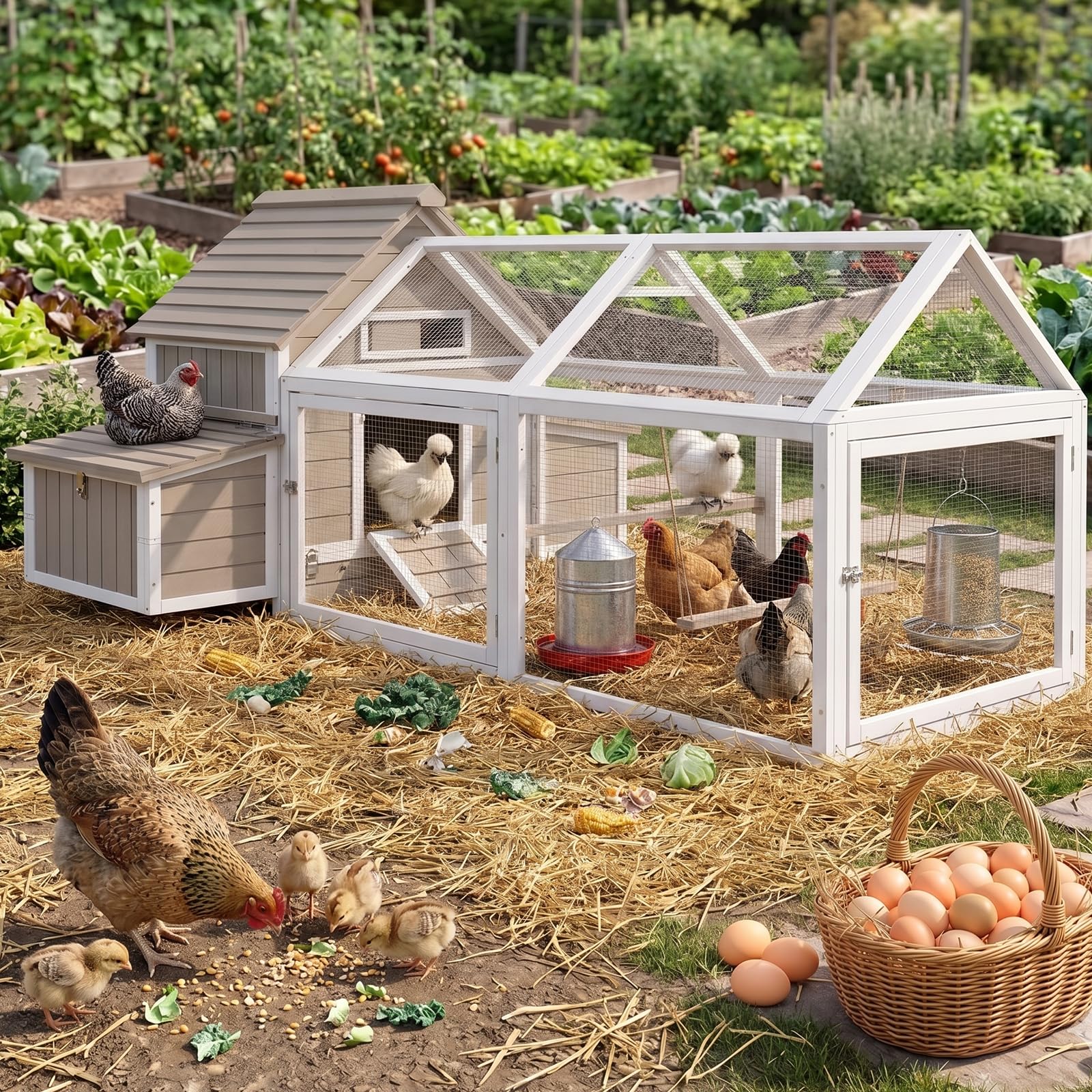
Compare the numbers against the ketive Grey above and the gap is obvious. This one gives you 21.33 ft² of usable space versus 13.54 ft², inside an 83″L x 58″W x 39.5″H frame versus 71.3″L x 26.14″W x 39.4″H. That 70% larger footprint and 58% more usable floor area make the “4–6 chickens” label honest rather than stretched. If your flock might grow, the expandable design is the headline: you can connect a second unit to reach 6–12 birds, depending on breed and space.
Small design choices add up here. Two drop-down doors double as ramps, so hens walk in and out from either side instead of queueing at one opening. The slide-out tray pulls from the front or back, which matters when the coop sits along a fence and you can only reach one end. Inside, three roosting bars plus a wooden swing perch cut down nighttime crowding — more perches means less squabbling over the best spot. Two side nesting areas create four separate boxes reinforced with thick L-brackets, and lift-up lids make egg collection quick.
Owners like the function and the value, and the assembly gets a lot of goodwill. What tempers the enthusiasm is material heft — the panels do not feel substantial to everyone who assembles them, and that shows up in how the range of size opinions splits. Treat it as a starter coop that rewards a sheltered, drained spot rather than a bare one. The 67.1 pounds means two people should do the moving when the four carry handles come into play.
The expandable route: buy this if you want a real 21.33 ft² run now and a bolt-on second unit later as the flock grows.
Not the pick for: anyone expecting heavy-gauge panels from the start — this is a lightweight starter build.
3. RUNVA Large Wooden Chicken Coop
A long, slim run that slides into a narrow side yard where wider coops simply will not go.
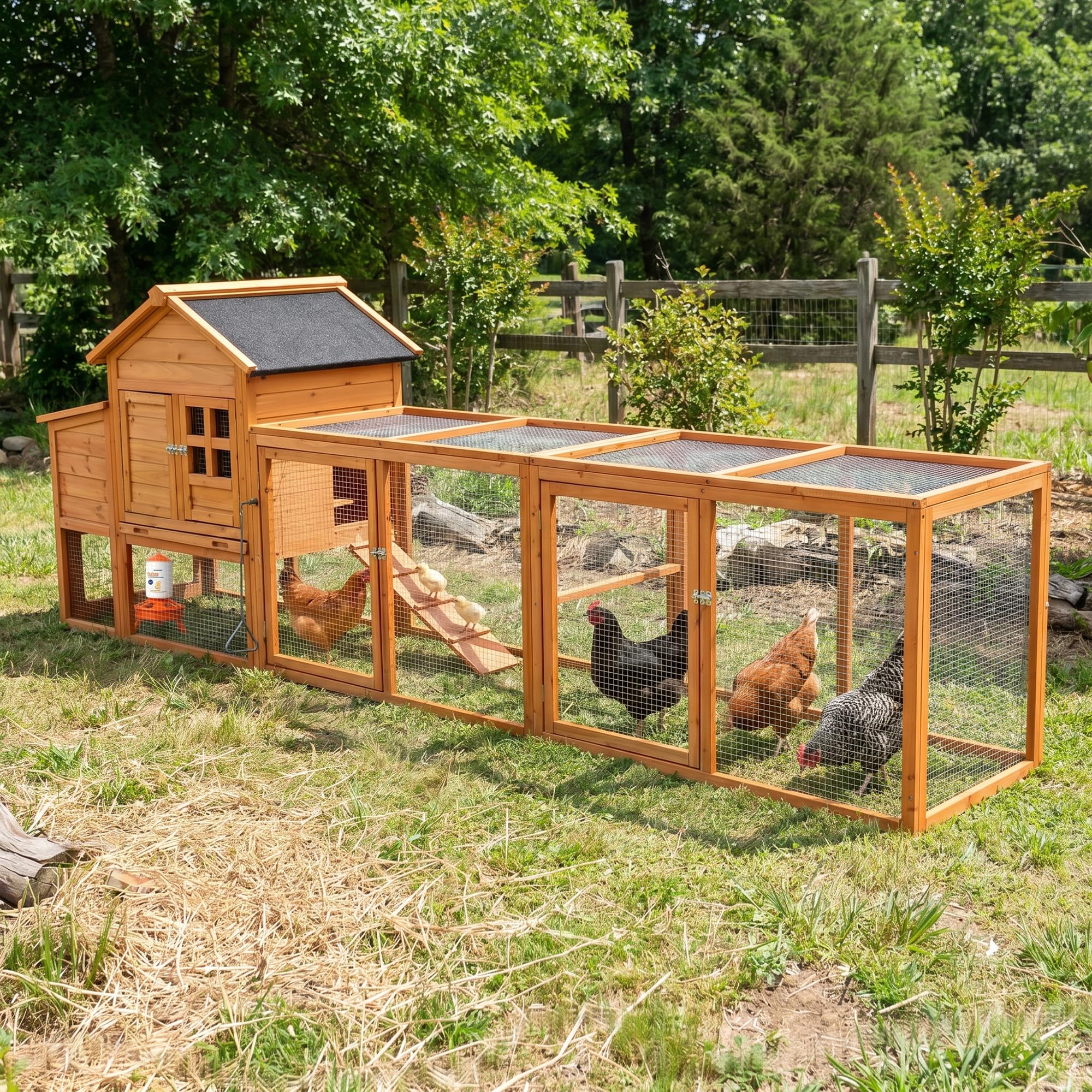
Picture the strip of ground beside a garage: long, but not deep. That is where this coop earns its spot. At 121″L x 24.88″W x 41.3″H it stretches out without bulging, so it fits a long, thin gap. The raised fir hen house sits above a wire run, so hens roost, lay, feed, and scratch inside one footprint — no separate pen needed. Compare that 121-inch length to the ketive Grey’s 71.3 inches and you get a much wider runway for scratching. The trade-off is depth, not extra floor area, so it suits a narrow yard rather than a small square one.
Predator thinking shows up in the details. Galvanized welded mesh (steel wire fencing welded at every crossing point) wraps every side, the frame is solid wood, and a lockable sliding door rod handles the main entrance. That lock matters most, because foxes are very good with a plain hook. The asphalt roof sheds rain and snow, and the non-toxic varnish resists water, rot, and sun damage so the fir stays solid. Cleaning is quick: the removable dropping tray slides out, the nesting box is reachable through the lower access door, and the roost bar and nesting box come included. Two people with pre-drilled, labeled parts can get it standing in about an hour.
Where the experience gets uneven is size versus expectation. The run looks long, but several owners find it too tight for a full group of four to six birds, which is the recurring honest complaint in this category. The build quality lands somewhere between solid and light depending on the unit. If you plan around three hens and a sheltered spot, this is a smart use of a skinny yard.
What it solves: long-and-narrow yards get a genuine run with a lockable door rod, welded mesh on every side, and an asphalt roof that sheds weather.
The trade-off: the 121-inch length reads bigger than it lives — plan for fewer birds than the label suggests.
Made for: a side-yard strip where width is the enemy and length is the only luxury you have.
Think twice if: you already run four to six full-grown hens — the long run looks roomier than it feels to them.
4. Aivituvin AIR61 Chicken Coop with Run
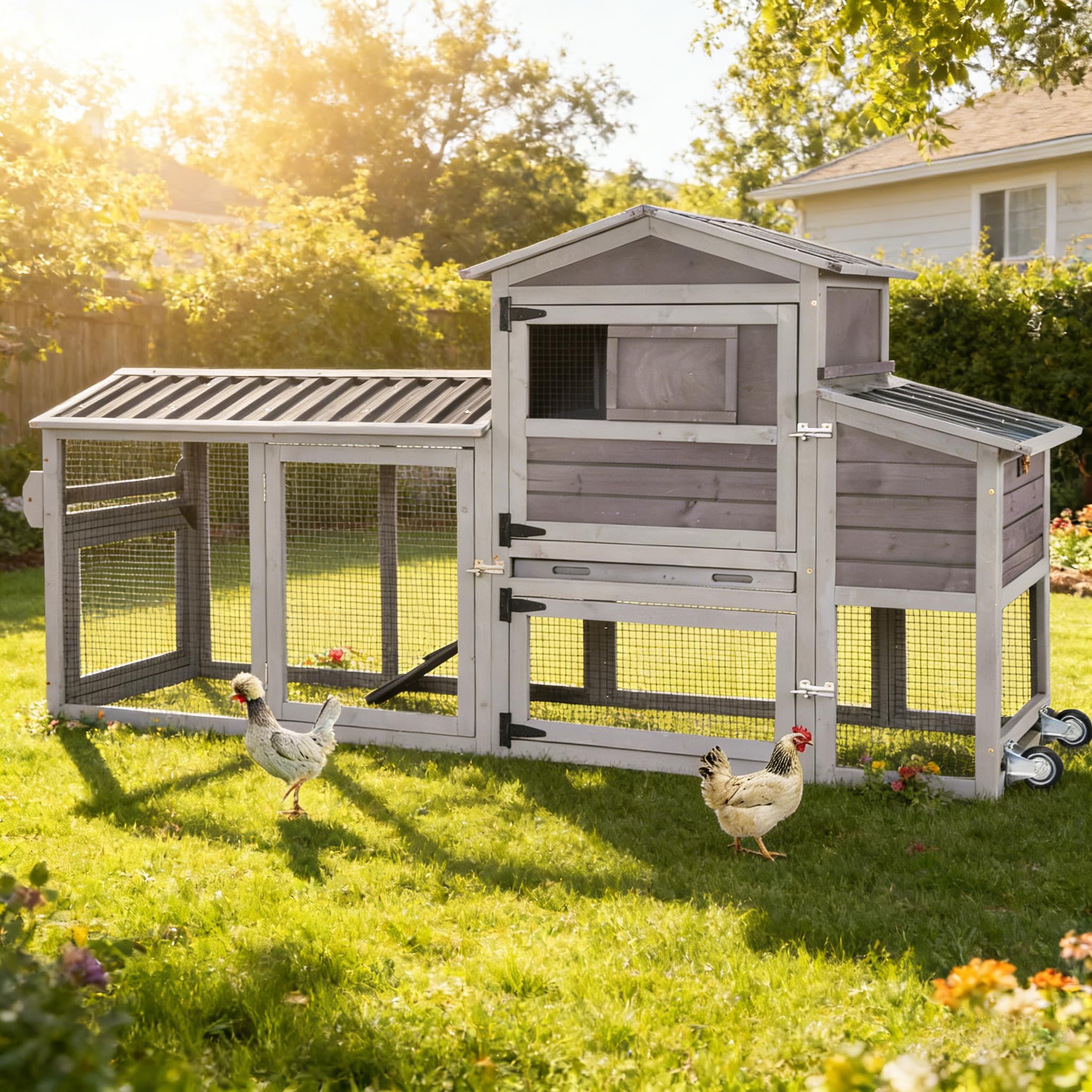
Solid fir panels and a sloped asphalt roof are the two things owners praise most on the AIR61.
Build quality leads every conversation about the AIR61, and that is the strongest praise a wooden coop can earn. The frame is solid fir finished with an eco-friendly paint, and the roof is sloped asphalt over a waterproof and UV-resistant shell. That sloped asphalt roof sheds spring rain off the hen house and nesting boxes instead of letting it pool inside. The waterproof PVC cover above the nesting boxes adds a second layer right over the eggs, and the custom locks on the nests are the kind of detail you notice only when it saves you from a raccoon.
On ground and movement, four wheels and a side handle let you roll it to a clean patch with one hand. Four access points makes daily upkeep fast, and the removable leakproof tray pulls out cleanly. The number to size your flock with is the “2–3 chickens” comfort range: buyers find it right for that, while some feel it runs tight for full-grown birds. If you have more than three hens to house, the ketive 83″L above gives you 21.33 ft² where this one runs shorter on floor space.
The clever part is the expandable design. Order a second unit and remove the side doors on each, and the two join into one larger enclosure. Bolt on a second AIR61 and the enclosure grows with your flock instead of being replaced.
Why it stands out: solid-build fir, a fully waterproof asphalt roof, and PVC covers over the nesting boxes keep rain where it belongs — outside.
The ceiling to respect: this is a 2–3-chicken footprint, and full-grown hens will notice the difference.
Reach for it if: you want a well-built starter mobile coop and can add a second unit later to grow the enclosure.
Look elsewhere if: your flock is already at four adult hens — you want the roomier mid-range footprint instead.
5. Magazoopet 158″ L Chicken Coop with Run
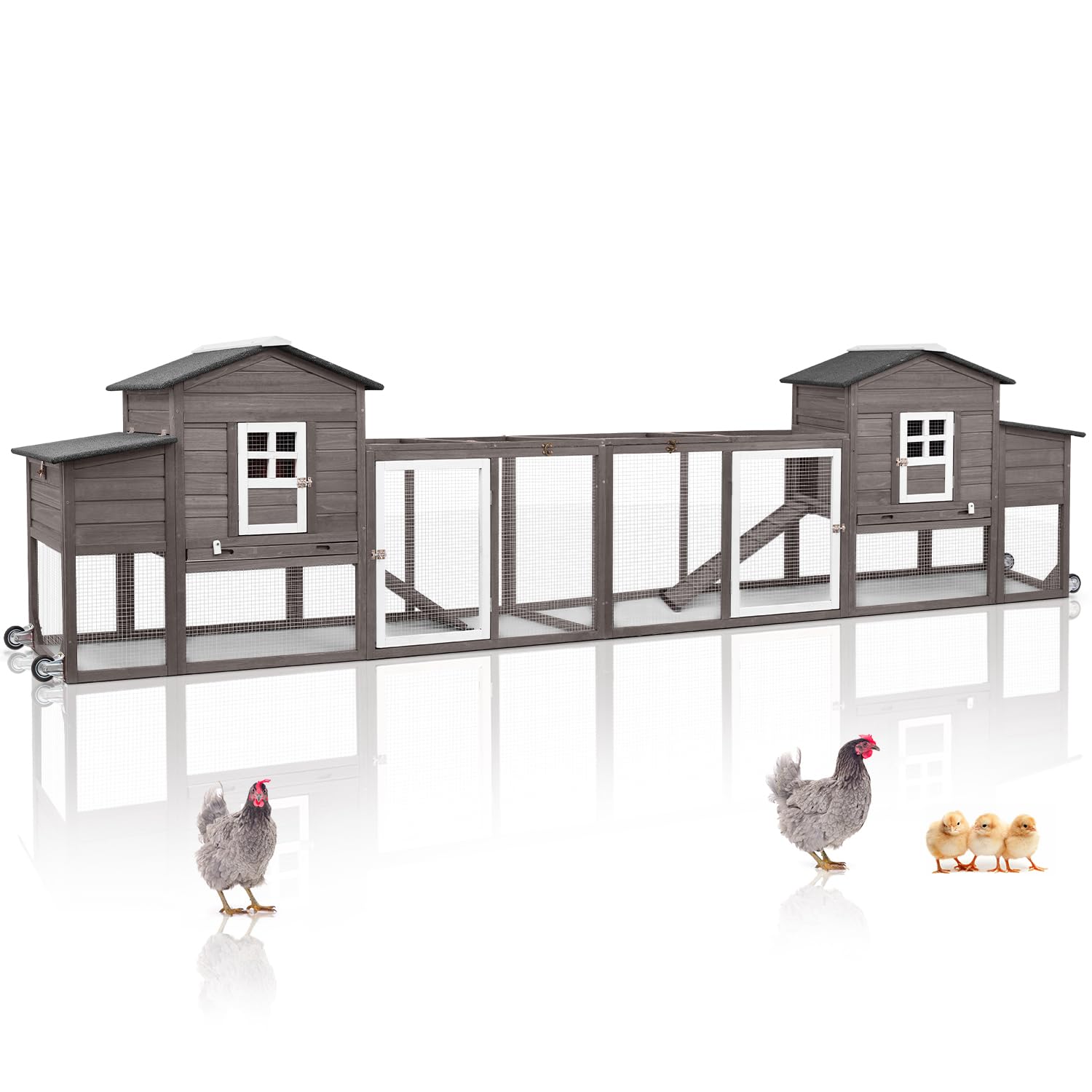
At 158 inches nose to tail, this is a runway disguised as a chicken coop.
Nothing else in this roundup stretches as far. The 158″L x 22″W x 39.4″H frame gives bantams and lightweight breeds an almost continuous scratch line, and the four nesting boxes plus six perches keep the laying and roosting ends separate. With lockable caster wheels it rolls to a fresh patch easily, so a long structure stays manageable. Bear in mind how narrow it is: at 22 inches wide, it is a straight-line enclosure that suits a boundary or wall placement, not a corner. If you need a deeper, squarer footprint, the ketive 83″L is the better geometric match.
Wet weather gets handled by the asphalt roof and a UV-resistant roof panel, with a sloped line that keeps water from pooling. The leak-proof PVC cover and anti-escape lock cover the nesting side, and the slide-out waste tray speeds cleaning. 58 pounds is light enough that two people can position it before you lock the casters. It also works for rabbits, ducks, and similar small pets, so it is not strictly a chicken-only purchase.
What people notice first is the length and the look, and that impression holds. The assembly, at roughly 6 hours of bolt-together work, is a full afternoon rather than a lunch break — worth clearing the calendar for. Durability is the variable: some owners get several seasons out of it, while a few find the panels looser than expected over time. Panel alignment takes patience at the end of the build; snug each bolt in stages rather than torquing one corner fully. Treat it as a well-priced long run that wants careful assembly, not a bombproof permanent structure.
The straight-line advantage: 158 inches of run with six perches and four nesting boxes gives bantams serious scratching room.
Where it demands patience: plan around six hours to assemble, and ease each panel into alignment before you tighten down.
Best for: a long garden wall or fence line, and owners keeping bantams or lighter breeds with wheels they actually use.
The honest limit: 22 inches of width means it is a runway, not a deep roaming pen.
6. PetsCosset 116″ Chicken Coop with Run
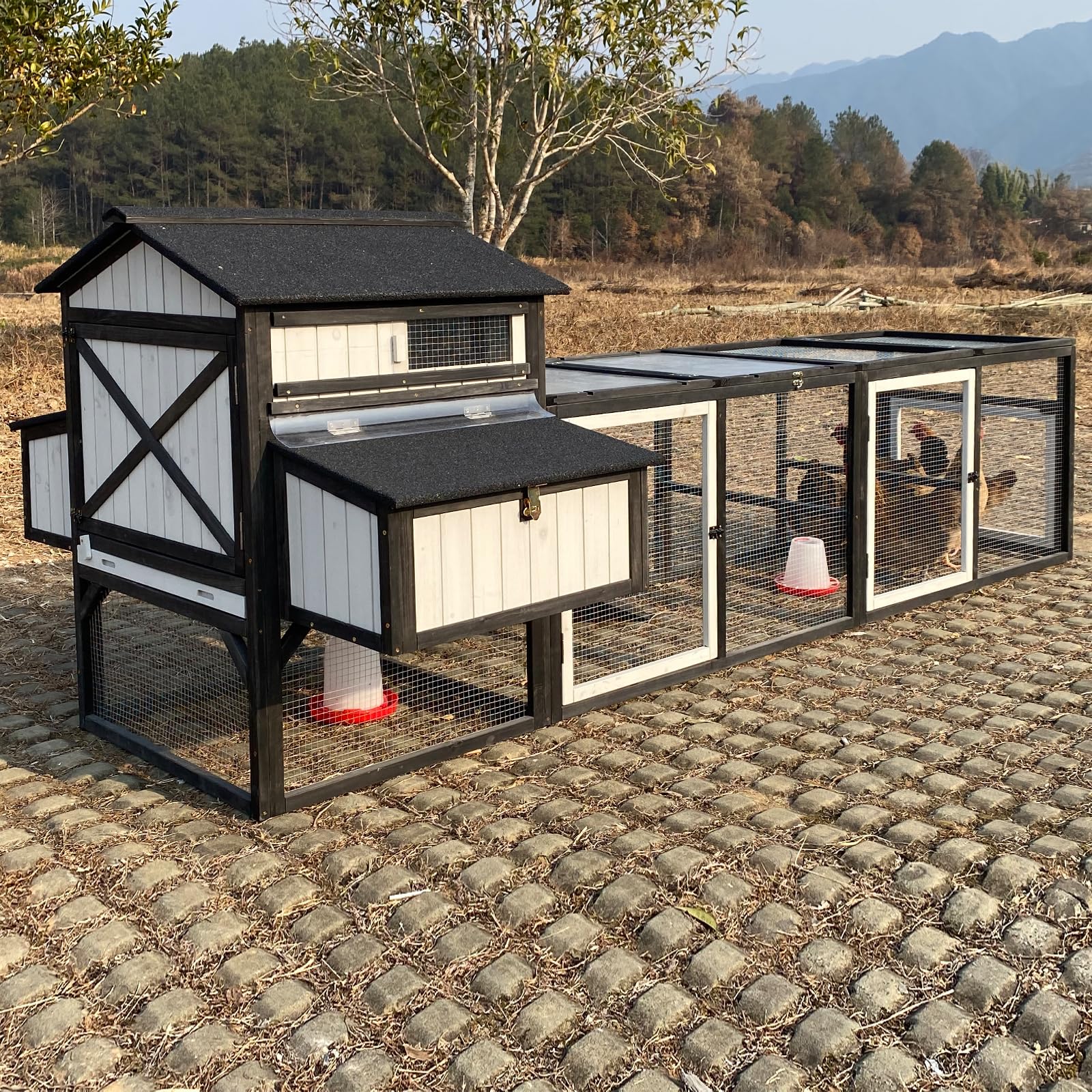
The most floor space in the roundup, split across two levels so the laying house stays separate from the run.
28.41 square feet across two connected levels is the number to anchor on, and it explains the 97-pound build. That 116″L x 56″W x 44″H frame has a distinct resting room upstairs and an exercise area below, connected by a ramp. Hens leave the shelter, walk down, and scratch without you opening a gate. That separation is genuinely useful: eggs, roosts, and feeding each get their own zone, which makes the daily routine cleaner than in a single-room coop.
The roof does two jobs. A sloped asphalt roof covers the hen house while a UV-resistant panel shades the exercise run, so hens get overhead cover while still being outside. Lockable doors on the shelter reduce accidental escapes during cleaning. Four divided nesting boxes organize laying, four rounded perches handle nighttime roosting, and a removable tray slides out for waste removal.
Size is the honest variable here. The 8–10 chicken label is an optimistic read; much of the feedback lands on this working best for a much smaller group. Assembly gets praise for clear directions, and it finds a fan base among owners of smaller animals like quail. If you have a modest flock and want distinct zones rather than extra length, this layout makes sense — just measure your expectations to the birds you actually own.
Choose it for: the two-level zoning — a raised shelter, a separate run, and one ramp between them.
Adjust for: the 8–10 chicken label is generous; plan around a smaller flock than that.
7. GUTINNEEN AIR67-N Large Chicken Coop
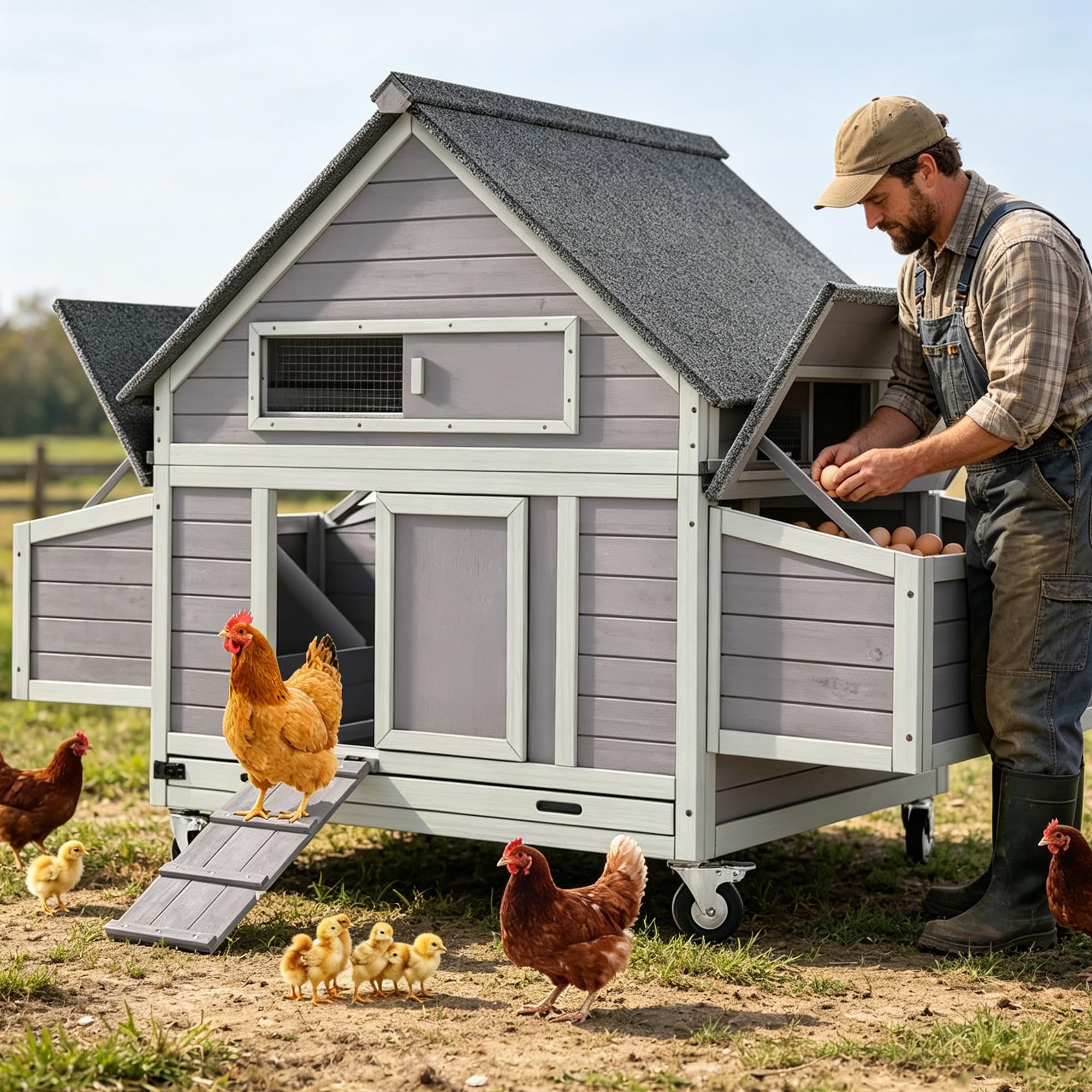
Its wheels lift the floor 4.92 inches off the ground — a small gap that changes wet-season life.
The 4.92-inch raised floor keeps the base above puddles in heavy rain and snow, so birds stand on dry footing. It keeps the base above puddles in heavy rain and snow, so the birds stay on dry footing rather than muck. The 14.61 ft² of space sits in a 67.3″L x 40″W x 49.75″H frame, and the two nesting boxes with six compartments give up to six hens a divided place to lay. The top roof opens and closes for egg collection, so you are not reaching into a dark corner.
Four large wheels mean it rolls to fresh grass without effort, and four access points let you reach every corner. The removable bottom sliding tray pulls out from front or back, so placement along a fence does not box you in. Solid wood panels and a lock on each access point are the predator line, and it is an all-breed size, so it suits ducks and rabbits as readily as chickens.
Durability is the honest caveat with this one. The praise for build quality is strong, but it shares a note that echoes through the wooden-coop category — thin panels and joints that want care over time. A seasonal check of the roof, the locks, and the wheel mounts keeps it going. For an above-ground, mobile, divided-nest coop in a wet yard, the improve floor is worth having.
What the raised design buys you
- 4.92-inch improve floor clears puddles in heavy rain and snow
- Two nesting boxes with six compartments and an openable roof for collection
- Four large wheels for easy moves to fresh grass
- Slide-out tray accessible from the front or back of the coop
The upkeep it asks for
- Panel thickness and joints need a seasonal check to last
- The 4–6 bird label is tight for larger, heavy breeds
If your yard puddles: the 4.92-inch raised floor and wheels keep birds dry and let you chase the dry spots.
Not for heavy breeds: standard-size hens fit better than big birds, and the panels reward an annual inspection.
8. GUTINNEEN 67.3″ L Chicken Coop on Wheels

Six nesting sections in a wheels-and-handle frame — a laying station that rolls to clean grass.
Where the AIR67-N above is a wet-yard solution, this sibling is a laying solution. Two large boxes split into six sections handle up to six hens’ eggs, and an easy-open roof makes collection quick — that is the feature laying-flock owners care most about. Around it sits 19 ft² of space in the same 67.3″L x 40″W x 49.75″H frame, with room to expand later by adding a chicken run.
Moving and cleaning work the same way as on the AIR67-N: four large sturdy wheels roll it to a fresh patch, four access points reach every corner, and a removable sliding tray keeps cleaning fast. Solid wood construction and locks secure the flock. The 6–8 chicken label fits the 19 ft² of space honestly, though owners of large hens should check that against breed size, since big birds take up more room.
Sturdiness is where the feedback splits. Some find it sturdier than expected; a few report weak middle legs and rough weather taking a toll. Heavier breeds and full-time exposure are the harshest tests. Set it on firm ground and inspect the legs and wheel mounts each season, and you are working with the design rather than against it. The quality of the panels and the assembly are what buyers appreciate most.
What it does best: six divided nesting sections, an easy-open roof, and four wheels that move the whole laying station at once.
Keep it honest: set it on firm ground and check the middle legs yearly — rough exposure is where it shows wear.
Perfect for: a laying flock up to six hens where collection speed and mobility matter most.
Consider the AIR67-N instead: if your yard floods — that one’s raised floor handles wet ground better.
9. Aivituvin Extra Large Chicken Coop
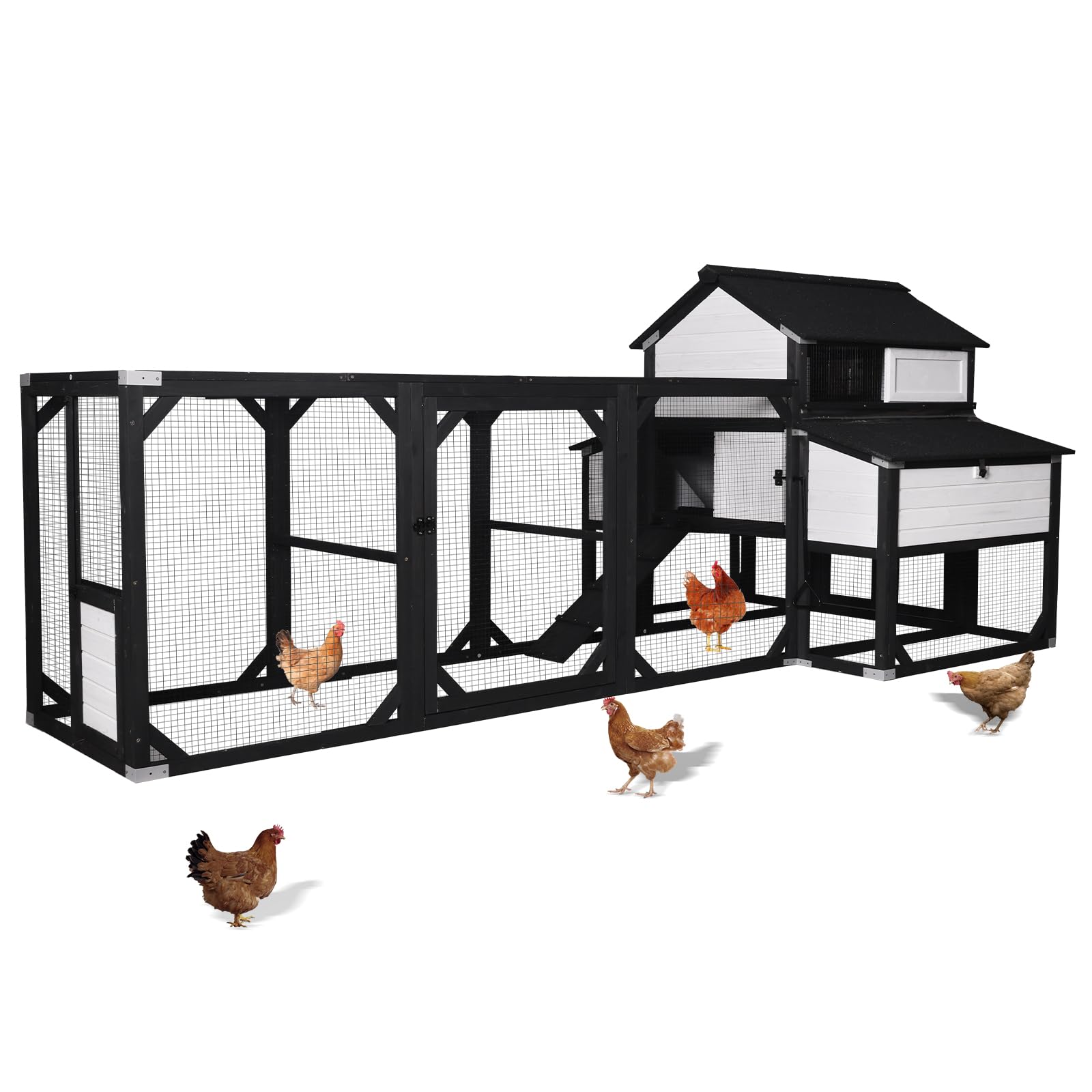
The largest structure here, and the only one with metal brackets at every corner of the frame.
Reinforcement is the whole idea with this one. L-shaped metal brackets sit at every corner of the 118″L x 56.7″W x 50″H frame, which is how you build stability into a structure this large. The run is wrapped in high-density galvanized wire mesh to keep predators out, and a fully waterproof asphalt roof keeps rain off the interior. Six nesting boxes each get a PVC cover, and a predator-proof lock on the nesting area is a real deterrent to raccoons and foxes rather than a token hook.
Cleaning a coop this size could be a chore, and Aivituvin has tried to engineer that out. Extra-large sliding trays pull out for waste, and five access doors let you reach every corner without stepping inside. Screened windows keep airflow moving and cut odor, which matters more as the enclosure grows. Pre-drilled, labeled panels are meant to make assembly manageable even for first-time keepers, even if the sheer number of parts will stretch the build into a full day’s effort.
The honest check is whether you truly have a flock this big. The 8–10 chicken label is for a genuine full-size flock, and a smaller group will rattle around in it. It is also the most structure to move and secure, so a flat, well-drained pad is worth preparing before it arrives. If you keep a substantial flock and want corner-bracket stiffness plus five-door access, this is the pick built for that scale.
The standout spec: L-shaped metal corner brackets plus a 118″L x 56.7″W x 50″H frame — this coop is built for size and stiffness together.
The honest fit check: 8–10 chickens is the real target; a small flock will feel lost inside, and you will need a level, drained pad.
The big-flock answer: six predator-locked nesting boxes, five access doors, and corner brackets that hold a large structure steady.
Not your fit if: you keep under four hens — the size and part count become effort without benefit.
Know the Specs
Usable space in square feet
Usable space is the floor area your chickens can actually walk on, usually the run plus any raised resting area. It tells you how many birds the coop comfortably houses, far better than the sticker count. A coop with 13.54 ft² is a small-flock footprint, while one with 21.33 ft² or 28.41 ft² gives a growing group real room. As a rule of thumb, more square feet per bird means less stress, less mess and calmer laying. Check the overall dimensions in inches too, because a long, narrow shape and a short, deep one can hold the same area but fit very differently in a yard.
Wire mesh, roofs and locks
These three describe how well a coop keeps predators out and weather off. Galvanized wire mesh resists rust and survives claws and teeth — look for it on every side of the run, not just the front. An asphalt roof is the water-shedding layer above the hen house, and UV-resistant panels protect the run from harsh sun. A lockable sliding door or sliding rod is the detail that stops a raccoon from unlatching the entrance, while reinforced safety locks on the nesting box protect eggs. Fir wood and eco-friendly paint or varnish add the final layer of moisture resistance when you clean it properly.
Common Questions
How many chickens can a wooden coop hold per square foot?
Do wooden coops rot in wet weather?
Do I need wheels on a chicken coop?
What is the difference between a coop with a run and a coop without one?
How long does it take to assemble a wooden chicken coop?
How do I keep raccoons and foxes out of a wooden coop?
Can I use a wooden chicken coop for ducks or rabbits?
Is a bigger coop always better?
How do I clean a wooden chicken coop quickly?
Do I need a nesting box per hen?
Should I put the coop on grass or a hard surface?
The Bottom Line
For most people, the wooden chicken coop that balances space, mobility, and easy cleaning is the ketive Large Wooden Chicken Coop with Run and Wheels. Its 13.54 ft² of usable space, asphalt roof, and pull-out tray suit a small flock, and one person can roll it to fresh grass. If your flock is likely to grow, the ketive 83″L gives you 21.33 ft² now and an expandable design for later. For a laying station that rolls with six nesting sections, reach for the GUTINNEEN 67.3″ on Wheels. Whatever you choose, place it on flat, drained ground and give the fir and locks a seasonal once-over — that small habit keeps a wooden coop solid through many seasons.
How we choose
We do not accept paid placement. Every pick is matched to a real buyer and a real use-case; we do not hands-on test units.
Sources
Specifications: manufacturer listings and product documentation. Review insights: verified customer reviews, as of November 2026. Pricing: not shown on this page (it changes often); check the current price via the retailer link.
As an Amazon Associate, Tactical Gear Guy earns from qualifying purchases. This does not affect which products we feature.