Specs are compiled from manufacturer listings and verified buyer reviews and can change over time — please confirm the key details on the product page before buying.
Your original Xbox still boots, but the controllers have not aged well — mushy sticks, dead triggers, and a cord that has been yanked one time too many. Replacement and upgrade options still exist for the 2001 console. Picking the right one means deciding between a modern wireless pad with drift-free sticks and a cheap wired pair that just gets you back to playing. This guide covers the three that actually work with the original hardware and tells you which one fits your setup.
This guide is built by comparing the manufacturers’ published specifications and the patterns across verified customer reviews, so you get each pick’s real strengths and trade-offs instead of marketing spin.
The controllers here split cleanly into a modern wireless upgrade and faithful wired replacements, and the right one depends on whether you value drift-free sticks or a simple plug-in fix. Below is the honest breakdown of the best Xbox Original Controller for your shelf.
Top Picks
How To Choose The Best Xbox Original Controller
The original Xbox uses a proprietary controller plug (a connector shaped only for that console), so any pad you buy has to be built for the 2001 console specifically. A modern Xbox One or Series controller will not plug in and work. That narrows the field fast. The remaining choices come down to three things: if you want wireless freedom, how the sticks are built, and whether you are buying one pad or a spare pair.
Wireless freedom versus a corded connection
A wireless controller runs on a 2.4 GHz radio link (a short-range wireless signal, similar to a wireless mouse) and leaves you free to sit back on the couch. The trade-off is that you are depending on a receiver and a battery instead of a direct cable. A corded pad plugs straight into the console with USB and never needs charging, which suits a console that already lives permanently under the TV.
Why Hall Effect sticks matter on an old console
Most thumbsticks use physical contacts that wear down over time, which is why old pads drift — the character creeps across the screen even when you are not touching the stick. Hall Effect sticks use a magnetic sensor instead, so there is no contact surface to wear out. On a console you plan to keep playing for years, that is the single most useful upgrade you can buy.
Button count and layout
The original Xbox pad carried the standard layout of two thumbsticks, a D-pad (a directional pad), four face buttons, two triggers, and two bumpers. Count the buttons before you buy. A 15-button pad typically adds extra inputs and a modern shape, so you get more controls in your hands. A 10-button replacement mirrors the classic S-Type layout you already know, so your muscle memory carries over. Neither is wrong — it depends on if you want muscle memory or extra function.
Side-by-Side Comparison
| Model | Best For | Connection | Button Count | Console Fit | Amazon |
|---|---|---|---|---|---|
| Retro Fighters Hunter★ Best Overall | Modern wireless upgrade | 2.4 GHz wireless | 15 | Original Xbox, Switch, PC | Amazon |
| Mars S-Type 2-Pack | Two-player nights on a budget | Wired USB | 10 | Original Xbox | Amazon |
| Xbox Controller (Large Duke) | Authentic original feel | Wired | 10 | Original Xbox only | Amazon |
Detailed Reviews
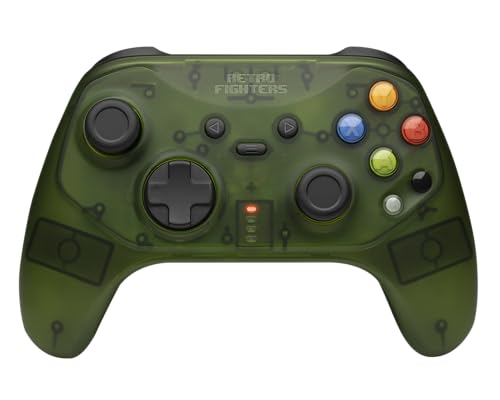
1. Retro Fighters Hunter XBOX Wireless Controller
Our pick — 4.5+★ from 300+ verified ratings; the strongest balance of quality and price.
The only pad here with drift-free magnetic sticks and no cord to trip over.
The Hunter is the only controller in this group with Hall Effect analog sticks — magnetic sensors instead of wearing contacts, so the thumbsticks don’t drift over time. That alone earns it the top spot, and its 2.4 GHz wireless lets you play from the couch instead of leaning toward the console. It also carries 15 buttons against the 10 on the Mars S-Type pair, giving you more inputs and a shaped, modern grip instead of the flat classic shell.
What wins people over, overwhelmingly, is the build — the buttons and triggers land like a modern Series X/S pad, which is a genuine jump from the mushy originals. The ergonomic shape draws the second-strongest praise, and the green shell earns its own share of compliments. Battery life holds up for a fair stretch of play. As owners put it, many call it the best wireless controller they have used on the old console. Set against the larger Duke body at 7 x 6.1 x 2.7 inches, the Hunter is the more compact of the two at 4.76 x 7.01 x 2.76 inches, so it suits smaller hands and a crowded entertainment unit.
The catch is connectivity, which is the one area that splits opinion — some units pair instantly, while others take fiddling or drop the link occasionally. Neither is a reason to walk away, but if you want a zero-fuss corded plug-in, the pair below is simpler.
What earns its keep
- Hall Effect sticks that won’t develop drift from worn contacts
- Triggers and buttons that feel like a modern Series X/S pad
- 2.4 GHz wireless with low latency for couch play
- 15 buttons, an ergonomic curve, and a sharp green shell
Where it asks patience
- Wireless pairing is the split-opinion spot — some units need coaxing
- Costs more than the corded replacements here
Grab this one if: you want a drift-free wireless pad that plays like a modern controller on the 2001 console.
Hold off if: you would rather never think about pairing and a battery — the corded pair is the simpler path.
2. Replacement Controller Microsoft S-Type Black 2-pack
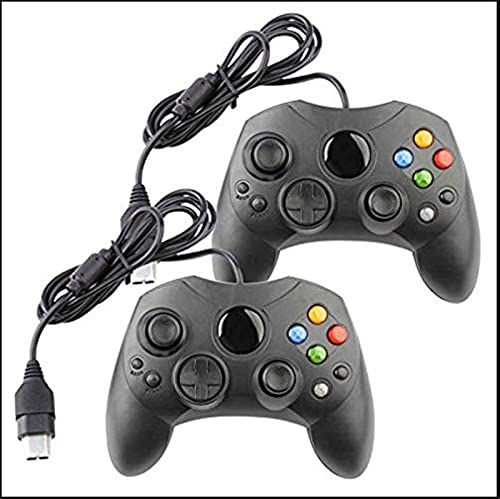
Two classic-layout wired pads in one box, made for player-two nights.
If the goal is simply to get two people back onto the original Xbox, this pair does it with the least fuss. You get two black controllers wired by USB (a straight plug-in cord, no receiver or battery) and built for the 2001 console. The layout is the familiar S-Type arrangement — 10 buttons across the face, triggers, bumpers, and sticks — so anyone who grew up on the original pad picks it up without relearning anything.
That 10-button count is the honest difference from the Retro Fighters Hunter and its 15 buttons; this one mirrors the classic shell rather than adding modern extras. Because both pads are corded, there is nothing to charge and no pairing to babysit — you plug in and play. For a retro room where the console never moves, that reliability is the whole appeal.
The plain value: two controllers for one modest outlay is the real selling point, and it covers the most common reason people shop here — a second player.
What to weigh: this is a small-volume listing with a modest reputation behind it, so expect a basic replacement rather than a premium-feeling pad. Treat the sticks as standard components that will not have the magnetic durability of the Hunter.
Reach for this if: you need two working pads fast for co-op and do not care about wireless.
Look elsewhere if: drift-free sticks and a modern feel matter more to you than doubling up.
3. Xbox Controller (Large Duke) (Renewed)

The oversized nostalgia piece — the exact hulking shape some players still swear by.
This is the big one — the Large Duke body, a Microsoft-branded pad built only for the original Xbox console, not the Xbox One. At 7 x 6.1 x 2.7 inches it is the widest of the three in hand, and for players who liked the original chunky grip, that size is the entire point. It is a renewed unit, meaning a refurbished controller rather than a fresh factory build, and it carries 10 buttons in the classic arrangement.
What people respond to is the shape and the functionality — the ergonomics are the most-talked-about strength, and buyers describe units that look and work like new, down to a cord and shell that appear cleaned. Being wired, it needs no charging and no receiver, so it slots into a console setup and just works.
The honest caveat is durability: the right-hand stick is the recurring weak point to watch on a renewed unit, so treat the sticks gently and check them on arrival. With a modest reputation behind it, this is for the player who specifically wants the big-body feel — not someone chasing the most reliable long-term pad, where the Hall Effect sticks of the Hunter pull ahead.
Best for the chunky-grip faithful: players who want the authentic large-shape original in hand.
Think twice if: you want a fresh build with drift-proof sticks — buy the Hunter instead.
Know the Specs
Hall Effect Analog Sticks
Hall Effect sticks read movement with a magnetic sensor instead of rubbing contacts together. That matters because contacts wear down and cause drift — the character creeping while your thumb sits still. On a console you keep playing, magnetic sticks outlast the contact-based sticks in the other two pads here.
2.4 GHz Wireless vs Wired USB
A 2.4 GHz connection keeps latency low for responsive play, but it depends on a wireless link and a battery rather than a direct cable. Wired USB skips the radio entirely: no battery, no receiver, no pairing, but you are tethered to the console. Pick wireless for couch distance, wired for a fixed setup that never needs charging.
Common Questions
Will these controllers work with the original 2001 Xbox console?
Do Hall Effect sticks really stop stick drift?
What does a renewed controller mean for the Large Duke?
Can I use the Retro Fighters Hunter on a Nintendo Switch too?
How many buttons does each controller have?
Which is better — wireless or wired on an old Xbox?
Do I need a separate receiver for the wireless Hunter?
Is the Large Duke comfortable for smaller hands?
Which one should I buy for two-player games?
The Bottom Line
For most people keeping an original Xbox alive, the winner is the Retro Fighters Hunter — its Hall Effect sticks end the drift problem that kills old pads, and the 2.4 GHz wireless frees you from the cord. If you need two pads for co-op nights, grab the Mars S-Type 2-pack and you are playing in minutes. And for the player who wants the authentic hulking grip of the original, the Large Duke delivers that exact feel — just inspect the sticks on arrival.
How we choose
We do not accept paid placement. Every pick is matched to a real buyer and a real use-case; we do not hands-on test units.
Sources
Specifications: manufacturer listings and product documentation. Review insights: verified customer reviews, as of November 2026. Pricing: not shown on this page (it changes often); check the current price via the retailer link.
As an Amazon Associate, Tactical Gear Guy earns from qualifying purchases. This does not affect which products we feature.