Specs are compiled from manufacturer listings and verified buyer reviews and can change over time — please confirm the key details on the product page before buying.
A thick mat should cushion your knees without letting a lunge wobble. That is the trade-off in this category: the thicker the foam, the more your wrists and ankles sink and shift. Every pick below gives you roughly 6mm or more of cushioning, and each one sits at a different point on the soft-versus-steady line. One honest note first: this list uses flexible matching for the “thick non-slip” brief, so not every pick is the exact thickness or size you searched for. A close same-type mat does the same job, and I give you the exact number for each one so nothing is vague.
This guide is built by comparing the manufacturers’ published specifications and the patterns across verified customer reviews, so you get each pick’s real strengths and trade-offs instead of marketing spin.
The picks run from plush beginner foam to a dense studio mat built to outlast your routine. Read on for the thick non-slip yoga mat that matches your joint cushioning needs and your balance demands.
Top Picks


How To Choose The Best Thick Non-Slip Yoga Mat
Thickness is the first number you check, and the one most likely to mislead you. A 10mm mat of soft foam can feel less supportive than a dense 6mm mat. Density — how tightly the foam is packed — decides whether your knee sinks into the mat or rests on top of it. So compare foam density before you compare millimeters.
Match thickness to your poses, not the marketing
Kneeling and seated work on a hard floor wants the most cushioning, so 10mm and 12mm mats earn their place there. Standing balance poses want a firmer surface, and a dense 6mm mat keeps you steadier through a warrior hold. If your routine mixes kneeling and standing work, a 7mm mat splits the difference.
Understand the two grip surfaces
Non-slip is really two jobs. The top surface has to hold your hands and feet when they get sweaty, which is why textured or granular tops show up on the grippier mats. The bottom has to hold the floor, so look for a rippled or patterned underside rather than a smooth one. A mat can grip sweaty hands well and still slide on a smooth floor.
Pick a width that fits your body and your room
Standard mats run 24 inches wide, which leaves many taller people hanging off the edge mid-pose. A wide mat at 32 inches gives you real room for lateral lunges and wide-legged stretches. The trade-off is floor space and carry weight — the 32-inch and 48-inch mats here are the heaviest to roll and haul.
Side-by-Side Comparison
| Model | Best For | Thickness | Size (L x W) | Material | Amazon |
|---|---|---|---|---|---|
| Gaiam Premium 6mm Print Mat★ Best Overall | Everyday yoga with a design you like | 6mm | 68″ x 24″ | PVC | Amazon |
| Gaiam Thick Mat with Carrying StrapBeginner Cushion | Beginners on hard floors | 10mm (2/5″) | 72″ x 24″ | NBR foam | Amazon |
| YOTTOY Extra Thick TPE MatPlush 12mm Cushion | Kneeling and seated poses | 12mm (1/2″) | 72″ x 24″ | TPE | Amazon |
| KEEP Extra Wide Mat | Wide poses for taller bodies | 7mm | 72″ x 32″ | TPE | Amazon |
| Retrospec Solana 1″ Mat | Pressure-point relief and Pilates | 1″ | 72″ x 24″ | Foam | Amazon |
| UMINEUX Rubber + TPE Mat | Sweaty sessions that need grip | 10mm (0.4″) | 72″ x 24″ | Natural rubber + TPE | Amazon |
| Karma Fitness Large Workout Mat | HIIT and floor strength circuits | 10mm (0.39″) | 72″ x 32″ | TPE | Amazon |
| Hatha Yoga Large TPE Mat | Full-floor coverage for home gyms | 1/2″ | 72″ x 48″ | TPE | Amazon |
| Manduka PRO Yoga Mat | Long-term studio-grade practice | 6mm | 85″ x 26″ | PVC | Amazon |
Detailed Reviews
1. Gaiam Premium Yoga Mat, 6mm Thick Print Mat
Our pick — 4.5+★ from 22,000+ verified ratings; the strongest balance of quality and price.
A 6mm print mat that hides floor grime and takes the sting out of kneeling.
The number to start with here is 6mm — that is the cushioning layer between your knees and a hard floor, and it lands right in the range where a mat protects joints without turning into a sponge. The mat measures 68″L x 24″W, so it suits a standard practice space rather than wide floor work. What wins people over is the design: at 1,200 mentions it is by far the most-discussed thing about this mat, and it is the rare piece of gear buyers actually look forward to unrolling.
Value is the next most-mentioned point, with 512 mentions, and that holds up: the PVC surface is 7P free, meaning it is made without a list of specific phthalate plasticizers (softening chemicals), and a free downloadable yoga class comes bundled in. The catch is grip, and it is worth weighing: some owners find the textured top tacky and stable, while others find it slick under sweaty hands. The other recurring note is a harmless odor out of the wrapper, which the maker itself tells you to air out for 2-3 days before first use.
What holds up in daily use
- The 6mm layer is thick enough to soften a hardwood floor under your knees
- 7P free PVC and a free downloadable class sweeten the deal
- Dark prints hide the scuffs and asphalt marks that show on light mats
Where it asks patience
- Grip splits opinion — tacky for some hands, slippery for sweaty ones
- Plan on airing it out for 2-3 days before the smell settles
- At 68″ x 24″ it will not cover a tall frame in wide-legged poses
Settle in here if: you want a comfortable everyday mat with a print you actually enjoy looking at, at 6mm of cushioning.
Have a backup plan if: you sweat heavily — the top surface is the one part owners disagree on.
2. Gaiam Thick Yoga Mat
Ten millimeters of plush foam that your knees will notice before your hands do.
If you have ever winced lowering into a kneeling pose on a wooden floor, this is the mat built around that exact moment. It is 10mm — a 2/5″ layer of high-density NBR foam (a soft rubber-foam blend) — spread across 72″L x 24″W. Thickness is what people talk about most here, at 1,200 mentions, and comfort follows right behind at 1,100, which tells you the cushioning is doing its job rather than just existing on a spec sheet. Weighing 1.27 kg, it rolls up quickly and the adjustable strap makes the trip between rooms easy.
The softer side of that comfort is where the honest trade-off lives. NBR foam prioritizes shock absorption over firmness, so this is a mat for kneeling, stretching and low-impact floor work — not for a demanding standing balance practice. Durability and stability both draw split opinions, with some owners trusting it to hold up and stay put while others find it tears and slides. Worth knowing before you buy: the foam smell needs 24-48 hours of airing out, and a damp-cloth wipe is all the cleaning it wants.
Who it rewards: beginners, Pilates regulars and anyone doing floor work on concrete or tile who wants the pressure off their joints rather than a precision training surface.
A softness caveat: that same plushness means a very deep pose can compress the foam, so heavier practitioners may want a firmer foam underneath during standing work.
Best matched to: the first-year yogi who spends more time on their knees than on one leg.
Think twice if: your practice is mostly single-leg balance poses where a firm base matters more than cushion.
3. YOTTOY Extra Thick Yoga Mat 1/2inch
Half an inch of TPE — 12mm — between your knees and the floor.
This is the plush end of the scale — 12mm of cushioning against the Gaiam Premium’s 6mm. That extra foam makes kneeling and seated postures genuinely comfortable, and it is a full 72″L x 24″W surface with a granular top designed to increase friction and absorb sweat. The reversed underside carries a water-ripple texture to grip the floor. What wins people over is the quality of the build, at 85 mentions, and the cushioning sits second at 34.
The TPE material (a rubber-like plastic, free of the softening chemicals found in some PVC mats) is SGS and TUV certified for environmental safety, which the maker ties to being free of heavy metals including Pb and Cd. Cleaning is a wipe with cold water and mild detergent — just keep it out of direct sunlight. The stability is where opinions split: some owners find it stays put, others say it shifts around too much, and 4 lbs of foam is the likely reason. That weight and height also raise a portability question for anyone carrying it on public transport.
The knee-friendly read: if joint comfort during kneeling is your top priority, this 12mm pad is one of the most cushioned options here.
Where a soft pad bites back: that same thickness can pitch a standing pose slightly off balance, and the mat tends to migrate on smooth floors.
Reach for it when: your knees dictate the choice and you mostly work from kneeling or sitting positions.
Look elsewhere if: you are chasing a demanding standing balance practice or need something that folds away easily for a commute.
4. KEEP Extra Wide Yoga Mat, 7mm Thick 72″ x 32″ Exercise Mat
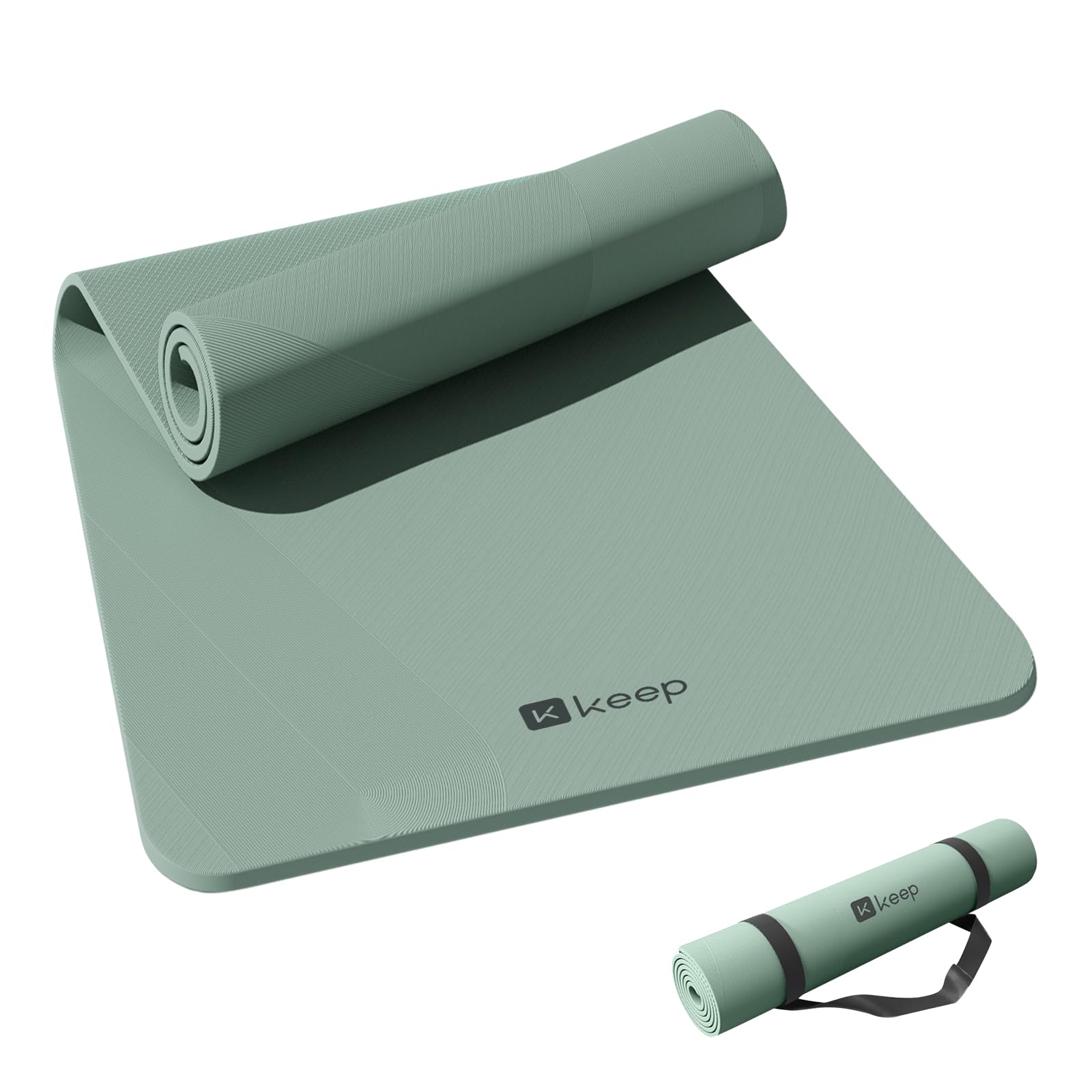
A wide, light mat that gives your arms somewhere to go during lateral poses.
For anyone who has rolled off the edge of a standard mat mid-lunge, the width is the whole story here. At 32″ wide this is wider than the Gaiam Premium’s 24″ mat, and longer at 72″ versus 68″, so you get real room to stretch without worrying about landing on the floor. At 2.8 lbs it is noticeably lighter than the YOTTOY’s 4-pound mat, which matters when you are carrying it to a class. The fingerprint-textured top handles grip during poses and the reverse side gets a full anti-slip pattern, designed to stay put on both dry and wet surfaces.
Quality is what shines through, at 140 mentions, with size right behind at 101 and thickness at 67. The 7mm padding is the practical middle ground — enough to protect knees and elbows without the spongy give of a full half-inch mat. The TPE material is chemical-free and free of plasticizers and formamide. A few owners note the pads slide occasionally, so give it a wipe on the underside before a hard session, and spot clean with cold water rather than soaking it.
The roomy case
- 32 inches wide accommodates wide-legged and lateral movements comfortably
- 7mm thick with a fingerprint-texture top and full anti-slip base
- 2.8 lbs plus a free adjustable polyester strap keeps travel simple
What to keep in mind
- Wide surface needs a bigger space to unroll at home
- You pay for that storage width in floor real estate, not just in the mat
- Wipe both sides clean before a heavy session if it tends to drift
The roomy pick: this is the mat for taller bodies and anyone whose practice includes wide-legged or lateral work.
The only catch: that extra 8 inches of width means more floor to clear before you practice.
5. Retrospec Solana 1″ Extra Thick Yoga Mat

One full inch of firm foam for the joints that complain the loudest.
The Solana is deliberately the outlier here: at a full 1″ thick and 72″L x 24″W, it is far thicker than the 7mm KEEP above, and that height is what eases pressure on joints, hips, hands and knees. The material is firm rather than squishy, so it supports a moving body instead of swallowing it. Appearance is the most-discussed point at 60 mentions, and cushioning follows at 35 — a pairing that fits a mat meant to feel comfortable and look good in a studio.
Pilates and floor work suit it best, and at 2.2 lbs with a nylon carrying strap it moves between home and studio without much fuss. It is BPA free and free of phthalate, heavy metals and latex. The manufacturer warns it may have a light odor at first and asks you to air it for a day or two. Clean it with gentle soap and water, wipe, and hang to dry — never submerge it.
For the pressure-point crowd: this is the pick for anyone whose knees, wrists or hips feel every inch of a hard floor, especially during longer floor-based sessions.
The honest limit: foam this firm at 1″ is a lot of material underfoot, and a few owners find the extra height alters their balance in standing poses.
Suits you best when: joint padding outranks a sleek low profile, and you mostly practice from the floor.
Not the one for: anyone who wants a mat that lies nearly flush with the floor for flowing standing sequences.
6. UMINEUX Extra Thick Yoga Mat 10mm

Rubber underneath TPE gives this one a grip that holds through a sweaty session.
Pair natural rubber with TPE (a recyclable rubber-like plastic) and you get a surface that stays tacky even when sweat is running, which is exactly where a soft foam mat starts to fail. At 10mm and 72″L x 24″W, this UMINEUX combines real cushioning with a textured face on both sides of a reversible design. Weighing 5.5 lbs, it is the heaviest standard-width option on this list, and the rubber side is the reason. Quality leads the conversation at 58 mentions, with thickness just behind at 42 and grip at 28.
The rubber raises the support density, so it resists the sink-and-lose-balance problem that plush foam can bring. Knee support scores its own mentions at 17, and the maker markets it toward Pilates and floor exercise. Expect a harmless rubber aroma that the instructions say fades after 5-7 days in a well-ventilated spot, and store it cool and dry away from direct sun. Durability draws mixed notes — a few owners see early wear, so it rewards careful storage.
Why it grips
- Rubber layer keeps the grip holding even during heavy sweating
- Denser support than all-foam mats of the same thickness
- Reversible texture suits different preferences and exercise styles
What it asks of you
- At 5.5 lbs it is a heavier roll to carry to class
- Rubber smell can linger for up to a week while it airs
- Mixed durability notes suggest storing it flat and out of the sun
Hands-down winner for sweat: pick this when hot, slippery sessions are your norm and you need grip that does not quit.
Weigh it up: the rubber that gives it bite is also what makes it the heaviest standard-width mat here.
7. Karma Fitness Large Workout Mat 72″x32″

Built for sumo squats and lunges, not just sun salutations.
This one is sized for movement that spills outside a yoga mat’s footprint. At 72″L x 32″W it is wider than a standard 24″ mat, which gives your hands and feet somewhere to land during press-ups, sumo squats and lateral lunges. The cushioning comes from a dual-layer TPE build — 10mm across the 72″x32″ surface — that the maker describes as denser than standard NBR foam, so it stays stable under high-intensity work rather than squishing away underneath you. Weighing 1.8 kg, it packs into the included carry bag with an adjustable shoulder strap.
The other half of the grip story is the diamond texture, which provides multidirectional grip on both sides. Quality is what owners hone in on, at 28 mentions, with size second at 16, and the waterproof, sweat-resistant surface is easy to wipe down. Unlike a soft yoga foam mat, this one is designed not to feel overly soft or unstable, which is why it can carry you from Pilates into a strength circuit without complaint.
For the floor-circuit set: this is a mat that treats a home workout like a home workout, with room for genuine lateral movement and a grip that works in both directions.
Where it draws the line: 32 inches of width needs a generous footprint, and the carry bag and shoulder strap are what make moving all that mat manageable.
The cross-trainer’s choice: buy this if your routine blends yoga with strength and HIIT on the same floor.
Space is the deciding factor: only pass it over if your practice corner is narrow.
8. Hatha Yoga Large TPE Yoga Mat 6’x4’x1/2″

Half an inch of TPE across a full 72″ x 48″ — effectively a portable floor.
Nothing else here comes close on pure surface area. Forty-eight inches wide and 72 inches long, this Hatha mat at 1/2″ thickness behaves more like a padded studio floor than a personal mat, giving you room for yoga, Pilates, stretching, jump rope and squats on one surface. The high-density TPE (a recyclable, phthalate-free rubber-like plastic) is made with a non-slip texture on both sides for traction. Quality is the standout, at 97 mentions, with size second at 63 and thickness at 58.
What that extra surface asks of you is space and muscle. Weighing 8.8 pounds, this is one of the heaviest mats on the list, and two bundling ribbons are included precisely because rolling and storing something this large needs the help. Odor draws mixed feedback, and durability splits too — some buyers report it holds up while others see it tear, so look after the edges and dry it flat. Spot clean with cold water and mild detergent, and keep it out of prolonged sunlight.
Space to spare: if you want a mat that feels like a whole workout zone rather than a strip, the 72″x48″ surface delivers that.
The room-and-weight cost: 48 inches wide and 8.8 pounds means you need the floor and a plan for carrying it.
Best suited to: a dedicated home-gym corner where the mat largely stays put.
Second-guess it if: you travel to a studio every session.
9. Manduka PRO Yoga Mat 6mm

Dense 6mm foam, a closed-cell surface, and a build meant to outlive the trend.
This is the mat for someone who is done replacing gear every couple of years. The 6mm of ultra-dense cushioning is less about plush softness and more about firm, stable support — it spreads your weight and protects the knees without the sink you get from a soft half-inch mat. The dimensions make the case for tall or broad bodies: 85″L x 26″W, a length and width that give bigger practitioners real room. Quality is what stands out, at 24 mentions, and length follows at 13.
what separates it day to day is the closed-cell surface. That means the material seals out moisture instead of soaking it in, so the mat stays fresh through repeated sessions and cleans with a simple wipe using the recommended wash. It is made in an emissions-free German facility from OEKO-TEX certified PVC (a standard for tested, low-harm materials) and is latex-free. A no-slip dot pattern on the bottom holds it to the floor. The honest caveat: grip genuinely splits, with the mat slippery for some at first, and at 9.5 lbs it is a stay-put mat rather than a carry-along.
The long-game case
- Ultra-dense 6mm cushioning gives firm support rather than a soft sink
- Closed-cell surface seals out moisture for easier cleaning
- OEKO-TEX certified PVC in a latex-free build
Where expectations need calibrating
- Grip is divisive — slick under some hands until it breaks in
- 9.5 lbs makes it a home-base mat, not a commuting mat
- Dense foam feels firm, which is not what everyone means by cushioned
Worth the long haul: choose this if you want one dense, hygienic mat you keep for years instead of replacing.
Fair warning: some find the surface slick until it wears in — and the denseness is firm, not plush.
Know the Specs
Thickness and Density
Thickness in millimeters tells you how much foam sits between your joint and the floor. It says nothing on its own about support, because a dense 6mm mat can hold you steadier than a soft 10mm one. Many buyers assume thicker always means better comfort, but the real guide is density — a dense mat spreads your weight across the surface, while a soft mat lets you sink and wobble. Match more thickness to kneeling and seated poses, and firmer density to standing balance work.
Top and Bottom Grip
Non-slip means two surfaces doing two jobs. The top has to hold sweaty hands and feet, which is why grippier mats use textured or granular tops. The bottom has to hold the floor, so a patterned or rippled underside tends to beat a smooth one. A mat can excel at one and only do fine at the other, which is why grip feedback often splits on the same mat — how much you sweat and what floor you practice on changes the result.
Foam Type
NBR foam is the softest and lightest, so it cushions deeply but offers less dense support. TPE is a rubber-like plastic that is recyclable and often denser than NBR, balancing cushioning and stability. PVC is dense and holds firm, which suits long-term stability. Natural rubber adds a tacky grip that resists sweat, at the cost of extra weight and a rubber smell that fades over time.
Width and Length
A standard mat runs about 24 inches wide and 68 to 72 inches long. Wider mats at 32 inches or more give room for lateral movement and suit taller bodies, but they need more floor space and are heavier to move. Long mats at 85 inches suit big frames; wide, deep mats add comfort for sprawling poses but push up both footprint and carry weight.
Common Questions
Is a thicker yoga mat always better for my knees?
Will a non-slip mat still slip when I sweat?
What is the difference between TPE and NBR foam for a yoga mat?
How wide a yoga mat do I need for wide poses?
Why does a new yoga mat smell when I unroll it?
Can I clean a thick yoga mat with soap and water?
Is a heavy mat worth the extra carrying weight?
How long does a dense yoga mat like the Manduka PRO last?
Do thick mats work for Pilates and HIIT as well as yoga?
Are these mats free of chemicals like phthalates and BPA?
The Bottom Line
For most people, the thinnest confident answer here is the Gaiam Premium 6mm Print Mat. Its 6mm of cushioning protects your knees without turning a standing pose into a balance test, and its 7P-free PVC build suits everyday practice. If your joints want more give, the YOTTOY 12mm mat adds more cushioning depth. If sweat is the enemy, grab the UMINEUX rubber-and-TPE mat for its hold. And if you would rather buy once and practice for years, the Manduka PRO is built around dense support and honest durability.
How we choose
We do not accept paid placement. Every pick is matched to a real buyer and a real use-case; we do not hands-on test units.
Sources
Specifications: manufacturer listings and product documentation. Review insights: verified customer reviews, as of November 2026. Pricing: not shown on this page (it changes often); check the current price via the retailer link.
As an Amazon Associate, Tactical Gear Guy earns from qualifying purchases. This does not affect which products we feature.