Specs are compiled from manufacturer listings and verified buyer reviews and can change over time — please confirm the key details on the product page before buying.
Want one answer? Buy the Winnerwell Nomad Medium. Its 800 cubic inches of firebox (the metal box where the wood burns) and 304 stainless steel body resist rust in wet conditions, so you get heat that lasts a night. On a tighter budget, the VEVOR and the AVOFOREST give you real heat for a fraction of the weight and outlay. What actually decides whether you sleep warm or spend the night feeding a stove that smokes you out of your own tent depends on a few specs below.
This guide is built by comparing the manufacturers’ published specifications and the patterns across verified customer reviews, so you get each pick’s real strengths and trade-offs instead of marketing spin.
A tent stove only earns its place if the chimney clears your stove jack and the firebox holds enough wood to last a night. Below you’ll find nine portable wood stoves ranked by what matters in a cold tent: heat, weight, and how cleanly they vent smoke. These are the wood stoves for tents worth loading into your truck.
Top Picks


How To Choose The Best Wood Stove for Tents
The single most common mistake is buying a stove before measuring the stove jack in your tent. A stove jack is the fireproof boot or opening in your tent wall or roof where the chimney exits. If your chimney pipe is wider than that opening, the stove is useless to you no matter how well it burns.
Match the chimney to your stove jack first
Chimney diameters in this category run from 2.24 inches up to 2.76 inches, and that range is not interchangeable. A 2.76-inch pipe will not squeeze into a 2.24-inch jack, and a loose pipe sits off-centre and leaks smoke at the roof. Measure the jack opening before you fall in love with a stove.
Chimney height matters too. Six or seven sections gets you around six to seven and a half feet, which clears most canvas bell tents and teepees. Too short a stack puts the pipe end too close to the canvas, and too long a stack loads the roof boot with weight.
Firebox size decides how often you get up at night
A firebox measured in cubic inches tells you how much wood fits at once. A 640-cubic-inch box and an 800-cubic-inch box both work, but the bigger box lets you load longer pieces and stay in your sleeping bag instead of feeding the fire at 3 a.m. Wood length matters too, so check the largest log a firebox will swallow before you commit.
Weight is a packing decision, not a bragging right
Stoves in this list run from just over 11 pounds to 26 pounds — that gap is the difference between a truck-camping stove and a backpacking one. Stainless builds sit in the middle; titanium bodies drop the weight sharply but cost more per pound saved. Choose based on how far you actually carry it, not on the number alone.
Side-by-Side Comparison
| Model | Best For | Firebox | Weight | Chimney | Amazon |
|---|---|---|---|---|---|
| Winnerwell Nomad Medium★ Best Overall | Best all-round tent stove | 800 cu in | 19.4 lb | 5 sections, 2.5 in dia | Amazon |
| VEVOR Camping Wood StoveBudget Champion | Budget first stove | 640 cu in | 11.7 lb | 8 pipes | Amazon |
| AVOFOREST Hot Tent StoveBest Fire View | Fire-watching ambience | — | 9.16 kg | 6 pipes, 2.36 in dia | Amazon |
| Kungka Black Wood Stove | Big area heating | 200 sq ft coverage | 24 lb | 7 sections, 2.24 in dia | Amazon |
| Gonex Hot Tent Stove | Long-burn cooking setup | 16.9 × 10 × 9.5 in | 23.8 lb | 2.76 in dia, 72.8 in tall | Amazon |
| Kungka Tent Stove 7.3ft | Tall tents and yurts | 6 chimney sections | 20 lb | 2.76 in dia | Amazon |
| OneTigris Tiger Roar | Glass-front fire viewing | — | 10 kg | 7 sections + 4 elbows | Amazon |
| KingCamp Hot Tent Stove | Multi-person base camps | 18.1 × 11 × 9 in | 26 lb | 6 pipes, 2.8 in dia | Amazon |
| TSG Portable TA1 Titanium | Backpacking hot tents | 23 L | 8.16 lb | 2.48 in dia, 8.2 ft | Amazon |
Detailed Reviews
1. Winnerwell Nomad Medium Tent Stove
Our pick — 4.5+★ from 350+ verified ratings; the strongest balance of quality and price.
A 304 stainless stove with an 800-cubic-inch firebox that nests its chimney and legs inside the body.
The Nomad Medium is built from 304 stainless steel — a food-grade alloy that resists rust and corrosion even when it sits wet in a truck bed. That matters on multi-day trips where your stove never fully dries between nights. The firebox measures 800 cubic inches, which is enough room for proper split logs rather than kindling you have to keep topping up.
Everything nests. The four legs fold flat underneath, the five chimney sections (2.5-inch diameter) stow inside the stove body, and the side shelves double as a carry handle. Packed, it measures 15 by 8 by 8 inches and weighs 19.4 pounds, so it fits behind a truck seat or across the top of a pack frame.
What wins people over most is the build — the quality of the steelwork is the thing owners talk about above everything else, and the construction follows right behind. It warms a 16-foot bell tent in about 20 minutes once the fire is going. Assembled with the full stack it stands 90 inches tall, so check that against your tent’s peak.
The honest caveat: value is the one split verdict in its review history, with some buyers feeling the outlay is steep next to cheaper steel. If you camp a handful of weekends a year, a lighter-duty stove does the same job. If you’re out every winter, this is the one that outlasts the tent it heats.
Where it earns its keep
- 304 stainless body resists rust in wet, freezing conditions
- 800 cubic inch firebox takes full split logs
- Chimney and legs stow inside the stove for packing
- Heats a 16-foot bell tent in around 20 minutes
What to weigh up
- Some owners feel the outlay is steep for the size
- Assembled stack reaches 90 inches, so tall tents suit it best
- At 19.4 pounds it is not a backpacking stove
Buy this if: you winter camp regularly in a canvas bell tent and want a stove that will still be going in five seasons.
Think twice if: your tent jack is narrow — the 2.5-inch chimney needs a matching opening.
2. VEVOR Camping Wood Stove
Half the weight of the Winnerwell, and it throws heat across a smaller tent just fine.
Here is the number that sells this stove: 11.7 pounds total, bag and gloves included. Set that against the Kungka Black at 24 pounds and you are looking at a stove you can actually carry a few hundred yards from the truck. The 640-cubic-inch firebox is smaller than the Winnerwell’s 800, but it still takes real firewood, and the damper plus ventilation holes give you actual control over the burn.
The 8-pipe chimney system is the most generous stack in this list, and the rain hat, stove bag, and protective gloves all come in the box. Detachable 8-by-12-inch shelves on both sides give you a spot for a kettle, and the conductive plate on top lets you cook properly rather than just reheat. Coverage is rated at 100 square feet, so it suits a smaller tent or a wall tent used by one or two people.
What buyers talk about most is the size — how compact it goes down — followed by value. Assembly is quick and the air damper is the part owners single out as working especially well. Heat output and burn time get a genuinely mixed read: some find the heat strong and the burn long, while others find the body gets very hot and the wood burns fast. The 1mm panels are 0.04 inches thick and resist warping, but the carrying case draws complaints for being flimsy.
Strong points
- 11.7 pounds all-in makes it genuinely portable
- Eight chimney pipes plus rain hat and gloves in the box
- Shelves and conductive cooking plate add real utility
Trade-offs
- Burn time divides opinion — some find it fast
- The carry bag is the weak link in the kit
- 100 square foot coverage limits it to smaller shelters
Right call for: a first stove or a second stove for the smaller tent, where low weight beats long burn time.
Look elsewhere if: you need all-night heat from one load of wood.
3. AVOFOREST 304 Stainless Wood Burning Stove
Two heat-resistant glass windows turn a shelter into a fireplace with a view.
Most stoves in this category are a metal box with a door. This one puts two high-definition heat-resistant glass panels in the body, so you get the flame without opening anything. Fireproof cotton strips line the glass edges to cut smoke, and the whole body is hand-polished 304 stainless — waterproof, rust-proof, and easy to wipe down.
You get a full kit from the start: five chimney pipes plus a fireproof star cover, a spark arrestor on top (a mesh cap that stops embers spraying out), three ground stakes and ropes to hold it steady, plus a brush, gloves, and fire tongs. The chimney runs a 2.36-inch universal diameter, so you can buy extensions anywhere if you need more height.
Quality is the runaway strength here — the finish and the steelwork are what owners praise above all else, with heat output and value close behind and portability rounding it out. The compact size splits opinion, though; several describe it as extremely small, and that is worth taking seriously if you have a big shelter. Smoke is the genuine weak spot, with escaping smoke through the top and poor burning reported when the fire is first lit. The maker’s own advice is to open the air circulation and damper together at light-up, and only then dial the firepower back.
Who it suits: campers who want the fire visible on a cold evening and are prepared to learn the damper settings, in a one or two person tent.
The honest catch: expect brief smoke at start-up and the odd scratch from shipping on a hand-finished body — both are normal here.
Fits you if: the glass and the polished finish matter as much as the heat.
Not for you if: you want a set-and-forget burn with zero smoke learning curve.
4. Kungka Black Wood Burning Tent Stove

Built for the big canvas wall tent where everybody needs to feel the heat.
It heats up to 200 square feet — double the VEVOR’s 100 square feet — which is the number that matters if you’re warming a shelter with bunks or a group sleeping setup. The borosilicate glass door (a heat-resistant glass that takes direct flame contact) lets you watch the fire and judge how much wood is left without opening it. The removable ash tray means cleanup happens in the morning, not in the dark.
The seven-section chimney reaches 6 feet with each section adjustable independently, which is genuinely useful on a tipi or a bell tent where the jack height isn’t standard. Wind ropes, ground nails, and a rain cap come with it. The chimney diameter is 2.24 inches, so it fits standard stove jack openings. Everything — all seven pipes, the poker, the accessories — stores inside the stove body, and the storage rack flips into a carry handle.
Size is the quality buyers bring up most, and heat output follows. Setup is quick and the flat top doubles as a full cooking surface for cast iron and kettles. At 24 pounds it is one of the heavier stoves here — realistic for truck camping and ATV access, less so for a long carry. Smoke gets a mixed read: some buyers see little to none, others notice a smell that needs burning off. The maker says to burn it outdoors for 60 minutes first to cure the paint, which is normal for any new stove.
what separates it: it heats 200 square feet, and its 6-foot adjustable stack fits odd tent shapes.
What you accept: 24 pounds of steel and a curing burn before the first indoor use.
Reach for this: when the tent is big and the stove lives near the vehicle.
Pass it by: if you’re hiking the stove in — 24 pounds punishes a long portage.
5. Gonex Hot Tent Stove
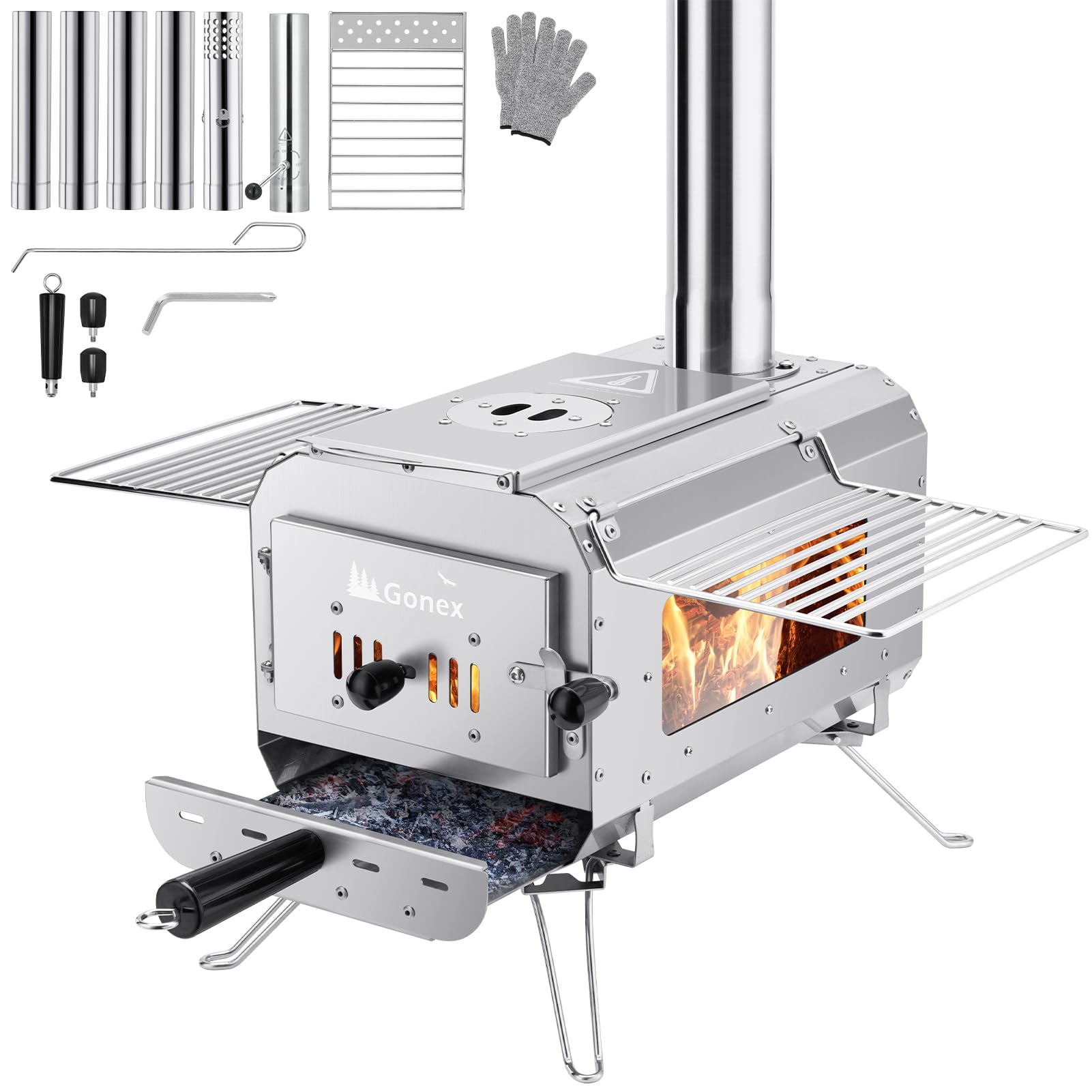
A 16.9-inch firebox that swallows standard pre-cut logs without trimming.
That firebox length is the whole point. Logs cut to standard lengths drop straight in, so you saw less at camp and refill fewer times through the night. The 1mm stainless body is rated to withstand 932°F without warping. The 72.8-inch chimney runs a 2.76-inch diameter — the widest stack in this list — and its crescent-shaped damper keeps airflow moving even when it’s closed.
Small details are thought through. The side-mounted heat-resistant window lets you check the flame without opening the door, and the heatproof handle stays safe to grab when the stove is at temperature. There’s a removable ash drawer for bottom ignition and quick cleaning, plus a rear anti-clogging structure that keeps debris from choking the burn. The foldable grill expands the cooking area, and the wide lid works as a barbecue surface.
What owners rate highest is performance, with value close behind, and the damper and venting in particular get called out as working properly. The thing to know is heat output splits opinion — it keeps people warm, but some find the whole stove runs red hot, so you’ll want it set up with clearance from the canvas.
Why it works
- 16.9-inch firebox takes standard log lengths
- 2.76-inch chimney with a crescent damper that stays open to airflow
- Cooking lid, foldable grill and ash drawer in one package
Worth knowing
- Some find the body runs very hot — mind your clearances
- 23.8 pounds keeps it a vehicle-based stove
The smart pick if: you cook as much as you heat and want a wide stack that vents cleanly.
skip it if: you want a light stove to carry on your back.
6. Kungka Tent Stove 7.3ft
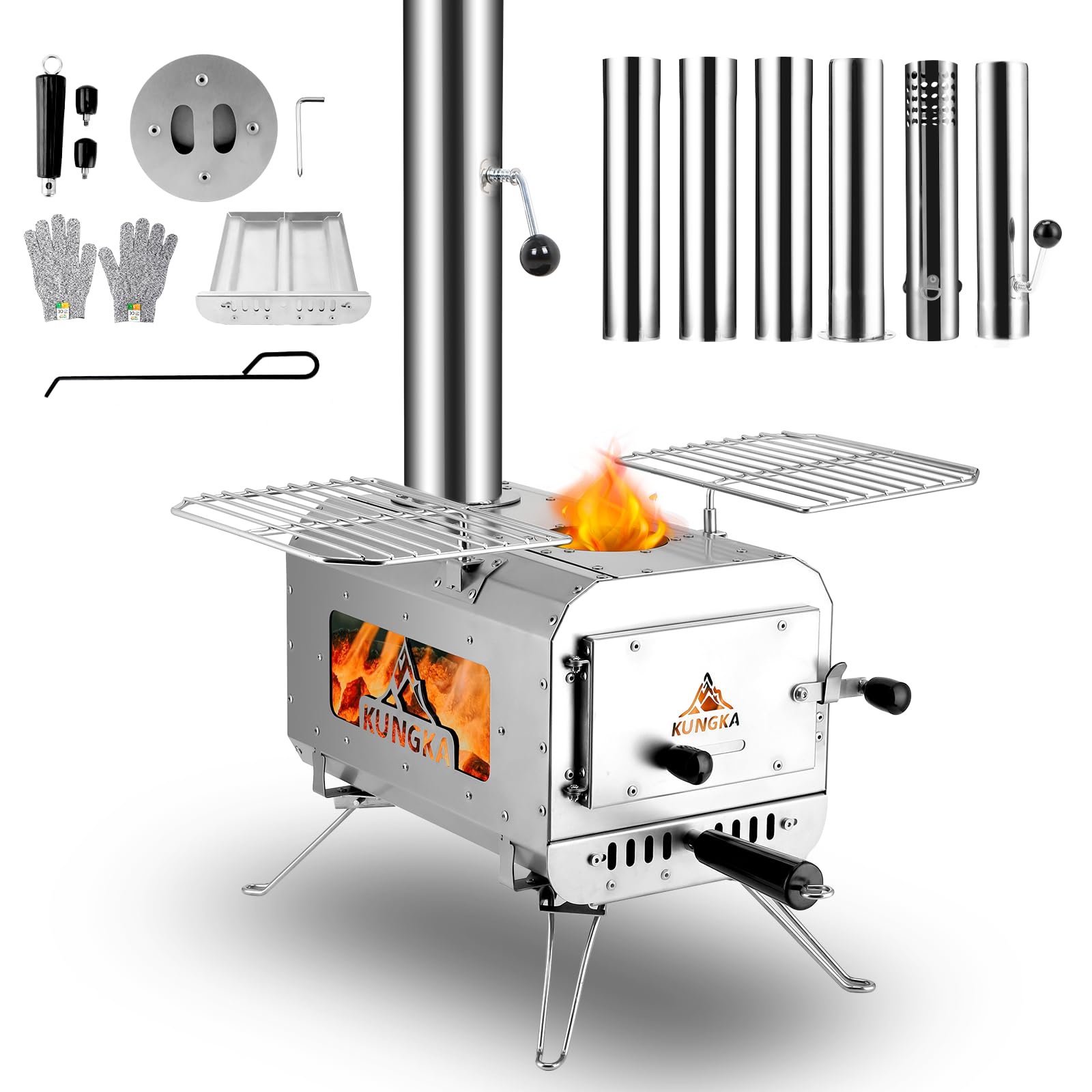
Seven point three feet of chimney clears the tallest yurt and teepee peaks.
If your tent has a high apex, this is the practical answer. Six chimney sections take the stack to 7.3 feet with a 2.76-inch pipe diameter, and the adjustable valve plus rain cap handle wet weather. Two air inlets give you fire control at the base, and the spark arrestor sits on top of the stack.
Glass is where this one stands out from the black Kungka above — a door window plus large side viewing windows in heat-resistant, flame-retardant glass, so you can watch the burn from a couple of angles. Legs fold, side tables unfold into a storage rack, and the chimney sections and accessories store inside the stove body. It weighs 20 pounds and comes with a one-year warranty and cut-resistant gloves included.
Build quality is the top thing buyers praise, with quality and performance right behind it. Packing and storage get specific mention as neat and compact. Heat output is the mixed note — plenty of warmth, and a few find it runs hotter than they expected, which is a fire-management job rather than a fault.
Standout detail: 7.3 feet of adjustable chimney with a 2.76-inch diameter and a full set of glass viewing panels.
The trade: 20 pounds and more stack to manage at setup, so give yourself the extra ten minutes.
Suits you if: you run a teepee, yurt or tall wall tent and need the chimney to clear the peak.
Not ideal if: your stove jack sits low and the extra stack just gets in the way.
7. OneTigris Tiger Roar Tent Stove
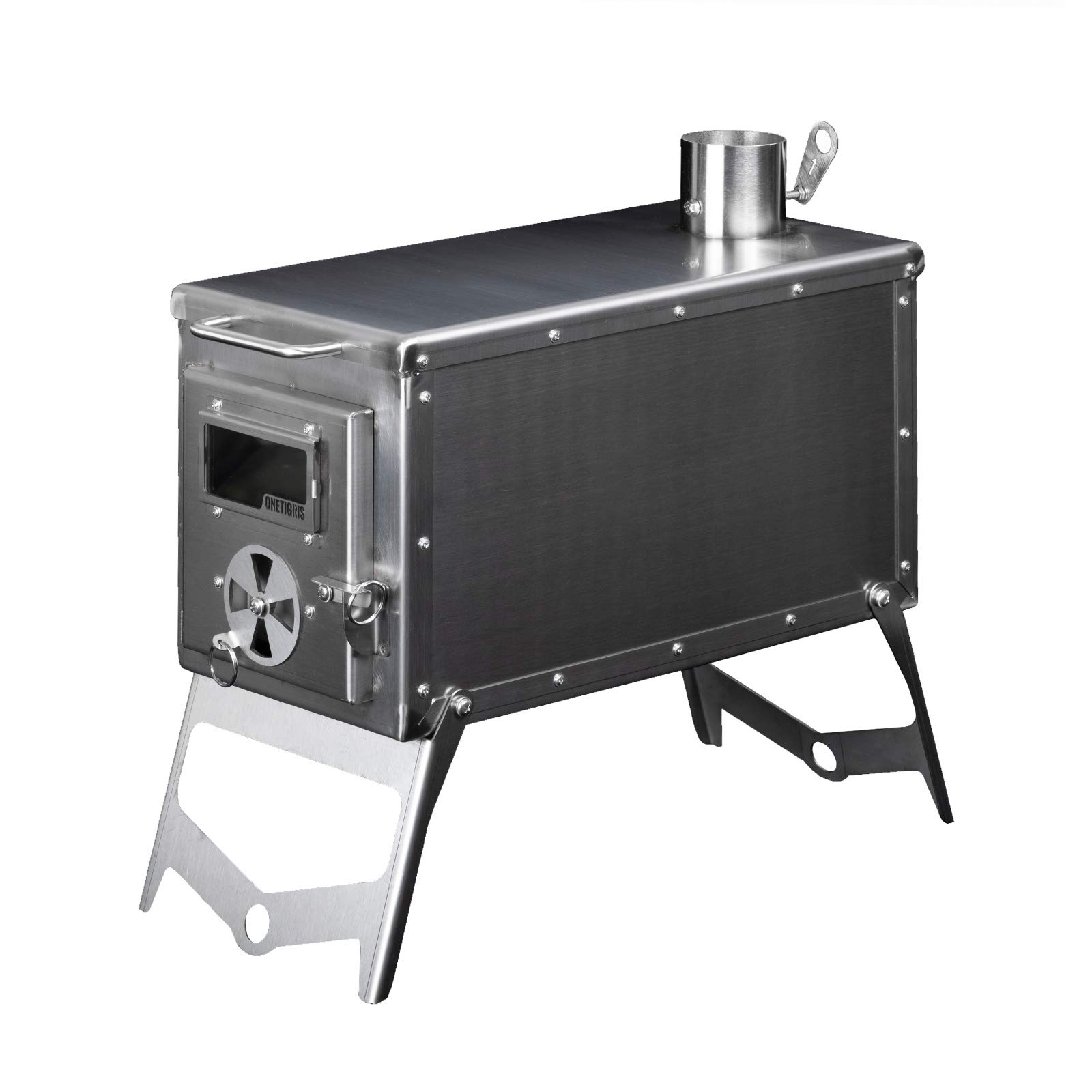
The most configurable pipe setup here, with glass that shrugs off 760°C.
The window is the headline. Schott ROBAX glass-ceramic — the same family of material used in wood-burner doors on stoves for homes — withstands blazing short-term temperatures of up to 760°C, plus the sudden thermal shocks of a fire lighting and dying. A spare pane comes in the kit, which tells you the maker expects you to use this thing hard.
Then there’s the exhaust. Seven pipe sections plus two 45-degree and two 90-degree elbow pipes let you route the stack around a pole, out a side jack, or up through a roof with an offset. An internal guide flake slows gas flow and catches sparks so the stove won’t throw embers, and you can turn the elbow to keep rain and snow out. The air intake valve splits airflow up and down to burn fuel more completely and stop smoke backing into the tent.
The 304 stainless body is forged with 3mm thickness at the top so it holds shape after repeated burns, while the chimney pipes are 201 stainless. Size is what wins people over most here — how well the whole thing packs — with heating performance next, and it has kept campers going in 3°F conditions. Weighing 10 kg, it’s a car-camping stove rather than a backpack one. Functionality divides opinion, and durability and smoke containment are the two areas that draw real criticism, so treat the pipe joints carefully and seat them correctly.
What earns the premium: Schott ROBAX glass rated to 760°C and a pipe set with four elbows for routing around almost anything.
Where to take care: pipe joints and smoke sealing are the parts to assemble patiently, not rushed at dusk.
Pick it when: your tent layout needs elbows and offsets to get the stack out cleanly.
Leave it if: you want a straight-up-the-middle stack and nothing else to assemble.
8. KingCamp Hot Tent Stove
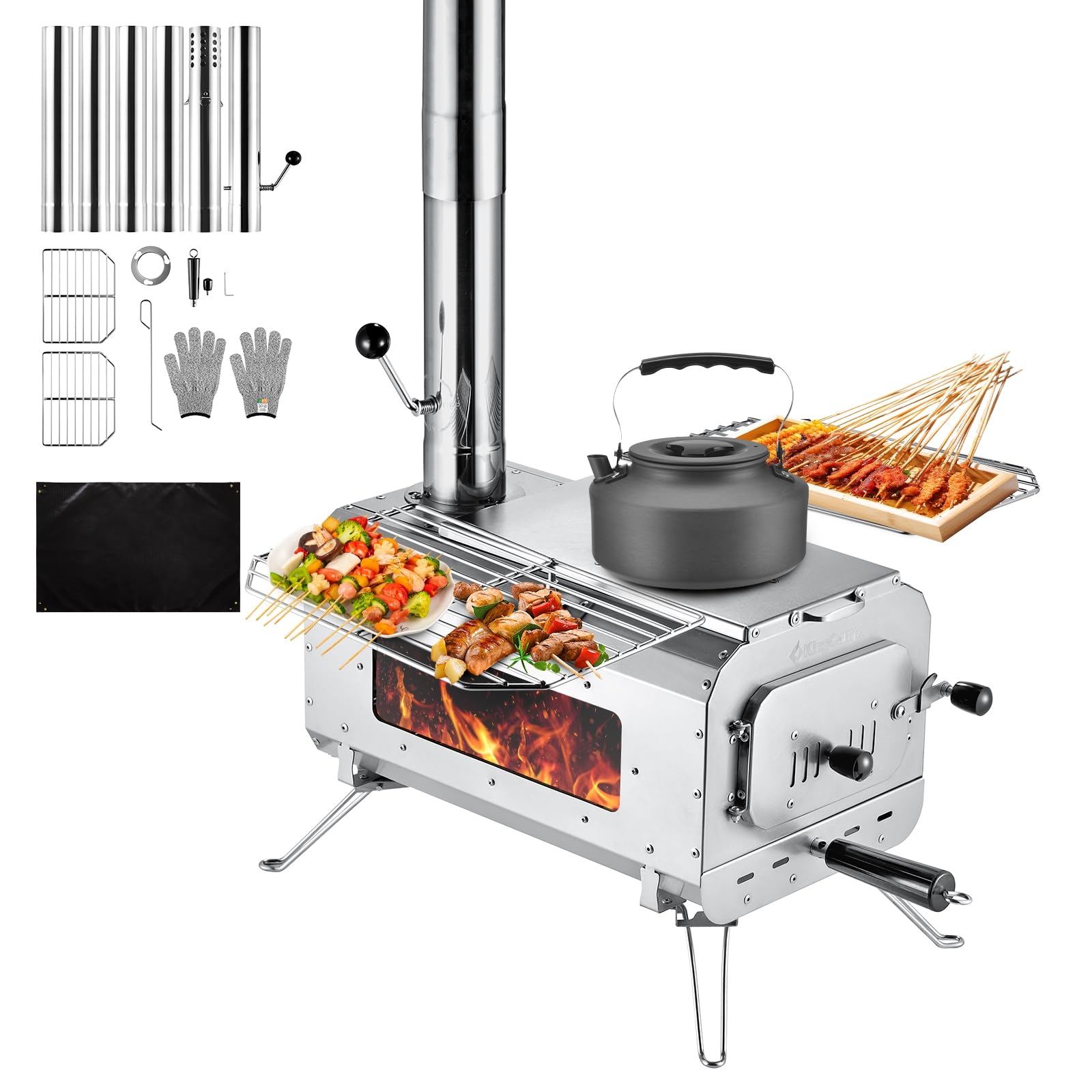
A 26-pound base-camp stove for heating a shelter full of people.
Detachable side racks on both sides widen the cooking area — useful when several people are boiling water at once — and the four foldable legs let you set the working height. The chimney is six pipes at 2.8 inches in diameter, the widest here, with a rotary switch on the pipe to control the flame and heat-resistant glass windows on the body.
Stainless steel frame construction takes the heat of long winter trips, and the chimney pipes store inside the firebox for transport. There’s a carry bag included. The maker’s own safety note is worth repeating: keep the chimney outlet at least 1.5 meters from the tent fabric so sparks can’t land on the canvas, and preheat the outlet pipe before the first full burn.
Performance and heat output are what buyers are impressed by — one owner heats a 16-by-16-foot tent with it comfortably. The honest issue is smoke leaking at the pipe joints, which is the recurring note across its reviews. That’s a seating and sealing job, not a reason to write the stove off, but budget time to fit the sections properly.
Where it shines
- Heats a 16-by-16-foot tent well
- Detachable side racks widen the cooking surface
- 6 chimney pipes store inside the firebox
What to plan for
- Smoke leakage at pipe joints needs careful sealing
- At 26 pounds it stays close to the vehicle
Go with this for: group base camps where a big shelter needs steady warmth and cooking space.
Think again if: you’re packing light — 26 pounds is the heaviest stove here.
9. TSG Portable TA1 Titanium Tent Wood Stove
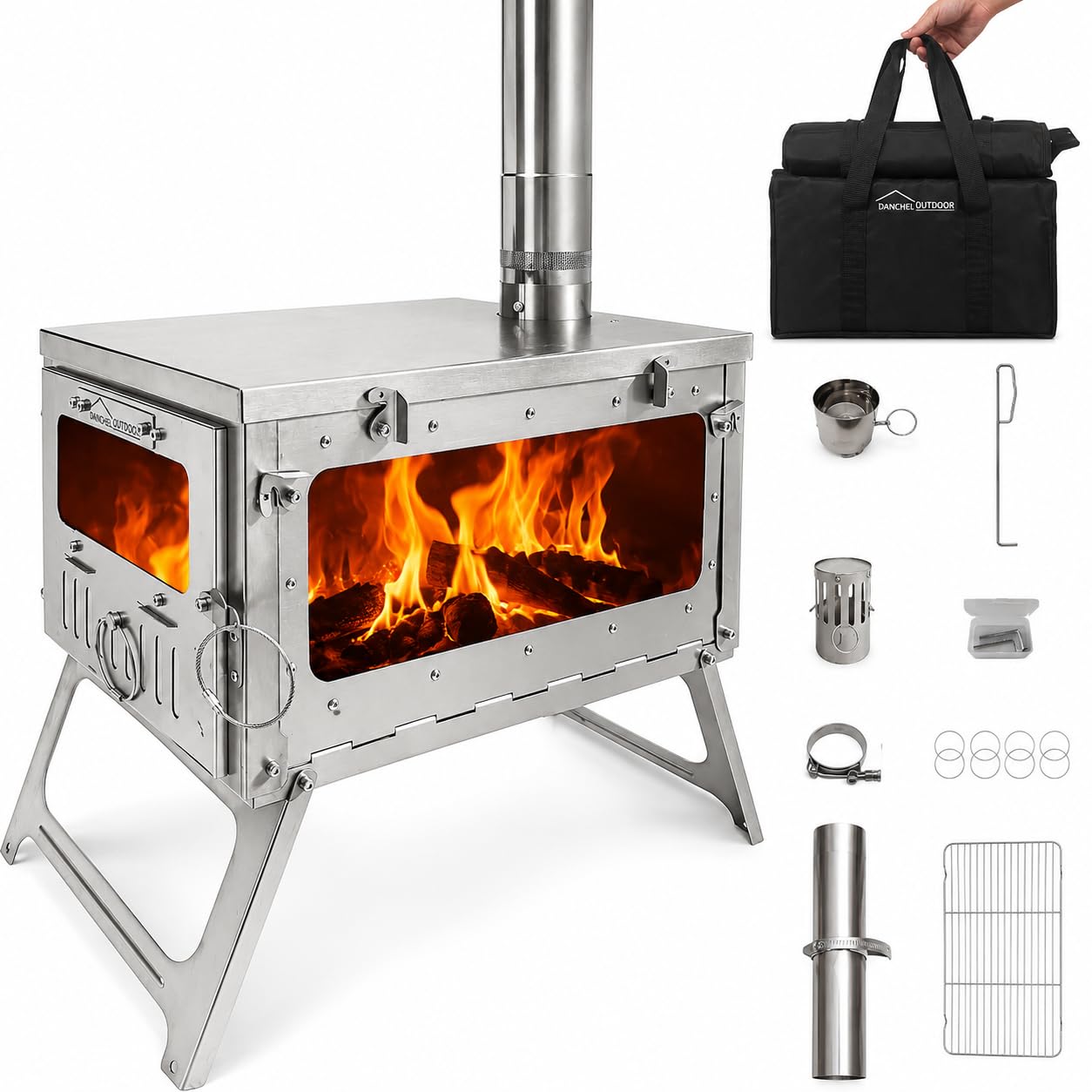
Titanium at 8.16 pounds — the lightest stove in this lineup by a wide margin.
Set it beside the Winnerwell at 19.4 pounds and the gap tells the whole story: this is the stove you actually carry on your back. The TA1 titanium body resists rust and takes high heat, and the 23L firebox (a 16.9-by-10-by-8.4-inch burn chamber) accepts wood pieces up to 16 inches long. Coverage is rated at 200 square feet, which puts it alongside the Kungka Black for heating reach.
Air control is unusually granular for a packable stove: seven adjustable intakes plus a damper regulate the burn, and a built-in cooling rack lifts the firewood so air circulates underneath. The two-plate top carries up to 22 lbs for a pot or a pan, and a high-temperature-resistant side window lets you check the fire without opening the door. The H-shaped legs hold it steady on uneven ground, and a titanium spark arrestor with three wind rope rings keeps embers contained.
The kit runs an 8.2-foot stove pipe with eight rings, a hook, a pipe fastener, and a carry bag. Effectiveness is what buyers rate highest, with heat output and weight right behind it, and it works well in 40-degree conditions. Durability is the one mixed note, so treat the thin titanium with respect and store the pipe carefully between trips.
The mic-drop number: 8.16 pounds in titanium with a 23L firebox — nothing else here comes close on weight-to-capacity.
What you trade: titanium is thin, so pack the pipe and panels with care to keep it sound season after season.
Made for: backpackers and hot-tent hikers who count every pound and still want 200 square feet of heat.
Not the one for: rough-and-tumble truck camping, where a thicker steel body forgives more abuse.
Know the Specs
Firebox size in cubic inches or litres
The firebox is the burn chamber, and its size decides how much wood goes in at once. Measured in cubic inches or litres, a bigger box takes longer logs, needs fewer refills, and holds heat longer through the night. A smaller box suits a one-person shelter, while a 23L or 800-cubic-inch chamber is aimed at multi-person tents and long winter evenings.
Chimney diameter and section count
The chimney pipe carries smoke out through your stove jack. Its diameter must match the jack opening — diameters here range from 2.24 to 2.8 inches and they do not cross-fit. Section count sets the total height, and more sections mean you can adjust to odd tent shapes. A rain cap and spark arrestor keep weather and embers out of the tent.
Material: stainless steel versus titanium
Stainless steel bodies resist rust and hold their shape under heat, with 304 alloy being the common corrosion-resistant grade. Titanium does the same job at far less weight, but the panels are thinner and demand gentler handling. If you carry the stove on your back, titanium pays off; if it rides in a truck, steel forgives more.
Weight and packed size
Weight determines how the stove travels. In this category the range runs from 8.16 pounds in titanium up to 26 pounds in a large steel body. Packed dimensions matter too — a stove that nests its chimney and legs inside the body carries more easily and takes less room behind a seat or across a pack frame.
Common Questions
Will a tent wood stove fit through my tent’s stove jack?
How much wood does a small tent stove hold at once?
Why does my new tent stove smoke so much on the first burn?
Is a titanium tent stove worth choosing over stainless steel?
Can I cook on a tent stove or is it heating only?
How much clearance does a hot tent stove need from the tent fabric?
Can I use a tent wood stove inside a garage or shed?
How long does a burn last in a portable stove overnight?
Do I need a spark arrestor on the chimney?
What size tent will a small wood stove actually heat?
The Bottom Line
For most people, the best wood stove for tents is the Winnerwell Nomad Medium. Its 800 cubic inches of firebox and 304 stainless construction give you heat that lasts a night and a body that survives wet seasons — buyers rate it 4.5+ stars across 300+ reviews. Want to spend far less and pack far lighter? Grab the VEVOR at 11.7 pounds. And if you count every ounce, the TSG titanium stove is the one to reach for at 8.16 pounds.
How we choose
We do not accept paid placement. Every pick is matched to a real buyer and a real use-case; we do not hands-on test units.
Sources
Specifications: manufacturer listings and product documentation. Review insights: verified customer reviews, as of November 2026. Pricing: not shown on this page (it changes often); check the current price via the retailer link.
As an Amazon Associate, Tactical Gear Guy earns from qualifying purchases. This does not affect which products we feature.